


Roofing SEO: How Roofers Get Found on Google and the Map
Roofing SEO is how homeowners find a roofing company on Google. It covers your website, your Google Business Profile, your reviews and a page for each service and town. Done well, it turns searches into calls and inspections. Visits alone pay no bills.
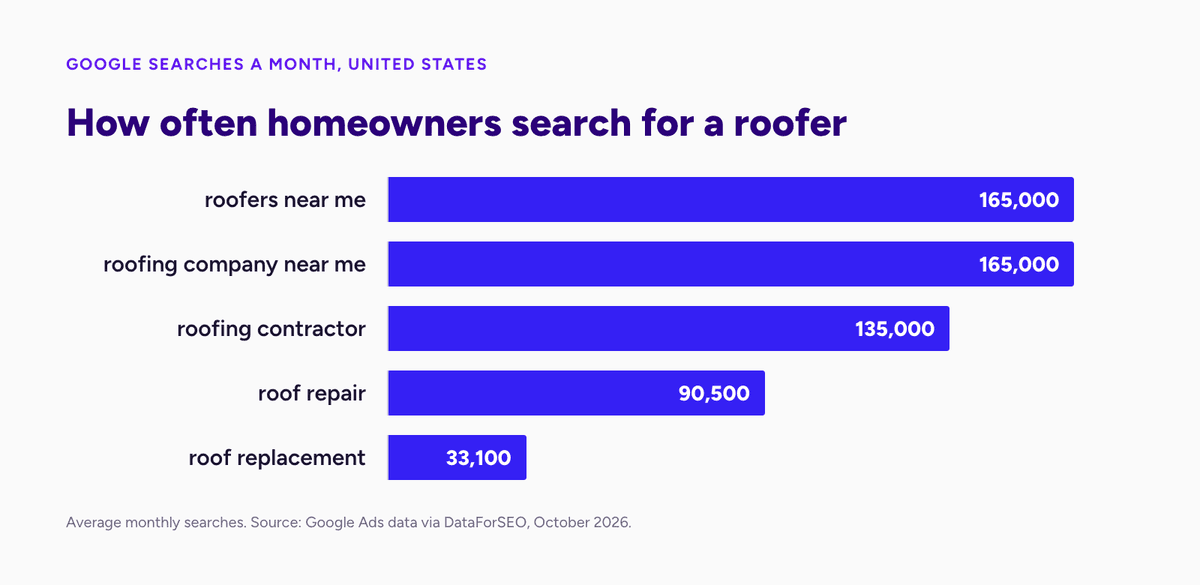
In 2026, roofers near me draws about 165,000 US searches a month. The homeowner is worried. Google answers with a map of three local roofers at the top. Regular links sit under the map, and AI answers too.
You will see how Google picks local roofers and which pages to build. You will also see how reviews move the map and how to count calls by source. Each step leaves a trail you can check every month, so roofing SEO never asks for blind trust.
Book a callKey Takeaways
- Two places matter most: the Map Pack of three local roofers, and the regular results under it. AI answers are a growing third.
- Google ranks local results on relevance, distance and popularity. You control relevance and popularity.
- Each service and town needs its own useful page, never a copy with the city name swapped.
- Reviews, a complete profile and a fast site move the map more than any trick.
- Measure calls and booked jobs by source, or you cannot tell what is working.
Everything below expands on these 5 points, in the order a roofer meets them.
What Is Roofing SEO?
Roofing SEO means making your company the one Google shows when someone near you needs a roofer.
Roofing SEO has two parts: the Map Pack, the box of three businesses with a map near the top of a local search, and the organic results, the regular links below it.
The goal is the phone ringing. A page with 500 visits and no calls fails. A page with 50 visits and 5 inspection requests is. Good roofing SEO earns its keep in booked jobs, and traffic only helps explain them.
See your new homepage before you pay anything
Send us your roofing website. Tell us the towns you cover. The homepage rebuild is free. You see it before you pay anything. We also check where you rank on the map today. You get that report town by town. Every next step starts from your own numbers. The preview needs no contract.
Book a callWhy Roofing SEO Matters
Roofing is a search business: homeowners search when a leak shows up or a storm passes through, and they rarely keep a roofer's number on hand.
Across the US, roofers near me and roofing company near me are each searched about 165,000 times a month, and roofing contractor about 135,000 times. Those calls go to the roofer Google trusts most.
Reviews shape the choice once they find you. BrightLocal's 2026 Local Consumer Review Survey found 97% of consumers read reviews for local businesses, and 47% will not use a business with fewer than 20 reviews.
Paid ads can buy a spot, but the clicks stop the day you stop paying. Search rankings keep working after the work ends.
How Does Google Rank Local Roofers?
Google's help page on improving your local ranking names three factors: relevance, distance and popularity. A roofer can work on all of those but one.
- Relevance is how well your profile and pages match what the homeowner typed. Listing every service, with a page for each, raises it.
- Distance is how far you are from the searcher. Nobody can change it. Your service area and town pages are the answer to it.
- Popularity is how well known and trusted you look: reviews, links from other sites and mentions around the web.
Google adds that businesses with complete and accurate info are more likely to show up. A half-filled profile gives away ground before the race starts.
Where Roofers Show Up in Search
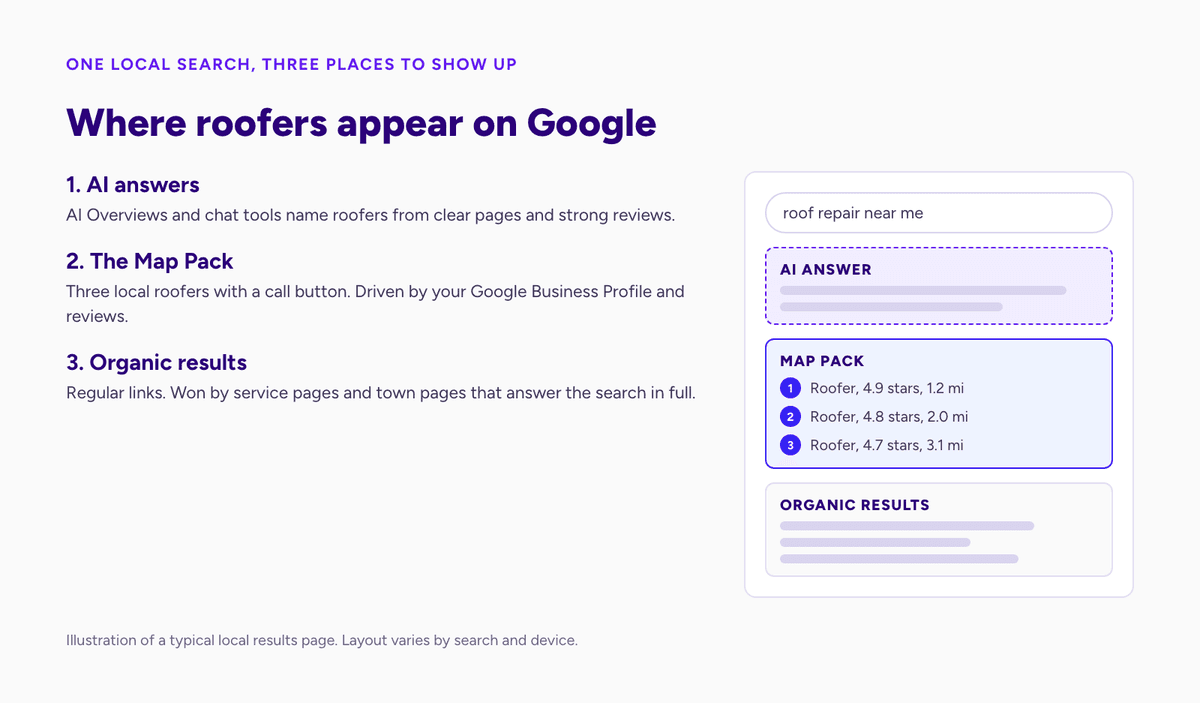
There are 3 places a roofer can appear, and each has its own rules, so a roofing SEO plan treats them as separate jobs.
The Map Pack
The Map Pack is the source of the most calls. It shows a call button, a star rating and the distance at a glance. Many homeowners call from it and never open a website.
Your place in it depends mostly on your Google Business Profile: its category, services, photos and reviews. Your website still feeds it: Google reads the site to judge relevance.
Organic Results
The organic results are the regular links under the map. Here your service pages and town pages do the work.
A homeowner comparing roof replacement options reads before calling, and the page that answers their question in full wins the visit. A homepage that covers everything rarely ranks for anything specific.
AI Answers
AI answers are a growing third place to show up, with more searches starting in AI Overviews, ChatGPT, Gemini and Perplexity.
Google's guide to AI features in Search says the same practices that help regular results apply. Clear answers, named services and towns, and strong reviews get a roofer named.
BrightLocal found 45% of consumers now use AI tools for recommendations, up from 6% a year earlier.
Keyword Research for Roofers
Keyword research for roofing SEO starts from 2 lists: the services you sell and the towns you work in. Every useful search combines a need with a place, and each need shows a different stage of the job:
- Roof repair near me means a leak right now, in most cases. Speed and a phone number win.
- Roof replacement cost means planning and comparing. Detail and trust win.
- Storm damage roof or hail damage roof repair spikes after bad weather.
- Commercial roof coating or flat roof repair comes from property managers.
- Any of these plus a town name means the person wants a local crew.
Give each need its own page, and pick one main search for each page. Two pages chasing the same search compete with each other and both lose. Our list of roofing SEO keywords groups the common ones by job type.
How a Roofing Website Turns Visits Into Calls
A roofing website is there for one job: turning a visit into a call or an inspection request. Rankings bring people to the door, and the site gets them to knock.
We build sites like this on our own platform, and our roofing website design page shows what goes into one.
Phone Number, Real Photos and Plain Words
A tap-to-call button on every page is the first needed, visible on a phone without scrolling, with a short quote form as the second choice.
Show your own roofing crews and your own jobs. Homeowners spot stock photos right away. Explain the work in short sentences, and claim only what you can prove. A clear page with honest photos beats clever copy.
Find out where you show up on the map
We check your roofing company on Google Maps. The check runs point by point on a grid. It covers your whole service area. Then we walk you through it on a short call. You see the towns that already find you. You also see the towns that call a competitor. The check is free, with no obligation.
Book a callSpeed and Mobile First
Google now indexes the mobile version of a site first, so the phone view is the one that counts. A homeowner with water coming through the ceiling will not wait for a slow page.
Google's Core Web Vitals measure loading, response and layout shift, and each one is fixable. Speed also means how fast you can update the site. On our platform a new town page or photo goes up in minutes.
Roofing Service Pages
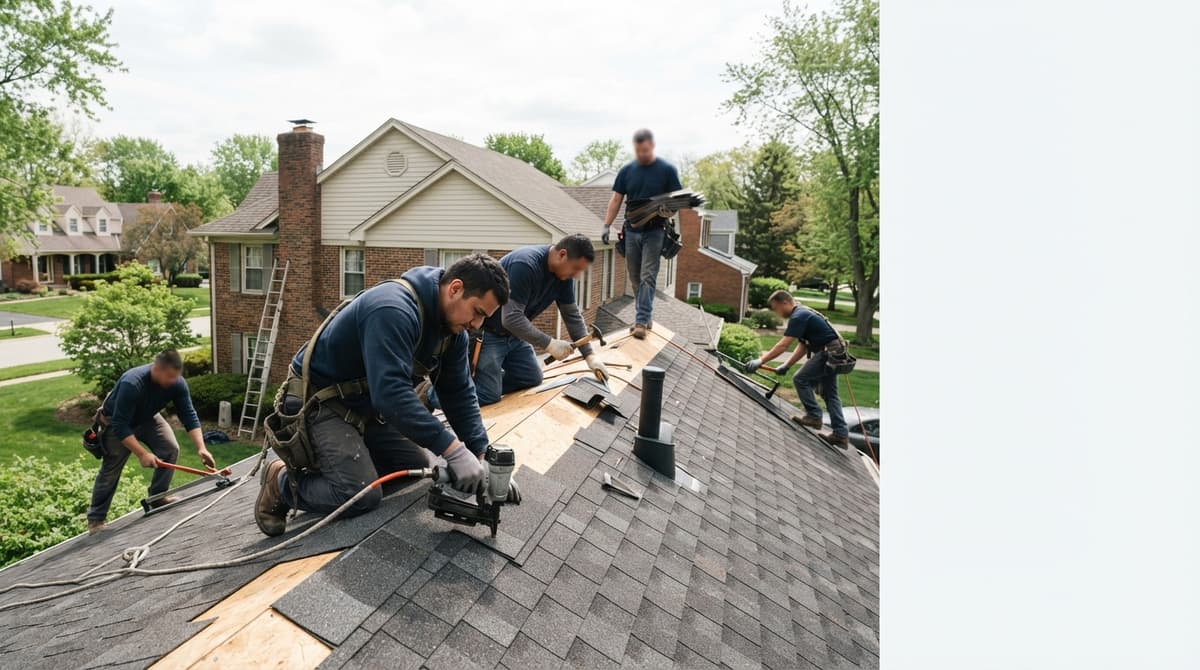
Every job you want more of is worth its own page: roof repair, roof replacement, storm damage, gutters, commercial roofing and anything else you sell.
One roofing service page per job lets Google match each search to the right answer, and lets you write in depth about each one.
A strong service page covers four things:
- What the job is, in plain words a homeowner would use.
- When someone needs it, with the warning signs they can see from the ground.
- How it goes, from the first inspection to cleanup on the last day.
- What to do next, with a call button and a form right there.
Add photos from real jobs of that type. Google's SEO Starter Guide asks for pages that are useful and easy to follow, and that is the whole brief.
Town Pages That Earn Their Place
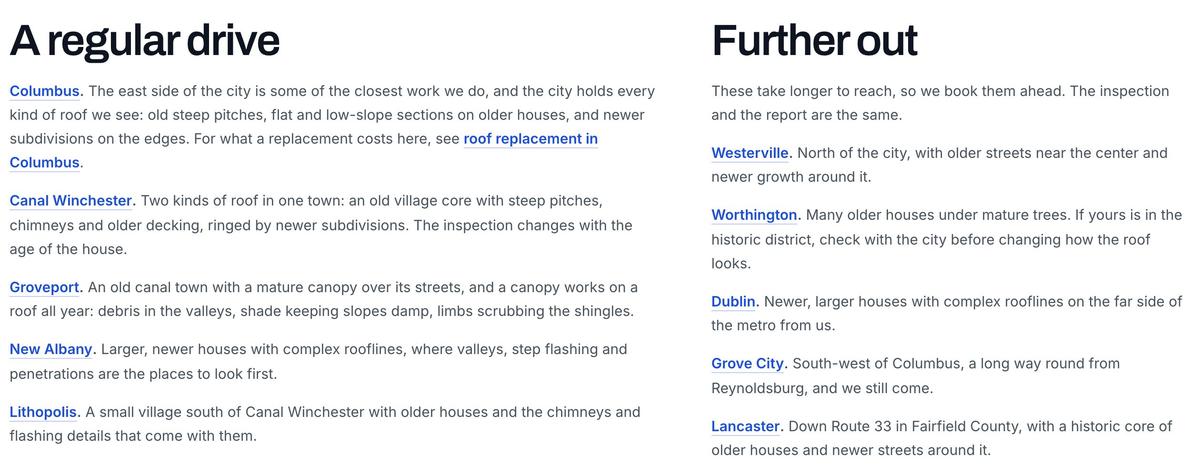
Town pages are how roofing SEO reaches each place you work, not only where the office sits. Build one for each town you truly serve, starting with the ones that send the best jobs.
What Makes a Town Page Useful
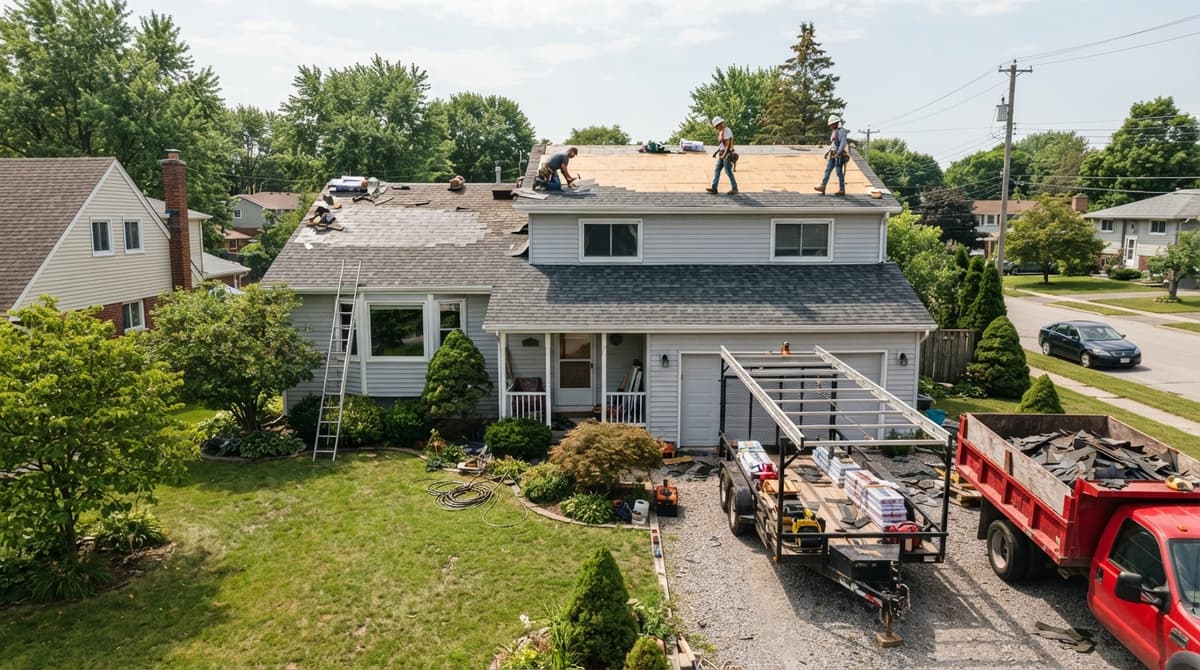
Real local detail is what makes a roofing town page worth ranking: jobs you finished there, the neighborhoods you cover, the roof styles common in that area and local permit rules. Add a photo or two from each job.
A homeowner who sees work three streets away trusts you faster than one reading generic copy.
How to Avoid Doorway Pages
Copying one page and swapping the town name is the fastest way to waste the work. Google's spam policies list "multiple domain names or pages targeted at specific regions or cities that funnel users to one page" as doorway abuse.
Twenty near-identical pages rank as none. If you cannot say something true and specific about a town yet, wait until you can.
Your Google Business Profile
Your Google Business Profile is the base of every Map Pack result, so your profile gets as much care as the website. Our guide to Google Business Profile for roofers walks through every field. The neededs:
- Primary category: Roofing contractor, plus secondary categories that fit, such as Gutter cleaning service.
- Name: your real business name. Google's guidelines say it "should reflect your business's real-world name," so no keywords stuffed in.
- Service area: most roofers visit customers, so Google asks them to set a service area and hide the street address.
- Services: every one you sell, each with a short description.
- Photos: new job photos every month, never stock images.
- Hours and phone: matching your website exactly.
A listing set up once and left alone slowly falls behind roofers who post jobs and photos every month.
How Reviews Affect Roofing SEO
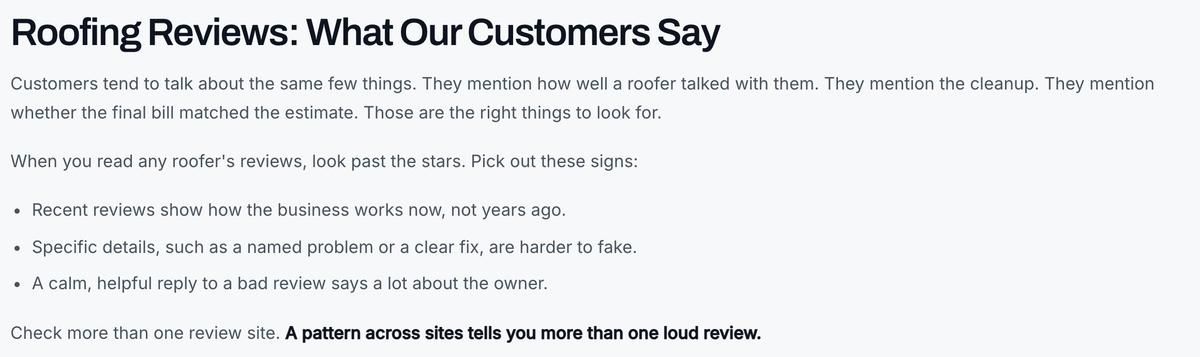
Reviews are one of the strongest signals in the Map Pack, and recency counts as much as the total.
Google's ranking page says more reviews and positive ratings can help your local ranking. BrightLocal's survey adds that 74% of consumers look for reviews from the last three months, and 89% expect owners to reply.
The habit that works is simple:
- Ask the day the crew finishes and cleans up.
- Send a link that opens straight to the review box.
- Reply to every review within days, good or bad.
Never pay or offer discounts for reviews. Google's page on managing reviews calls incentives "strictly prohibited," and the FTC's rule banning fake reviews lets it seek civil penalties. See how to get more roofing reviews for request wording homeowners answer.
Talk to the person who would do the work
The person you talk to is the person doing the work. Bring your questions. Bring the towns you serve. Name the roofing jobs you want more of: repairs, replacements or storm work. You leave with a clear read on your website. You also get notes on your Business Profile and the first fixes to make.
Book a call
Do Citations and Local Links Still Matter?
Citations are mentions of your business on other sites, and Google trusts a roofer that other local sites mention, as long as the details match.
Your name, address and phone number should be identical everywhere they appear: your site, your profile, directories and supplier pages. One old phone number on a listing site can split your trust between two businesses.
Good local links come from relationships you already have:
- Contractor directories run by shingle makers like GAF, Owens Corning and CertainTeed, once you qualify.
- Suppliers and distributors that list the contractors they sell to.
- Your chamber of commerce and local trade groups.
- Sponsorships of local teams, charities and events.
Earn links like these. Skip anyone selling them in bulk. Paid link schemes are on the same spam policy list as doorway pages.
Content That Answers Roof Questions
Roofing SEO content is useful when it answers what homeowners ask before they call: signs of roof damage, repair versus replacement, what a new roof costs and how long the job takes.
Google's guide to helpful, people-first content asks whether a reader leaves feeling they found what they needed.
Each answer also gives your service pages something to link to, and gives AI tools a clear passage to quote. A short, true answer from a roofer beats a long page of filler from a marketer.
Storm Damage and Seasonal Pages
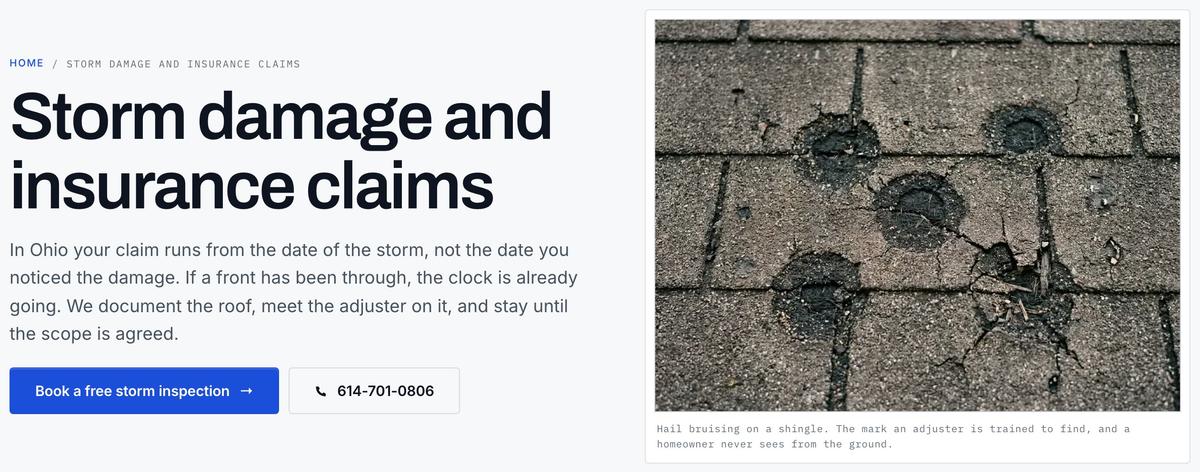
Storm pages are a timing problem: storm searches arrive all at once, and Google takes weeks to index new pages. Have storm damage, hail and insurance claim pages live before the season.
The Insurance Information Institute's hail facts count 5,432 major hail events in the US in 2025, with Texas alone at 902, about 17% of the total.
On insurance topics, explain the process in general terms and never promise an insurer will pay a claim.
Which Technical Basics Matter?
There are 5 technical basics that decide whether Google can read your site at all. None of them win jobs alone, but a broken one can hide every page you built.
- A sitemap: a file listing your pages, explained in Google's sitemaps overview.
- Clean titles: one per page naming the service and town once. Google explains how it builds title links.
- One H1 per page, with headings that follow the order of the page.
- Local business schema: code that states your name, phone and hours, described in Google's local business guide. Use only facts the page already shows.
- Working pages: no broken links, and a secure https address.
Our on-page SEO checklist covers these one page at a time.
Get a second opinion on your current setup
A second opinion is free. Already paying someone for roofing marketing? Send us the website. Send the reports you get each month. We read them and compare them with your real spot on Google. Then we tell you what works and what wastes money. You also get the questions to ask your provider next. You keep the notes either way.
Book a callHow to Know If Roofing SEO Is Working
Roofing SEO is working when calls and form requests from search go up, and you can name the pages that brought them. That takes tracking from the first day.
Track Calls and Forms by Source
Call tracking gives each channel its own phone number. Every call then shows its source: search, the map, an ad or a bot. Form tracking does the same for quote requests.
Sorting out the junk matters: if your phone rings 60 times in a month and 15 calls are spam, only 45 are real leads.
Google Search Console shows which searches your pages appear for, and keeps 16 months of data to compare one storm season with the last.
What Is a Map Pack Grid Scan?
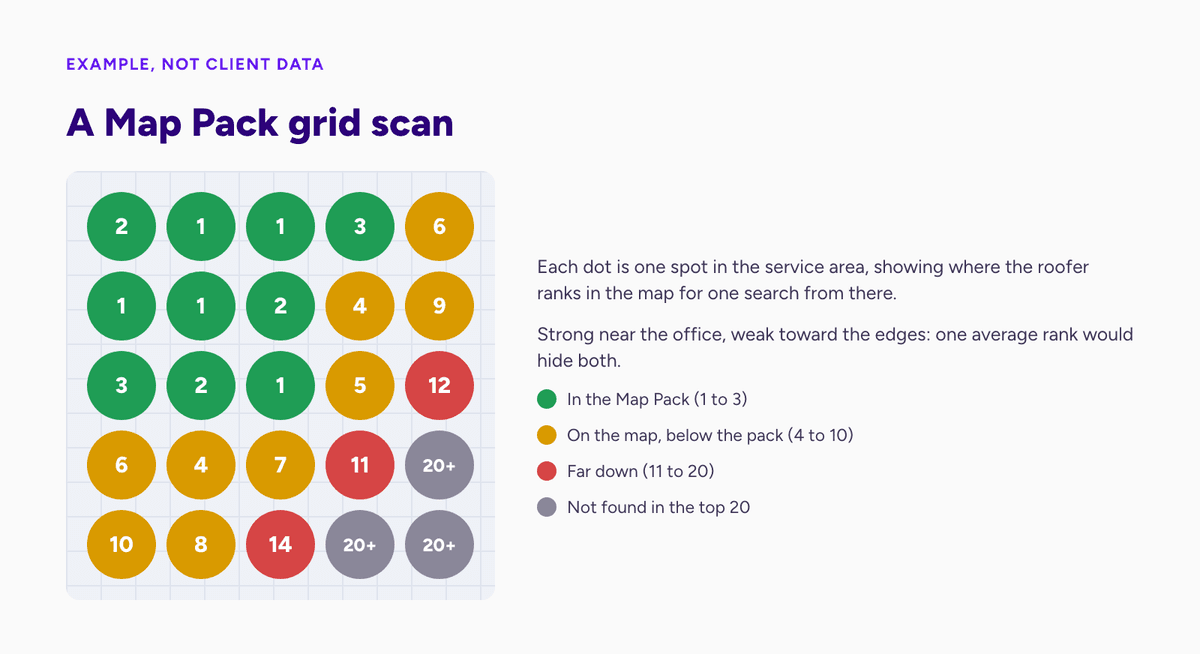
A Map Pack grid scan is a check of your map position from dozens of points across your service area. Your rank changes block by block. One average number hides the towns where you never appear.
We run a monthly grid for a central Ohio roofing and exteriors client, and the grid is how the owner sees which towns are moving.
How Long Does Roofing SEO Take?
Roofing SEO takes months, not weeks. Expect early signs in about 90 days and steady calls in 6 to 12 months, depending on how many roofers compete in your area and how many reviews you have.
See how long roofing SEO takes for the month-by-month version.
Watch for the early signals: new pages showing as indexed in Search Console, more map views on your profile and grid points turning from red to green. Calls follow those signals.
Anyone who promises a number one spot by a date is guessing, and Google's own guide to hiring an SEO warns that "no one can guarantee a #1 ranking on Google."
What Results Can Look Like
Results depend on the market, so treat any number as an example rather than a promise. Our best past SEO campaign grew organic traffic 26x in 14 months, and another grew it 15x. Neither was a roofer. Roofing markets have their own competition.
Traffic is a step, and calls are the goal. A site can grow its visits and still miss on jobs if the pages are vague and the phone number is hard to find. Judge any campaign by the work it books.
Common Roofing SEO Mistakes
The 6 mistakes below show up on most roofing sites. Every one of them looks like progress, and the phone stays quiet:
- One page for every service, so repair, replacement and storm work compete and nothing ranks.
- Copied town pages with only the city name changed and nothing local on them.
- A Business Profile set up once and forgotten, with old photos and unanswered reviews.
- No call tracking, so nobody knows which leads came from search.
- Judging by traffic alone instead of the booked jobs that pay the crew.
- A slow site on phones, losing callers every day it stays slow.
Fixing even two of these does more for a roofer than any new tactic.
Should You Do Roofing SEO Yourself?
A roofer can do roofing SEO alone. Many start that way. The work is not hard to understand. It is hard to keep up during storm season, when crews are busy and the profile, pages and reviews all need attention at once.
If you hire help, ask four questions before you sign:
- Who does the work, and will I talk to that person?
- What will you track, and will I see calls by source?
- Who owns the website, profile and analytics? It should be you.
- How fast can you make changes when a storm hits?
Our page on choosing a roofing SEO company covers the red flags in more detail.
A Simple Roofing SEO Starter Plan
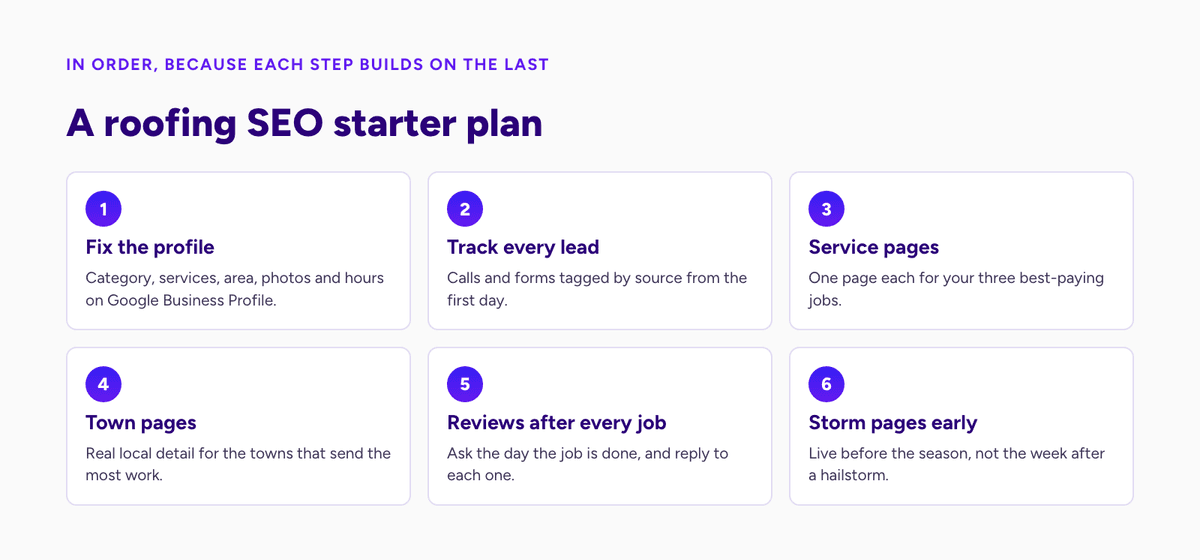
Order is what matters here. Each step builds on the one before it, so work through these 6 in turn:
- Fix your Google Business Profile: category, services, area, photos and hours.
- Set up call and form tracking so every lead has a source from day one.
- Build service pages for your three best-paying jobs.
- Add pages for the towns that send the most work.
- Ask for a review after every job, and reply to each one.
- Publish storm pages before the season starts.
A roofer who finishes all six has the base that every later month of roofing SEO builds on.
Your First 30 Days
Month one of roofing SEO fixes the base. Audit the profile and the site for wrong details, slow pages and missing services. Get tracking live and plan the first pages. Every later number goes against the baseline you set now.
Months Two Through Twelve
From month 2, publish roofing service and town pages in steady batches, ask for reviews after each job and check the grid each month.
Add pages where the map is weak and expand into new towns once the first ones hold. Steady monthly work is what builds a channel that lasts.
Start With Your Homepage
The website is where every roofing SEO plan we run starts. SEO can only send visitors to a page that turns them into calls.
So the first step costs nothing: we rebuild your homepage free and show it to you before you pay anything. You see the design, the call button and the quote form on your own phone, then decide.
Frequently asked questions
Is Roofing SEO Worth It for a Small Roofing Company?
Yes, if you serve a defined area and want calls you do not pay for one at a time. A small roofer in a few towns ranks faster than a large one in a big metro. There is less competition to pass. It pays off when you track booked jobs, not visits.
Can I Do Roofing SEO Without a New Website?
Sometimes. If your site loads fast on a phone, shows a call button on every page and has a clear quote form, it can carry SEO as it is. Most roofing sites we see need work first. Our homepage rebuild is free, so you can compare before you decide.
Do I Need a Separate Website for Each Town?
No. One site with a useful page for each town works better than many small sites. Separate sites split your reviews, links and trust. Google also treats sites that only funnel visitors to one business as doorway pages.
Does Social Media Help Roofing SEO?
Not directly. Posts on social platforms do not move your Google rankings much. They help in other ways: job photos you post can go on your Business Profile too, and an active page reassures homeowners who look you up before calling.
Should a Roofer Use Google Local Services Ads Instead of SEO?
They work well together. Local Services Ads sit above the map and charge per lead, so they bring calls quickly while SEO builds. The difference is cost over time: ads charge for every lead forever, while pages and a strong profile keep working once they rank.
Start with a free homepage rebuild
The first step is a rebuilt roofing homepage. We check your map position. You get a clear plan for your market before any payment. The plan names the service pages your area supports. It names the town pages too, in the order we would build them. Nothing to pay until the plan earns it. The homepage preview is yours to keep.
Book a callRelated guides
More on the same work.
Guides
- Best Roofing SEO Companies
- Roofing SEO Company
- Roofing SEO Services
- Local SEO for Roofing Companies
- HVAC SEO
- How to Get More Roofing Reviews
- Roofing Marketing Agency
- Roofing Website Design
- Roofing Website Builder
- Roofing Leads
- How to Get Roofing Leads
- Google Ads for Roofing Companies
- Roofing Landing Page
- On Page SEO Check List
- Google Business Profile for Roofers
- Digital Marketing for Roofers