


Roofing SEO Services: What You Get Each Month
Roofing SEO services are the monthly work that gets a roofing company found on Google and the map. They cover service and town pages, Google Business Profile upkeep, review requests, local links and call tracking. Here is what each covers and what to expect monthly.
Book a callWhat Are Roofing SEO Services?
Roofing SEO services are the ongoing tasks that help a roofer rank when homeowners search for roof repair, roof replacement or a roofer near them. SEO stands for search engine tuning. The aim is calls, inspection requests and signed jobs, with rankings as the route there.
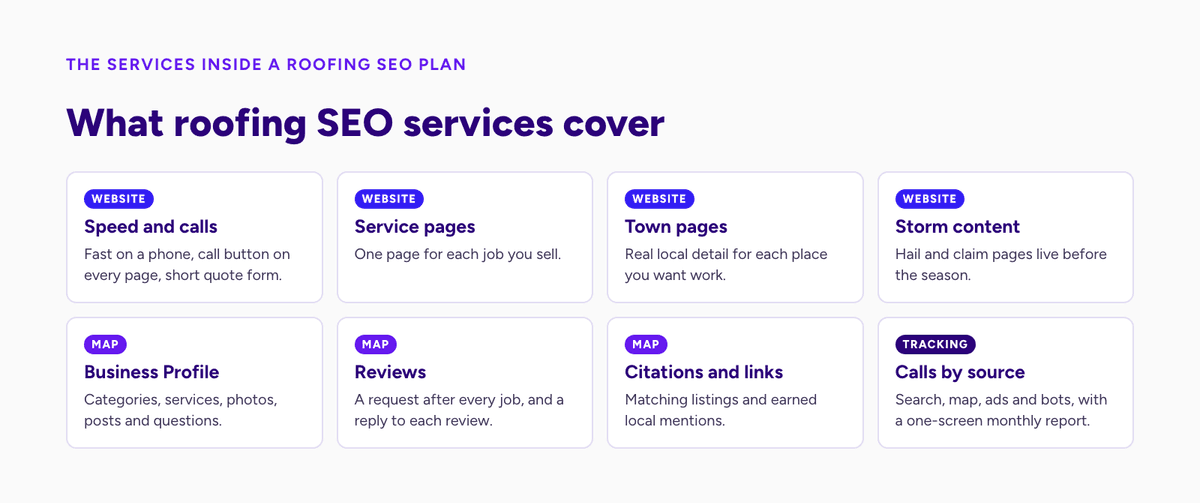
Most plans bundle the same core services:
- Website work: speed, a call button on every page and a short quote form.
- Service pages: one for each job you sell.
- Town pages: one for each place you want work.
- Google Business Profile management: categories, services, photos and posts.
- Review generation: requests after every job, and replies.
- Local citations and links: consistent listings and earned local mentions.
- Call and form tracking: every lead tagged by source.
- Reporting: what was built, what moved and what it brought in.
Plans rarely differ on the list. They differ on how much of each service a provider delivers every month, and whether you can see it.
Who Roofing SEO Services Are For
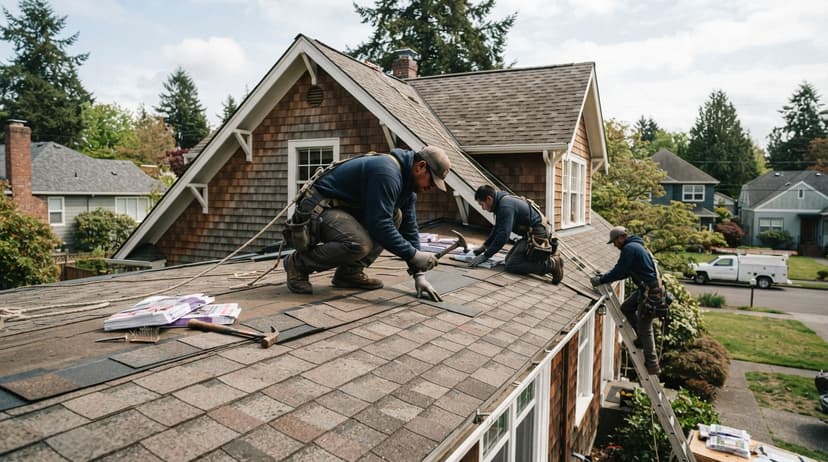
Roofing SEO services fit owners who want a steady flow of calls they do not pay for one at a time. That includes residential roofers, commercial roofers and exteriors companies that also sell gutters, siding or windows.
Three kinds of roofer get the most from it:
- Referral-heavy roofers who want a second source that does not dry up between busy seasons.
- Ad-heavy roofers tired of paying for every click, often $30 to $40 each for roof repair searches.
- Growing roofers moving into new towns where nobody knows their name yet.
It is a poor fit for an owner who needs calls next week and nothing after. Ads do that better.
See your new homepage before you pay anything
Send us your site and the towns you cover. We rebuild your homepage free and show you where you rank on the map today.
Book a callYour Options for Getting Roofing Leads
There is no single best route, and most roofers end up mixing two or three. The trade-offs are clearer side by side:
| Option | Best for | Main limit |
|---|---|---|
| Do it yourself | Owners with spare hours and a small area | Hard to keep up while running crews |
| Freelancer | One task, like a profile cleanup | Rarely covers pages, map and tracking together |
| SEO agency | Steady monthly work on everything | You need to check what is built each month |
| Lead-sharing sites | Fast leads without a website | Leads are often sold to several roofers |
| Local Services Ads | Calls at the very top of Google | Every lead is paid for, every month |
SEO is the only option on the list where the work keeps paying after it is done. A page that ranks in March still sends calls in October.
How Homeowners Find a Roofer on Google
Homeowners find roofers in two places on a local search. The Map Pack shows three nearby businesses with a call button, stars and distance. The organic results below it list websites.
Google's help page on local ranking explains the map: "Local results are mainly based on relevance, distance, and popularity." Your profile and pages drive relevance. Reviews and mentions drive popularity. Distance is fixed, which is why a roofer needs town pages to compete beyond its own street. The same page adds that "businesses with complete and accurate info are more likely to show up in local search results."
Most searchers glance at the map, then open a website or two to check the work before calling. Roofing SEO services have to cover both, because a strong profile pointing to a weak site still loses the call.
The Core Roofing SEO Services, One by One
Each service below solves a different problem. A plan that skips one leaves a gap the others cannot fill.
Website Speed and Conversion
A roofing website earns its keep when a visit becomes a call. The service covers page speed, phone layout, a tap-to-call button on every page and a quote form of five fields or fewer.
Google measures loading and stability with its Core Web Vitals. A slow page loses a homeowner standing under a leak. On our own platform, edits like a new phone number or a fixed form go live in minutes rather than waiting on a developer.
Service Pages
Service pages give each job its own page: roof repair, roof replacement, storm damage, gutters, siding and commercial roofing where you offer it. Each page answers four things: what the job is, when someone needs it, how the work goes and how to get a quote.
One page per job lets Google match each search to the right answer. Google's SEO Starter Guide asks for pages that are useful and easy to read, and a page that tries to cover every job reads like neither.
Town Pages
Town pages let you rank where you work, not only where your office sits. Each one needs facts no other town page has: jobs finished there, the neighborhoods you cover and roof styles common in the area.
Copying one page and swapping the city name is the fastest way to waste this service. Google's spam policies define doorway abuse as pages "created to rank for specific, similar search queries" that lead users to pages "that aren't as useful as the final destination." Real local detail is the difference.
Google Business Profile Management
Profile management keeps the listing that drives the Map Pack complete and current. The monthly work:
- Categories: Roofing contractor first, plus secondary categories that fit.
- Services: every job listed with a short description.
- Photos: new job photos each month.
- Posts: finished jobs, seasonal offers and storm notices.
- Questions: common questions answered before customers ask.
- Accuracy: hours, phone and service area kept current.
Google's guidelines need your real business name, so a good service never stuffs keywords into it. For roofers who visit customers, the same guidelines ask you to "use a precise, accurate address and/or service area to describe your business location."
Review Generation
Review generation is a system, not a favor. A request goes out the day each job is finished, with a link that opens straight to the review box, and every review gets a reply.
Recency matters as much as count. BrightLocal's 2026 consumer survey found 74% of consumers look for reviews from the last three months and 89% expect owners to respond. Offering a discount for a review is out: Google's review page calls incentives "strictly prohibited," and the FTC's rule banning fake reviews lets it seek civil penalties against knowing violators.
Find out where you show up on the map
We check your Google Maps position across your service area and walk you through it on a short call. Free, with no obligation.
Book a callLocal Citations and Links
Citation work makes sure your name, address and phone match on every directory and listing. Link work earns mentions from local sites Google already trusts:
- Contractor directories run by shingle makers such as GAF, Owens Corning and CertainTeed.
- Suppliers and distributors that list their contractors.
- The chamber of commerce and local trade groups.
- Sponsorships of teams, charities and community events.
A provider selling hundreds of links for a flat fee sells exactly the kind Google's spam policies warn about.
Content for Storm Season and Common Questions
Content work answers what homeowners ask before calling: repair or replace, what a new roof costs, what happens after hail. It also means storm damage and insurance claim pages live before the season, since new pages take weeks to get indexed.
Hail is common enough to plan around. The Insurance Information Institute's hail facts count 5,432 major hail events in the US in 2025, with Texas alone accounting for 902, about 17% of the total.
Call and Form Tracking
Tracking ties every lead to its source: organic search, the map, ads, referrals or bots. Without it, nobody can say which service is working. Bots matter more than most owners expect, because junk calls and spam forms inflate the numbers.
Each tracked call should show you:
- The source: organic search, Map Pack, an ad or a referral.
- The page the caller was reading before they called.
- The time and length of the call, so you can spot missed calls.
- Whether it was real, with robocalls and spam filtered out.
Traffic alone misleads. A page with 400 visits and 12 leads converts at 3%, while a page with 100 visits and 8 leads converts at 8%. The smaller page is the better one.
Reporting
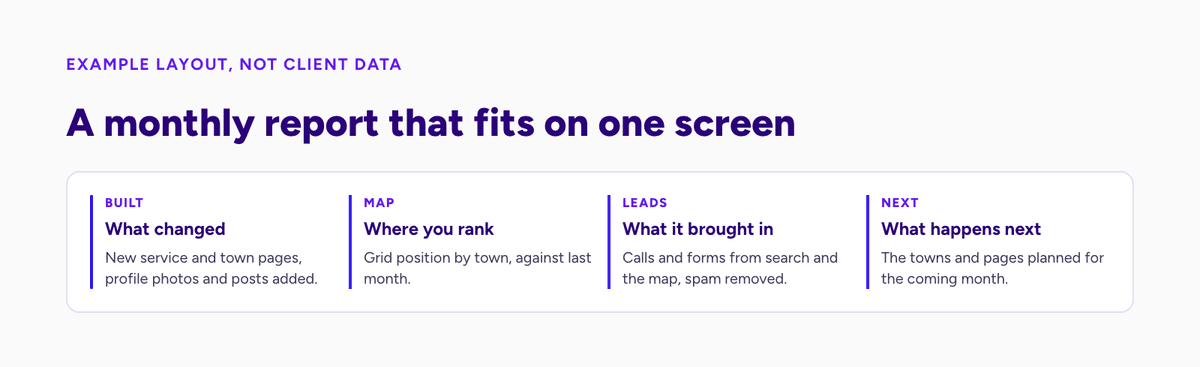
A good report fits on one screen and answers four questions: what was built this month, where you rank on the map, how many calls and forms came from search, and what happens next. A report that is all traffic charts and keyword lists hides whether anything worked.
Roofing SEO Services and Your Other Marketing
SEO rarely works alone, and it should make the rest of your marketing easier to judge rather than harder.
Google Ads and Local Services Ads
Ads fill the calendar while pages build, and they are useful for testing a new town before you invest in pages there. With call tracking in place, every lead shows whether it came from an ad or from search. Most roofers who track both end up shifting budget toward search over time, because an ad charges for every lead while a ranking page does not.
Referrals and Yard Signs
Referrals still close better than almost any other lead. But a referred homeowner usually searches your name before calling, and what they find decides whether the referral holds. A site with real photos and a profile with recent reviews turns that search into a call instead of a second opinion.
Social Media
Posts on social platforms do little for Google rankings directly. They do help in two ways: the same job photos can go on your Business Profile, and an active page reassures homeowners who look you up. Treat social as a place to show work, not as an SEO tactic.
What a Map Pack Grid Scan Shows
A Map Pack grid scan checks your map position from many points across your service area, often a 5 by 5 or 7 by 7 grid. Your position changes block by block, so one check from your office says little about the town ten miles away.
We run a monthly grid for a central Ohio roofing and exteriors company where we built service and town pages for the 17 towns it serves. The grid shows which towns are moving and which need work next, which turns "rank better" into a short list of weak spots.
Residential vs. Commercial Roofing SEO Services
The same services serve both markets, but the pages look different because the buyers do.
Residential Roofers
Homeowners decide fast and on trust. Residential services lean on:
- Speed to call: the phone number and estimate button at the top of every page.
- Reviews and photos of houses like theirs, in their town.
- Insurance and financing answers, written plainly and without promises.
- Storm pages ready before hail season.
Commercial Roofers
Property managers and facility teams compare carefully and buy less often, but each job is worth far more. Commercial services lean on:
- Ability pages for flat roof systems, coatings and maintenance plans.
- Case studies of buildings of a similar size and type.
- Manufacturer certifications you actually hold.
- A site visit request instead of a quick quote form.
Signs Your Current Roofing SEO Isn't Working
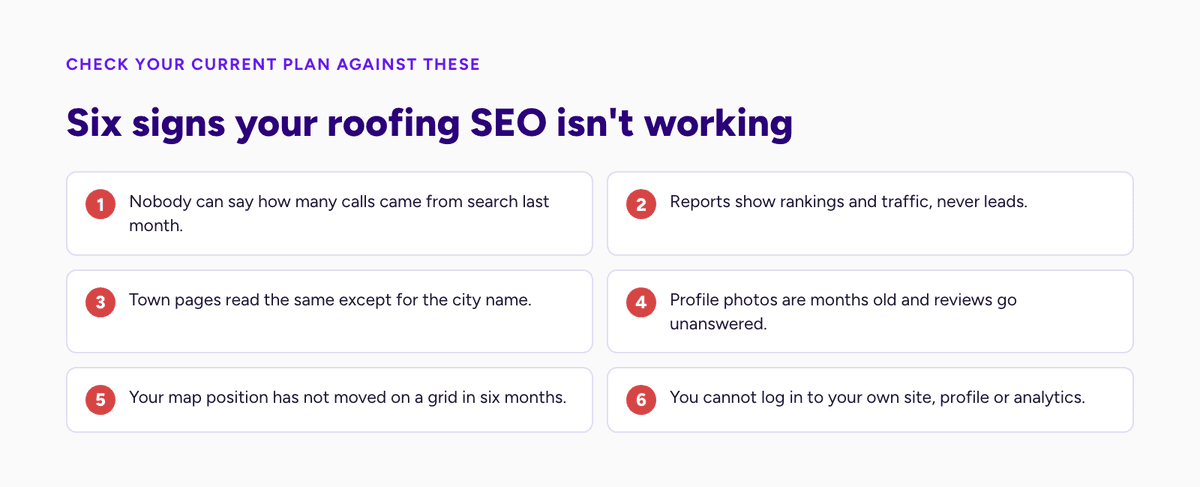
If you already pay for roofing SEO services, these signs suggest the plan needs a hard look:
- Nobody can tell you how many calls came from search last month.
- Reports show rankings and traffic but never leads.
- Your town pages read the same except for the city name.
- Your Business Profile photos are months old, and recent reviews have no replies.
- Your map position has not moved on a grid in six months.
- You cannot log in to your own website, profile or analytics.
Any one of these is worth a conversation. Three or more usually means the work is not being done.
Talk to the person who would do the work
The person you talk to is the person doing the work. Bring your questions, your towns and the jobs you want more of.
Book a callWhat You Provide
Good roofing SEO services ask for very little of your time, but a few things only you can supply:
- Access to your website, Google Business Profile and analytics.
- Your services and towns, ranked by the jobs you most want.
- Real job photos, taken on a phone, before and after.
- A quick answer when we ask about a job, a town or a claim.
What Should You Get Every Month?
A monthly roofing SEO plan should leave a trail you can check. At minimum, ask for:
- New or improved pages, listed by service and town.
- Profile updates: photos added, posts published, questions answered.
- Reviews requested and replied to, with the count for the month.
- Map position on a grid, compared with last month.
- Calls and forms by source, with spam filtered out.
- Next month's plan, in a sentence or two.
If a provider cannot show you this list, you cannot tell what you are paying for.
Visits From AI Tools
Homeowners now ask ChatGPT, Gemini, Perplexity and Google's AI Overviews to recommend roofers. Google's guide to AI features in Search says the same practices that help regular results apply.
We report visits from AI tools as their own channel, so you can see the trend instead of having it buried in direct traffic. Pages that state plainly what you do, where, and for whom are the ones an AI answer can quote.
How Long Before Roofing SEO Services Pay Off?
Expect early signs in about 90 days and steady calls in 6 to 12 months. New pages need weeks to be indexed, then time to earn trust, and the map moves as reviews build.
For a sense of what steady work can do, our best past SEO campaign grew organic traffic 26x in 14 months, and another grew it 15x. Neither was a roofer, and every market has its own competition. Google's guide to hiring an SEO says plainly that "no one can guarantee a #1 ranking on Google," so treat any promised date as a guess.
Find out where you show up on the map
We check your Google Maps position across your service area and walk you through it on a short call. Free, with no obligation.
Book a callHow Roofing SEO Services Are Priced
Most providers price roofing SEO services monthly by scope: how many towns, how many services and how many pages a month. A roofer covering three towns needs far less than one covering 30, which is why we quote after looking at your market rather than posting one price.
Compare the cost with ads. Google Ads data from DataForSEO's keyword planner puts roof repair clicks at about $40 each and roof replacement at about $31. Ten clicks can cost $400 before anyone calls, every month, for as long as you run them.
Be wary of a flat price that does not say what gets built. If two providers quote the same for 3 towns and 30, one of them is doing very little.
Before You Sign Up
Five questions sort good services from weak ones:
- Who does the work? With us, the person you talk to is the person doing it.
- What gets built each month? By service, town and page.
- How are calls tracked? By source, with spam removed.
- Who owns the site and accounts? You should hold every login.
- What happens in a bad month? A clear answer shows a clear process.
Our page on choosing a roofing SEO company covers the red flags in more depth.
Common Mistakes With Roofing SEO Services
Roofers who left a past plan tell us the same few stories:
- Starting in the busy season, when there is no time to review anything. Start in the slow months so pages are live when demand returns.
- Never tracking calls, so good work gets cut and weak work keeps running.
- One page for many towns, which Google reads as one place.
- Switching providers every few months, resetting the work each time.
- Buying reviews or links, which risks the profile itself.
What the First 90 Days Look Like
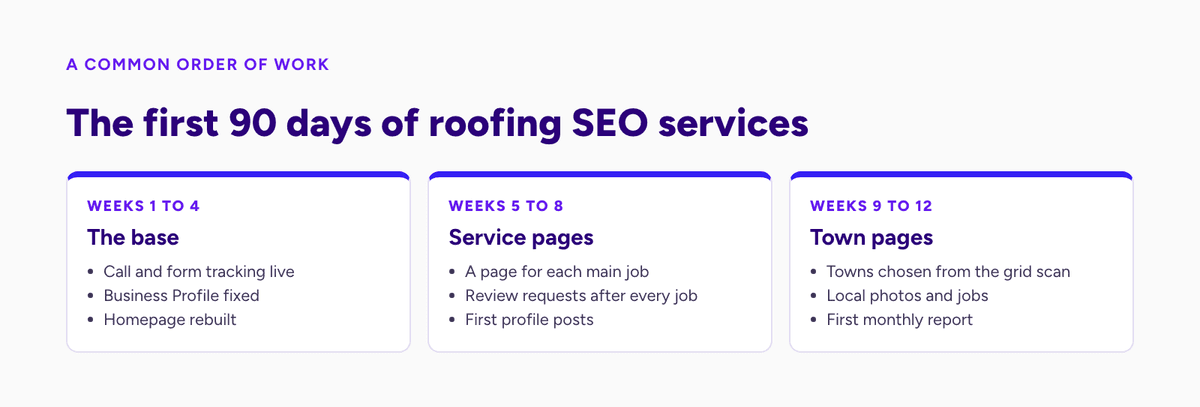
The first three months follow a common order, though every roofer starts somewhere different:
- Weeks 1 to 4: we set up tracking, fix the Google Business Profile and rebuild the homepage.
- Weeks 5 to 8: service pages for your main jobs, plus review requests after every job.
- Weeks 9 to 12: town pages for the towns that matter most, chosen from the grid scan.
From there the work becomes monthly: more town pages, fresh photos and posts, review replies and a new grid each month.
Start With a Free Homepage
Every plan we run starts with the website, because SEO can only send people to a page that turns them into calls. So we rebuild your homepage free and show it to you before you pay anything. If you like it, we talk about a monthly plan. If not, you owe nothing. To check your current pages yourself first, work through our on-page SEO checklist, or read the roofing SEO guide for how the whole system fits together.
Frequently asked questions
What Is the Difference Between Local SEO and Roofing SEO Services?
Local SEO is the general practice of ranking a business in its area. Roofing SEO services apply it to how roofing actually sells: storm-driven demand, separate repair and replacement buyers, insurance questions and town-by-town service areas. The tools are the same; the pages and timing are built around roofing.
Do Roofing SEO Services Include Google Ads?
Not usually. Ads are a separate service with their own budget. They work well alongside SEO, filling the calendar while pages build, and call tracking shows which one each lead came from so you can shift spend toward what books jobs.
How Much of My Time Do Roofing SEO Services Take?
A little at the start: access to your website and Google Business Profile, your list of services and towns, and photos from real jobs. After that, about 15 minutes a month to send new photos and tell us what kind of work you want more of.
Will Roofing SEO Services Bring Commercial Roofing Leads?
They can, with pages built for property managers: flat roof systems, coatings, maintenance plans and case studies of similar buildings. Commercial searches are fewer than residential ones, but each job is worth far more, so a few pages can pay off.
Do I Need to Supply Photos?
Real job photos help more than almost anything else, on the website and the Business Profile. Phone photos are fine. Before and after shots of the same roof, and the crew at work, are the ones homeowners look at longest.
Start with a free homepage rebuild
Your homepage rebuilt, your map position checked and a clear plan for your market. Nothing to pay until you decide.
Book a callRelated guides
More on the same work.