

Roofing Leads: Where They Come From and How to Get More
Roofing leads are people who call, fill out a form or ask for an estimate. A lead is not a booked job yet, and the source it came from decides what it costs you and how often it books.
Book a callWhat Are Roofing Leads and Where Do They Come From?
A roofing lead is a person who shows interest in your work. They call you, send a form or ask for a quote. Some leads become jobs. Many do not. Keep that gap in mind when you count them.
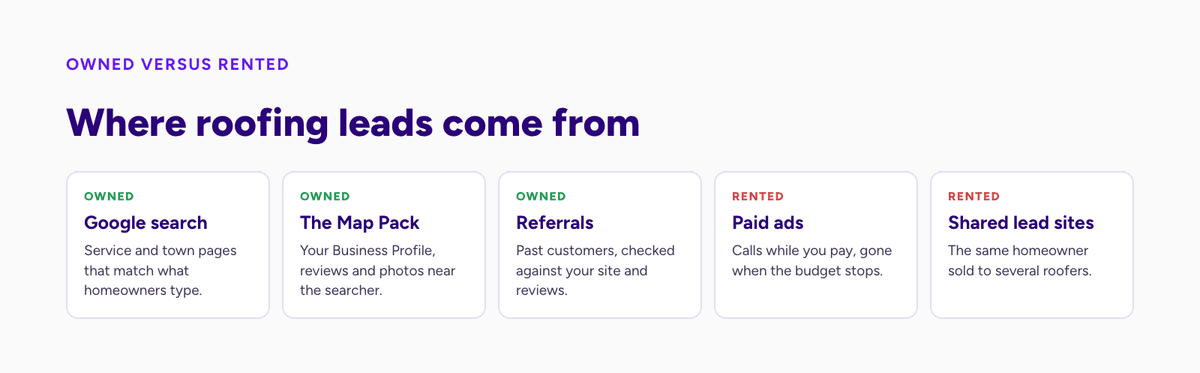
Most owners have more than one source running at the same time:
- Google search, where homeowners type a need and a town.
- The Google Map Pack, the short list of local businesses above the map.
- Paid ads that bring calls while you pay.
- Referrals and repeat customers.
- AI tools that suggest roofers.
Each source needs its own count, because each one works differently.
How Do Roofing Leads From Google Search Reach You?
Roofing leads from Google search reach you when a homeowner types a phrase like "roof repair" plus a town name and clicks your page. Your service pages and town pages answer those searches. The homeowner lands on your site and calls you. No shared list sits in the middle.
This is the core of roofing SEO: build pages that match what people type. A page for roof repair, one for replacement and one for storm damage each speak to a different search. Google's own SEO Starter Guide says to create content for people first. A clear page that answers one need is how you get more roofing leads from Google.
See your new homepage before you pay anything
Send us your site and the towns you cover. We rebuild your homepage free and show you where you rank on the map today.
Book a callLeads From the Google Map Pack
The Google Map Pack shows 3 businesses near the person searching. Many roofing calls and direction taps come straight from that listing. The homeowner may never open your website.
Position changes by where the searcher stands. A homeowner on the north side of town may see you. A homeowner 10 miles south may not. Your own phone shows a flattering picture, because you are standing at your own office. That is why we track the map on a grid, not from one spot. Google's guidelines for representing your business cover what the listing may say: "Use a precise, accurate address and/or service area to describe your business location."
Paid Ads, Referrals and AI Tools
Three smaller sources deserve a short look each. Each one needs a separate count:
- Paid ads can bring roofing calls fast. They stop when the budget stops. Track ad calls apart from search and map calls, so you know what the ads did.
- Referrals and repeat customers are a real source for roofers. Referred people still check your website and map listing before they call. A weak website can lose a referral you already earned.
- AI tools are used by some homeowners to ask for roofer suggestions. We track visits from AI tools as their own channel. Clear, well-organized pages are easier for these tools to quote.
None of these sources works well if the website behind it is weak.
Shared Leads vs. Leads You Earn
Shared leads are sold to several roofers at once. Earned leads come from your own website and map listing. The trade-off is speed against ownership.
A bought lead can arrive quickly. The homeowner may also be calling 3 other roofers. You compete on speed and price before you say a word. An earned lead found you on purpose. It takes longer to build, and it keeps working.
How much do roofing companies pay for leads? It varies by area and seller, so we will not give a figure. Run the math with your own numbers instead. Say you pay $50 a lead and book 1 job from every 5 leads. Each job costs $250 in lead fees alone. Compare that to your profit on a roof.
The main lead sources compare like this:
| Source | How you pay | Speed | Who else gets the lead |
|---|---|---|---|
| Shared lead sites | Per lead | Same day | Often 3 or 4 other roofers |
| Google Ads | Per click, about $40 for roof repair | Same day | Nobody, but every click costs |
| Local Services Ads | Per lead | Days | Nobody, but every lead costs |
| SEO and the Map Pack | Monthly work | 3 to 12 months | Nobody, and it keeps working |
| Referrals | Good work | Unpredictable | Nobody |
The Google Ads figure comes from DataForSEO's keyword planner, which puts roof repair at about $40.31 a click and roof replacement at about $30.63.
Own your lead source and you stop renting it.
Find out where you show up on the map
We check your Google Maps position across your service area and walk you through it on a short call. Free, with no obligation.
Book a call
How Does Google Decide Which Roofers to Show?
Google shows roofers using three signals. It says so plainly in its Business Profile help: "Local results are mainly based on relevance, distance, and popularity." No one can promise you a top spot. You can improve each of the three.
- Relevance is how well you match the search.
- Distance is how far you are from the searcher.
- Popularity is how well known and trusted you are.
This is how local search works for every home service business. Good local SEO for roofing companies works on all three signals at once.
Relevance and Distance: Why Town Pages Matter
Relevance starts with one page per service. Make one for repair, one for replacement and one for storm damage. One topic per page keeps the message clear. Match your business listing categories and services to those pages.
Distance is harder. You cannot move closer to the homeowner. You can show which towns you serve. Town pages give Google a clear reason to show you in each place. They also tell the homeowner you work nearby.
Do not copy and paste the same page for every town. Each page needs real local detail, such as jobs you did there, local roof types and nearby streets. Thin pages add little.
Popularity: Reviews, Mentions and a Trusted Website
Popularity comes from real reviews, mentions and a site people trust. Reviews matter to homeowners too: BrightLocal's 2026 Local Consumer Review Survey found 97% of consumers read reviews for local businesses. Ask happy customers for honest reviews. Google's guide on getting reviews explains how. Never pay for them or write them yourself. The FTC's rule on fake reviews bans that practice.
Keep your name, address and phone number the same everywhere. Do not claim a rating, award or license on your page unless you can prove it. Trust is earned one honest detail at a time.
Why Your Roofing Website Decides If a Lead Calls
Every source ends at your site or your listing. If the page is slow or confusing, the lead leaves. You paid in time or money to earn that visit. A weak roofing website wastes it.
A site that turns visits into roofing calls has these basics:
- Your phone number is visible and tappable on a phone.
- The form is short: name, phone and what they need.
- Your services are listed in plain words.
- Pages load fast on a cell connection.
We run our own website platform, so changes go live in minutes. That matters when you find a broken form on a Friday. Good roofing website design is a lead tool, not a brochure.
What a Roofing Service Page Needs
A service page needs a plain description of the job, the steps you follow and the towns you serve. Add real photos of your own work. Stock photos feel fake to a homeowner looking at a roof.
End with one clear next step: call or request an estimate. Say it twice if the page is long.
Avoid claims you cannot back up. Do not state insurance, licenses or 24/7 service unless the owner confirms them. A false claim costs more than a missing one.
A Real Example: What Does a 17-Town Roofing Setup Look Like?
A 17-town setup is a roofing and exteriors company in central Ohio with a service page for each job and a town page for each of the 17 towns it serves. We do not name the client. We do not state results here.
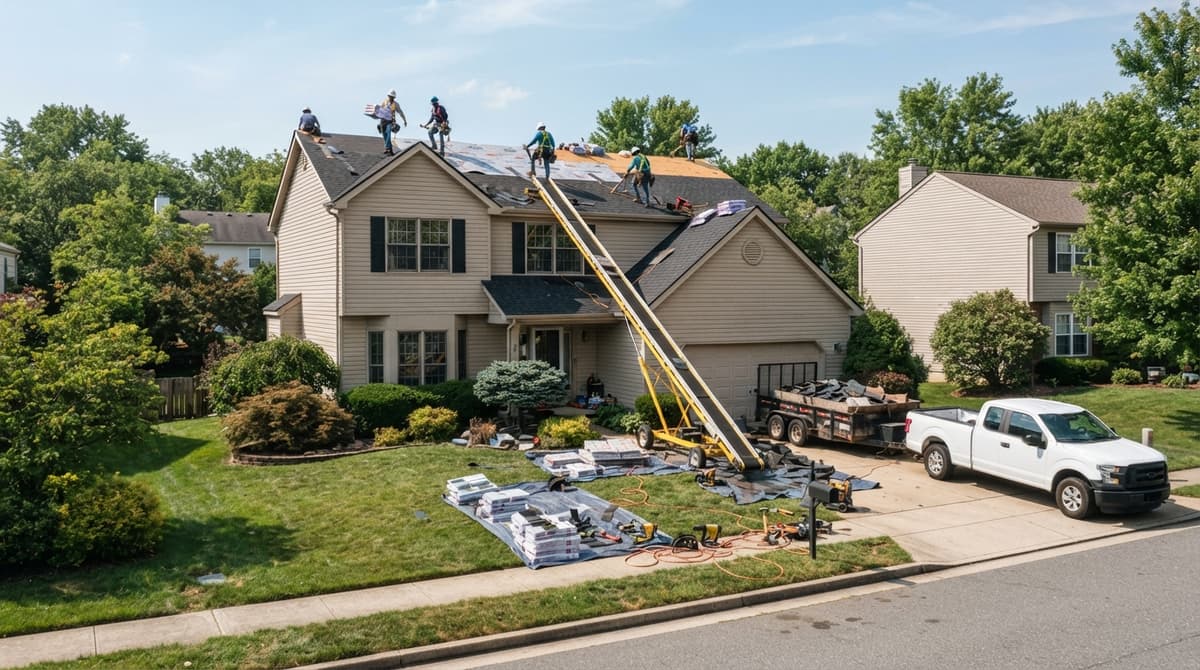
Each month, we run a Google Maps grid scan of its service area. The scan shows where the company appears in map results and where it does not. We use that to pick the next town page to build or improve. Every month's work starts from the map, not a guess.
What Is a Map Grid Scan?
A map grid scan places a grid of points across your service area. Each point shows where you rank in the Google Map Pack for a search from that spot. Green points mean you show up near the top. Weak points mean you do not.
That view shows strong and weak towns at a glance. A weak town tells you where to build or improve a town page. A single rank check from your office cannot show that.
Talk to the person who would do the work
The person you talk to is the person doing the work. Bring your questions, your towns and the jobs you want more of.
Book a callHow to Track Where Your Roofing Leads Come From
You can tell where a lead came from by counting calls and forms by source. Use these tools and habits:
- Give each source its own phone number or tracking tag: search, map, ads and bots.
- Filter out bot and spam contacts, so your numbers stay honest.
- Check Map Pack position on a grid, not in a single spot.
- Track visits from AI tools as their own channel.
Do AI tools send roofing leads? Some homeowners use them. The volume may be small, so count it apart and watch it grow.
Why Counting Leads Is Not Enough
A lead only matters if it becomes a booked job. Ask your office how each call went. Was it a real homeowner? Did they book? Was it a wrong number or a sales call?
Match leads to booked jobs when you can. A source that sends 10 calls and 3 jobs beats one that sends 30 calls and none. Judge a source by the jobs it books.
Common Mistakes That Waste Roofing Leads
Most lost roofing leads trace back to four mistakes:
- Missed calls and slow follow-up. A homeowner who gets no answer calls the next roofer.
- One page for every service and every town. Google cannot tell what you want to be found for.
- No tracking. Nobody knows what works, so money follows habit.
- Paying for leads without knowing who else gets them. You may be one of 4 bidders for the same roof.
Fix the website and the follow-up first. Those cost less than buying more leads.
How We Help Roofers Get More Leads
We build websites and run SEO for home service businesses across the United States. Our own platform means changes take minutes. Our roofing SEO services are a monthly plan priced by towns, services and pages a month. The person you talk to is the person doing the work.
One past SEO campaign grew organic traffic 26x in 14 months, and another grew it 15x. We are Top Rated Plus on Upwork with 99% job success, and we have done work for brands like New Balance, Purina and Aramark, plus SEO for Planned Parenthood. We make no promise of rankings or lead numbers, because Google decides those. If you want a roofing marketing agency that shows its work, this is how we run it.
Want to See Your Homepage Rebuilt Free?
Yes, we rebuild your homepage free and show it to you before you pay anything. You see the work first. That makes it a low-risk way to try us.
The next step is simple. Share your website and the towns you serve. We do the rest and send you the result.
Frequently asked questions
How much do roofing companies pay for leads?
There is no single price. It depends on your area, the seller and whether the lead is shared. Work out your own cost per booked job. If you pay $50 a lead and book 1 job in 5, each job costs $250 in lead fees.
Where do roofing leads come from?
Roofing leads come from Google search, the Google Map Pack, paid ads, referrals and repeat customers, and AI tools. Most roofers use more than one. Track each source on its own, so you know which one books jobs.
What is the difference between shared leads and leads you earn?
Shared leads are sold to several roofers at once. You compete from the first call. Earned leads come from your own website and map listing. They take longer to build, but the homeowner chose to contact you.
Why do town pages matter for roofing leads?
Google weighs distance when it picks roofers to show. A town page tells Google and the homeowner that you serve that place. Each page needs real local detail. Copy-paste pages add little.
What should a roofing website have so visitors call?
A visible phone number on mobile, a short form and plain service descriptions. Add real photos of your work and a clear next step on every page. Make sure pages load fast. Do not claim licenses or awards you cannot prove.
Are exclusive roofing leads worth more than shared ones?
Usually, because you are the only roofer calling. Compare them on cost per booked job rather than cost per lead: an exclusive lead at twice the price can still be cheaper if it books three times as often.
How fast should a roofer call a new lead back?
As fast as you can, ideally within minutes. A homeowner with a leak often calls several roofers in a row, and the first one to answer usually gets the inspection. Call tracking shows missed calls so none slip through.
Start with a free homepage rebuild
Your homepage rebuilt, your map position checked and a clear plan for your market. Nothing to pay until you decide.
Book a callRelated guides
More on the same work.
Guides
- Roofing SEO
- Roofing SEO Services
- Local SEO for Roofing Companies
- Roofing Marketing Agency
- Roofing SEO Company
- Roofing Website Design
- Roofing Website Builder
- Best Roofing SEO Companies
- How to Get More Roofing Reviews
- Google Business Profile for Roofers