

Local SEO for Roofing Companies: Map Pack, Pages and Reviews
Local SEO for roofing companies is the work of making your business show up when nearby homeowners search for roof help. You do it with a Google Business Profile, service pages, town pages and reviews. Then you measure it with calls, not guesses. Nobody can promise a rank or a lead count.
Book a callWhat Is Local SEO for Roofing Companies?
Local SEO is how you help your roofing company show up when people nearby search for roof help. SEO stands for search engine tuning. It means making your business easy for Google to find and trust.
You can show up in 2 places:
- The Map Pack: a short list of 3 businesses shown with a map.
- The regular results: the web page links listed below the map.
Roofing is a local job. Your crew cannot fix a roof 300 miles away, so the search is local too, and the plan has to be built town by town and job by job.
Why Local Search Matters for Roofers
Homeowners search with a town name or the words "near me" when a roof leaks or needs replacing. Google Ads data from DataForSEO's keyword planner shows roofers near me and roofing company near me each draw about 165,000 searches a month in the US. Every one of those is a local search, answered with a map.
Many people call straight from the map. They never open your website. If you are missing from the map, you miss calls you never knew about. No one tells you who dialed the other roofer.
See your new homepage before you pay anything
Send us your site and the towns you cover. We rebuild your homepage free and show you where you rank on the map today.
Book a callHow Does the Google Map Pack Work for Roofers?
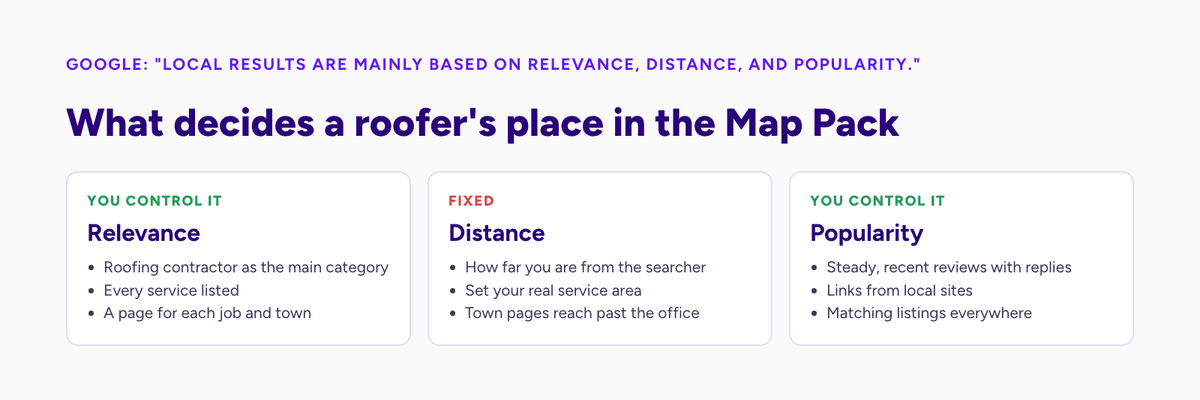
The Map Pack picks 3 businesses that best match a search, weighing relevance, distance and popularity. Google says in its help page on local ranking: "Local results are mainly based on relevance, distance, and popularity."
Here is what each word means:
- Relevance: how well your profile fits what the person typed. A roofer with clear roofing categories fits "roof repair."
- Distance: how far your business sits from the searcher, or from the town they named.
- Popularity: how well known and trusted you are. Reviews, links and mentions across the web all feed this.
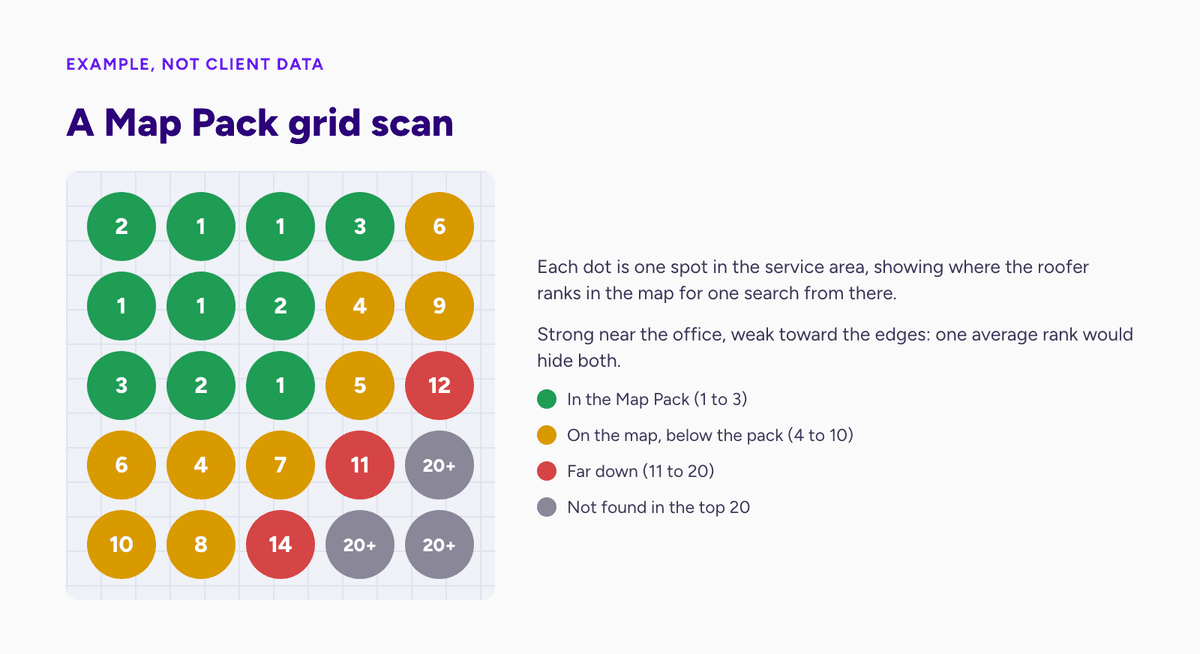
Your position changes with where the searcher stands. A homeowner 2 miles north may see a different list than one 2 miles south. No single rank number describes your whole area.
Map Pack vs. Regular Search Results
The two lists draw on different sources, and a roofer needs both working together. The table shows the split.
| Map Pack | Regular results | |
|---|---|---|
| Pulls mainly from | Your Google Business Profile | Your website pages |
| Best fed by | Categories, reviews, photos | Service and town pages |
| Shown to | Searchers near the business | Searchers matching the page topic |
A strong profile with a thin website leaves half the page empty. Treat the profile and the site as one system.
Start Local SEO for Roofing Companies With Your Google Business Profile
Your Google Business Profile is the free listing that feeds the map, so it is the base of everything else. First, claim it. Then verify it with Google, which proves the business is real and yours.
A claimed profile is not enough. Keep it accurate and active. Update hours after a holiday or a storm rush. An abandoned profile tells Google and customers that nobody is home.
Pick the Right Categories and Services
The main category tells Google what you are. Choose one that matches roofing, such as a roofing contractor category. Then add the jobs you really do. Common ones are roof repair, roof replacement, storm damage and gutters, if you offer them.
Google's guidelines for representing your business ask for accurate information. List only services you actually sell. A false service brings calls you cannot take and risks a suspended profile.
Keep Your Name, Address and Phone the Same Everywhere
These three details, often called NAP, should match across your profile, your website and every directory, letter for letter. "Street" in one place and "St." in another can confuse both Google and customers.
Use a phone number you can track. Call tracking means a number that logs each call and its source. Put that number on the profile and the site, and use it everywhere. Then you can see which calls came from the map. One tracked number, used the same way everywhere, keeps the data clean.
Photos, Posts and Updates
Add real photos of your own jobs. Show a roof before the work and after it. Post an update now and then, such as a finished project or a storm-season reminder.
Do not use stock photos and pass them off as your work. Customers can tell. Google can tell too. Real photos from your own crews build more trust than a polished picture of someone else's roof.
Find out where you show up on the map
We check your Google Maps position across your service area and walk you through it on a short call. Free, with no obligation.
Book a call
Do I Need a Service Page for Each Roofing Job?
Yes. Give each job you sell its own page, because one page cannot answer repair, replacement and storm damage well. These are your roofing service pages.
Build one page for each of these:
- Roof repair
- Roof replacement
- Storm damage
- Any other job you offer, such as gutters
Each page should answer one question well. Say what the job is, when a homeowner needs it, and how the work goes. Add a clear call to action and your phone number near the top. Do not stuff the page with the same phrase over and over. Google's guide to helpful content asks for pages written for people first. A page that helps one homeowner decide is a page that can rank.
Build Roofer Town Pages for Each Town You Serve
You need a page for each town you serve, because Google needs a page that shows you work there. A service area listed only on your profile has nothing behind it. Roofer town pages give each town a place to land.
Here is a real shape. We work with a roofing and exteriors company in central Ohio whose site has service pages and town pages for the 17 towns it serves. Each town page carries its own jobs and photos, which is what keeps them from reading as copies.
List only towns you truly serve. A town page for a place you never work is a false promise.
How to Avoid Thin Town Pages
A thin page is one where only the town name changes. Google's spam rules call near-copies built to catch searches doorway pages. Avoid them.
Add real local detail instead:
- Name the neighborhoods you work in.
- Describe the roof types common in that town.
- Show projects you can document with photos.
- Link each town page to the matching service pages, and back.
A town page earns its place when a neighbor could not mistake it for any other town.
Roofing Reviews: Get Them, Read Them, Answer Them
Roofing reviews help people choose you, and they feed the popularity part of the map. A roof is a big buy. Buyers read what neighbors said before they call.
How to Ask for Reviews
Ask after each finished job. Send the link by text while the crew is still fresh in the customer's mind. Keep the ask short and polite.
How to Reply
Reply to good reviews and bad ones. Stay calm and polite. Say what you will do to fix the problem. Future customers read your replies too.
Never buy or fake reviews. The FTC finalized a rule banning fake reviews and testimonials, and Google's review policy bars fake content as well. Earn each review one job at a time.
Local Links and Mentions
Links from local sites show Google that you are a real business in a real place. Think of each link as a neighbor vouching for you.
Good sources to try:
- Your local chamber of commerce member page
- Supplier and manufacturer pages that list installers
- Sponsorships of youth teams or town events
- News stories that mention a project or a donation
Go for quality over quantity. One link from a town chamber is worth more than 50 links from junk directories. Pick links a real customer might click.
Make Your Roofing Company Website Fast and Easy to Call
A roofing company website must load fast and let a phone user call in one tap. Most roofing searches happen on a phone, and Google now judges sites mostly by their mobile version. Slow pages lose people. Google's Core Web Vitals measure load speed and how stable a page feels.
Put a tap-to-call button at the top. Keep forms short. Ask for a name, a phone number and the problem. A good on-page SEO checklist starts with these basics: clear titles, clear headings and a visible phone number.
Our own platform lets changes go live in minutes. A site you can fix the same day beats one that waits a week.
What Should a Roofing Page Show to Earn Trust?
A roofing page should show your real work: project photos, a short note on each job and the town it was in. Add plain answers to the questions homeowners ask, such as how long a repair takes.
Do not claim licenses, insurance or awards unless you can prove them. Only publish a claim you could show a customer on paper.
Talk to the person who would do the work
The person you talk to is the person doing the work. Bring your questions, your towns and the jobs you want more of.
Book a callHow Can I Check My Map Pack Position With a Google Maps Grid Scan?
A Google Maps grid scan checks your map position at many points across your service area, so you see the whole picture. One check misleads. Your position differs from block to block.
A 7 by 7 grid has 49 points. Run it monthly for 12 months and you have 588 checks. That is far more honest than one search from your office.
We run a monthly Google Maps grid scan for a central Ohio roofing and exteriors company. The scan shows strong and weak areas. A weak area is a clue to build a new town page or ask for more reviews there. The scan turns a vague worry into a list of places to work on.
What Should a Roofing Company Track Besides Rankings?
A roofing company should track calls and forms by source, because rankings alone do not pay the bills. Booked jobs do. Try this math. Say you get 20 calls a month from the map and 1 in 4 books. That is 5 jobs. Now you know what the map is worth.
Count Calls and Forms by Source
Split your calls and forms into these sources:
- Search: people who found your website in regular results.
- Map: people who called from the Map Pack or your profile.
- Ads: people who clicked a paid ad.
- Bots: spam calls and fake forms, so you can strip them out.
Know which channel brings real calls. Count the jobs, not the clicks.
Track Visits From AI Tools as Their Own Channel
Some people now ask AI tools to suggest a roofer. Those visits matter, but only a little today. Track them as their own channel so you can see if they grow.
Clear, factual pages are easier for these tools to quote. State your services, your towns and your contact details plainly. Plain facts are the easiest thing for an AI tool to repeat.
Common Local SEO Mistakes Roofers Make
Most roofers lose ground through a short list of repeat mistakes. Check your own business against it.
- An unclaimed or outdated profile that shows old hours or a dead phone number.
- Service areas listed with no page to back them up.
- Town pages copied from one another with only the name swapped.
- No call tracking, so nobody knows where calls come from.
- Expecting results overnight and quitting at month 2.
The last one hurts most. Local SEO rewards the roofer who keeps going.
Find out where you show up on the map
We check your Google Maps position across your service area and walk you through it on a short call. Free, with no obligation.
Book a callHow Long Does Local SEO for Roofing Companies Take?
Local SEO builds over months, not days. The honest answer is that no one can promise a ranking or a lead count. Be wary of anyone who does.
Past results are a guide, not a promise for your business. Your town, your rivals and your starting point all change the outcome.
Plan for steady work. Build pages, earn reviews and read your scans each month. Judge the work by the trend over a season, not by a single week.
Should I Do Local SEO for Roofing Companies Myself or Hire Help?
You can do the first steps yourself, and hire help when the work grows past your free hours. Start alone. Then decide based on how many towns you serve.
What You Can Do Alone
Claim and verify your profile. Ask for a review after every job. Make your listing details match everywhere. These cost time, not money.
What to Ask Any Provider
Many pages, tracking and scans take real hours. When you weigh a roofing SEO company, ask who does the work and how they report results. Ask what roofing SEO services include each month. We say the person you talk to is the person doing the work. Ask for reports tied to calls, not just rankings.
How We Handle Local SEO for Roofers
We build websites and run SEO for home service businesses across the United States. For roofers, we plan around your towns and your services.
SEO is a monthly plan based on the towns, services and pages a month you want. We do not state a price here, because the plan depends on your area.
Our proof, exactly as it stands:
- 26x organic traffic in 14 months on our best past SEO campaign, and 15x on another.
- Top Rated Plus on Upwork with 99% job success.
- Work for brands like New Balance, Purina and Aramark, plus SEO for Planned Parenthood.
We show you the plan and the reports, so you always know what we did.
See a New Homepage Before You Pay
We rebuild your homepage for free and show it to you before you pay anything. You have no duty to continue. If you like it, we talk about next steps. If not, you keep what you saw.
Request the free rebuild and judge the work with your own eyes.
Local SEO for Roofing Companies: Quick Answers
What can I do for free? Claim your profile, make your listing details match everywhere, and ask each customer for a review.
How many towns should I cover? Cover each town where you really work. Add them in order of job value.
What do I track? Track calls and forms by source, plus your map position on a grid.
Frequently asked questions
Is local SEO different for a roofer with several offices?
Yes. Each real office with staff can have its own Google Business Profile, and each profile needs its own town pages and reviews. A roofer with one office and a wide service area keeps one profile with a service area, and reaches other towns through town pages.
How much do roofing companies pay for leads?
It varies a lot by town, lead type and whether the lead is shared or exclusive. Any single number would mislead you. Judge leads by cost per booked job: total spend divided by jobs won. That figure tells you if a lead source is worth it.
What is the best way to advertise a roofing company?
No single way wins for every roofer. Paid ads bring calls fast but stop when you stop paying. Local SEO builds slowly and keeps working. Referrals and reviews help both. Track calls by source, then put money where booked jobs come from.
Do visits from AI tools matter for roofers?
They matter a little today, and may grow. Track them as their own channel in your reports. Clear, factual pages that state your services and towns are easier for AI tools to quote.
What should a roofer put on a Google Business Profile?
Put a roofing main category, the services you really offer, accurate hours and a tracked phone number. Add real photos of your own jobs. Keep your name, address and phone number the same as on your website.
Can I rank in a town where I have no office?
In the regular results, yes, with a useful town page backed by real jobs there. The Map Pack is harder, because distance from the searcher counts. Reviews from customers in that town and steady activity on your profile help close the gap over time.
Start with a free homepage rebuild
Your homepage rebuilt, your map position checked and a clear plan for your market. Nothing to pay until you decide.
Book a callRelated guides
More on the same work.