

3pl Vs 4pl
A 3PL is a company that stores, picks, packs, and ships your goods; a 4PL is a company that manages your 3PLs and the rest of the supply chain for you. That is the whole difference between 3PL vs 4PL, and it decides who you call when an order is late. A 4PL owns no warehouse as a rule and charges a management fee of 5 to 15 percent on top of the 3PL rates it coordinates.
This guide, reviewed in September 2026, explains both in plain terms, sets out when each one makes sense for a business shipping 50 to 5,000 orders a week, gives the cost of each, and shows where your own warehouse management system fits. The short version: under 3 warehouses and one country, a 3PL and your own WMS; past that, a 4PL starts to earn its fee.
Published 24 August 2026. Reviewed and updated 15 September 2026.
Book a callWhat Is a 3PL and How Does It Work?
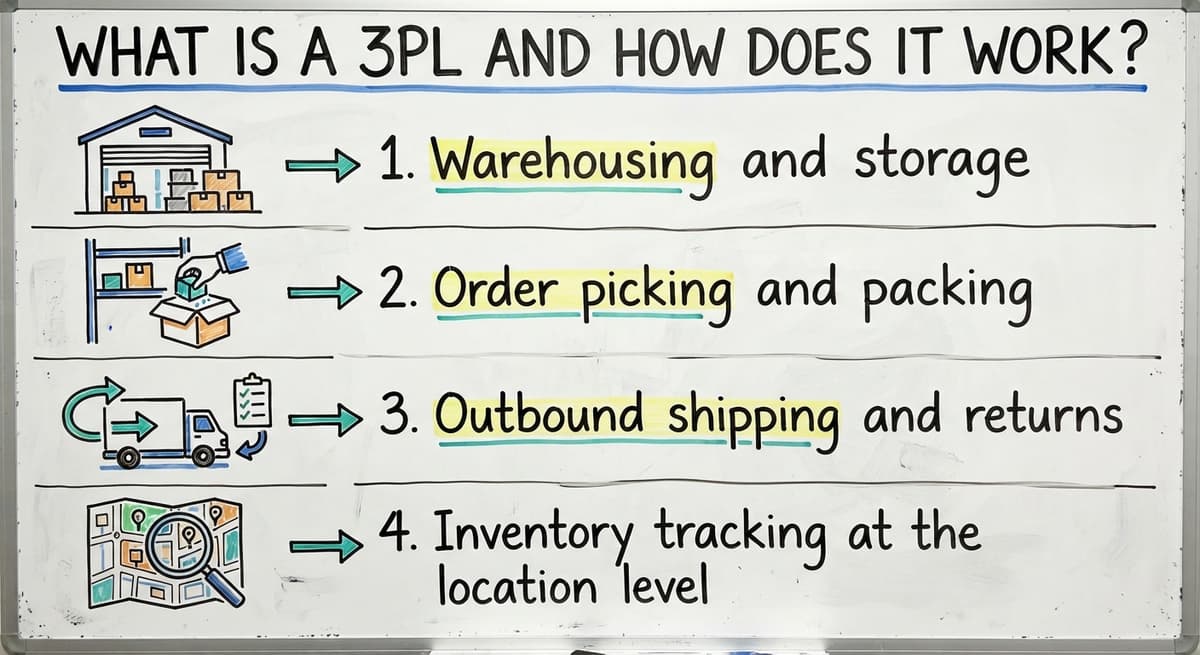
A 3PL, or third-party logistics provider, handles the physical work of storing and moving your products. That means warehousing, picking, packing, and shipping.
You still make the decisions. You manage the relationship. The 3PL just does the work.
Reviewed August 2026. Each figure comes from the assumptions stated beside it, so you can substitute your own and the arithmetic still holds.
This model is common for small to mid-size distributors and fulfilment centres.
Think of a local warehouse that stores your inventory and ships orders when customers buy. You stay in charge. They handle the floor.
- Warehousing and storage
- Order picking and packing
- Outbound shipping and returns
- Inventory tracking at the location level
For most wholesale distributors with one or two warehouse locations, a 3PL is the right fit.
Would you rather have it built around your operation?
The first look is free. If you would rather not compare products, describe how your operation already works and we build the system around it.
No build cost. You see it running on your own process first, and the monthly subscription starts only once it is live.
Book a callWhat Is a 4PL and When Does It Apply?
A 4PL, or fourth-party logistics provider, sits above the 3PLs. Instead of doing the physical work, a 4PL manages your entire supply chain on your behalf. They hire and oversee the 3PLs, coordinate across regions, and act as your single point of contact for all logistics decisions.
The IRS Publication 538 notes that "the method of accounting you use must be consistent from year to year," a principle that applies equally well to logistics strategy: once you hand off supply chain control to a 4PL, consistency and commitment to that structure become essential to making it work.
A 4PL arrangement is more hands-off for the business owner. That sounds appealing until you realize it also means less direct control. This model is common for large enterprises running multi-region supply chains with several warehouse partners at once.
If your team cannot manage several 3PL relationships at once and your logistics spend is large enough to justify a management fee, a 4PL might make sense. For most small businesses, it does not.

The Core Difference Between 3PL and 4PL
Here is the simplest way to say it: a 3PL executes your logistics. A 4PL manages the people who execute your logistics.
With a 3PL, you are the logistics director. With a 4PL, you hire someone else to be the logistics director. That is a big shift in how your operation runs.
- 3PL: You manage the relationship, they do the work
- 4PL: They manage everything, including other 3PLs
- 3PL: You are a client with a vendor
- 4PL: You are a client with a managed service
A useful analogy: the 3PL drives the truck. The 4PL plans the entire route network and decides which trucks to use.
The right choice depends on your team size, the complexity of your supply chain, and how much control you want to keep.
Cost Differences to Expect
Cost is one of the clearest ways to separate the two models.
A 3PL charges per unit, per pallet, or per shipment. The pricing is tied to volume, which makes it easier to predict and easier to scale.
When you ship more, you pay more. When volume drops, costs drop with it.
A 4PL adds a management layer on top of those costs. You pay for the 3PLs doing the work and for the 4PL overseeing them. That management fee is fixed or contract-based, regardless of your volume.
For operations with 5 to 100 staff, the overhead of a 4PL is hard to justify.
Smaller distributors almost always get better value from a direct 3PL arrangement. You keep more margin and you keep more control.

Control and Visibility in 3PL vs 4PL
Inventory visibility is where the two models feel most different day to day.
With a 3PL, you can see your inventory directly. You get real-time data on stock levels, orders, and shipments. Operations managers who need to know what is happening today prefer this setup.
With a 4PL, information passes through another layer before it reaches you. The 4PL summarizes what the 3PLs report.
By the time you see it, it has been filtered. Losing visibility is one of the most common complaints from businesses that switch to a 4PL.
If your team needs daily visibility into inventory and fulfilment, a 3PL is the better fit.
Is the comparison easier when one option is built for you?
Yes. Off-the-shelf means fitting your process to the software, and custom is the other way round. The first look costs nothing.
Book a callWhen Does a 3PL Make More Sense?
Most readers of this article should be using a 3PL. Here is how to know if that is you:
- You operate one or two warehouses with a manageable number of SKUs
- You want to stay close to fulfilment decisions
- Your team already tracks orders in QuickBooks or spreadsheets
- You need flexibility without long-term management contracts
- You are a wholesale distributor or small fulfilment centre
The 3PL model keeps you in the driver's seat. You choose your logistics provider. You set the standards. You see the results.

When Does a 4PL Make More Sense?
A 4PL is an enterprise-level decision. It makes sense when:
- You operate across many regions with multiple warehouse partners
- Your internal team cannot manage several 3PL relationships at once
- You are willing to trade direct control for operational convenience
- Your logistics spend is large enough to justify a management fee
This is not a small-business decision. If you are still running on QuickBooks and managing a team under 100 people, a 4PL is almost certainly more overhead than it is worth.
How Does Your Warehouse Management System Fit In?
Whether you use a 3PL or 4PL, your internal systems still need to connect to your logistics provider. That is where a 3PL warehouse management system overview becomes important to understand.
A warehouse management system connects your orders, inventory, and shipments in one place. It reduces the manual work of managing a 3PL relationship and gives you the visibility you need without chasing emails or spreadsheets.
For small distributors, custom warehouse software for small distributors can sit alongside QuickBooks instead of replacing it. That matters because most small operations have years of data and workflows built around QuickBooks. You should not have to start over.
QuickBooks integration for warehouse operations means your team keeps using the tools they know while gaining better inventory control and order tracking. Good software reduces errors and saves time without adding complexity.
Wholesale distribution software built around how you already work is worth far more than a generic platform that requires you to change your process to fit the tool.
Quick Comparison: 3PL vs 4PL at a Glance
| Factor | 3PL | 4PL |
|---|---|---|
| Who manages logistics | You | The 4PL provider |
| Cost level | Lower, volume-based | Higher, contract-based |
| Control level | High | Low |
| Inventory visibility | Direct, real-time | Filtered through provider |
| Best fit | Small to mid-size businesses | Large enterprises |
| Typical team size | 5 to 100 staff | 100-plus staff, multi-region |
For most small and mid-size distributors, the answer is clear: a 3PL gives you better value, better visibility, and more control.
A 4PL makes sense only when your supply chain is too complex for your internal team to manage.
If you are running a warehouse or distribution business and want to get more out of your 3PL relationship, the right software can make that partnership far easier to manage.
Start by looking at how your current systems connect to your logistics provider and where the gaps are costing you time.
Frequently asked questions
Frequently asked questions
What is 2PL, 3PL, 4PL, and 5PL?
The 4 terms describe levels of logistics outsourcing. A 2PL is a direct provider like a carrier or warehouse you hire yourself. A 3PL handles warehousing, picking, packing, and shipping on your behalf. A 4PL manages multiple 3PLs and oversees your entire supply chain.
A 5PL takes that further by integrating technology and data across the full logistics network, using advanced automation. Most small and mid-size businesses work with a 2PL or 3PL. The 4PL and 5PL models are enterprise-level arrangements.
Is Amazon a 3PL or 4PL?
Amazon operates as both, depending on the service. Amazon FBA (Fulfillment by Amazon) functions as a 3PL: it stores your inventory, picks, packs, and ships orders.
Amazon Logistics, which coordinates carriers and delivery networks, operates more like a 4PL in its own supply chain. For sellers using FBA, Amazon is acting as their third-party logistics provider.
What is an example of 4PL logistics?
A large retail brand selling across North America, Europe, and Asia might hire a 4PL to manage all of its regional warehouse partners, freight forwarders, and customs brokers. The 4PL becomes the single point of contact, coordinating every provider and reporting back to the brand's leadership team.
Accenture and DHL Supply Chain both offer 4PL services at an enterprise level. This model is not common for small or mid-size businesses because the management fee is difficult to justify at lower volumes.
Is UPS a 3PL or 4PL?
UPS operates primarily as a carrier, which makes it a 2PL in the traditional sense. However, UPS Supply Chain Solutions offers 3PL services including warehousing, fulfilment, and freight management.
UPS does not typically position itself as a 4PL, though it can coordinate multiple logistics functions for large clients. For most businesses, UPS is a carrier or a 3PL partner depending on which services you use.
Which is better for a small warehouse or distribution business, 3PL or 4PL?
A 3PL is almost always the better choice for small warehouses and distributors. It costs less, gives you direct visibility into your inventory, and keeps you in control of fulfilment decisions.
A 4PL adds a management layer that most small operations do not need and cannot easily justify on a cost basis. If your team is under 100 people and you operate one or two locations, stick with a 3PL.
Do I lose visibility over my inventory with a 4PL?
Yes, in most cases. With a 4PL, information passes through the provider before it reaches you. You see summaries rather than live data. This is one of the most common complaints from businesses that move to a 4PL model.
If daily inventory visibility matters to your operation, a 3PL gives you a more direct connection to your stock levels and order status.
How does a warehouse management system work with a 3PL partner?
A warehouse management system connects your orders, inventory, and shipment data in one place. When you work with a 3PL, the WMS acts as the link between your internal records and what is happening at the warehouse. It reduces manual data entry, gives you real-time stock visibility, and makes it easier to spot problems before they become customer issues.
For small distributors already using QuickBooks, a WMS that integrates with QuickBooks means you do not have to change your accounting workflow to get better logistics control.
When should a small business consider moving from 3PL to 4PL?
A small business should only consider a 4PL when it has outgrown its ability to manage multiple 3PL relationships internally. That means operating across several regions with different warehouse partners, a logistics spend large enough to cover a management fee, and an internal team that simply does not have the bandwidth to coordinate providers.
For most businesses under 100 staff, that point has not been reached. The move to a 4PL is an enterprise decision, not a growth milestone for small distributors.
When should a company switch from a 3PL to a 4PL?
When it runs 3 or more 3PLs, ships in more than one country, or spends a full-time role managing logistics vendors.
Below that, a 4PL adds a management fee of 5 to 15 percent for coordination you can still do yourself.
Can a 3PL also provide 4PL services?
Yes. Larger 3PLs sell a managed-logistics tier that coordinates other providers, carriers, and customs on the client's behalf. It is a 4PL in function, sold by a company that also owns warehouses.
What is the difference between a 3PL and a freight forwarder?
A freight forwarder moves goods between countries and handles the customs paperwork; it does not hold your stock.
A 3PL holds stock and fulfils orders. Many businesses use both, with the forwarder feeding the 3PL.
How much does a 3PL cost?
Storage at $10 to $40 per pallet a month, receiving at $5 to $15 per pallet, pick and pack at $2 to $4 per order plus $0.25 to $0.75 per extra item, and postage at the 3PL's negotiated rate.
A 1,000-order month with 50 pallets in storage lands at $4,000 to $8,000 before postage.
What is in a free first look?
A 30 minute call, your operation mapped, and a clear picture of what we would build. No obligation and nothing to install.
Book a callRelated guides
The rest of this guide, for the parts of the job this page does not cover.
Guides
- 3pl Software
- 3pl Companies
- Best 3pl Wms Software
- 3pl Warehouse Management System
- Product Fulfillment Center