

3pl Meaning
If you run a warehouse or distribution operation and someone mentions a 3PL, you need a clear answer fast. This article gives you that answer and walks through what it means for your day-to-day operations.
Published 24 August 2026. Reviewed and updated 15 September 2026.
Book a callWhat Does 3PL Mean?
3PL stands for third-party logistics. A 3PL is an outside company that handles storage, shipping, and order fulfillment on behalf of another business.
The "third party" sits between the seller and the end customer, taking on the physical work of moving and managing goods.
Reviewed August 2026. Each figure comes from the assumptions stated beside it, so you can substitute your own and the arithmetic still holds.
The arithmetic is worth doing before the software conversation. 3 people spending 6 hours a week between them chasing the same questions, at 22 dollars an hour, is 936 hours a year of paid time spent confirming what a system would already know. Over 3 years that is 2,808 hours.
That is the whole definition. No complicated framework required.
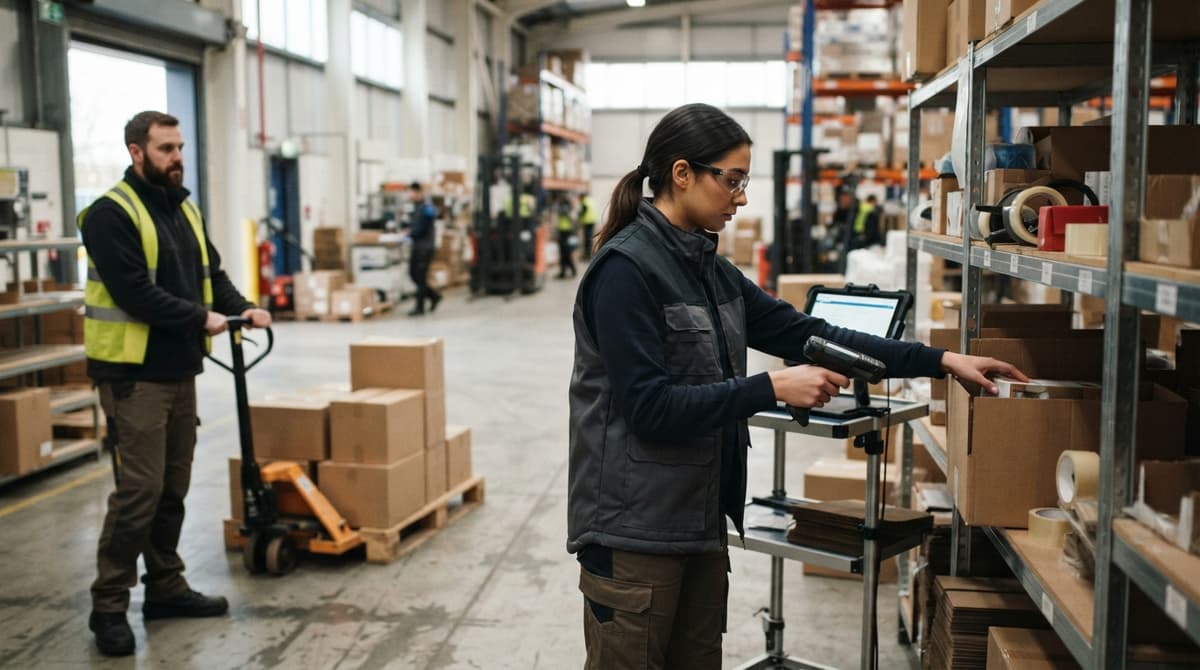
If you are an operations manager hearing this term for the first time, think of a 3PL as a hired logistics team that operates from its own facility using its own equipment.
Would you rather have it built around your operation?
The first look is free. If you would rather not compare products, describe how your operation already works and we build the system around it.
No build cost. You see it running on your own process first, and the monthly subscription starts only once it is live.
Book a callWhat Does a 3PL Actually Do?
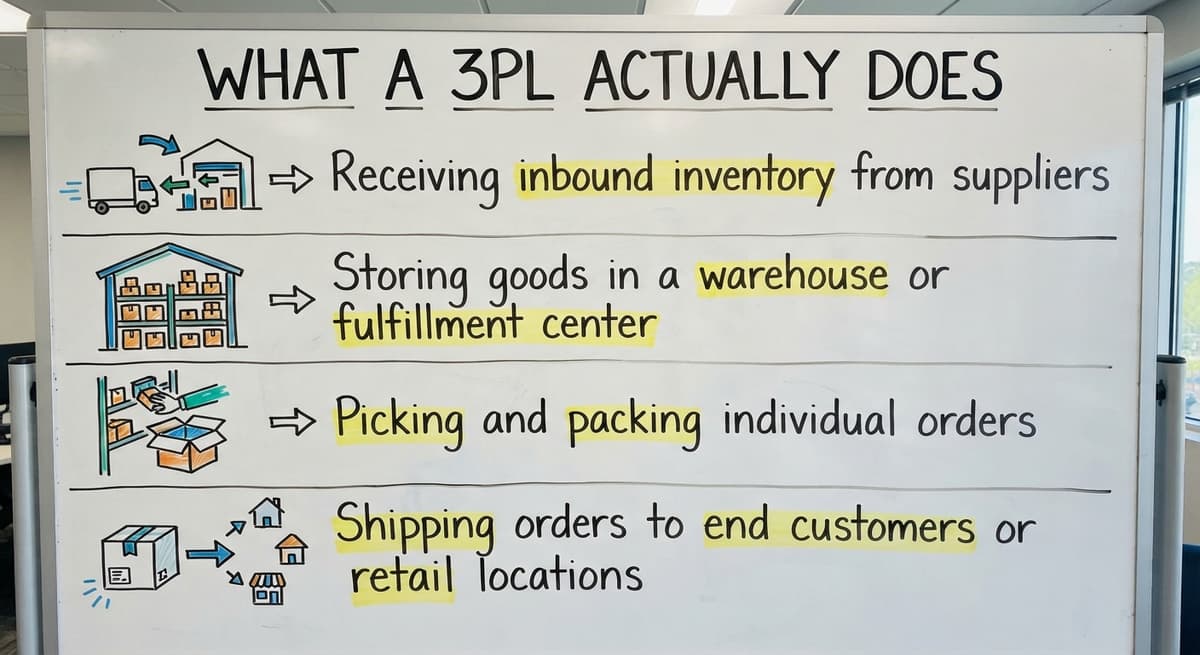
A 3PL provider handles the physical side of getting products from point A to point B. The core services are straightforward:
- Receiving inbound inventory from suppliers
- Storing goods in a warehouse or fulfillment center
- Picking and packing individual orders
- Shipping orders to end customers or retail locations
Many 3PLs also manage returns, apply labels, and coordinate freight across multiple carriers. That last part is where a 3PL separates itself from a standard freight carrier.
A freight carrier moves goods. A 3PL manages the full cycle around those goods.
Here is a simple example. A wholesale distributor sells cleaning supplies to regional grocery chains. Rather than leasing its own warehouse space, it sends inventory to a 3PL.
The 3PL receives the pallets, stores them, picks cases as orders come in, and ships them to each store. The distributor never touches the product after it leaves the manufacturer.
One note on accounting treatment: if your 3PL relationship involves prepaid expenses or inventory valuation questions, the IRS offers guidance on timing and methods in IRS Publication 538, which states that "under an accrual method of accounting, you report income in the year earned and deduct expenses in the year incurred."
What Is the Difference Between a 1PL, 2PL, and 3PL?
The simplest way to place yourself in the supply chain is to count the parties involved. Here is how the levels break down:
| Level | Who Handles Logistics | What They Do |
|---|---|---|
| 1PL | The business itself | Moves goods with its own trucks and staff |
| 2PL | A hired carrier | Transports goods, no warehousing |
| 3PL | An outside logistics partner | Adds warehousing, inventory management, and fulfillment on top of transport |
| 4PL | A supply chain manager | Oversees multiple 3PLs and the broader network |
Most small and mid-size distributors either operate as a 1PL or hire a 3PL. A 4PL arrangement is reserved for larger organizations managing complex, multi-region supply chains.
Who Uses a 3PL
Third-party logistics providers serve a wide range of businesses, but 4 profiles show up consistently:
- E-commerce sellers who need warehouse space without signing a long-term lease
- Wholesale distributors outsourcing part of their order fulfillment to reduce overhead
- Small and mid-size operations that cannot justify a full in-house logistics team
- Businesses with seasonal volume spikes that need flexible capacity without permanent staff
If your team runs between 5 and 100 people, a 3PL can give you the physical infrastructure of a much larger operation without the fixed cost. That flexibility is the main draw for lean teams.

Benefits of Using a 3PL
The most practical benefit is lower upfront cost. Owning a warehouse means paying for the building, racking, forklifts, and the people to run it. A 3PL spreads those costs across many clients.
Beyond cost, the advantages stack up quickly:
- Scale volume up or down without hiring or laying off warehouse staff
- Access shipping rates the 3PL has already negotiated through carrier volume
- Free your own team to focus on sales and customer relationships rather than logistics
- Tap into an existing logistics partner network without building it yourself
None of these benefits are guaranteed. They depend on choosing the right 3PL and setting up clear expectations from the start.
Is the comparison easier when one option is built for you?
Yes. Off-the-shelf means fitting your process to the software, and custom is the other way round. The first look costs nothing.
Book a callCommon Challenges When Working With a 3PL
Outsourcing fulfillment creates real problems that are worth knowing before you sign a contract.
Visibility is the biggest issue. When your inventory sits in someone else's building, you lose direct sight of it. Stock counts become a matter of trust until you have a system that confirms them.
Other common friction points:
- Order and inventory data lives in the 3PL's system, not yours, which creates reconciliation headaches at month end
- Communication delays when an order goes wrong, because you are one step removed from the warehouse floor
- Integration problems between the 3PL's software and your QuickBooks or spreadsheets
These are not reasons to avoid a 3PL. They are reasons to go in with a clear data plan.

How Does a 3PL Warehouse Management System Fit In?
A warehouse management system, or WMS, is the software that tracks inventory, orders, and movements inside a warehouse. A 3PL WMS is built to serve multiple clients from one platform, which is different from a single-company WMS.
For the business owner, this matters because your stock counts, order statuses, and receiving records all live inside that system.
If you cannot see that data in real time, you are making decisions on stale information.
A solid 3PL warehouse management system overview will show you how the platform connects the 3PL's warehouse operations to each client's order data.
When that connection works, you see inventory levels update as orders ship. When it breaks, you find out at the worst possible moment.
This is also where warehouse management software for small operations differs from enterprise tools.
Small operations do not need a system built for a 500-person logistics company. They need clean data flowing into the tools they already use.
When Should a Small Operation Think About 3PL Software?
There are 5 signs that point to a software problem before they point to a staffing problem:
- Orders tracked in spreadsheets that someone updates manually
- Inventory counts done by walking the floor rather than pulling a report
- QuickBooks showing numbers that do not match what the 3PL reports
When those three things are true at once, the operation has outgrown its current setup. A purpose-built connection between the 3PL's data and your existing QuickBooks can close that gap without a full ERP migration.
QuickBooks integration for distributors is a practical middle step that keeps your accounting intact while adding real-time inventory visibility.
Operations with 5 to 100 staff do not need enterprise software to get accurate stock counts.
Custom warehouse software vs off-the-shelf WMS is a real decision worth making carefully, but the threshold is lower than most vendors will tell you.
Fulfillment center software solutions built for smaller operations exist specifically because the enterprise tools are overkill for lean teams.
The goal is accurate data flowing to the right people, not a system that requires a dedicated IT team to maintain.
What Are the Key Takeaways on 3PL Meaning?
A 3PL is an outside company that handles warehousing, inventory management, and order fulfillment on your behalf. Understanding that definition is the first step to choosing the right logistics partner and the right tools to support that relationship.
The right software does not replace what already works. It connects your 3PL's operations to your existing QuickBooks and reporting environment so you have accurate numbers without rebuilding your entire process.
If your current setup leaves you guessing about stock levels or chasing the 3PL for order updates, that is a solvable problem.
The solution starts with knowing what a 3PL is and what data it should be giving you.
Frequently asked questions
Frequently asked questions
Is Amazon a 3PL or 4PL?
Amazon operates as both, depending on the service. Fulfillment by Amazon (FBA) is a 3PL service: Amazon stores your inventory, picks and packs orders, and ships them to customers.
Amazon's broader logistics network, which manages multiple carriers and fulfillment partners on behalf of sellers, behaves more like a 4PL. Most sellers using FBA are working with Amazon as a 3PL provider.
What does 3PL and 4PL mean?
3PL stands for third-party logistics. A 3PL provider handles warehousing, inventory management, and order fulfillment for another business.
A 4PL, or fourth-party logistics provider, goes one level up and manages the entire supply chain on a client's behalf, overseeing multiple 3PLs. Most small and mid-size operations work with a 3PL, not a 4PL.
Is DHL a 3PL?
Yes. DHL Supply Chain, one of DHL's business units, operates as a 3PL provider, offering warehousing, fulfillment, and inventory management services.
DHL's express parcel service is closer to a 2PL, meaning it transports goods without managing storage or fulfillment. The distinction depends on which DHL service you are using.
How does 3PL make money?
A 3PL charges on a combination of storage fees, per-order handling fees, and outbound shipping markups. Storage is billed by pallet or bin per month. Handling covers pick-and-pack labor per order.
Shipping is billed at a rate slightly above what the 3PL pays carriers, which is how they monetize their negotiated carrier relationships. Some 3PLs also charge setup fees or monthly minimums.
What is the difference between a 3PL and a regular shipping company?
A regular shipping company, or 2PL, moves goods from one place to another. A 3PL does that plus warehousing, inventory management, and order fulfillment.
The 3PL takes ownership of the full logistics cycle, not just the transport leg.
What problems come with using a 3PL?
The most common problems are visibility gaps, data reconciliation headaches, and integration failures. When your inventory sits in a 3PL's facility, you depend on their system for accurate counts.
If their software does not connect cleanly to your QuickBooks or spreadsheets, you end up with two sets of numbers that rarely agree.
What is a 3PL warehouse management system?
A 3PL warehouse management system, or 3PL WMS, is software built to manage inventory, orders, and warehouse movements for multiple clients from one platform. It tracks what comes in, what is stored, and what ships out.
For the business owner, it is the source of truth for stock counts and order status.
When does a small operation need to think about 3PL software?
When orders are tracked in spreadsheets, inventory counts are done by hand, and QuickBooks numbers do not match what the 3PL reports, the operation has outgrown its current setup.
A purpose-built integration between the 3PL's data and existing accounting tools can solve this without a full ERP migration.
How much does a 3PL cost?
Storage at $10 to $40 per pallet a month, receiving at $5 to $15 per pallet, pick and pack at $2 to $4 per order plus $0.25 to $0.75 per extra item, and postage at the 3PL's negotiated rate.
A 1,000-order month with 50 pallets stored runs $4,000 to $8,000 before postage.
What services does a 3PL provide?
Receiving, storage, order picking and packing, shipping through its carrier accounts, returns handling, and kitting or labelling on request. Some add freight forwarding and customs; the core is storage plus fulfilment.
How do I choose a 3PL provider?
Match on location near your customers, experience with your product type, a rate card you can model against your order profile, and a portal that shows live stock.
Then send a test batch of 50 orders before signing a term.
Is a 3PL suitable for a small business?
Yes, from about 200 orders a month, when packing at home or in the office costs more in hours than the 3PL's pick and pack fee.
Below that, the monthly minimums most 3PLs charge outweigh the time saved.
What is in a free first look?
A 30 minute call, your operation mapped, and a clear picture of what we would build. No obligation and nothing to install.
Book a callRelated guides
The rest of this guide, for the parts of the job this page does not cover.
Guides
- 3pl Software
- 3pl Companies
- Best 3pl Wms Software
- 3pl Warehouse Management System
- Fnsku Meaning
- Product Fulfillment Center