How Long Does Roofing SEO Take? A Month-by-Month Timeline
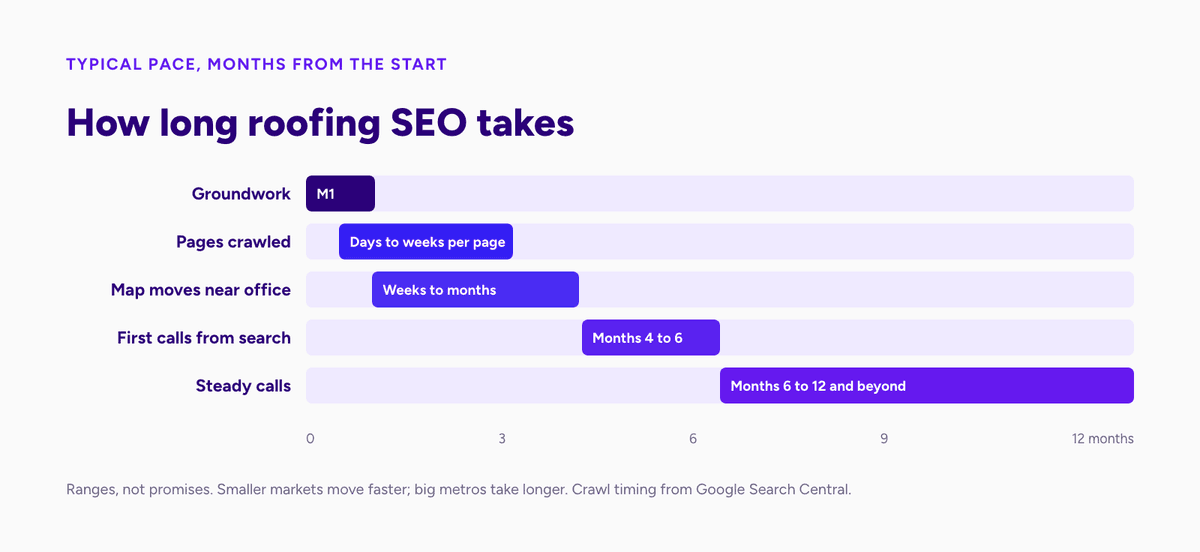
Roofing SEO takes 3 to 6 months to show clear movement and 6 to 12 months to bring steady calls. The first month goes to groundwork, new pages need weeks to be crawled, and the Map Pack moves as reviews build. Here is what happens in each stage, what speeds it up and what to watch while you wait.
Most roofers see early signs within 90 days and a steady flow of calls from search between month 6 and month 12. A roofer in a small market with few competitors often moves faster. A roofer in a big metro with dozens of established competitors takes longer.
Three clocks run at once:
Google's clock: new pages have to be found, crawled and trusted.
The review clock: the Map Pack rewards a steady stream of recent reviews, which only builds job by job.
The season clock: roofing demand spikes after storms, and pages that are live before a storm catch it.
You control the work. You do not control Google's pace, which is why honest timelines come as ranges.
Typical ranges for each stage, from groundwork in month one to steady calls after month six.
See your new homepage before you pay anything
Send us your site and the towns you cover. We rebuild your homepage free and show you where you rank on the map today.
Search engines need time to find a page, read it and decide how far to trust it. Google's guide to asking Google to recrawl says plainly: "Crawling can take anywhere from a few days to a few weeks." A page that has not been crawled cannot rank, so every new service or town page starts with that wait.
Crawling is only the first step. Once indexed, a page competes with roofers who have had their pages up for years, with links and reviews behind them. Trust builds through reviews, links from local sites and a profile that stays active, and none of that happens in a week.
What Happens in Month 1?
How long roofing SEO takes depends heavily on month one, which is groundwork. Nothing visible changes in the results yet, but everything after it depends on this month.
Fix the Google Business Profile
The profile is the base of every Map Pack result. Month one sets the right primary category, lists every service, sets the real service area and adds current job photos. Google's guidelines need your real business name, so no keywords go into it.
Set Up Call and Form Tracking
Tracking goes live before any new page does, so every later number has a baseline. Each call and form gets tagged by source: organic search, the map, ads or bots. Without that baseline, nobody can say in month six what changed.
Rebuild the Homepage
A slow or confusing homepage wastes every visit SEO earns later. We rebuild it first, free, and show it to you before anything is paid for. A fast page with a call button on every screen turns the traffic that comes later into calls.
Run the First Grid Scan
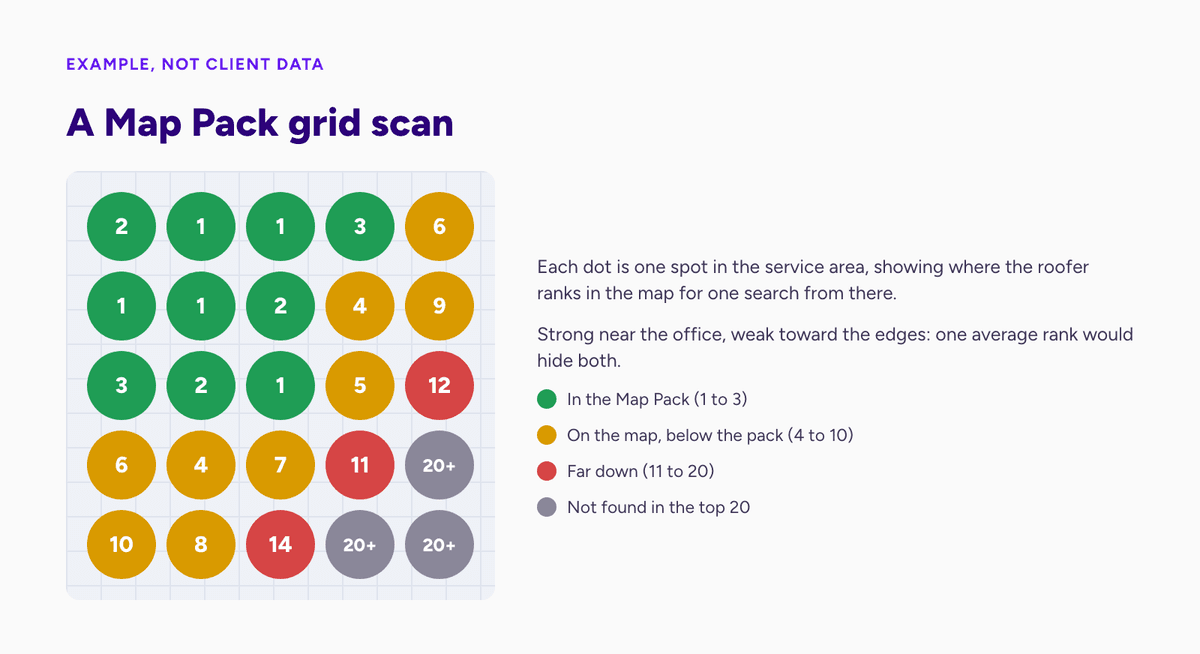
A Map Pack grid scan checks your map position from dozens of points across your service area. The first scan is the before picture. Months later, the same grid shows where you moved and where you did not.
What Happens in Months 2 and 3?
Roofing SEO takes its first visible step in months two and three, when pages go live and Google starts to notice.
Service pages publish first: roof repair, roof replacement, storm damage and any other job you sell.
Town pages follow, starting with the towns that send the best jobs.
Review requests go out after every job, with a link straight to the review box.
The profile gets weekly activity: photos, posts and answers to common questions.
The first signs show up in Google Search Console rather than your phone: pages indexed, impressions rising, a handful of clicks for long, specific searches like roof repair in a named town. On the map, grid points near your office start turning green first.
What Happens in Months 4 to 6?
For most roofers, this is how long roofing SEO takes to bring calls: months four to six, when early signs turn into leads. Service pages that were indexed in month two have had time to earn trust, and town pages begin ranking for their own searches.
Expect the first clear calls from search in this stretch, usually for specific searches rather than the biggest terms. A homeowner searching for hail damage repair in your town is more likely to find you by month five than one searching roofers near me in the city center.
Reviews matter most here. BrightLocal's 2026 Local Consumer Review Survey found 74% of consumers look for reviews from the last three months, so a roofer asking after every job keeps a recent stream that a dormant profile cannot match.
What Happens in Months 6 to 12?
Past month six, roofing SEO takes on a different shape, because results start to compound. Each new page links to the ones before it, reviews keep accumulating and the grid fills in town by town. This is when roofing SEO starts to feel like a channel rather than an experiment.
Work in this stage:
More town pages for towns where the grid is still weak.
Content that answers homeowner questions: repair or replace, what a new roof costs, what happens after hail.
Storm pages refreshed before the season.
Local links from suppliers, manufacturer directories and community sponsorships.
By month twelve, most roofers with steady work behind them have a clear picture of which towns and services bring jobs, and the plan shifts toward doing more of what works.
Find out where you show up on the map
We check your Google Maps position across your service area and walk you through it on a short call. Free, with no obligation.
Roofing SEO takes different amounts of time for different pages. The search it targets decides most of it.
Service Pages
Service pages for roof repair, roof replacement and storm damage target the most competitive searches in your area. They are the foundation, and they usually take the longest to reach the first page, often four to eight months in a busy market.
Town Pages
A town page targets a narrower search, such as roof repair in one suburb. Fewer roofers compete for each one, so a well-built town page in a smaller town can rank within two to four months. In practice, town pages bring the first search calls for many roofers.
Storm and Insurance Pages
Storm pages compete with fewer roofers most of the year, then demand jumps after hail. Built early, they have months to settle before the season. Built the week after a storm, they are still waiting to be crawled when the calls go elsewhere.
Answer Pages
Pages that answer homeowner questions, such as whether to repair or replace, target long, specific searches. They can rank quickly, bring fewer calls each, and help your service pages by linking to them.
How Long Before Reviews Make a Difference
Reviews build one job at a time, so their effect grows steadily rather than all at once. A roofer finishing ten jobs a month and asking after each one might add five or six reviews a month. Over six months that is thirty or more fresh reviews, enough to change how the profile compares with competitors who stopped asking.
BrightLocal's survey adds a second reason to keep going: 47% of consumers will not use a business with fewer than 20 reviews. A roofer below that line is losing calls the map already sent.
Never shortcut this by buying reviews. Google's page on managing reviews calls incentives for reviews "strictly prohibited," and the FTC's rule banning fake reviews lets it seek civil penalties.
Why Some Agencies Promise Faster Results
A promise of first-page rankings in 30 days usually means one of three shortcuts, and each one costs more than it saves:
Bought links from networks built to sell them, which Google's spam policies name as link spam.
Copied town pages, hundreds of them overnight, which the same policies call doorway abuse.
Ranking for searches nobody makes, then reporting those rankings as progress.
A quick jump built on any of these tends to fade, and recovering from a penalty takes far longer than doing the work properly.
Does AI Search Change the Timeline?
Not much. Homeowners now ask ChatGPT, Gemini, Perplexity and Google's AI Overviews for roofer recommendations, and those answers draw on the same signals: clear pages, named services and towns, and strong reviews. Google's guide to AI features in Search says the same practices apply.
What changes is measurement. We track visits from AI tools as their own channel, so you can see them grow alongside search and the map rather than hidden in direct traffic.
Roofing SEO Timeline at a Glance
Stage
Main work
What you should see
Month 1
Profile, tracking, homepage, first grid
A baseline, no change in calls yet
Months 2 to 3
Service pages, first town pages, reviews
Pages indexed, impressions rising
Months 4 to 6
More town pages, steady reviews
First calls from specific searches
Months 6 to 12
Content, links, storm pages
Steady calls, grid filling in
Year 2
More towns and services
Growth from compounding pages
Talk to the person who would do the work
The person you talk to is the person doing the work. Bring your questions, your towns and the jobs you want more of.
How long roofing SEO takes in your market comes down to the same work moving at different speeds. Five things decide most of the difference.
What Speeds It Up
A smaller market: fewer roofers to pass, so pages rank sooner.
An existing site with some history: an older domain with a few links starts ahead of a brand-new one.
Steady reviews: a roofer who asks after every job builds the popularity signal faster.
Real local detail: town pages with actual jobs and photos earn trust faster than thin ones.
Fast changes: on our platform, an edit goes live in minutes, so fixes do not wait in a queue.
What Slows It Down
A big metro with established competitors and years of reviews.
A brand-new domain with no links and no history.
Copied town pages, which Google treats as one page or ignores.
A neglected profile with old photos and unanswered reviews.
Stop and start work, where months of pages are followed by months of nothing.
Does the Number of Towns Change the Timeline?
Yes. More towns mean more pages to build and more of the map to win. A roofer covering three towns can have every town page live in the first two months. A roofer covering 30 towns builds in batches, starting with the towns that send the best jobs, and the far towns take longer.
We work with a roofing and exteriors company in central Ohio that covers 17 towns. The monthly grid decides which town pages get built or improved next, so effort goes where the map is weakest rather than in alphabetical order.
Map Pack Progress vs. Website Progress
The two move at different speeds, and they are worth tracking separately.
The Map Pack
The Map Pack responds to your profile, reviews and distance from the searcher. Google's ranking page names them: "Local results are mainly based on relevance, distance, and popularity." A complete profile and steady reviews can move map positions near your office within weeks. Towns farther away move more slowly, because distance works against you there.
Organic Results
Organic results respond to your pages. New pages wait to be crawled, then climb as they earn trust and links. Organic progress tends to start later than map progress and keeps building longer, since every page you add stays at work.
Why One Search Can Mislead You
Searching your own business from your office shows a flattering picture, because you are standing next to your own address. A homeowner ten miles away sees something else. The grid scan is how you see what they see.
An example grid, not client data: the map moves near the office first, then the ring widens.
What Should You Track While You Wait?
The early months are easier to judge when you know which numbers move first:
Pages indexed in Google Search Console.
Impressions: how often your pages appear in results, even before clicks.
Map grid points turning from red to green.
Reviews per month and how recent the latest one is.
Calls and forms by source, with spam filtered out.
Impressions and grid points move before calls do. If none of them has moved by month four, the plan needs a hard look.
Find out where you show up on the map
We check your Google Maps position across your service area and walk you through it on a short call. Free, with no obligation.
SEO is slow by nature, so many roofers run something faster alongside it for the first months.
Google Ads bring calls the same day. Google Ads data from DataForSEO's keyword planner puts roof repair clicks at about $40 each and roof replacement at about $31, so budget carefully.
Local Services Ads charge per lead and sit at the top of the page.
Referrals still close best, and a good website makes them hold.
Call tracking shows which source each lead came from, so you can taper ads as search calls grow.
Storm Season and Timing
Timing matters more in roofing than in most trades, because demand arrives in bursts. The Insurance Information Institute's hail facts count 5,432 major hail events in the US in 2025. Since pages take weeks to be crawled, storm damage and insurance claim pages need to be live months before the season. Starting SEO in the slow months means pages are ready when the phones should be busiest.
Signs Your Roofing SEO Is Working
Real progress shows up in a predictable order:
New pages appear as indexed within weeks of going live.
Impressions climb before clicks do.
Grid points near your office turn green, then the ring widens.
Searches for specific services in specific towns start bringing calls.
Calls from search rise month over month, and some become signed jobs.
Signs It Is Not Working
Some patterns mean the work is not being done, or not done well:
No new pages in your Search Console after two months.
Reports with only rankings and traffic, never calls.
Town pages that read the same except for the city name.
A grid that has not changed in four months.
A promise of a number one spot by a date. Google's guide to hiring an SEO is blunt about that one: "If they guarantee you that their changes will give you first place in search results, find someone else."
What Results Can Look Like
Results depend on the market, so treat any figure as an example. Our best past SEO campaign grew organic traffic 26x in 14 months, and another grew it 15x. Neither was a roofer, and both were steady month-after-month work rather than a burst. Google itself suggests asking any SEO: "What kind of results do you expect to see, and in what timeframe?" A good provider answers with ranges and the reasons behind them.
Start the Clock Now
The fastest way to shorten the timeline is to start before you need the calls. Every plan we run starts with the website, so we rebuild your homepage free and show it to you before you pay anything. From there, month one can start right away. Read the roofing SEO guide for how the full system works, or what roofing SEO costs for how plans are scoped.
Frequently asked questions
Can roofing SEO work in 30 days?
Not fully. The first month goes to the Business Profile, tracking, the homepage and the first grid scan. Some map movement near your office can start within weeks of fixing the profile, but pages need time to be crawled and trusted before they bring calls.
Why is my competitor ranking when I just started?
They likely have years of pages, reviews and links behind them. That history is what new work competes against. Steady pages and reviews close the gap over months, starting with the towns and services where competition is thinnest.
Does roofing SEO stop working if I pause it?
Pages that already rank keep working for a while, which is the advantage over ads. But competitors keep adding pages and reviews, so a long pause usually means slow slipping, especially on the map, where recent reviews and activity count.
Is it faster to start with a new website?
Not always. An older domain with some history often ranks faster than a brand-new one. What matters more is that the site is fast, works on a phone and has a page for each service and town. We rebuild the homepage on your existing domain where we can.
When should a roofer start SEO in the year?
In the slow months before storm season. Pages take weeks to be crawled and months to earn trust, so starting in late fall or winter means service and storm pages are ready when spring and summer demand arrives.
Start with a free homepage rebuild
Your homepage rebuilt, your map position checked and a clear plan for your market. Nothing to pay until you decide.