

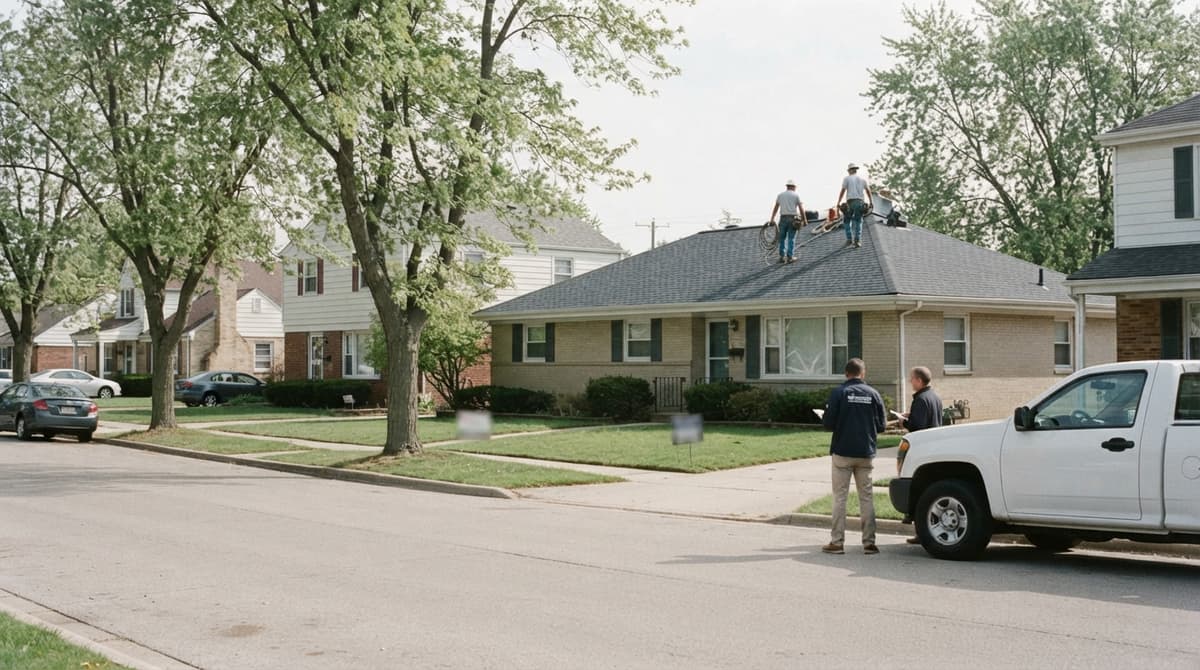
How to Get More Roofing Reviews (Without Breaking the Rules)
The way to get more roofing reviews is to ask every happy customer right after the job. Text the link before sunset, make the request face to face at the walk-through and reply to every review that comes in. Then do it all again on the next roof job.
Roofing is a trust buy. A new roof can outprice a car, and the homeowner hires a crew they have never met to climb onto the biggest asset they own.
Stars and written comments on Google are the first proof that stranger sees. A roofer with 12 old reviews loses that comparison to a rival with 80 recent ones, even when the work is equal.
The good news: most customers write a review when asked. Asking is the step most crews skip. A crew that asks every time can pass a lazy rival within a single season.
The work is small. The habit is the hard part.
Book a callWhy Reviews Matter
Reviews matter for roofing. The job is large, costly and hard to judge in advance. Homeowners read what neighbors say before they call. They want proof that a crew shows up, does clean work and leaves the yard tidy. Reviews work alongside the website and the profile in roofing SEO.
The research backs this up. BrightLocal's 2026 Local Consumer Review Survey reports these figures:
- 97% of consumers read reviews when they look at local businesses of any kind, per BrightLocal.
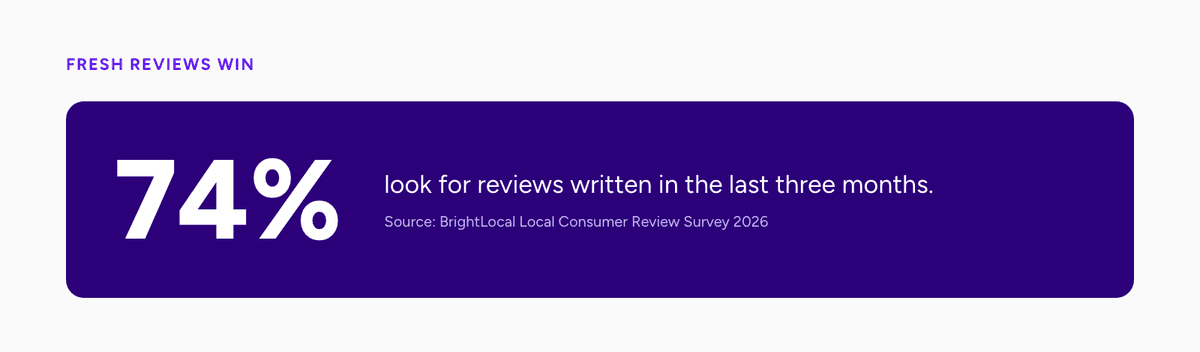
- 74% only care about reviews from the last three months, so an old pile counts for little (BrightLocal).
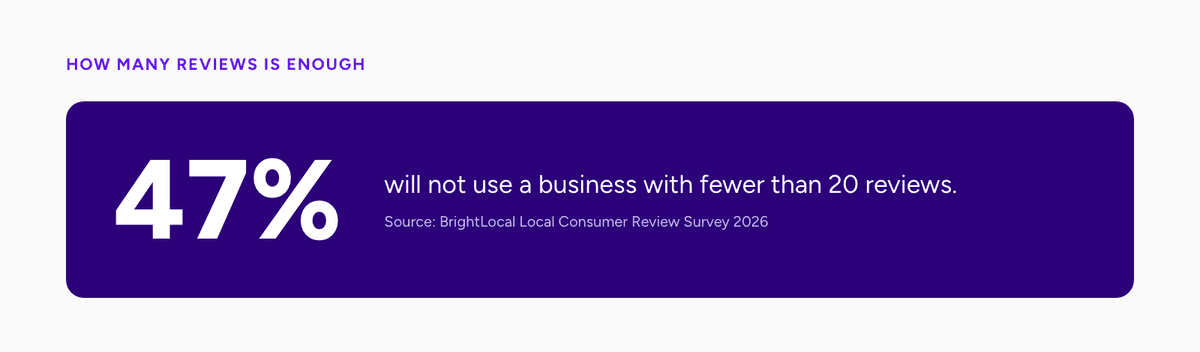
- 47% will not use a business with fewer than 20 reviews, a line many small roofers sit below (source).
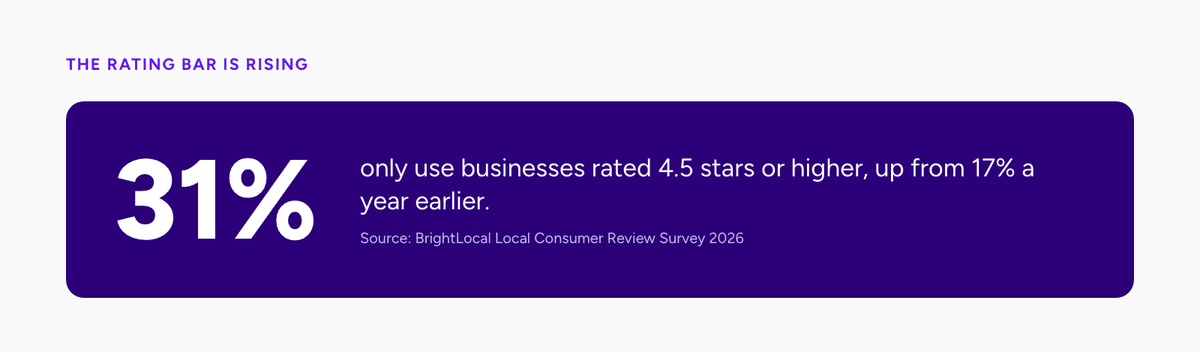
- 31% will only use a business rated 4.5 stars or higher, according to the same survey.
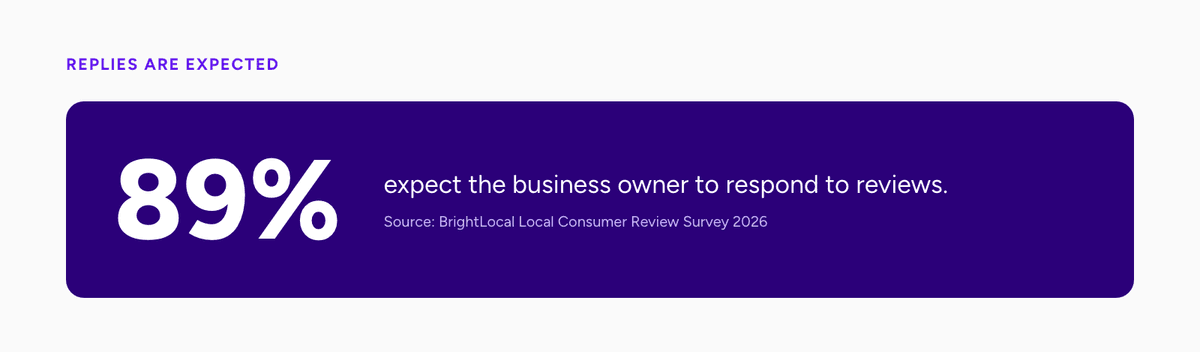
- 89% expect owners to respond to the reviews customers leave, the survey found.
What Does the Map Reward?
Reviews feed the map too. Whitespark's 2026 Local Search Ranking Factors report ranks high Google ratings 6th and the quantity of Google reviews with text 9th among 187 factors for the local pack. Moz's guide to local ranking factors also treats review signals as their own group.
No review count guarantees a ranking or a number of jobs. A profile full of fresh, honest comments still gives a stranger a reason to call. Roofing reviews are proof that helps a homeowner choose your crew.
See your new homepage before you pay anything
Send us your roofing website. Tell us the towns you cover. The homepage rebuild is free. You see it before you pay anything. We also check where you rank on the map today. You get that report town by town. Every next step starts from your own numbers. The preview needs no contract.
Book a call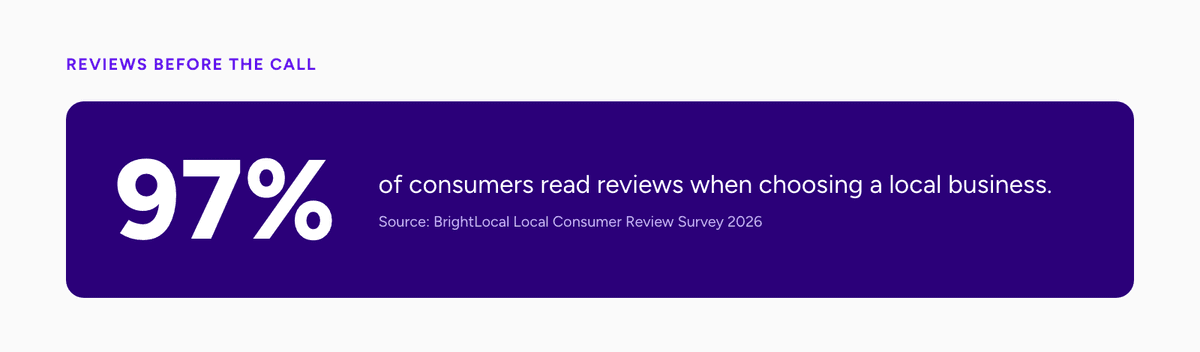
A Good Review
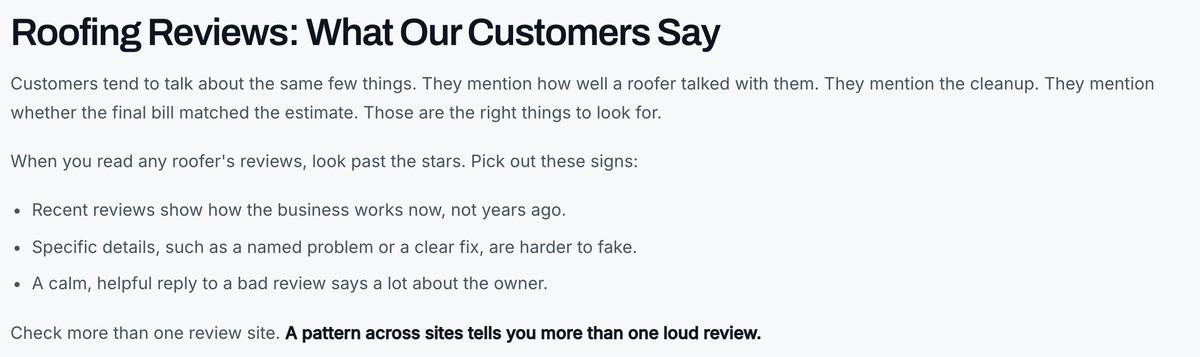
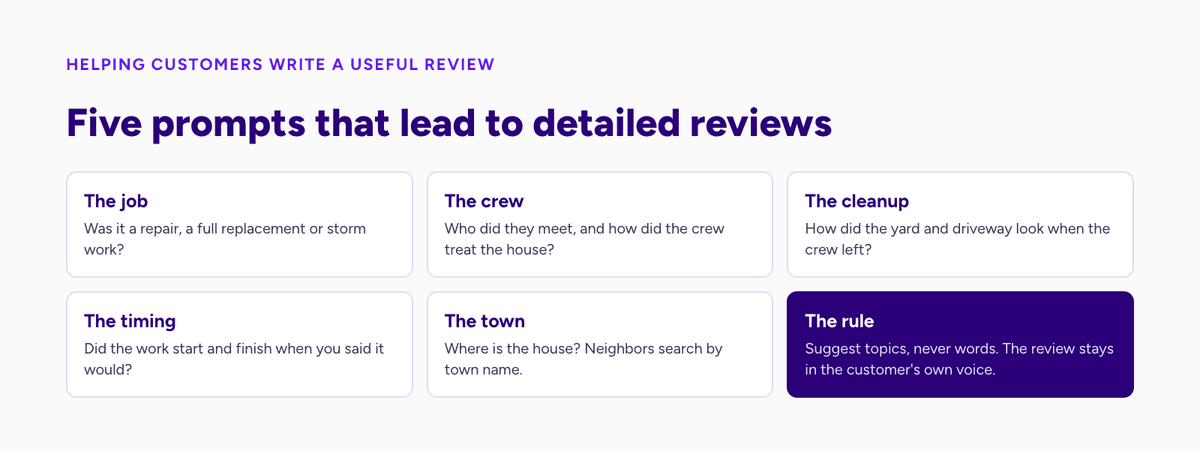
A useful roofing review is a star rating plus specific words about the job. The words carry the weight. Stars alone tell a buyer very little. Detailed reviews turn visits into roofing leads.
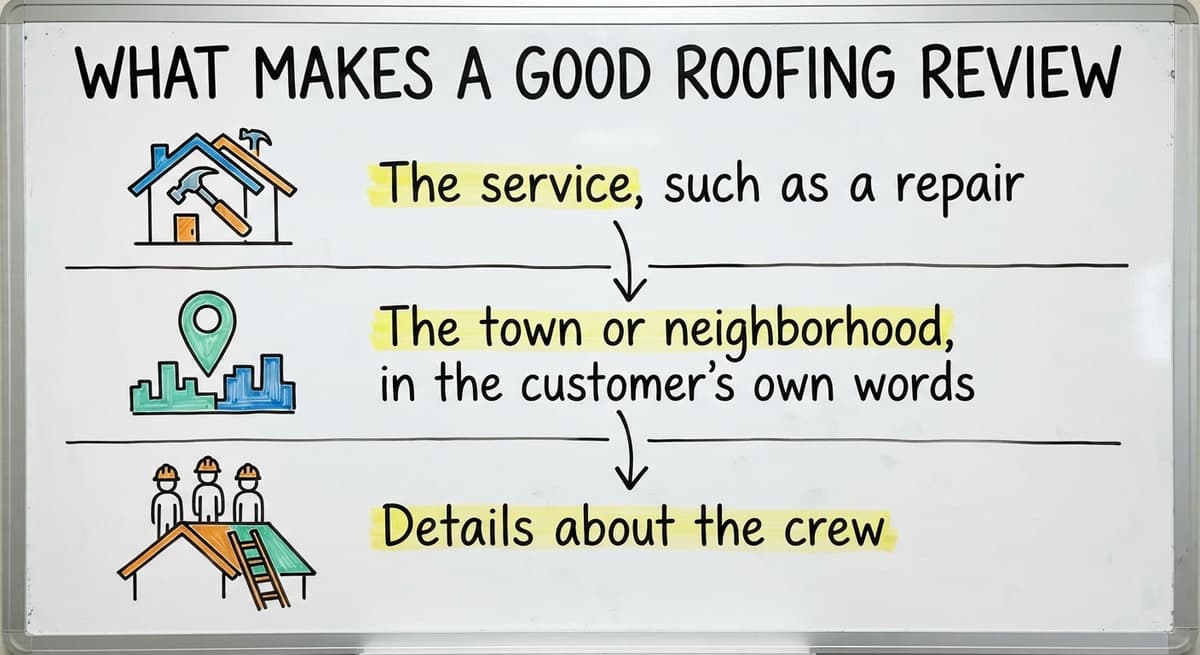
The strongest reviews mention 3 things:
- The service, such as a leak repair, a full tear-off and replacement, or storm damage work.
- The town or neighborhood, written in the customer's own words without any prompting.
- The crew itself: punctuality, the cleanup and how well the office kept the homeowner informed.
Never write a review for a customer, and never hand anyone a script. Google's policy on prohibited content bans fake and misleading reviews, and the FTC's questions and answers on its review rule explains what the federal rule covers. A roofing review only helps when the customer wrote every word.
Setup
There are 2 steps before the first request. The Business Profile has to be correct, and the link has to open cleanly on a cell.
Is the Profile Ready?
A profile is ready once the owner has claimed it, verified it and checked every field. Reviews land on the listing you own, so verify the business on Google first. Then check the name, phone number, services and service area.
Match those details to the website. A mismatch makes a buyer doubt the listing. A full Google Business Profile also follows Google's profile policies. Roofing reviews only help when people can find and trust the listing.
Where Is the Review Link?
The link sits inside the profile itself. Google's help article on links and QR codes gives 3 steps:
- Open the profile, select Read reviews and then Get more reviews.
- Copy the link, or download the QR code from a computer browser.
- Test it on a cell and confirm Google's form appears.
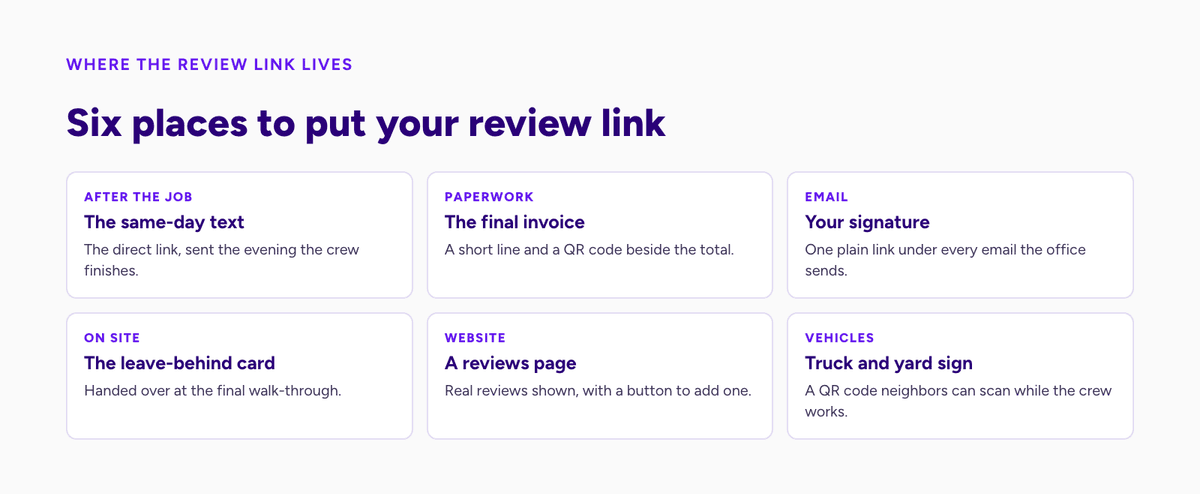
Google suggests putting it on receipts, in thank-you emails and at the end of chats. Each link points to one Place ID, the unique code Google's developer docs assign to every listing.
Save it in your phone, your email signature and your invoice template. One tap to the review form means more customers finish the job of writing.
Timing
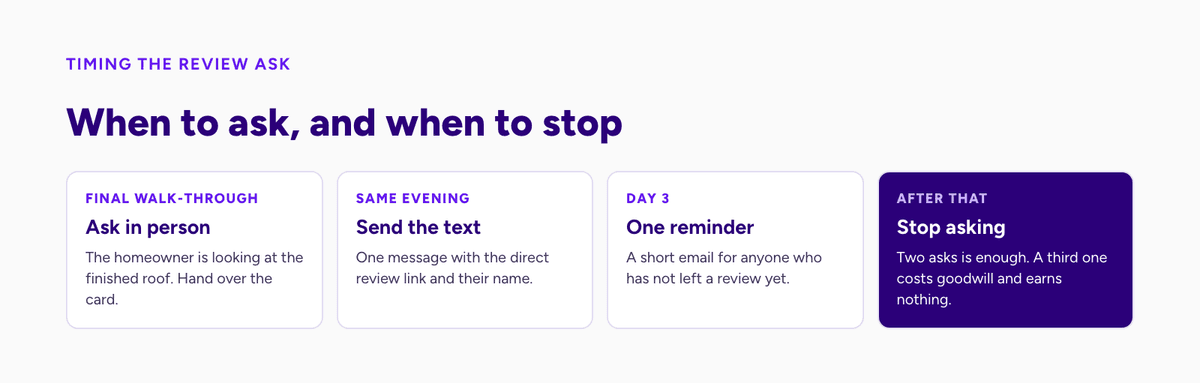
The best moment to ask is right after the crew finishes and the homeowner is happy. Use the final walk-through, or the minute cleanup ends. The customer is standing in front of a new roof and feels good about it.
Do not wait 3 weeks. Memory fades. Goodwill fades too. Whitespark's 2026 report ranks review recency 11th for the map.
Pick one fixed moment so the crew always knows when to ask. Google's tips favor a prompt request. Treat it as part of the job, like the magnet sweep for stray nails.
Who Should Ask?
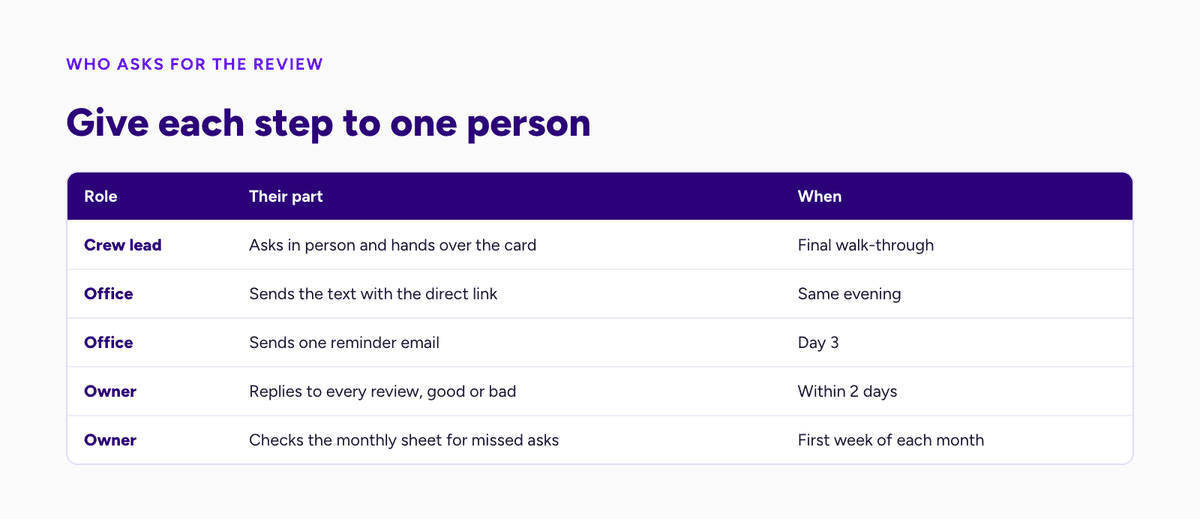
The best person to ask is someone the homeowner already knows. A crew lead can ask in person, and the office can follow up by text or email.
Give one named person the job so no customer slips through. Skip staff quotas. Google's content policy prohibits them. Keep every request short and kind. When nobody owns the ask, nobody makes it.
Asking Well
Several channels beat one, and Google's tips page suggests links, QR codes and replies together. Some people like a face-to-face request, others only answer texts, and a few still prefer paper.
BrightLocal found that 83% of people asked to leave a review went on to write one, and 28% say they always write one when asked, per its 2026 survey.
What Should a Roofer Say?
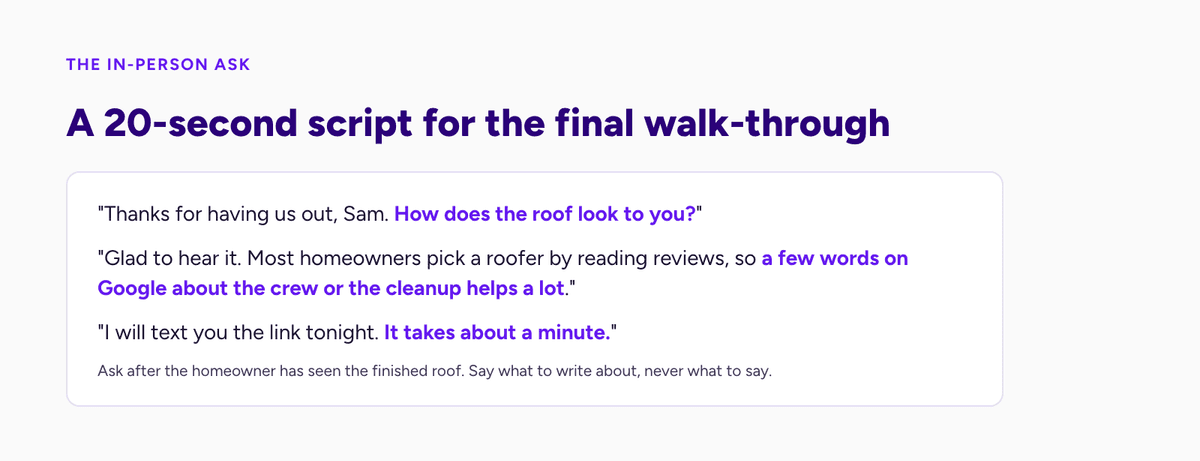
The in-person request works best when it is brief. Thank the homeowner, explain that reviews help a small company, then ask.
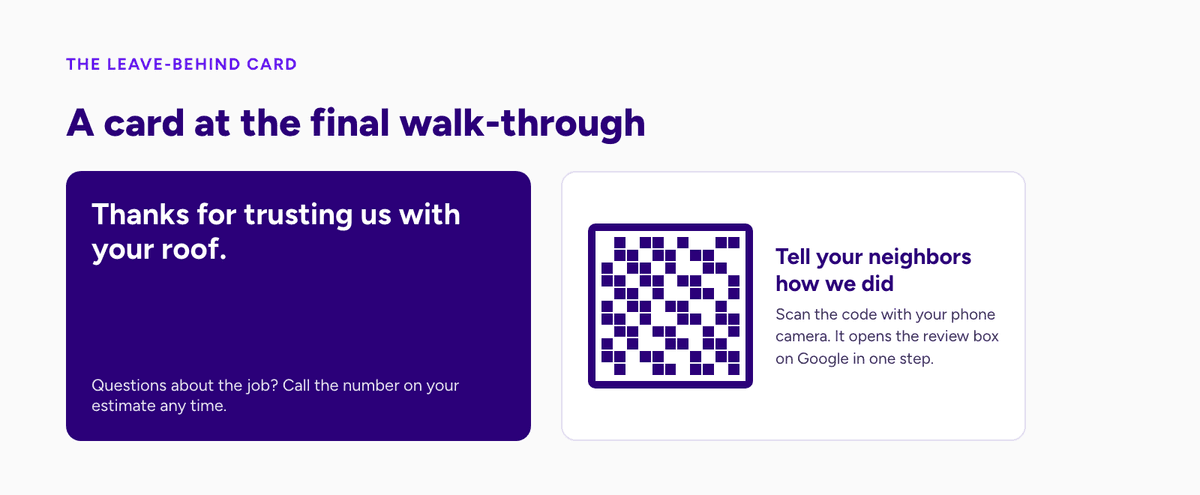
A simple version: "Thanks for trusting us with your roof. Reviews help a small company like ours. Would you share how it went?"
Hold up the QR code and offer to text it for later. Never pressure anyone. A kind, short request gets a better answer than a pushy one.
Find out where you show up on the map
We check your roofing company on Google Maps. The check runs point by point on a grid. It covers your whole service area. Then we walk you through it on a short call. You see the towns that already find you. You also see the towns that call a competitor. The check is free, with no obligation.
Book a callHow Do Texts Work?
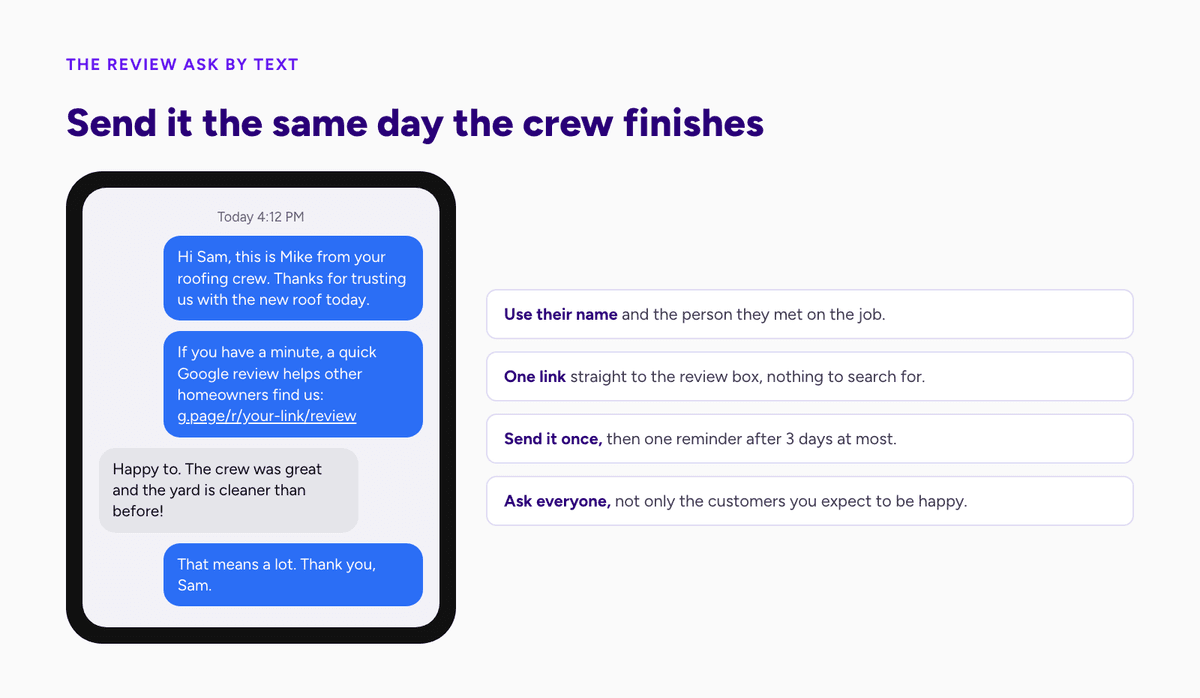
Texts are quick. Most people read them within minutes. Use the customer's first name, add the direct link and send it before the crew leaves town.
A sample text: "Hi Dana, thanks for choosing us for the new roof. If you have a minute, would you leave a quick review? Here is the link."
Send 1 gentle reminder if nothing comes back after 3 days. Stop there. Two texts is the limit for any customer.
When Does Email Fit?
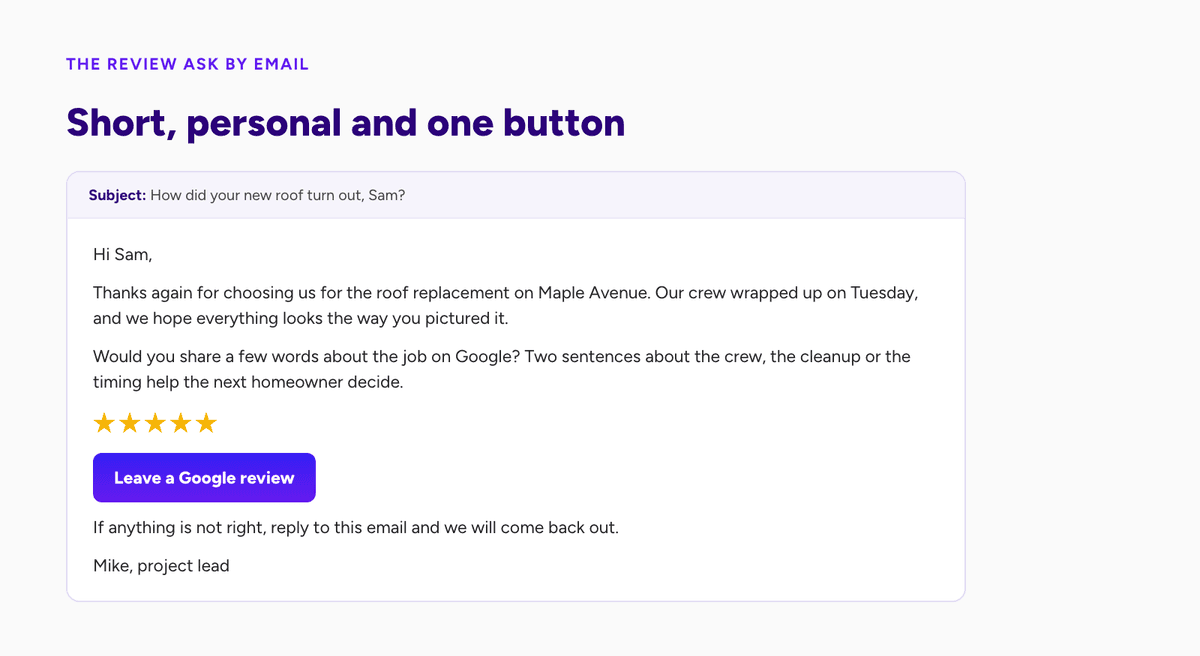
Email is the backup for customers who never text, and Google lists thank-you emails as a good place for the link. Use a clear subject line, such as "How did we do on your new roof?", thank the homeowner and add a single button.
Put the same link in the closing paperwork too. Email reaches the customers a text would miss.
Do Printed Cards Help?
A QR code is a square image a phone camera can read. Print one on a leave-behind card or yard sign, pointed at the link from Google's QR code page, and reviews arrive from people who never open a text.
Hand cards out at the final walk-through. Google's QR instructions explain the download. Older customers who like paper respond well to them. Scan the code before ordering 500 cards. A printed card is only as good as the code on it.
Your Website
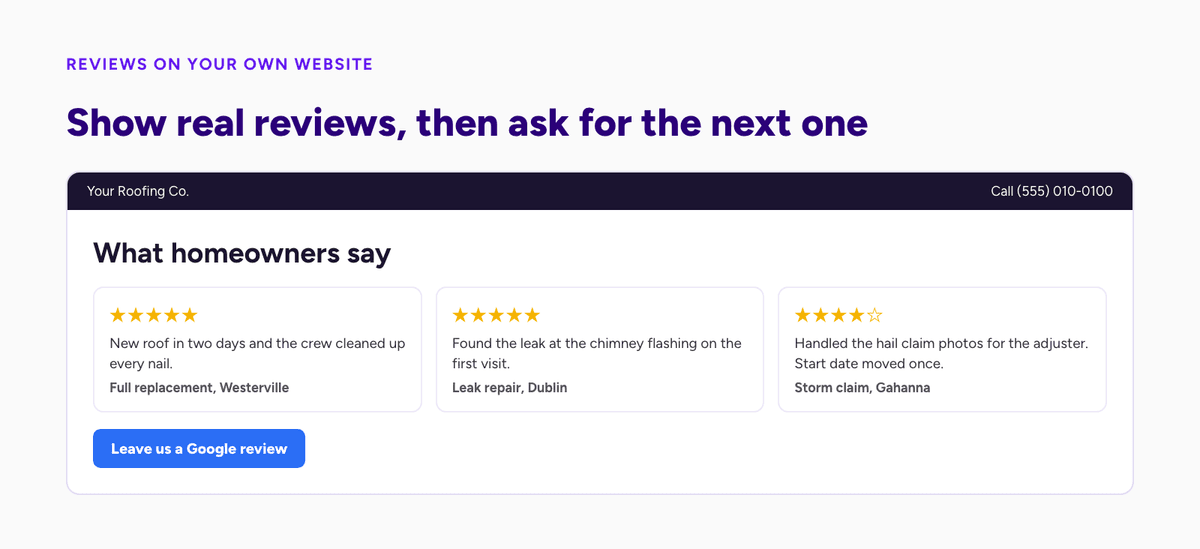
The company website is a second place to request reviews and show them. A thank-you page or footer button can point to Google's form. That link catches people who visit after the job, a use Google's review tips encourage. See roofing website design for layout.
Show real reviews on each service page and local landing page. Visitors then see proof right where they decide. Our platform pushes changes live in minutes, so a new review can appear the same day it arrives.
Never invent or edit a customer's words. Post them as written. Real comments next to a service list beat any claim a company writes about itself.
A Simple System
Steady habits produce roofing reviews every month. The 5 steps never change: Reviews feed every channel in how to get roofing leads.
- Finish the job and walk the property with the homeowner.
- Make the request with the crew still on site.
- Text or email the link within hours.
- Send 1 reminder after 3 days if no review has arrived.
- Reply within 2 days of it going live.
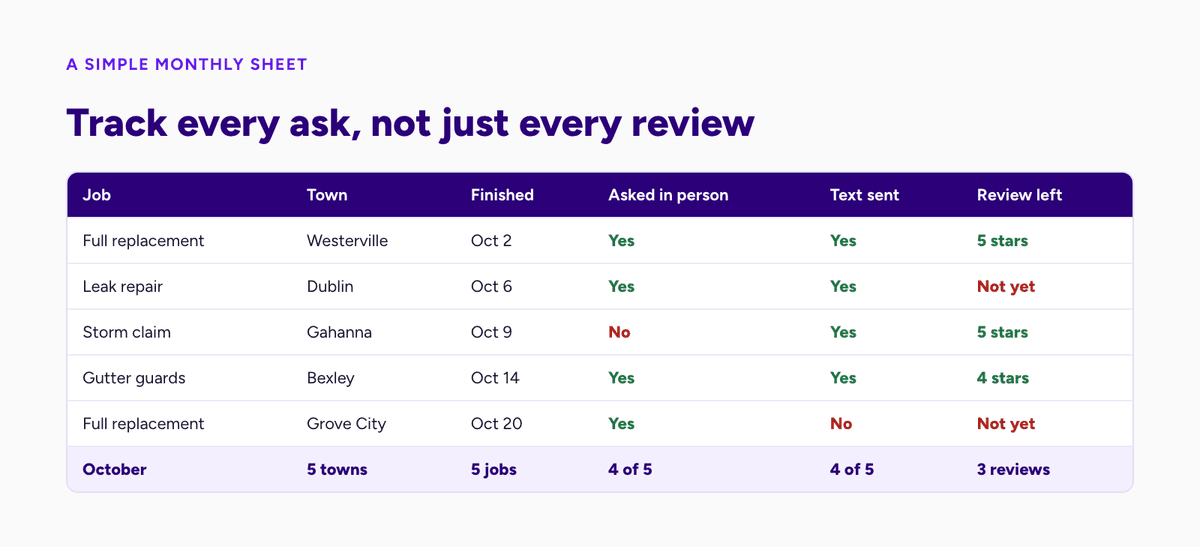
Keep a sheet of finished jobs and the customers you asked. Check it every week and close the gaps.
Here is math anyone can check. Say a crew finishes 20 jobs a month and 3 in 10 customers leave a review. That adds 6 reviews a month, or 72 a year. Small, steady requests beat one big push.

Replying
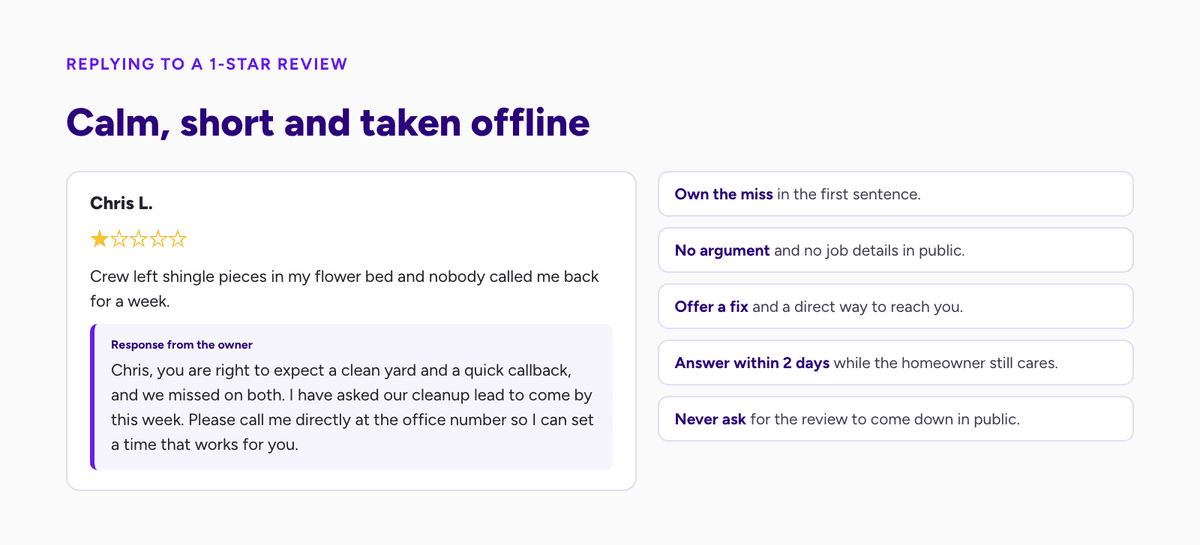
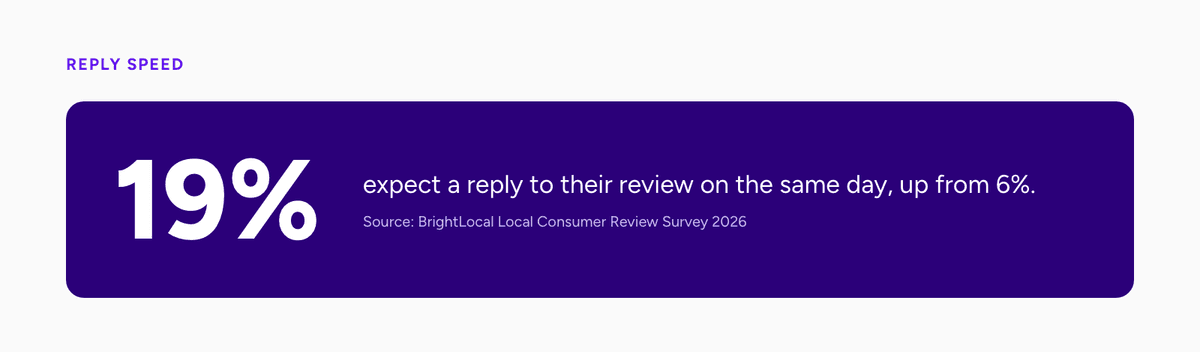
Every review deserves an answer. BrightLocal's survey puts the share expecting one at 89%. Google's page on managing customer reviews shows how owners reply from the profile, and its tips for getting more reviews advise short, personal, prompt replies.
Google says replies matter. "When you reply to customer reviews, it shows that you value their feedback." (Google Business Profile Help) Answering every review pays: 80% favor an owner who does (BrightLocal 2026). Silence costs more, with 42% unlikely to hire an owner who never replies.
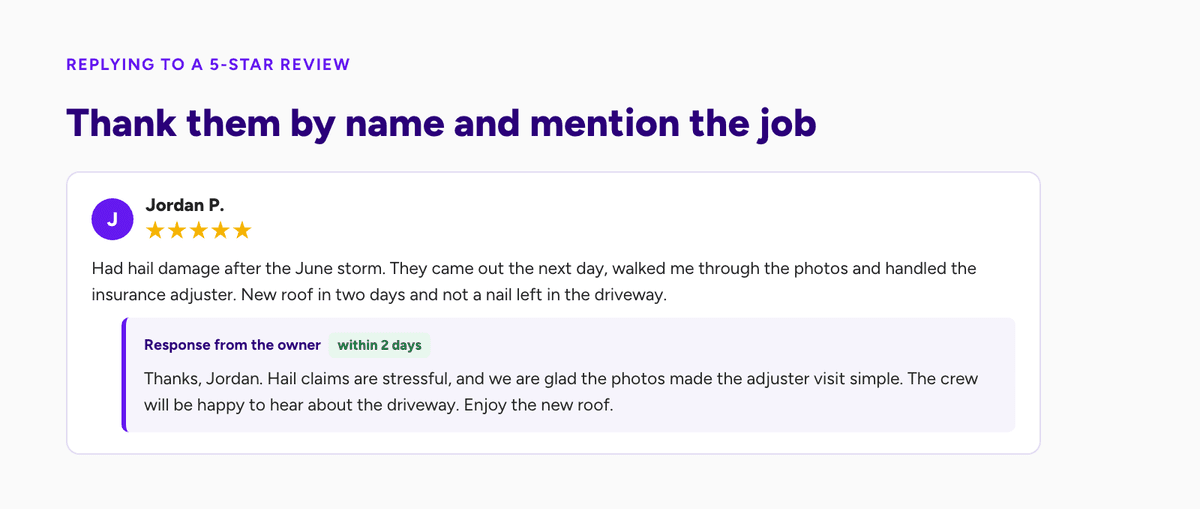
Thank people by name and mention the work, such as the new shingles or the quick leak fix. Stay friendly and leave private job details out.
Talk to the person who would do the work
The person you talk to is the person doing the work. Bring your questions. Bring the towns you serve. Name the roofing jobs you want more of: repairs, replacements or storm work. You leave with a clear read on your website. You also get notes on your Business Profile and the first fixes to make.
Book a callWhat About a Bad Review?
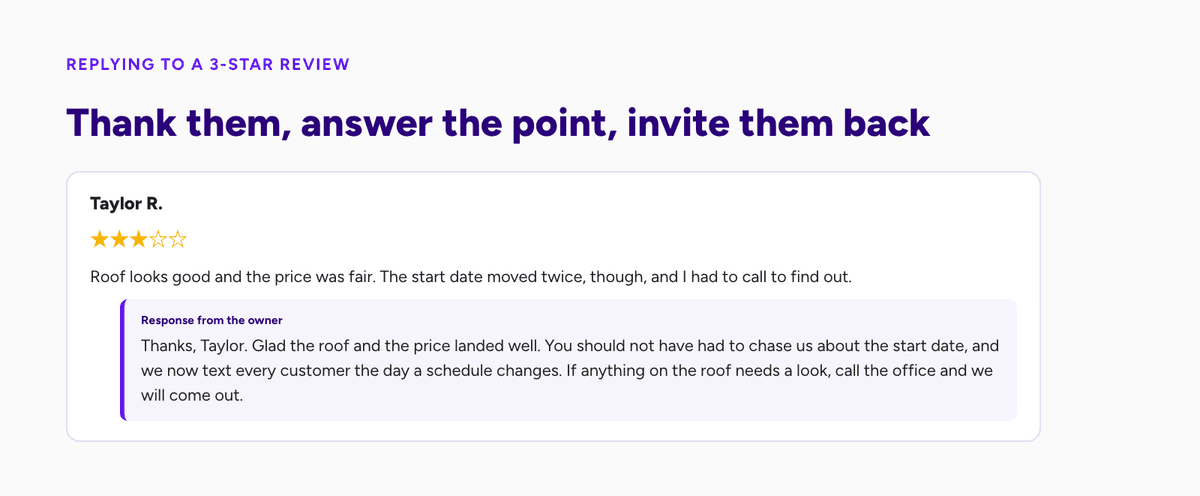
A bad review is a test of tone: stay calm and never argue in public. Apologize where it fits, state the facts in a line or two and offer a phone number to sort it out.
Fix the problem if you can. Some customers update their rating afterward, and the FTC confirms its rule "does not prohibit simply asking satisfied customers to update their reviews." Future customers judge a roofer by the reply, not by the one bad review.
What If the Review Is Fake?
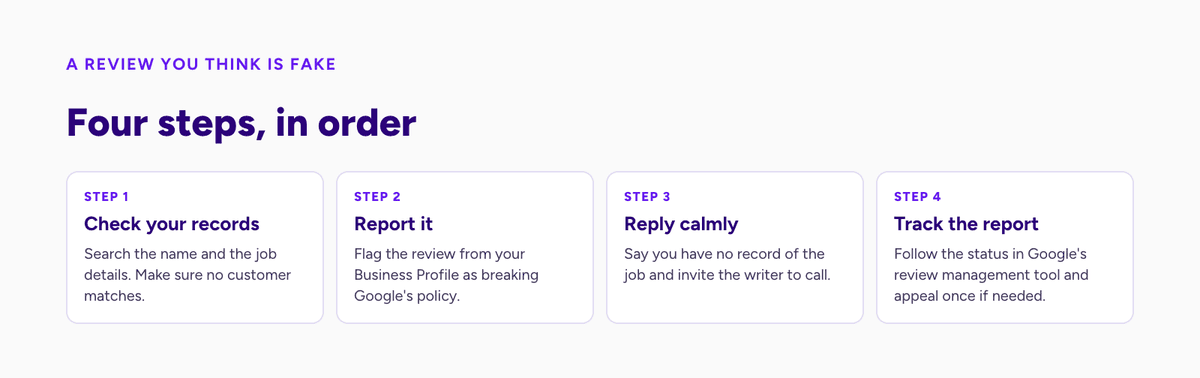
Owners can report a review from someone who was never a customer. Google's reporting instructions walks through it: open Read reviews, select Report and pick a reason. Google says evaluation takes several days, and the owner gets one appeal if Google rejects the report.
The Rules
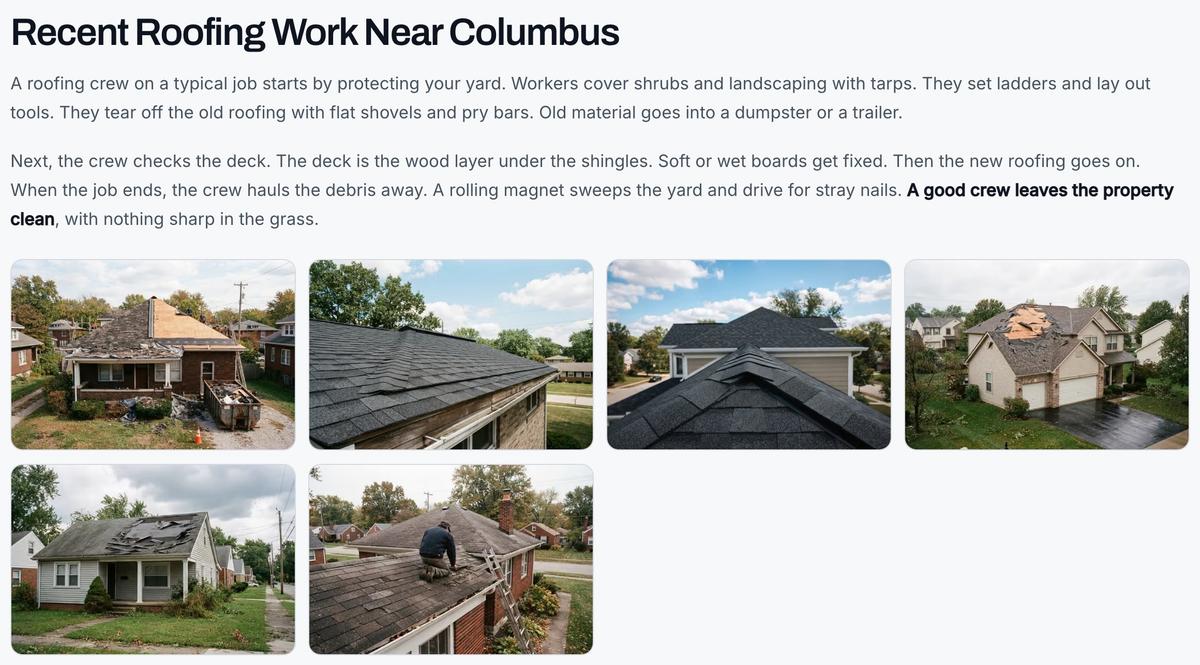
Google and federal regulators both ban paying or rewarding customers for reviews. Google's Maps content policy prohibits reviews bought with cash or with free goods.
Google's own tips page calls incentives "strictly prohibited." Paid reviews from a roofing marketing agency are a red flag. Stars matter to 92% of consumers (BrightLocal 2026). The rules protect that trust.
Federal law agrees, and the FTC's rule guidance spells out the details. The FTC's final rule banning fake reviews, announced in August 2024, lets the agency seek civil penalties.
Avoid these 4 practices:
- Buying reviews, or writing fake ones under friends' or employees' names.
- Offering gifts, discounts or free gutter cleaning in exchange for a review.
- Sending only happy customers to Google and steering complaints elsewhere, known as review gating.
- Asking staff to hit a weekly review quota. Google's policy bans that too.
What Does Breaking Them Cost?
Breaking the rules has a price. Google can restrict a profile by blocking new reviews, hiding existing ones or showing a warning that Google removed fake reviews.
Other platforms set their own rules:
- Yelp bans requests outright.
- Facebook lets customers recommend a Page.
- The Better Business Bureau takes reviews from customers.
Yelp goes further than Google. Its policy on soliciting reviews says plainly: "Don't ask anyone to review your business." Ask for Google reviews and let Yelp reviews arrive on their own. An honest mix of ratings looks more real than a perfect wall of stars.
Every Town
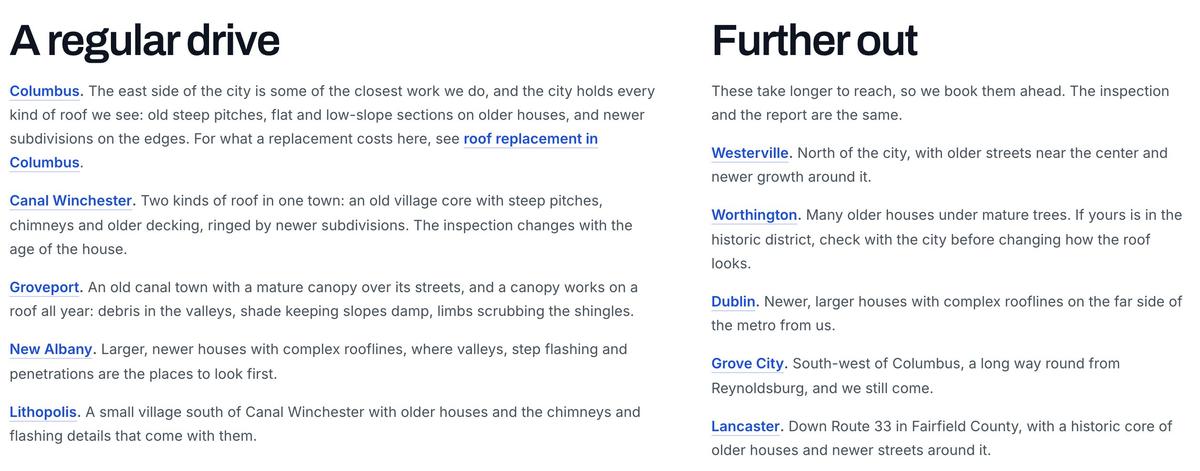
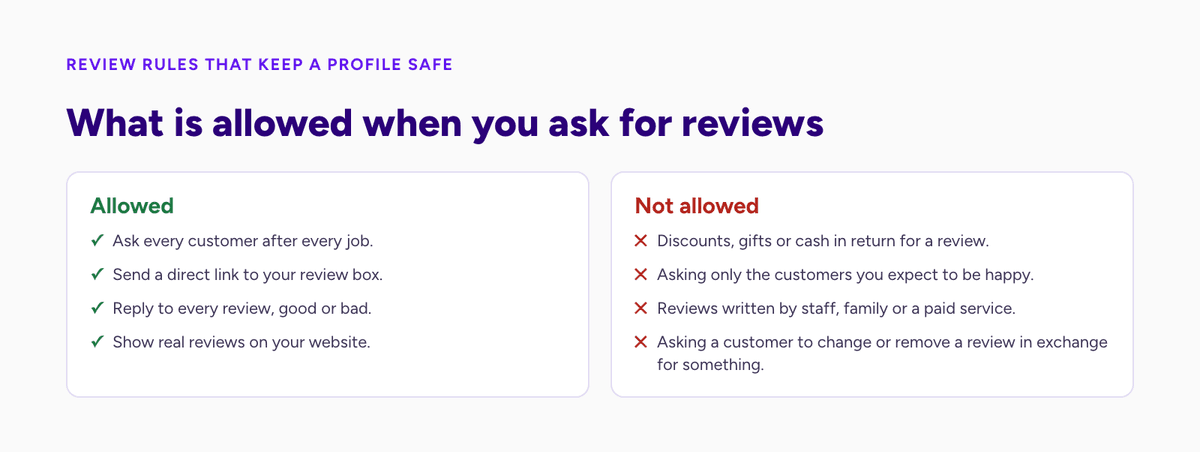
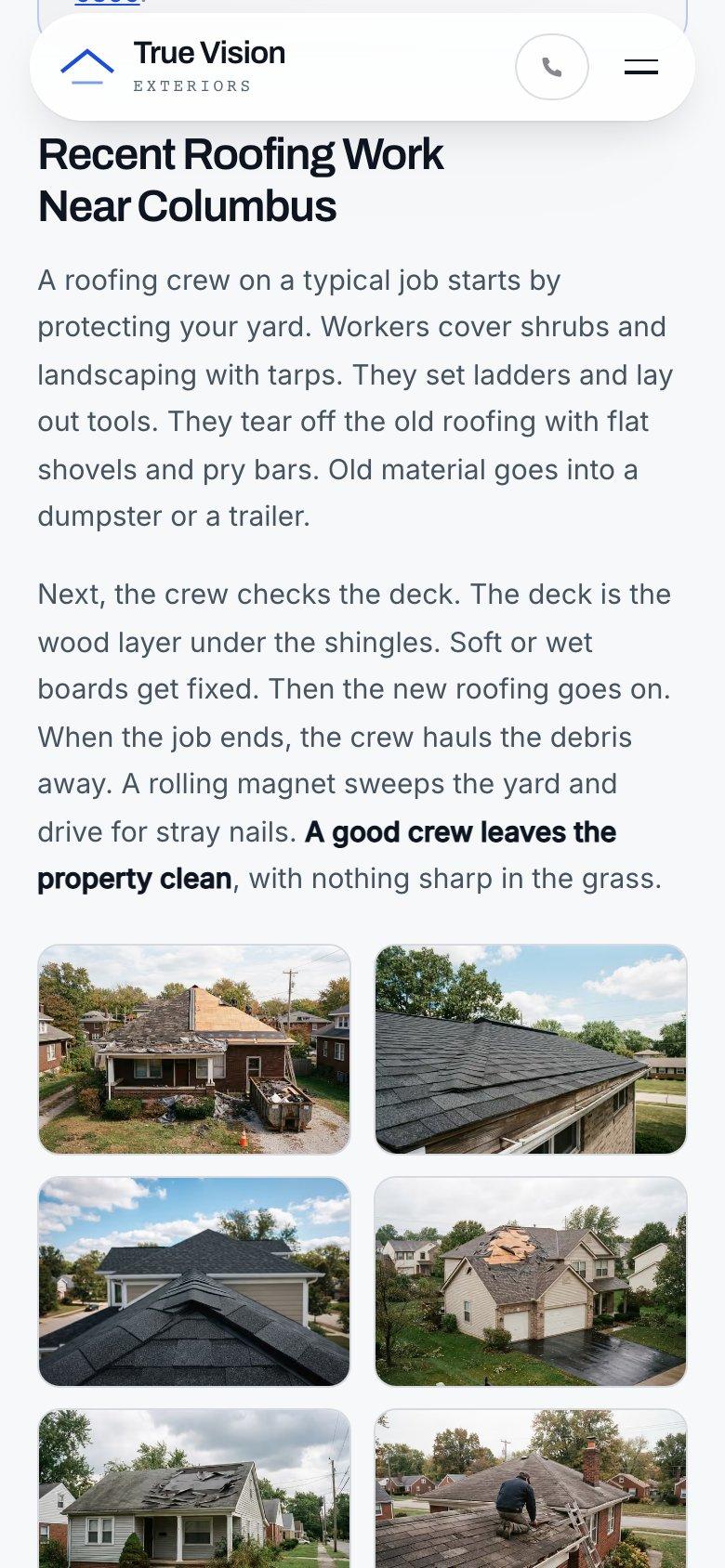
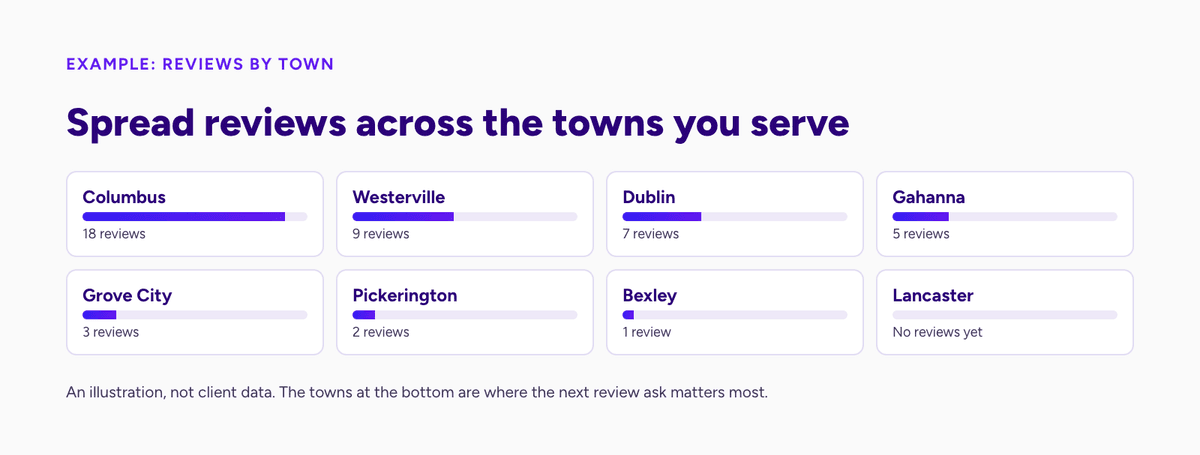
Reviews from every town a crew serves beat a pile from one suburb. Whitespark's ranking factors report places a sustained flow of new reviews 14th for the local pack. Cover repair, replacement, storm work and every other service you sell. Buyers in each town want proof from people nearby.
Never script what customers say. Ask about their real job, and their own words will name the street, the town and the work.
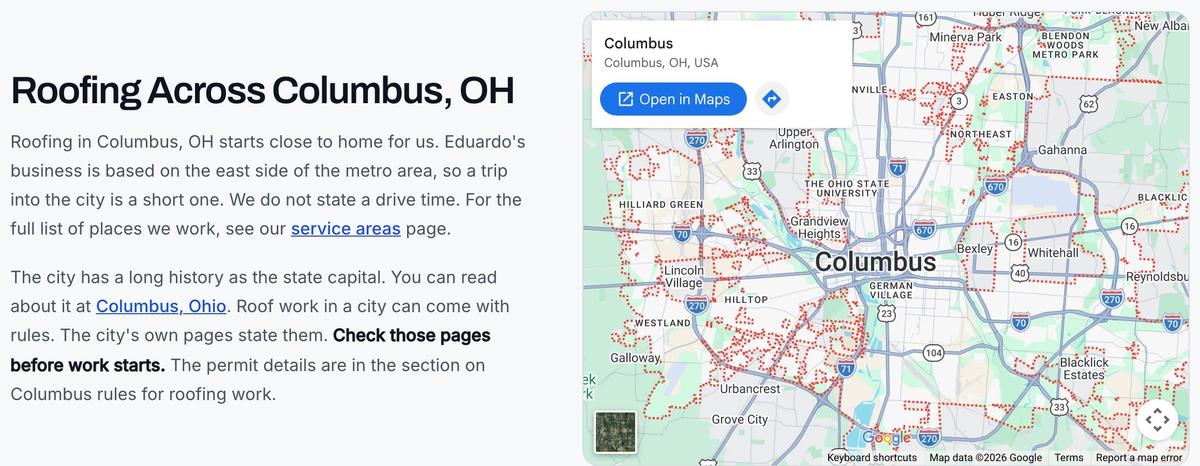
One roofing and exteriors company in central Ohio shows the pattern. It has a dedicated local page for each of the 17 towns it serves, and each page needs real proof from that area. Reviews from every town give each town page something real to show.
Get a second opinion on your current setup
A second opinion is free. Already paying someone for roofing marketing? Send us the website. Send the reports you get each month. We read them and compare them with your real spot on Google. Then we tell you what works and what wastes money. You also get the questions to ask your provider next. You keep the notes either way.
Book a call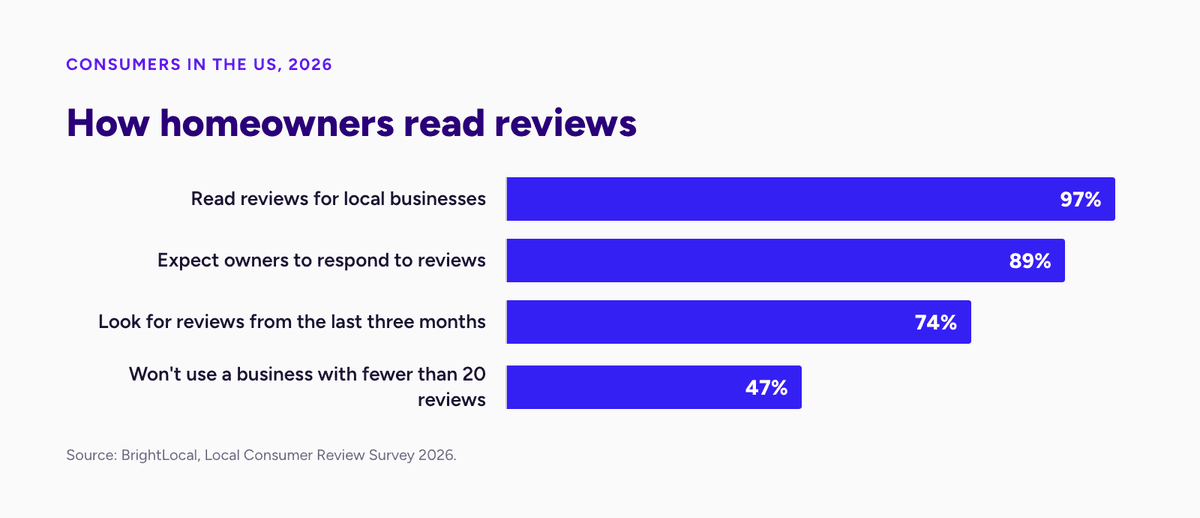
Tracking
Tracking shows if roofing reviews bring in calls. Each month, write down these 4 numbers: The full mix is in digital marketing for roofers.
- New reviews and the average rating, from the profile's review tab.
- Calls and forms by source: search, map, ads and bots, each counted apart.
- Map Pack position on a grid of points across the service area.
- Visits from AI tools such as ChatGPT, kept as their own channel.
Where Do Reviews Fit?
The Map Pack is the set of 3 businesses Google shows above the regular results. Google's local ranking help page says: "Local results are mainly based on relevance, distance, and popularity." Reviews are one sign of popularity.
Customers leave and edit them from Maps, as Google Maps help explains, and BrightLocal's review management handbook covers the wider routine.
Moz's local SEO learning center explains how reviews sit beside citations and links. Google is direct about it. "More reviews and positive ratings can help your business's local ranking." (Google Business Profile Help)
Reviews are one piece of local SEO for roofing companies. They work next to a strong website and local landing pages. BrightLocal's older Google reviews study found that local businesses averaged 39 Google reviews in 2018. For timing, see how long roofing SEO takes.
Past SEO campaigns we ran grew organic traffic 26x in 14 months, and 15x on another. We promise no ranking and no lead count. Reviews work best as one part of the whole system.
Official Sources
Each rule here has at least 1 public source behind it. These Google help pages cover the full review process:
- Tips to get more reviews: requests and replies.
- Review links and QR codes: copy, print, share.
- Managing customer reviews: owner replies.
- Reporting inappropriate reviews: flags and appeals.
- Prohibited content: fake reviews and spam.
- Maps content policy: no gating, quotas or paid reviews.
- Profile restrictions: blocks and warning labels.
- Improving local ranking: the three factors.
Outside Google, 5 more sources matter:
- BrightLocal's 2026 consumer survey: trust figures.
- BrightLocal's Google reviews study: top 3 results averaged 47 reviews in 2018.
- The FTC's August 2024 rule: fines for fakes.
- Yelp's solicitation policy: never request reviews.
- Whitespark's 2026 ranking factors: 187 signals ranked.
Next Steps
The first step is small: copy your link from the Google Business Profile site. Sign in through the Business Profile manager to find it. Ask at the right moment. Make it a habit. Answer every review. Our list of the best roofing SEO companies has questions to ask.
When the website needs work too, our first deliverable is a rebuilt homepage you review at no cost. SEO is a paid monthly plan, priced by the towns, services and pages you need. Reach out when you are ready, and we will look at the profile and the site together.
Frequently asked questions
How many Google ratings does a roofer need?
No fixed number decides rankings, but trust has a line: Per BrightLocal, 47% of consumers skip any business with under 20 reviews. Past that point, recency counts for more than the total. A steady handful each month beats a burst followed by silence, and it keeps the profile looking active to new homeowners.
Should a roofing crew collect Facebook or Yelp feedback too?
Google comes first for most crews. Its ratings appear on the map where homeowners place their calls. Yelp asks businesses not to request feedback at all, so let those arrive on their own. Facebook recommendations help homeowners who check there. Send each customer one link only, so nobody gets two and finishes neither.
What can an owner do about a fake one-star rating?
Respond calmly and briefly without accusing anyone, so other readers see a reasonable owner. Then report it from the profile if it breaks Google's policies, for example when the person was never a customer. Google reviews each report over several days and allows one appeal if the first decision goes against you.
Is it fine to send the link only to satisfied homeowners?
No. Screening customers so only happy ones get the link has a name: review gating. Google's Maps policy prohibits selectively soliciting positive feedback, and the FTC warns the practice risks breaking the FTC Act. Ask every customer the same way, and handle complaints directly by phone before they turn into public disputes.
Do owner replies help a roofer rank?
Google advises owners to reply, and answers show an active profile. The larger effect is on people: 89% of consumers in the 2026 survey cited above expect a reply. A calm answer to a complaint can win the next homeowner who reads it. That matters more than any small ranking signal.
Start with a free homepage rebuild
The first step is a rebuilt roofing homepage. We check your map position. You get a clear plan for your market before any payment. The plan names the service pages your area supports. It names the town pages too, in the order we would build them. Nothing to pay until the plan earns it. The homepage preview is yours to keep.
Book a callRelated guides
More on the same work.
Guides
- How to Get Roofing Leads
- Best Roofing SEO Companies
- Roofing Marketing Agency
- Roofing SEO
- Roofing SEO Company
- Roofing Website Design
- Roofing Website Builder
- Roofing SEO Services
- Local SEO for Roofing Companies
- Roofing Leads
- Google Ads for Roofing Companies
- Roofing Landing Page
- Google Business Profile for Roofers
- Digital Marketing for Roofers
- HVAC SEO