

HVAC Marketing Near Me
HVAC marketing near me is the search for a partner who helps local shops win calls. Distance matters less than clear web pages, accurate map data, and honest call tracking. Strong local visibility puts your trucks in more driveways.
A furnace and AC company lives or dies by the phone. When a furnace quits in January, the homeowner picks from whoever appears first on the screen. Below: how Google picks those shops in 2026, what a strong website needs, how town pages and ratings work, and the questions that vet any marketing team. Skip ahead freely.
Book a callWhat HVAC Marketing Near Me Means for Your Shop
Local hvac marketing is a choice between a nearby office and real local search skill. One meaning points to an agency down the street. The other covers work that reaches nearby homeowners.
Skill and clear reporting outweigh a street address. It covers your website, local search, Google Maps, call tracking, and partner selection.
Local shops need marketers who understand urgent home repairs. Distance to an office does not fix a broken website. Strong execution beats proximity. Start with the basics in this on page SEO checklist.
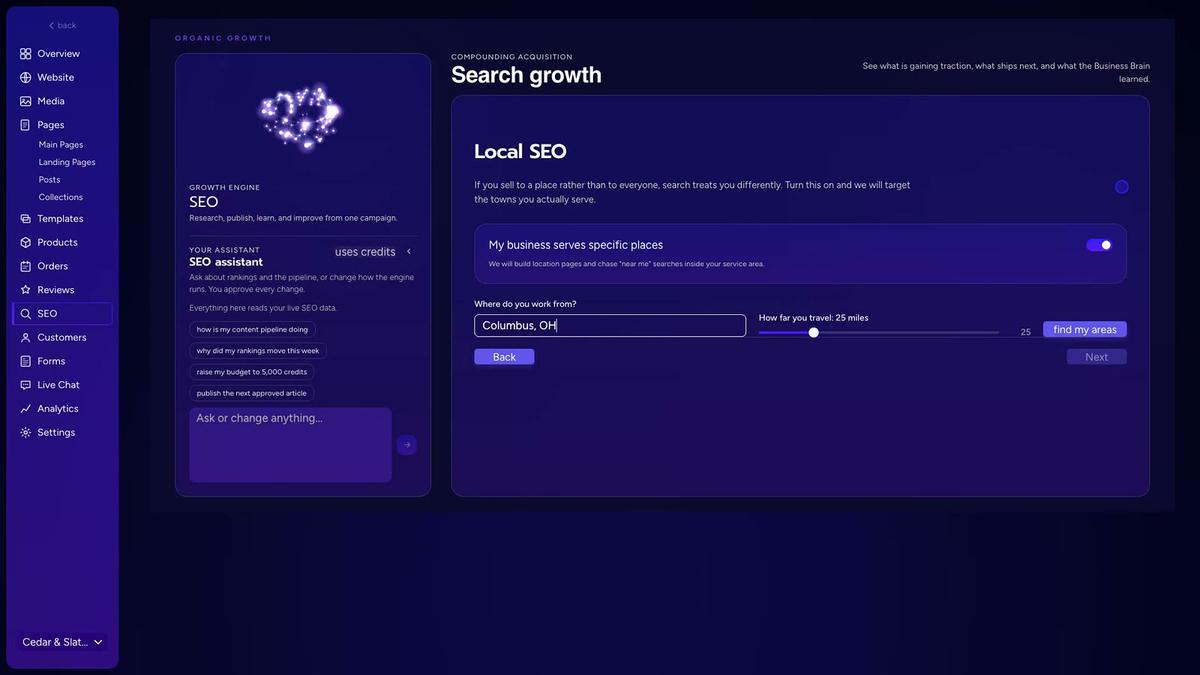
See your new homepage before you pay anything
Your HVAC homepage, rebuilt free. You see it before you pay anything.
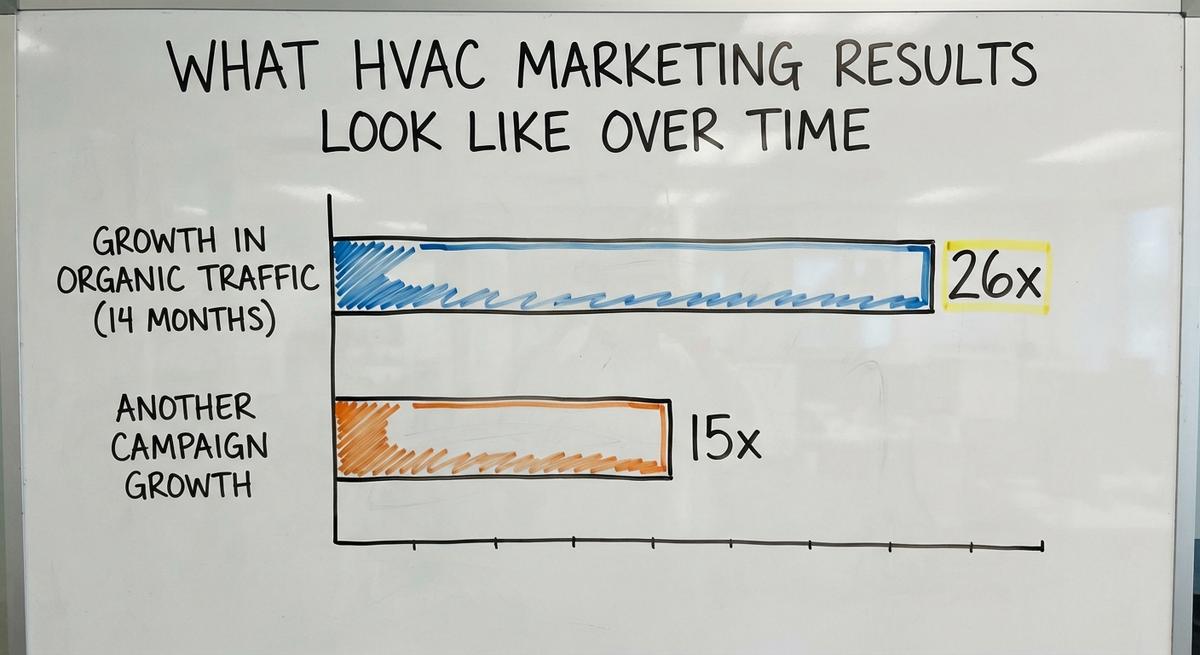
Past SEO campaigns grew organic traffic 26x in 14 months.
Book a callQuick Answer: What Good HVAC Marketing Does
Good hvac marketing is the system that puts your brand in front of homeowners who need help. Every visit should turn into a phone call or a scheduled job.
Honest tracking shows where each call started. No agency can promise a top rank or a fixed lead count. Google says its local results rest on three signals, covered below.
Good marketing connects your online presence with your dispatch board. Real results come from steady work on content and ratings. Clear pages and genuine feedback build those signals over time.
Who Is This HVAC Marketing Guide For?
The HVAC marketing guide below is a playbook for owners chasing more calls from Google. Roofers and plumbers can apply the same steps. Homeowners search for every home trade in a similar way.
Homeowners seeking DIY repair tips will not find advice here. It is written for shop owners who want steady local work. A roofing marketing agency and a furnace crew share one goal: a ringing phone.
Commercial bid contractors follow a different sales path. Residential crews win when a stressed homeowner finds their number fast.
Where Homeowners Find an HVAC Company Online
Urgent home searches are fast decisions made by stressed buyers. A homeowner with a broken air conditioner or furnace wants a quick answer. They check organic listings, Maps, sponsored spots, and chatbots.
Your site and map listing must agree on name, phone, and covered cities. Keep every claim true and provable. Conflicting directory details make buyers hesitate and call a competitor.
Local trades depend on earning trust in about 10 seconds. Speed and clarity win those quick decisions.
What Is the HVAC Map Pack?
The hvac map pack is a box of 3 local shops shown above regular search results. Your Google Business Profile and community reputation decide your spot inside it.
Urgent repair calls often start right inside this box on mobile. Accurate hours, categories, and service cities help you appear when a unit fails. Star ratings and review counts sit next to your name.
A complete profile stands out on small screens. That is where most emergency searches happen.
What Are Organic Search Results?
Organic search results are the plain web listings below Maps and ads. Your pages earn these spots by answering the exact question a buyer typed.
Organic rankings take months to build. Once you hold strong positions, they bring steady hvac leads from google without a fee per click. Many homeowners trust organic listings more than ads.
Shops earn those spots with helpful information. Each useful page acts like a permanent salesperson. Earned rankings deliver free clicks month after month.
How Do Paid Ads Work for HVAC Companies?
Paid ads are listings at the top of Google that charge per click or call. With Local Services Ads, advertisers "Pay only for leads related to your business and the services you offer," per Google Local Services Ads Help.
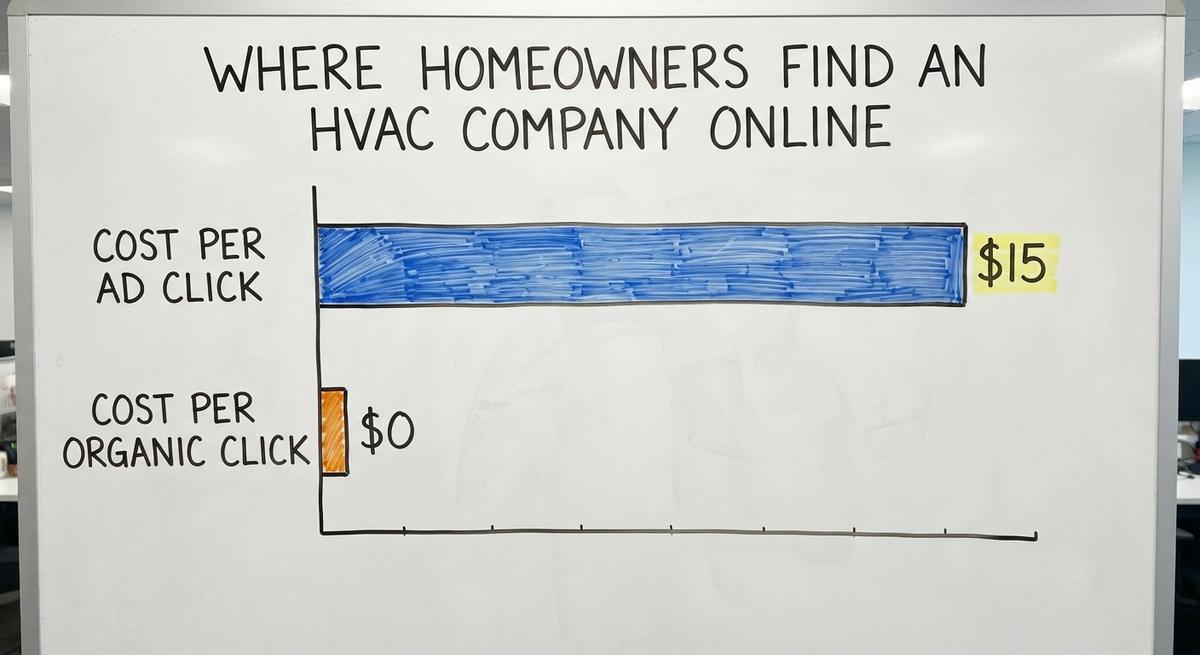
Ads bring fast calls during heat waves or cold snaps. Turning them off stops the calls at once. Paying $15 for one ad click adds up fast next to a $0 organic click. At that rate, 100 clicks cost $1,500.
Smart owners pair ads with strong organic pages for stability. Ads perform best as one tracked channel, not the whole plan.
What About AI Tools Like ChatGPT and Gemini?
Chatbots are new search channels that recommend local contractors. Buyers now ask these assistants to name a trusted shop nearby. These tools read public pages and customer reviews to pick reliable companies.
Clear, factual pages make it easy for AI tools to quote your services and towns. Vague fluff confuses them and gets your shop skipped. Google's own guidance on helpful content points the same way.
Report visits from AI engines separately. Plain facts help these assistants describe you correctly.
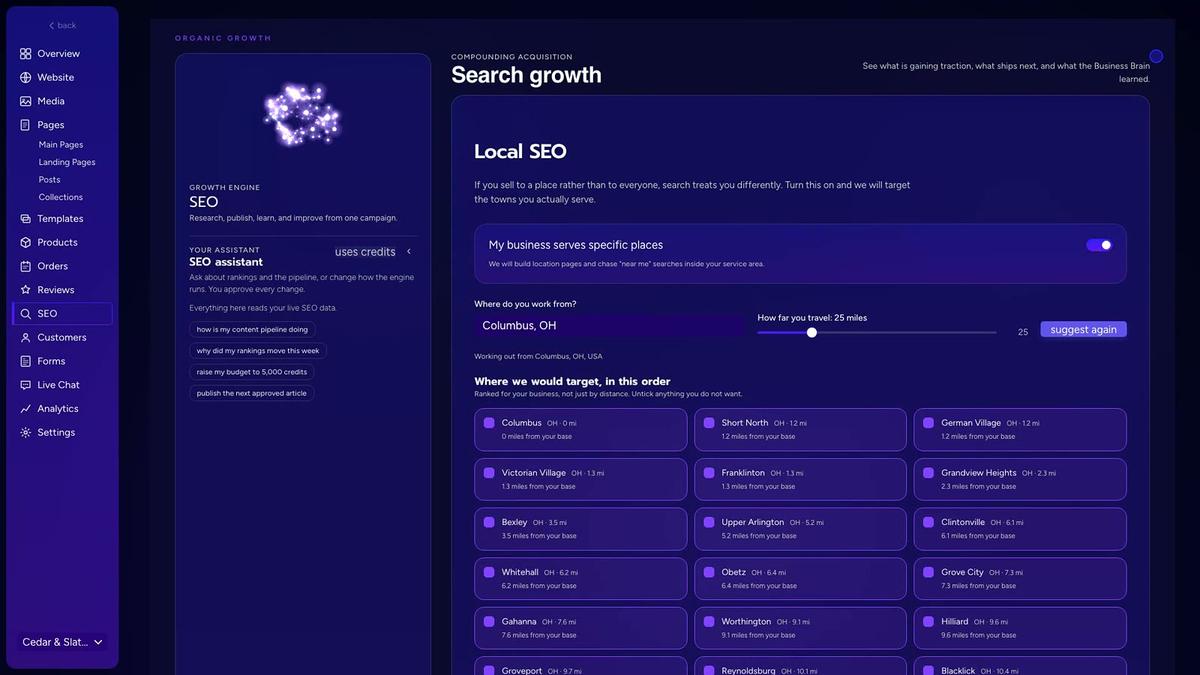
Find out where you show up on the map
A free map check for your HVAC company. See which towns find you and which call a competitor.
Book a callHow Google Decides Who Shows Up in Local SEO for HVAC
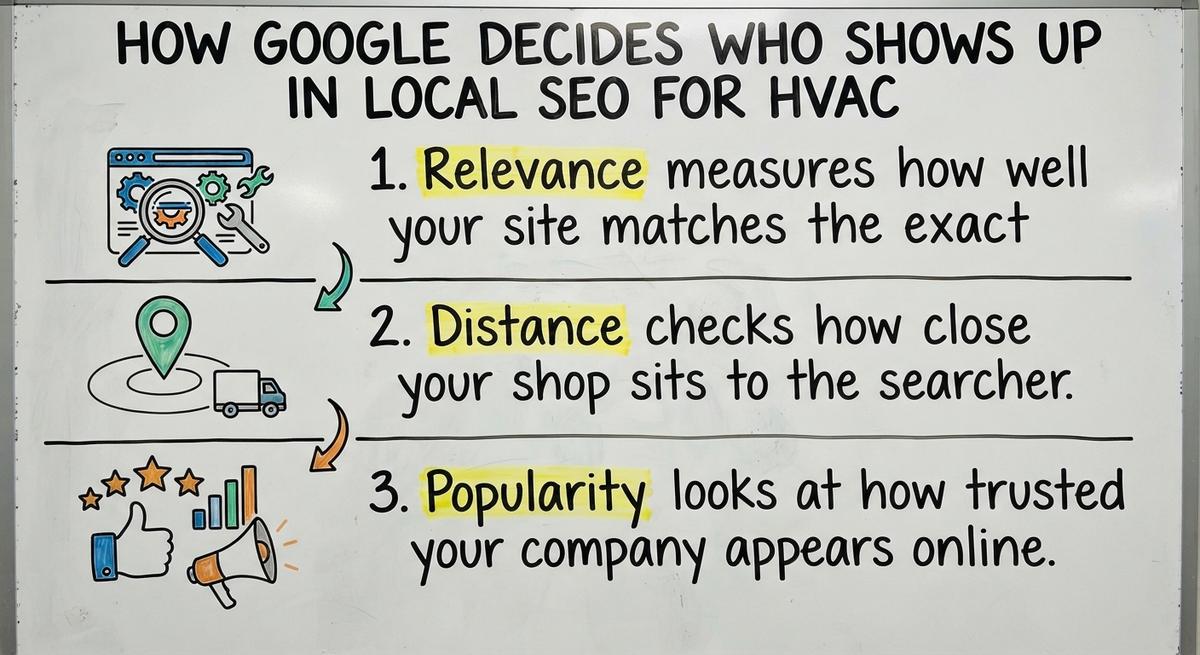
Google's local system is a set of 3 core rules for search and maps. As Google Business Profile Help explains, "Local results are mainly based on relevance, distance, and popularity."
Each rule plays a clear role when a homeowner searches for help:
- Relevance measures how well your site matches the exact service typed.
- Distance checks how close your shop sits to the searcher.
- Popularity looks at how trusted your company appears online.
Skipping any one of these limits how often your shop appears. Meeting all three takes steady site updates and real customer feedback.
Relevance, Distance, and Popularity in Practice
Relevance is a direct match between your pages and what a buyer needs. Build separate pages for AC repair, furnace installs, and heat pump tune-ups in plain words. Each service page signals relevance for that exact job.
You cannot move your shop closer to a searcher. Dedicated hvac town pages help you match searches in every city you cover. Popularity grows when customers leave honest reviews and local directories mention your name.
Steady review velocity shows Google that local people trust your crew. Ask happy homeowners for a quick rating right after the job. The same approach works across trades, as covered in local SEO for roofing companies.
Why Is Your HVAC Website the Base of Your Marketing?
Your hvac website anchors every marketing channel you run. Ads, maps, and organic search all send visitors straight to it. A slow or confusing site wastes ad money and weakens search work.
Sending paid traffic to a broken homepage burns cash. Ask each candidate how quickly they can change a phone number or add a service. The answer should be minutes or hours, not weeks.
Fast updates keep seasonal offers and phone lines accurate all year. A support ticket that sits for weeks costs real calls in peak season.
What a Good HVAC Website Needs
A strong hvac website is a fast tool that turns stressed visitors into callers. Every core page needs plain details without visual clutter.
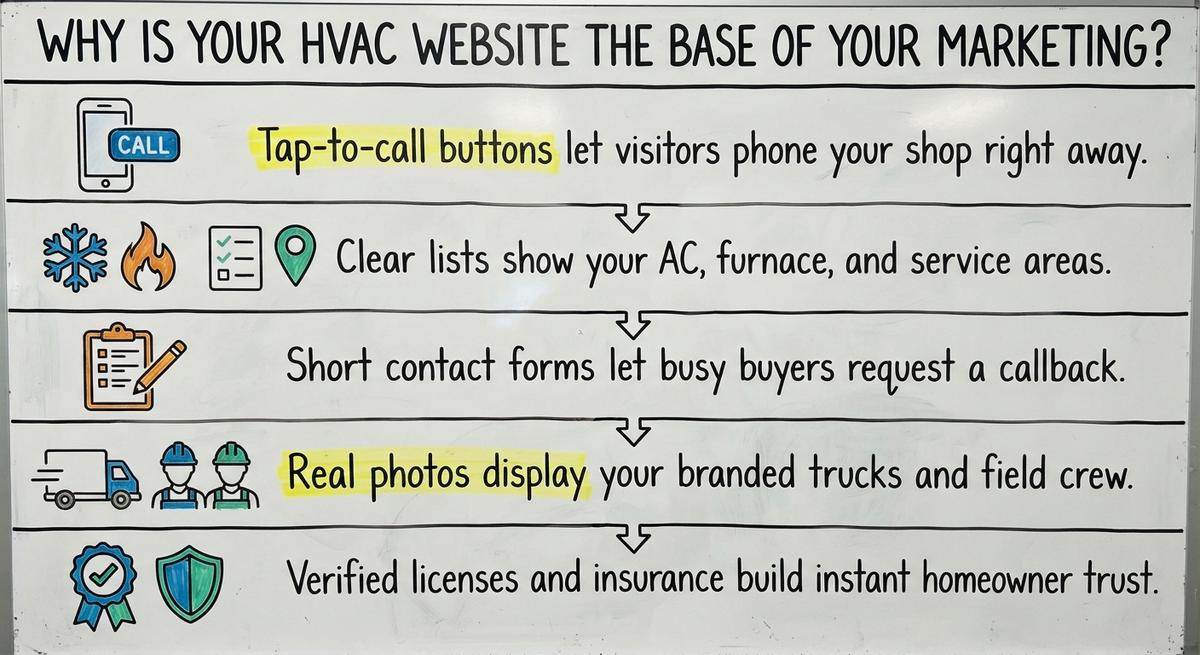
Include these neededs on your homepage:
- Tap-to-call buttons let visitors phone your shop right away.
- Clear lists show your AC, furnace, and service areas.
- Short contact forms let busy buyers request a callback.
- Real photos display your branded trucks and field crew.
- Verified licenses and insurance build instant homeowner trust.
Cluttered layouts hide the phone button and frustrate urgent callers. Never post awards, years open, or 24/7 hours unless they are true. Truthful pages turn more visitors into booked jobs. The same checklist shows up in good roofing website design.
Why You Should See Work Before You Pay
Seeing finished work first is the safest way to hire. Request a working homepage made for your company ahead of any contract.
Many contractors feel burned by an hvac marketing company that took money upfront and delivered little. Find out which person will actually build your site. Meet them before you agree to anything.
Judge the design on your own phone. A provider confident in its work will not mind the request.
Results you can check
Past SEO campaigns grew organic traffic 26x in 14 months, and 15x on another. Top Rated Plus on Upwork with 99% job success.
Work for brands like New Balance, Purina and Aramark, and SEO for Planned Parenthood.
Book a callHVAC Service Pages and Town Pages That Win Calls
An hvac service page is a page built for one specific job like AC repair. Cramming every service onto one page confuses homeowners and Google alike. Separate pages let Google match each search to your exact offer.
Each job page needs clear details on what the work includes. Explain the signs a unit needs help and what happens during a visit. Plain explanations calm nervous buyers.
Add covered cities and a bright call button to every page. Google Search Central describes "People-first content" as content "created primarily for people, and not to manipulate search engine rankings." Each page should work like a focused landing page with one job and one call to action.
Why Do You Need HVAC Town Pages?
Dedicated hvac town pages are local pages built for each city your trucks cover. Homeowners type their city name when they search for urgent repairs. A page per town helps your site match those searches.
Copy-and-paste pages with only the city name swapped hurt rankings. Google's spam policies warn that "Doorway abuse is when sites or pages are created to rank for specific, similar search queries." Mention landmarks, neighborhoods, and climate needs for each community.
Unique local pages pass quality checks and serve residents well. They give every city a fair chance to rank.
How Many Town Pages Does One Company Need?
The right number of town pages matches the towns your crews actually serve. A shop covering 17 towns needs 17 distinct pages, each with real local detail.
Every one should carry information tied to the work your techs do in that place. The same playbook used in digital marketing for roofers applies to AC and furnace shops. A monthly map grid scan across the territory shows weak zones.
Tracking every town separately shows where new content helps most. Expanding one city at a time builds steady regional strength.
What Monthly HVAC SEO Includes
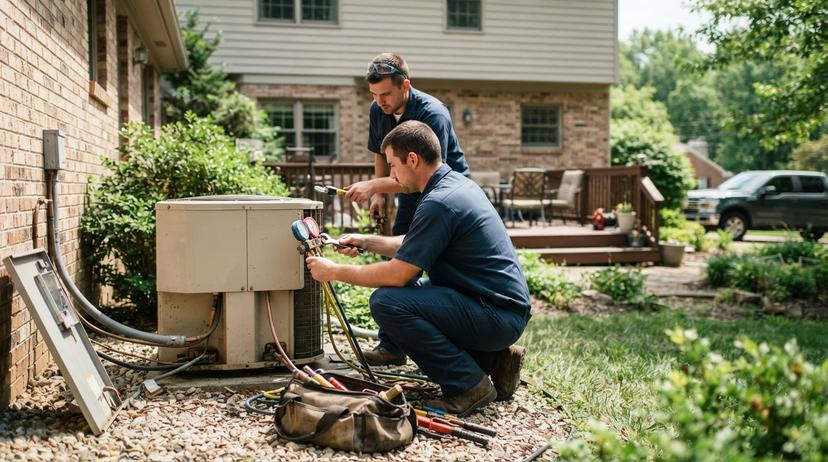
HVAC seo is ongoing work that helps pages and listings appear locally. It is never a one-time fix. Competitors update their sites, and weather shifts buyer demand each season.
Monthly scope depends on covered cities, services, and how many new pages ship. A solid plan covers four main areas:
- Writing and publishing new hvac service pages and city pages.
- Updating existing pages and fixing technical errors quickly.
- Caring for the map profile and tracking local ranks.
- Preparing AC pages before summer and furnace pages before winter.
Consistent updates keep a site ahead of shifting search rules.
Google Business Profile for HVAC, Reviews, and Citations
Your Google listing is the first thing a local buyer sees. Keeping your google business profile for hvac exact builds instant trust. Match shop name, phone line, address or territory, categories, and hours everywhere.
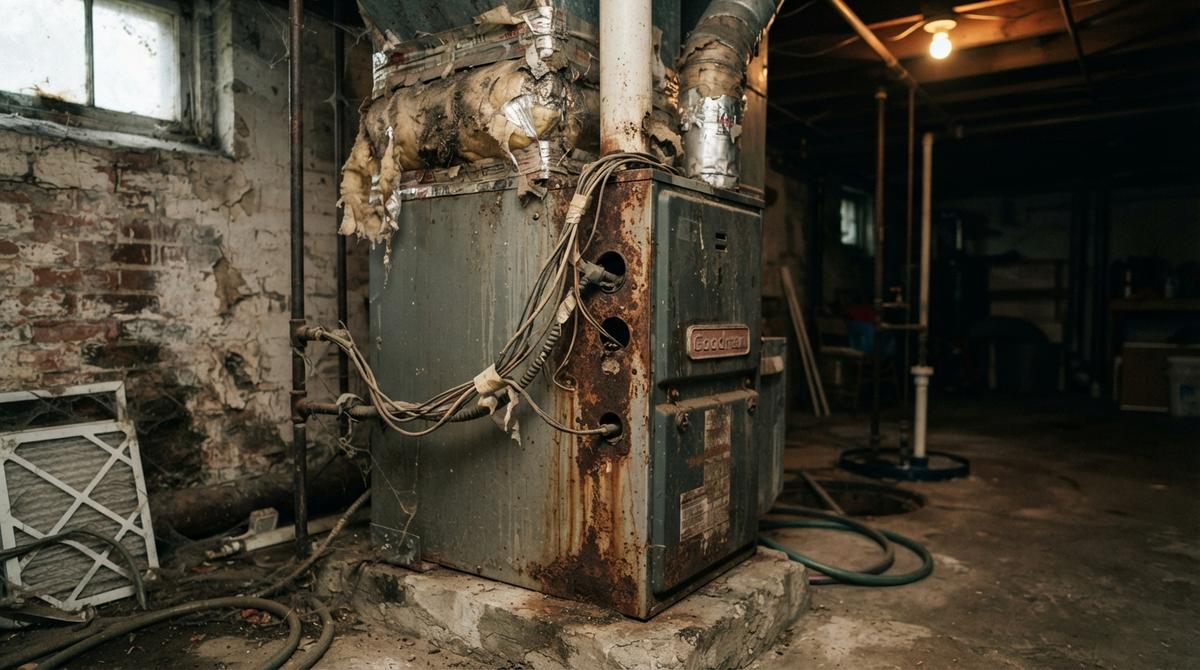
Local citations are online mentions of your shop details across directories like Bing and Yelp. Mismatched details confuse Google and homeowners. If 3 office staff spend 4 hours weekly fixing bad listings at $25 an hour, that wastes $15,600 yearly.
Clean directory data saves that office time:
- Match your exact shop name and phone across every directory.
- Upload real photos of completed installs and branded trucks.
- Post short seasonal updates to keep your profile active.
Consistent details build trust with search engines and local buyers. Google lists the profile fields that matter in its local ranking help page. This Google Business Profile guide for roofers walks through the same setup.
How to Ask for and Reply to HVAC Reviews
Customer reviews are proof that real neighbors trust your techs inside their homes. Ask every happy customer right after finishing a job. Texting a direct review link makes it fast for busy homeowners.
Google's review policy states that "Reviews and other user contributions to Google Maps must reflect a genuine experience." Never buy reviews or offer gifts for them. In BrightLocal's Local Consumer Review Survey, "97% of consumers still lean on reviews to guide their purchase decisions."
The same survey found 47% skip shops with fewer than 20 reviews. Another 89% expect business owners to reply. Polite replies to every rating show future customers that you care. More ideas for asking are in how to get more roofing reviews.
Tracking HVAC Leads From Google, Maps, Ads, and Bots
Lead tracking is the count of real phone calls and web requests by source. Raw website visits tell you nothing about booked jobs. You need to know which channel made the phone ring.
Bots and spam callers hit contact forms and tracking lines every week. Separating real jobs from junk protects your budget. Track five distinct channels:
| Traffic Source | What It Measures |
|---|---|
| Organic Search | Calls and forms from unpaid Google results |
| Map Pack | Calls and direction clicks from Google Maps |
| Paid Ads | Clicks, calls, and form fills from Google Ads |
| AI Tools | Visits from ChatGPT, Gemini, and Perplexity |
| Bots and Spam | Filtered junk calls and automated form fills |
Clear tracking shows which channel pays for itself every month. Contractors judge roofing leads by the same booked-job standard.
Get a second opinion on your current setup
Already paying for HVAC marketing? Get a free second opinion on what works and what wastes money.
Book a callHow Do You Read a Map Pack Grid Scan?
A grid scan is a test of your Map Pack rank at dozens of spots. Your map position changes block by block, even inside one city.
Expect strong green spots near your shop and weaker yellow or red spots farther out. Checking the grid monthly shows whether new pages lifted outer neighborhoods. Visual maps make progress easy for any owner to read.
Use the weak spots to pick which local pages to build next. Treat the scan as a planning tool, never as a rank promise.
What HVAC Marketing Results Look Like Over Time
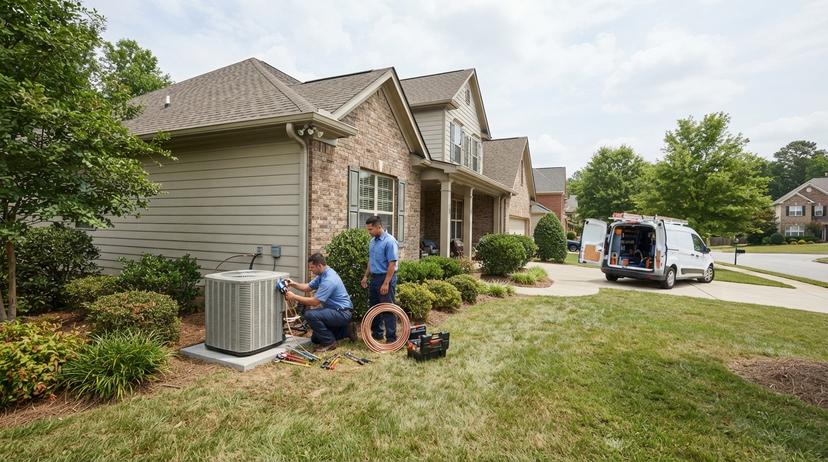
Local seo for hvac is a steady build over months as Google indexes new pages. Past campaigns by The Software Society grew organic traffic 26x in 14 months and 15x on another.
Every market differs, so past numbers never guarantee results for your company. Patience in the first quarter sets up stronger call volume later. A simple 90-day plan keeps the first quarter focused:
- Month 1 covers the homepage, map profile cleanup, and call tracking.
- Month 2 focuses on core cooling and heating service pages.
- Month 3 adds priority city pages and a first ranking map.
Steady monthly work builds lasting visibility across your service area. Timelines in other trades look similar, as this look at how long roofing SEO takes shows.
How to Choose an HVAC Marketing Partner
Choosing an hvac marketing partner is a decision based on visible work and real call data. Ask direct questions before signing any agreement.
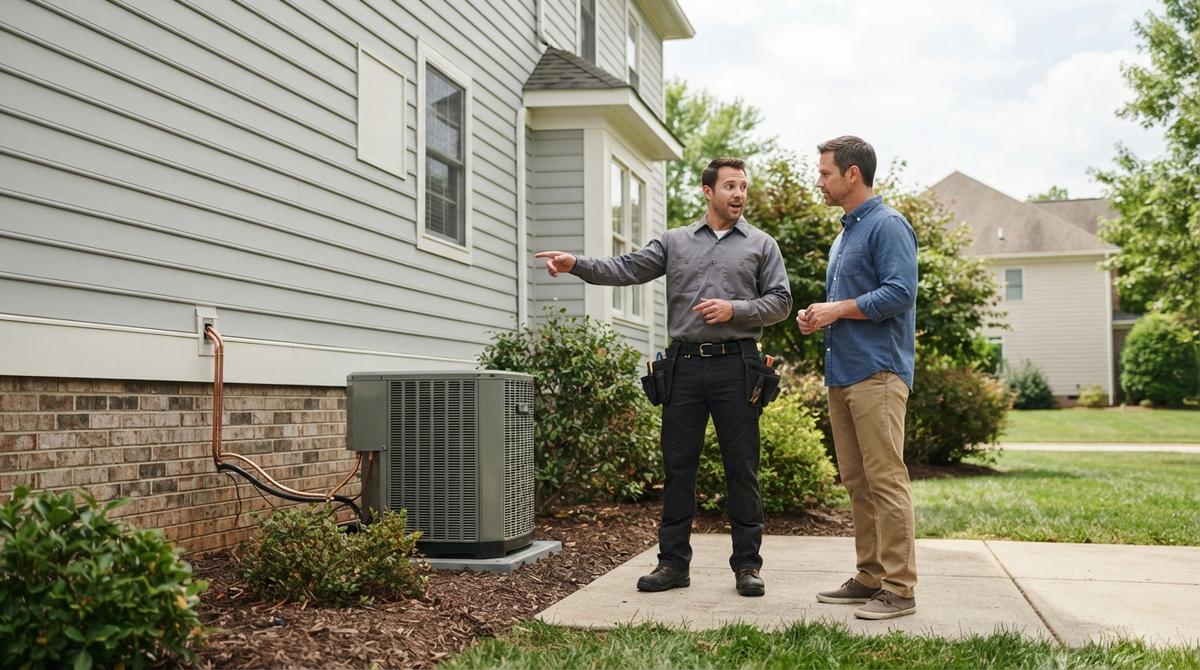
Use this checklist when interviewing any hvac marketing company:
- Ask who builds your pages and who answers your calls.
- Ask how they separate calls from search, maps, ads, and bots.
- Ask how fast they can update your hours or phone line.
- Confirm that you own your domain and website if you leave.
Watch out for promises of a number one spot or guaranteed lead counts. Clear ownership rules protect your assets if you ever switch. Long contracts with zero reporting are another major red flag. A list of the best roofing SEO companies shows what clear reporting looks like in a trade market.
Good partners show their work before asking for trust. The same vetting applies when hiring a roofing SEO company.
Does Your HVAC Marketing Partner Need to Be Local?
Your hvac marketing partner is a team judged by results, not zip code. Video calls, shared reports, and direct phone access work from anywhere in the United States.
What matters is working with people who know home service buyers and urgent searches. National experience brings proven methods from competitive markets to your town.
Direct communication beats a short drive. Ask who you will hear from each month, and how fast they reply.
Common HVAC Marketing Mistakes and How to Start Today
Common marketing mistakes are putting every service on one page or copying city pages. Skipping call tracking, ignoring Google Maps, and waiting weeks for simple edits also hold shops back. Copied city pages can also run into Google's spam policies.
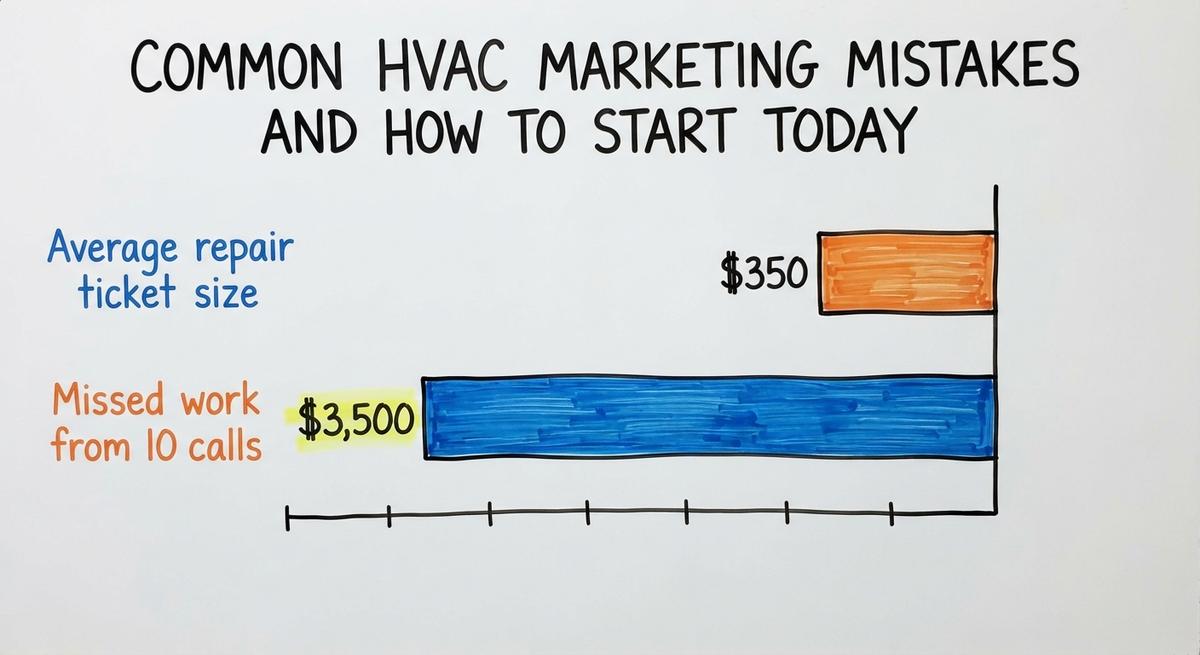
An average repair ticket of $350 means losing just 10 calls costs $3,500 in missed work. Start today with three quick checks:
- Open your Google listing and verify your phone, hours, and categories.
- Pull up your current homepage on a smartphone to test the call button.
- List the top cities and services where you want more calls.
Asking for reviews in exchange for discounts is another costly mistake under Google's review policy. Fix the basics first.
Next Step: Check Your Own HVAC Presence First
HVAC marketing near me is a mix of a fast site, dedicated pages, and honest tracking. Active map listings tie everything together so local buyers find your crew fast. You do not have to guess whether a marketing team can deliver.
Reviewing real work first takes the risk out of hiring. Ask every candidate for a sample made around your trade. Learn who does the work, and talk to that person directly.
Run the three checks above this week, then compare partners with the checklist.
Frequently asked questions
What does HVAC marketing near me mean?
HVAC marketing near me refers to finding marketers who can win calls for local heating and cooling companies in their service area. Some owners look for an agency nearby. Knowing how to build local service pages, manage Google Maps, and track calls by source matters far more than office distance.
How do I know which calls come from search, map, ads or bots?
Proper call and form tracking assigns separate tracking numbers and tags to each traffic source. You see exact counts for organic search, the Google Map Pack, paid ads, and assistants such as ChatGPT. Spam calls and automated bot form fills go on their own line, so real lead numbers stay accurate.
What is a Map Pack grid scan?
A Map Pack grid scan is a report that checks your Google Maps ranking at dozens of evenly spaced points across your service area. Map positions shift block by block. A grid scan shows where your shop ranks strong near your address and where visibility drops in nearby towns.
Can AI tools send visitors to my site, and how do I track them?
Yes, homeowners now ask AI tools such as ChatGPT, Gemini, and Perplexity to recommend local HVAC contractors. When your website has clear, factual service and town pages, those tools can cite and link to your site. Track AI referrals as their own channel in your monthly reports.
How much does monthly HVAC SEO cost?
Monthly HVAC SEO is usually priced as a custom plan. The number of towns you serve, the service lines, and how many pages are built each month all drive the fee. Ask each provider up front to show finished work for your business so you can judge quality first.
How long does HVAC SEO take to work?
HVAC SEO builds momentum over several months, not overnight. Search engines need time to crawl new service and town pages. Local reputation grows as real customer reviews come in. Paid ads can bring faster calls while organic pages gain strength.
Do I own my HVAC website if we stop working together?
Yes, you should always own your domain name and business assets. Before hiring any HVAC marketing partner, ask clearly what you keep if the monthly plan ends. Transparent partners make ownership clear upfront and never hold your business domain hostage.
Start with a free homepage rebuild
Book a short call. Your new HVAC homepage is free to see and yours to keep.
Book a callRelated guides
More on the same work.