

Hvac Inventory Management Software
HVAC inventory management software tracks every part, filter, refrigerant, and piece of equipment your business owns, across every warehouse, branch, and service truck, in real time. If you run a small or mid-size HVAC wholesale operation and you are still managing stock on spreadsheets, this guide will show you what dedicated software does, what to look for, and how to get started without ripping out QuickBooks.
Reviewed September 2026. Figures are worked from the assumptions stated beside them, so you can substitute your own and the arithmetic still holds.
Reviewed and updated: June 2025
Book a callWhat Is HVAC Inventory Management Software and How Does It Work?
HVAC inventory management software is a digital system that tracks your parts, supplies, and equipment across every location you operate. It records when stock arrives, when it leaves, and what is on hand right now. Unlike a generic inventory tool, it handles HVAC-specific items: refrigerants with lot numbers and expiration dates, high-value compressors, and filters that move in bulk. A non-technical owner can think of it as a live stockroom ledger that updates itself every time someone scans a part.
Generic tools treat a widget like a compressor. HVAC inventory control for distributors treats them differently because the stakes, the shelf life, and the regulations are different.
We build it for your operation, and the first look is free
If you would rather not compare products, describe how your operation already works and we build the system around it.
No build cost. You see it running on your own process first, and the monthly subscription starts only once it is live.
Book a callWhy HVAC Distributors Need Dedicated Inventory Tools
HVAC businesses face pressure that generic spreadsheets cannot absorb. Demand spikes every June and every December. Refrigerants expire and carry EPA handling rules. A single compressor can cost several hundred dollars, so a miscounted pallet hits the income statement fast.
Spreadsheets and QuickBooks alone do not give you real-time stock visibility across multiple locations. A technician in the field cannot check a spreadsheet to confirm a part is on the truck. A purchasing manager cannot see that Branch 2 is about to run out of R-410A while Branch 1 is overstocked.
As GS1 explains in its barcode standards records, "barcodes are the foundation of supply chain visibility," and without that foundation, every count is a guess. You can read more at gs1.org/standards/barcodes. The real cost of guessing shows up as missed jobs, emergency freight orders, and slow-moving parts that tie up cash for months.
What Inventory Problems Do HVAC Businesses Face Most Often?
The most common HVAC inventory problems are stockouts during peak season, duplicate buy orders, parts lost on service trucks, and manual count errors that compound over weeks. If you have ever sent a tech to a job site only to find the part is not on the truck, or ordered a pallet of filters you already had in the back corner, you have lived these problems.
For a 5-to-100-staff operation, these are not edge cases. They are Tuesday.
Tracking Parts Across Multiple Locations and Service Trucks
Good HVAC parts tracking software shows one view: warehouse stock, branch stock, and what is loaded on each truck. When a tech pulls a part, a scan logs the transfer. When a branch sends inventory to another site, the system records it automatically.
This matters because a part sitting on a truck in the wrong city is a stockout for the customer who needs it today. Without a unified view, your purchasing team orders more while the part collects dust 40 miles away. Multi-location inventory visibility is the single biggest gap between a spreadsheet and dedicated software.
Managing Seasonal Demand Without Overstocking
Software lets you set a minimum stock level for each SKU, the point at which a reorder alert fires before you run out. You also set a maximum, the point above which you stop buying. These min/max levels keep you from scrambling in July and from carrying dead stock through October.
Before each peak season, review your prior-year sales data inside the system and adjust the thresholds. The software flags what to order and when. You spend 20 minutes reviewing a suggested order instead of 3 hours counting shelves. That is the practical difference.
The comparison is easier when one option is built for you
Off-the-shelf means fitting your process to the software. We do it the other way round, and the first look costs nothing.
Book a call
Key Features to Look for in HVAC Inventory Management Software
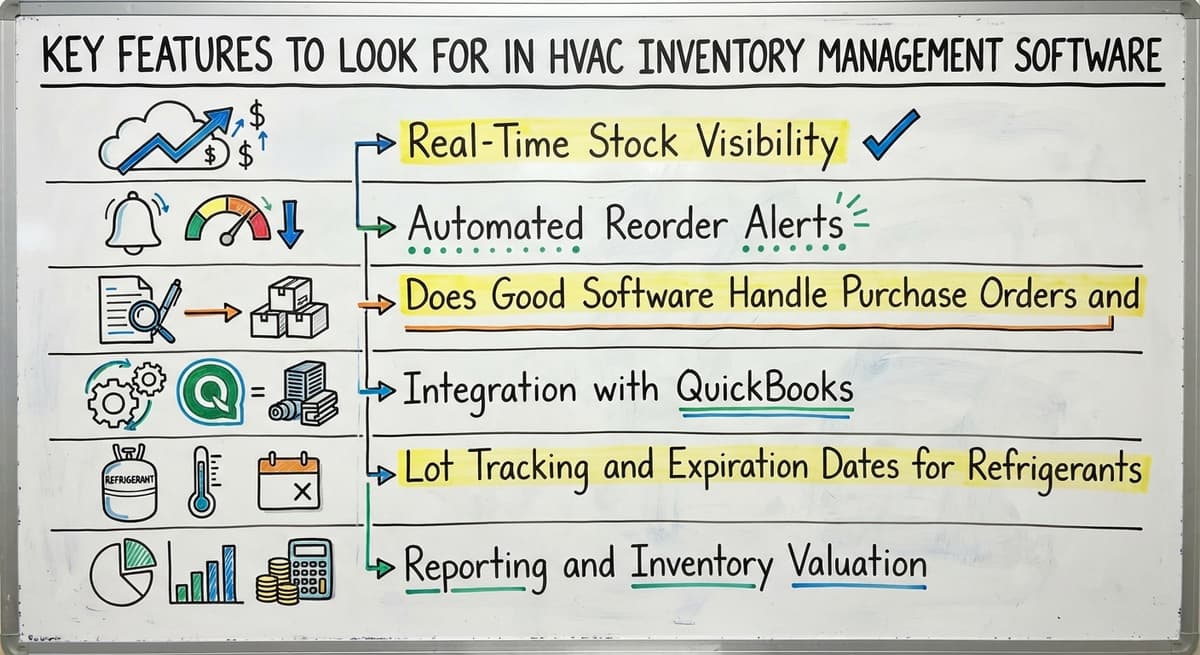
When you evaluate any system, treat this section as a buyer checklist. The right tool will cover real-time stock visibility, automated reorder alerts, buy order and vendor management, QuickBooks integration, refrigerant lot tracking, and useful reports. Each is explained below.
Real-Time Stock Visibility
Real-time means the count changes the moment a part is scanned out, not at the end of the day when someone updates a spreadsheet. Barcode or QR scanning is the most common input method: a handheld scanner or a phone camera reads the code, and the system subtracts one unit at once.
End-of-day updates create a window where your count is wrong. A tech orders a part that is already gone. A buy order goes out for stock you still have. Real-time stock visibility closes that window entirely, and it is the feature that makes every other part of the system reliable.
Automated Reorder Alerts
When stock drops to your set threshold, the system sends a alert or drafts a buy order for review. No one has to walk the shelves every morning to check levels. The software does it continuously.
Emergency orders cost more than planned ones, in freight, in vendor premiums, and in staff time. Automated reorder alerts for HVAC supply chain management cut emergency ordering because the trigger fires before the shelf is empty, not after the tech calls in from a job site.
Does Good Software Handle Purchase Orders and Vendor Management?
Yes. The right HVAC inventory management software ties each buy order to a specific vendor and tracks delivery status from the moment the order is sent. HVAC distributors often work with 5 to 15 suppliers and need to compare lead times before deciding who to order from this week.
When a delivery arrives and is checked in, the system updates stock counts automatically. That same receiving event feeds cost data back into your records. Accurate buy order management means your on-hand count and your cost basis stay in sync without a manual matching step.
Integration with QuickBooks
Most HVAC distributors already run QuickBooks and have no interest in replacing it. The right inventory software connects to QuickBooks rather than competing with it. QuickBooks integration for distributors means that inventory costs, vendor invoices, and payments flow between the two systems automatically.
You enter a receiving event once in the inventory system. QuickBooks sees the cost. You close a sale once. QuickBooks posts the revenue. No double entry, no copy-paste errors, and no end-of-month matching that takes two days. Your accounting stays clean and your inventory stays accurate at the same time.
Lot Tracking and Expiration Dates for Refrigerants
Refrigerants like R-410A and R-454B carry EPA handling requirements and have shelf-life considerations. Lot tracking lets you record which batch arrived, when it arrived, and which batch should ship first, a practice called FIFO (first in, first out).
If a refrigerant recall happens, lot tracking tells you exactly which units to pull and which customers received them. EPA compliance for refrigerant handling is easier to document when the lot number is attached to every transaction, not buried in a paper receiving log from three months ago.
Reporting and Inventory Valuation
The IRS is direct on this point. IRS Publication 538 states: "To figure taxable income, you must value your inventory at the beginning and end of each tax year." That is a legal requirement, not a preference. See irs.gov/publications/p538 for the full guidance.
The reports owners actually use answer three questions: What is not moving? Where did stock disappear? What did goods cost? Slow-moving stock reports free up cash. Shrinkage reports catch theft or receiving errors. Cost-of-goods reports feed year-end accounting. Accurate inventory valuation is both a tax obligation and a purchasing decision tool.
See it running on your own process first
No build cost. The subscription starts once it is live and doing the job, not before.
Book a call
Off-the-Shelf vs. Custom HVAC Inventory Management Software
Two paths exist, and neither is wrong by default. Packaged software, tools like Fishbowl, inFlow, or Sortly, works well for straightforward operations. Custom warehouse management software is built around the workflows you already run.
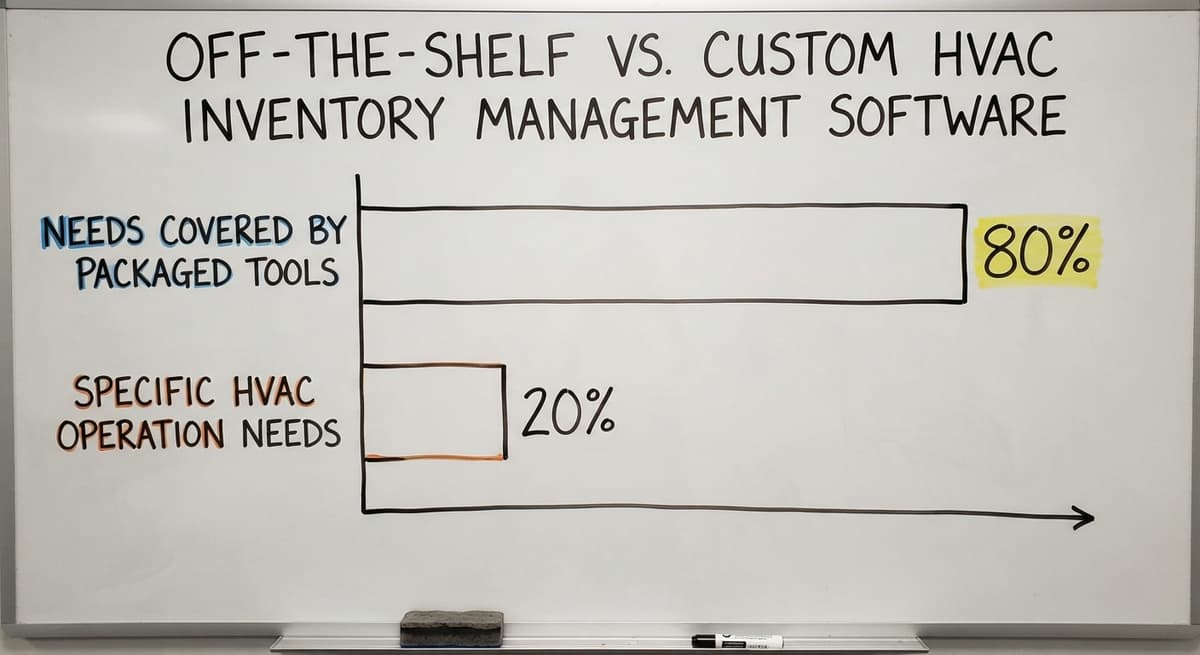
The honest difference is this: packaged tools ask you to change how you work to fit the software. Custom software changes to fit how you work. For many HVAC distributors, the packaged tools cover 80% of needs but fail on the 20% that is specific to their operation, part numbering systems, truck-level tracking, or a QuickBooks setup that cannot be migrated.
When a Pre-Built Tool Is Enough
A single-location distributor with a clean SKU list, no multi-truck tracking needs, and a straightforward QuickBooks file will likely find that an off-the-shelf product covers everything. If your biggest problem is that you have no system at all, starting with a packaged tool is faster and cheaper than a custom build.
The goal is to stop using spreadsheets, not to build the most sophisticated system possible. A packaged tool that you actually use beats a custom system that takes six months to scope.
Is Custom Inventory Software Affordable for a Small HVAC Operation?
Custom software makes sense when the packaged tools keep breaking down at the edges of your workflow. Multiple locations, unique part numbering, truck-level inventory, or a QuickBooks setup that no packaged tool integrates cleanly with: these are the tipping points.
Custom does not mean expensive or slow. A well-scoped custom build replaces only the broken parts of your operation, not the whole thing. If your warehouse receiving process is fine but your truck tracking is a disaster, a custom build can fix the truck tracking and leave everything else alone. The right custom software partner scopes to your actual problem, not to the largest possible contract. That is what distribution software for small business should look like.

How Custom HVAC Inventory Software Gets Built Around Your Operation
The build process starts with how your business already works. A good partner spends time in your warehouse, talks to your receiving staff, and maps the steps your team actually takes, not the steps a generic workflow assumes.
From that map, the builder identifies which steps are manual and error-prone, and replaces only those with software. QuickBooks stays in place. Your vendor relationships stay in place. Your part numbers stay in place. The system wraps around your operation rather than demanding you reshape it.
What the Implementation Process Looks Like
A realistic custom build for a small HVAC operation runs 6 to 14 weeks from kickoff to go-live, depending on scope. The business owner's main job is 3 to 4 working sessions: one to map the current workflow, one to review the first working version, and one or two to test before launch.
This is not an ERP rollout that consumes a year and a project manager. The same team that builds the software stays involved after launch, which means bugs get fixed by people who already know the system. That continuity is worth more than it sounds.

Keeping QuickBooks While Adding Real Inventory Control
QuickBooks is a legitimate accounting tool and you do not need to abandon it. The goal of custom HVAC inventory management software is to remove Excel and paper, not to replace software that already works.
A sync layer connects the two systems. When your inventory software records a receiving event, it posts the cost to QuickBooks. When a sale closes, the revenue posts. Vendor payments flow across without manual entry. The result is that your accounting stays in QuickBooks and your inventory stays accurate in a system built for inventory, and the two talk to each other automatically. That is what custom working software for warehouses should deliver.
Not sure this is the right shape for your operation
Describe how the work runs today. We map it on a call and show you what it would look like built around that, before you spend anything.
Book a call
ROI of Better HVAC Inventory Management
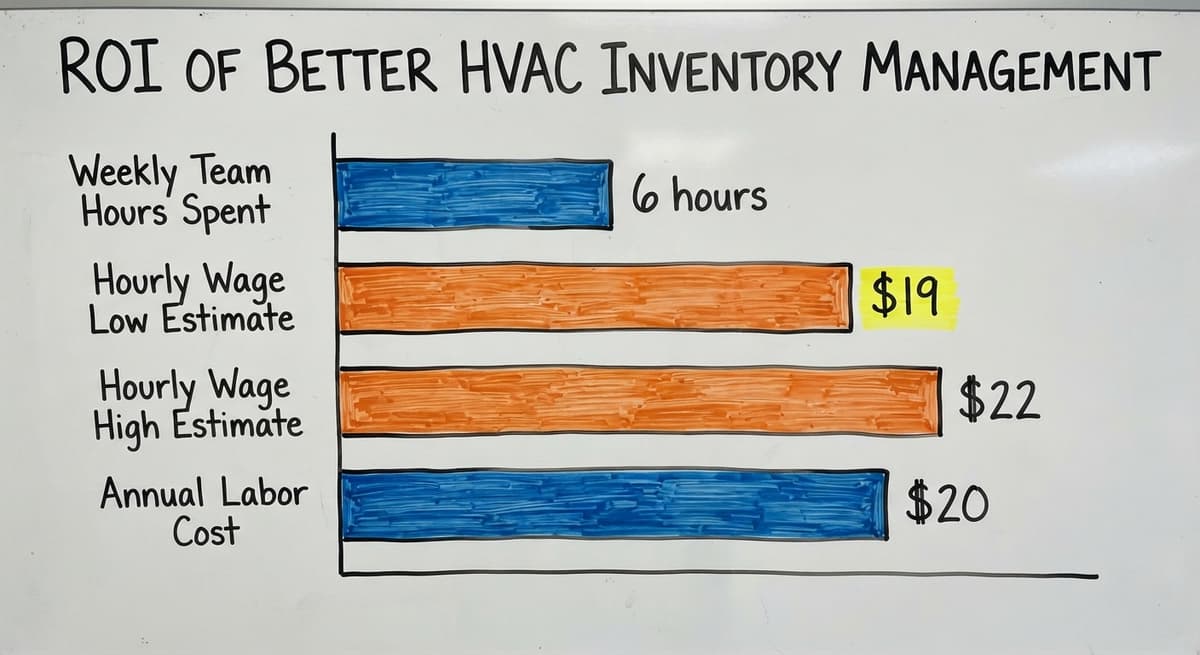
Return on investment for warehouse inventory software shows up in several places. Consider a 3-person purchasing and receiving team spending 6 hours a week on manual counts and data entry. According to the US Bureau of Labor Statistics, stock clerks and order fillers earn about $19 to $22 an hour. At $20 an hour, that is $18,720 a year in labor spent on tasks the software handles automatically.
Add the cost of 1 emergency freight order per month at $150, and that is another $1,800 annually. Add 2 stockouts per season that cost a job each, and the number grows further. Better inventory accuracy also means you can take on more jobs without adding headcount, because the system handles the coordination that used to need a person.

Questions to Ask Before Choosing HVAC Inventory Management Software
Use this list when you evaluate any system, packaged or custom. It puts the decision in your hands rather than the vendor's.
- Does it connect to QuickBooks without a manual export step?
- Can it track stock at multiple locations and on individual service trucks?
- Does it handle refrigerant lot numbers and expiration dates?
- Who supports it after go-live, and how fast do they respond?
- Can it use your existing part numbering system, or will you have to re-catalog everything?
- Does it send automated reorder alerts, or do you still have to check levels manually?
- What does the rollout timeline look like, and what do you need to do?
- Can the system grow if you add a location or 10 more users?
The answers to these questions separate software that fits your operation from software that fits a brochure.
Will HVAC Inventory Software Scale as My Business Grows?
Yes, when it is built with growth in mind. A modular custom build lets you add locations, users, or features without starting over. If you open a third branch next year, the system adds a third location. If you add a fleet of 5 more trucks, each truck gets its own inventory view.
Owners who are not ready for a full ERP do not need one. The NIST Manufacturing Extension Partnership offers vendor-neutral guidance on supply chain process, and its consistent message is that the right system is the one that matches your current scale while leaving room to grow. A system that fits today and grows with you is worth more than one that overpromises and underdelivers at 50 employees.
Why a Local Software Partner Delivers Better Results
A local partner can visit your warehouse, meet your receiving staff, and watch how parts actually move through your building. That is knowledge a remote vendor cannot get from a discovery call.
Local accountability is real. If something breaks after launch, a local team is reachable and motivated to fix it fast. Offshore vendors have time zone gaps and support queues. For HVAC distributors in and around Columbus, Ohio, working with a local rollout partner means someone who can be on-site when it matters, not just available by ticket.
That said, the principles here apply regardless of where you operate. The right partner, local or regional, knows your industry and stays involved after go-live.
Next Steps for HVAC Businesses Ready to Fix Their Inventory
The right starting point is a conversation, not a commitment. Describe how your operation works today: how many locations, how many trucks, what your biggest inventory headache is, and whether QuickBooks is in the picture. That conversation takes 30 minutes and tells you whether a packaged tool or a custom build is the right fit.
You do not need to overhaul everything. You need to replace the parts that are costing you jobs, cash, and time. If inventory management for small business HVAC operations is on your list of things to fix this year, the best move is to start the conversation now, before the next peak season hits.
Reach out to The Software Society to talk through what a custom inventory solution would look like for your operation.
Frequently asked questions
What are the top 5 inventory management software?
There is no single answer because the best fit depends on your operation. For HVAC distributors, commonly evaluated options include Fishbowl, inFlow Inventory, Sortly, Cin7, and custom-built systems. Fishbowl and Cin7 handle multi-location well. inFlow and Sortly work for simpler single-location setups. A custom build is worth considering when none of the packaged tools match your specific workflows, part numbering system, or QuickBooks setup.
What software do most HVAC companies use?
Most small and mid-size HVAC distributors use QuickBooks for accounting and a mix of spreadsheets or basic inventory tools for stock tracking. ServiceTitan and FieldEdge are popular for service contractors, but they focus on job scheduling rather than wholesale inventory. Distributors with more complex needs often pair QuickBooks with a dedicated inventory tool or a custom system built around their specific workflows.
Which software is most commonly used for inventory management?
Across industries, QuickBooks, Fishbowl, and Cin7 are among the most widely used inventory management tools for small and mid-size businesses. For HVAC-specific needs like refrigerant lot tracking, multi-truck visibility, and seasonal reorder management, many distributors find that these general tools need customization or a purpose-built layer added on top.
Is there a free software for inventory management?
Yes. Sortly offers a free tier for very small operations. inFlow Inventory has a limited free plan. Square for Retail includes basic inventory at no cost. Free tools work for simple, single-location setups with a small SKU count. They usually lack refrigerant lot tracking, multi-location visibility, automated reorder alerts, and QuickBooks integration, which are the features most HVAC distributors need as they grow.
Can HVAC inventory software work alongside QuickBooks instead of replacing it?
Yes. The right HVAC inventory management software connects to QuickBooks through a sync layer. Inventory events post costs and revenue to QuickBooks automatically. You keep your accounting in QuickBooks and manage stock in the inventory system. No double entry and no need to migrate your accounting history.
How long does it take to implement HVAC inventory management software?
A packaged tool can be set up in days to a few weeks for a simple operation. A custom build for a small HVAC distributor usually runs 6 to 14 weeks from kickoff to go-live. The business owner's time commitment is 3 to 4 working sessions. This is far shorter than a full ERP rollout, which can take 6 to 18 months.
How does refrigerant lot tracking work in inventory software?
When a refrigerant shipment arrives, the system records the lot number, quantity, and arrival date. When stock ships out, the system assigns the oldest lot first, which is called FIFO (first in, first out). If a recall happens, you can pull up every transaction tied to that lot number instantly. This also supports EPA records requirements for refrigerant handling.
What is the ROI of switching from spreadsheets to dedicated inventory software?
ROI shows up in reduced labor on manual counts, fewer emergency freight orders, and fewer stockouts that cost jobs. A 3-person team spending 6 hours a week on manual inventory tasks at $20 an hour spends about $18,720 a year on work the software handles automatically. Add emergency order costs and missed job revenue, and the payback period for most small HVAC operations is under 12 months.
Start with a free first look
A 30 minute call, your operation mapped, and a clear picture of what we would build. No obligation and nothing to install.
Book a callRelated guides
The rest of this guide, for the parts of the job this page does not cover.
Guides
- Cloud Stock Management Software
- Warehouse Inventory Management Software
- Quickbooks Inventory Management Software
- Inventory and Warehouse Management Software
- Custom Inventory Management Software
- Manufacturing Inventory Management Software
- Cost of Inventory Management Software
- Inventory Management Software Freeware
- Best Inventory Management Software for Small Businesses
- Free Inventory Management Software for Small Business
- Inventory Management Software Barcode Scanner
- Inventory Management Software with Barcode
- Free Inventory Management Software with Barcode Scanner
- Inventory Management for Multiple Locations
- Inventory Management System for Manufacturing
- Jewelry Inventory Management
- Dental Inventory Management
- Qr Code for Inventory Management
- Warehouse Inventory Tracking Software
- Warehouse Inventory Software Programs
- Inventory Software Warehouse
- Inventory Tracking Software for Small Business
- Accounting and Inventory Software for Small Business