

Hvac Inventory Management
HVAC inventory management is the process of tracking every part, refrigerant, tool, and consumable your business buys, stores, and sells, across every location where stock lives. If you run an HVAC parts distributorship and your current system is a spreadsheet or a QuickBooks items list, this guide is for you. Reviewed and updated July 2025.
Book a callWhat Is HVAC Inventory Management and Why Does It Matter?
HVAC inventory management covers the full stock picture: filters, compressors, refrigerants, copper fittings, and the tools your drivers carry. It is different from general warehouse inventory because stock does not sit in one place. Parts live on shelves, in trucks, and on job sites at the same time. Refrigerants add a compliance layer that most industries never face. Getting the count wrong costs you jobs, cash, and customers, which is why a purpose-built approach matters more than a generic one.
Reviewed September 2026. Figures are worked from the assumptions stated beside them, so you can substitute your own and the arithmetic still holds.
The IRS makes the stakes plain. IRS Publication 538 states: "To figure taxable income, you must value your inventory at the beginning and end of each tax year." That is a legal floor, not a best practice.
We build it for your operation, and the first look is free
If you would rather not compare products, describe how your operation already works and we build the system around it.
No build cost. You see it running on your own process first, and the monthly subscription starts only once it is live.
Book a callWhy Tracking HVAC Parts Is Harder Than General Warehouse Inventory
Seasonal swings hit HVAC distributors harder than most wholesale categories. AC parts spike in June. Heating parts spike in October. Neither spike is easy to predict at the SKU level.
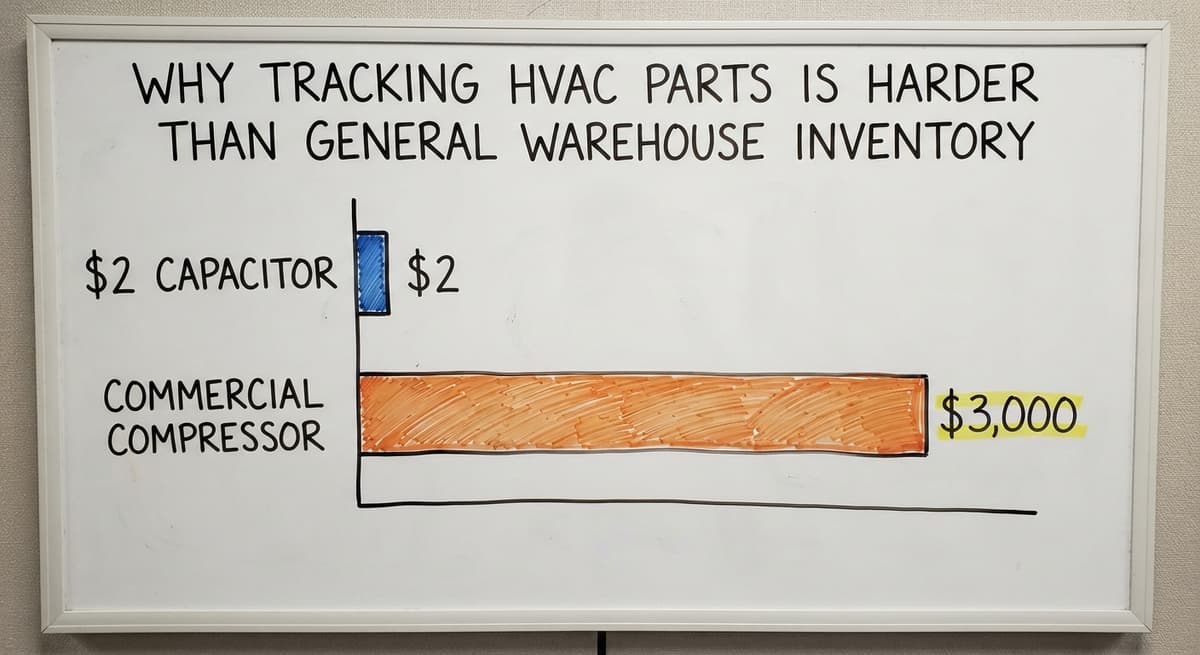
The SKU count alone creates complexity. A single distributor might carry thousands of line items, from a $2 capacitor to a $3,000 commercial compressor. According to GS1, the barcode standards that underpin scan-based counting exist precisely because "unique spotting of items is the foundation of supply chain visibility." Without that foundation, multi-location HVAC stock becomes a guessing game.
Refrigerant tracking adds a compliance requirement on top of the quantity question. You are not just counting cylinders. You are logging buys, use, and technician assignments to satisfy EPA Section 608. No general-purpose warehouse tool handles that combination out of the box.
What Does Poor HVAC Inventory Management Actually Cost?
Poor HVAC inventory management costs you in at least 4 ways, and most of them are invisible until the damage is done.
- A technician waiting on a part delays a job and frustrates the end customer, who calls a competitor next time.
- Over-ordering ties up cash on slow-moving stock that takes up shelf space for months.
- Manual count errors create emergency buys at spot prices, often 20 to 40 percent above your normal cost.
- Shrinkage and theft go undetected when no one tracks what leaves the building against what was sold.
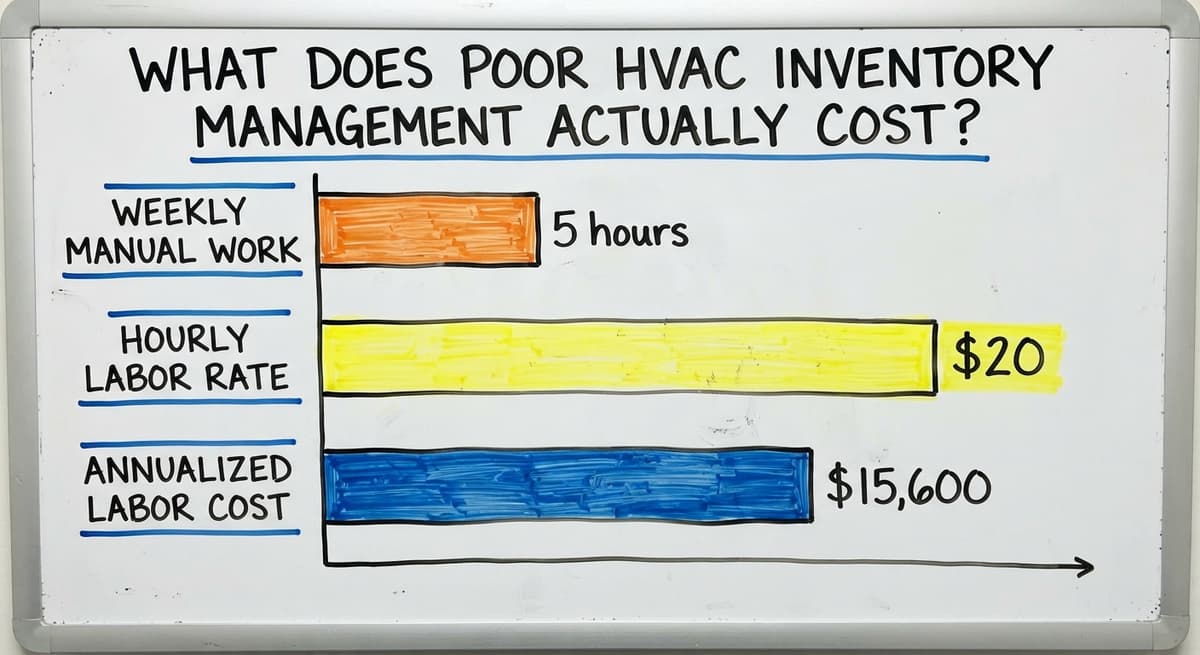
Consider the labor cost alone. If 3 people each spend 5 hours a week on manual counts and spreadsheet updates, and the Bureau of Labor Statistics puts stock clerk wages near $20 an hour, that is $15,600 a year spent on a process that still produces errors. A system that cuts that time in half pays for itself before the first year ends.
How Most Small HVAC Distributors Track Inventory Today
The tools most small distributors use were not built for this job. They work until they do not.
- QuickBooks items list acts as a makeshift catalog but does not track location or movement in real time.
- Excel spreadsheets get updated after each order, which means the count is always slightly behind.
- Printed pick lists and paper receiving logs create a paper trail that no one can search.
- Tribal knowledge held by 1 or 2 key employees becomes a single point of failure the day one of them leaves.
These methods break down when order volume grows, when a second truck is added, or when a new hire cannot read the spreadsheet the way the previous person did. The US Census Bureau's Monthly Wholesale Trade data shows that inventories-to-sales ratios in wholesale distribution are tight. There is no room for a system that loses parts between the receiving dock and the delivery truck.
The comparison is easier when one option is built for you
Off-the-shelf means fitting your process to the software. We do it the other way round, and the first look costs nothing.
Book a call
Core Components of a Good HVAC Inventory Management System
A solid system for an HVAC distributor does not need to be complex. It needs to cover the right ground.
- Real-time stock visibility across the warehouse, each truck, and any job site where parts are staged
- Buy order creation and receiving workflows tied to actual demand rather than gut feel
- Reorder point alerts that fire before a stockout happens, not after
- Serial and lot number tracking for equipment and refrigerants, which doubles as a compliance log
- QuickBooks integration that pushes costs and adjustments automatically without double entry
No single feature matters more than the others. A system with great reorder alerts but no location tracking still loses parts between the dock and the truck.
How Do I Track Parts Across a Warehouse and Multiple Service Trucks?
Tracking parts across locations is the problem most HVAC distributors solve last, even though it is the one that causes the most day-to-day pain. The answer is to treat every truck and every job site as its own location in your inventory system, not as an extension of the warehouse.
Here is a practical example. A distributor runs 3 delivery trucks and 1 warehouse. Without location tracking, a dispatcher cannot tell whether a part is on Truck 2 or sitting on a warehouse shelf. A driver transfers 4 capacitors to cover a job, and no one logs it. By end of week, the warehouse count is wrong and no one knows why.
With location-level tracking, every transfer between the warehouse and a truck creates a record. The NIST Manufacturing Extension Partnership notes that supply chain visibility depends on capturing movement events, not just starting and ending counts. Knowing where a part is at any moment is what separates a functional system from a faster version of the same old problem.

Seasonal Demand Planning and Reorder Points for HVAC Parts
Using History to Set Smarter Reorder Points
A reorder point is the stock level that triggers a new buy order before you run out. The simple formula is: (average daily sales × supplier lead time in days) + a safety buffer. For a fast-moving part like a 16x25x1 air filter, that buffer might be 3 days of stock. For a slow-moving commercial compressor, it might be 1 unit.
Seasonal patterns make this calculation more useful. Summer AC parts and winter heating parts follow predictable curves. Pull your prior-year sales data by month and set reorder points in April for summer stock, then again in September for heating season. Automating those alerts means nothing falls through the cracks when the team is busy filling orders.
Avoiding Dead Stock in October
Over-buying for peak season leaves you with dead stock when demand drops. The fix is to set a separate reorder point for the shoulder months, not just the peak. If you sold 200 condenser fan motors in July but only 40 in October, your October reorder point should reflect October demand. A system that lets you schedule seasonal reorder adjustments removes the guesswork and keeps carrying costs in check.
Refrigerant Tracking and EPA Compliance
EPA Section 608 needs records of refrigerant buys, use, and disposal. That means tracking by cylinder, by weight dispensed, and by the technician or job the refrigerant was assigned to. A count that only tells you how many pounds are on the shelf does not satisfy an audit.
Good HVAC inventory management turns your stock system into a compliance log at the same time. Every cylinder that comes in gets logged with its weight and lot number. Every pound that goes out is tied to a buy order or a job record. Spreadsheets fall short here because they cannot enforce the chain of custody that an auditor expects to see.
If your refrigerant records live in a separate notebook from your parts count, you have 2 systems doing the job that 1 connected system should handle.
See it running on your own process first
No build cost. The subscription starts once it is live and doing the job, not before.
Book a call
How Do Purchase Orders and Receiving Work in HVAC Inventory Management?
A buy order in HVAC inventory management is a formal request tied either to a reorder point alert or to a specific job requirement, and it is the starting point for every receiving transaction. The answer to getting receiving right is a 3-way match: the PO, the supplier's packing slip, and the invoice all need to agree before a receipt is posted.
Skipping that match is common in small operations because it feels slow. But receiving errors compound. A short shipment that gets posted as complete means your count is wrong from day one. Over time, those errors stack up into a count that no one trusts.
A system connected to QuickBooks pushes the received cost directly to the right account without anyone re-keying it. That single connection removes the most common source of double entry and keeps your books clean without adding work for your accounting staff.
Barcode Scanning, Mobile Receiving, and QuickBooks Integration
Scanning Out Manual Errors at the Dock
Barcode scanning removes the manual entry step that causes most receiving errors. A driver scans a part when it comes off the truck. A warehouse associate scans it when it moves to a bin. Neither person has to type a part number or remember a location. GS1 barcode standards make this possible across suppliers without custom labels, because most HVAC parts already carry a GS1-compliant barcode from the manufacturer.
You do not need an enterprise system to use barcodes. A mobile device and a simple scan-in, scan-out workflow is enough for most distributors with 5 to 50 staff. Any employee can learn it in under an hour.
Keeping QuickBooks Without Starting Over
QuickBooks handles accounting well. It was not built for live, multi-location inventory. The right approach is not to replace QuickBooks but to connect a purpose-built inventory layer to it. A clean integration pushes cost of goods, adjustments, and received inventory to QuickBooks automatically. Your accounting staff sees the same data they always have. The difference is that the numbers feeding QuickBooks are now accurate in real time, not reconciled at month end.
A messy integration needs someone to review and approve every sync. A clean one runs without manual intervention.

Custom Inventory Software Versus Off-the-Shelf Tools
Off-the-shelf inventory tools are built for a median customer. If your operation matches that median, they work well. Most HVAC distributors do not match it. The software asks you to change your receiving workflow, your truck stock process, or your refrigerant log to fit its design.
Custom inventory software for small distributors is built around how your operation already runs. You do not retrain your team on a new process. You get a system that reflects the process you already trust.
The cost comparison is not always what people expect. A large ERP rollout can take 12 to 18 months and cost more than most small distributors spend on software in a decade. A targeted custom build for a distributor with 5 to 100 staff can go live in weeks and cost a fraction of that. The question is not whether you can afford custom software. It is whether you can afford to keep bending your operation around a tool that was never built for it.
| Factor | Off-the-Shelf Tool | Custom Build |
|---|---|---|
| Fits your workflow | You adapt to it | Built around yours |
| Rollout time | Weeks to months | Weeks, phased |
| QuickBooks connection | Varies by vendor | Designed in from day one |
| Refrigerant compliance | Rarely included | Can be included |
| Cost at 5 to 50 staff | Low to mid | Mid, with better fit |
Not sure this is the right shape for your operation
Describe how the work runs today. We map it on a call and show you what it would look like built around that, before you spend anything.
Book a callSigns Your System Has Outgrown Spreadsheets
Four signals tell you the current approach has hit its limit.
- A stockout delayed a job in the last 90 days and no alert fired before it happened.
- Two people updated the same spreadsheet and created conflicting numbers that took hours to untangle.
- You cannot tell in real time what stock is on each truck without calling the driver.
- Month-end inventory counts take more than a day because no one trusts the running total.
If 2 or more of those are true, the problem is not the people. It is the tool.

How to Choose the Right HVAC Inventory Management Software
The right HVAC inventory management software starts with your biggest pain point, not a full feature wish list. If stockouts are killing your customer relationships, solve that first. If refrigerant compliance is keeping you up at night, lead with that.
When you talk to vendors, ask 3 specific questions:
- How long does rollout take, and who does the work?
- How does the system connect to QuickBooks without replacing it?
- Have you built for HVAC distributors before, or for distribution in general?
Prefer a partner who understands wholesale distribution over one who sells a generic platform and calls it configurable. The best system is the one your team will actually use, because it was built around the way they already work.
Getting Started: Audit First, Buy Second
Before you buy any software, spend a week documenting what you actually do. Map your top 20 percent of SKUs by sales volume. Those fast movers are where stockouts and over-orders hurt most. Identify your single biggest inventory pain point and write it down in one sentence.
A phased rollout works better than a big-bang switch. Fix the biggest gap first, prove the system works, then expand. Most small HVAC distributors can go live on core receiving and reorder tracking in 2 to 4 weeks when the partner does the rollout work alongside them.
Training does not have to pull people off the floor for days. A scan-in, scan-out workflow takes an afternoon to learn. The goal is a system that runs quietly in the background while your team focuses on filling orders and keeping customers.
Key Metrics That Tell You If Inventory Management Is Improving
Four numbers tell the real story after you make a change.
- Inventory turnover rate: how many times your average stock level sells through in a year. A rising number means parts are moving, not sitting.
- Stockout frequency: how often you run out of a part a customer needs. Track it by week so you can see the trend.
- Carrying cost: the cash tied up in slow-moving stock, including storage, insurance, and the opportunity cost of that capital.
- Order fill rate: the percentage of orders that ship complete on the first try. Anything below 95 percent points to a gap in either stock or visibility.
Watch these monthly for the first 6 months after any system change. The numbers will show you where the next problem is before a customer does.
If your current process has outgrown spreadsheets and a full ERP feels like overkill, The Software Society builds custom inventory systems around the way your operation already runs. No rip-and-replace, no months-long rollout. Talk to a local rollout partner who starts with your workflow, not a feature list.
Frequently asked questions
What is HVAC inventory management and why does it matter for distributors?
HVAC inventory management is the process of tracking every part, refrigerant, tool, and consumable your business buys, stores, and sells across every location where stock lives. It matters because parts sit in trucks, warehouses, and job sites at the same time, and losing track of any of them delays jobs, wastes cash, and creates compliance risk with refrigerant regulations.
How do I track refrigerants to stay EPA compliant?
EPA Section 608 needs you to log refrigerant buys, use by weight, and technician or job assignment for every cylinder. The cleanest approach is to treat your inventory system as your compliance log: every cylinder that comes in gets a lot number and weight record, and every pound that goes out is tied to a job or buy order. Spreadsheets cannot enforce that chain of custody reliably.
Can I keep using QuickBooks and still improve my HVAC inventory management?
Yes. QuickBooks handles accounting well but was not built for live, multi-location inventory. The right move is to connect a purpose-built inventory layer to QuickBooks rather than replace it. A clean integration pushes received costs and stock adjustments to QuickBooks automatically, so your accounting staff sees accurate numbers without re-keying anything.
How do I set reorder points for HVAC parts?
A reorder point is the stock level that triggers a new buy order before you run out. Calculate it as: average daily sales multiplied by your supplier lead time in days, plus a safety buffer. Set different reorder points for fast movers and slow movers, and adjust them seasonally so your summer AC stock and winter heating stock are pre-positioned before peak demand hits.
What is the difference between custom inventory software and an off-the-shelf tool?
Off-the-shelf tools are built for a median customer, which means you adapt your workflow to fit the software. Custom inventory software is built around how your operation already runs. For HVAC distributors with specific needs like refrigerant tracking, truck stock, and QuickBooks integration, a targeted custom build often costs less over time than bending your team around a generic platform.
How long does it take to implement a new HVAC inventory management system?
A phased rollout focused on your biggest gap first can go live in 2 to 4 weeks for most small HVAC distributors when the rollout partner does the setup work alongside your team. A big-bang switch to a full ERP usually takes 12 to 18 months and costs far more. Start with receiving and reorder tracking, prove it works, then expand.
What metrics should I watch to know if my inventory management is improving?
Watch 4 numbers monthly: inventory turnover rate, stockout frequency, carrying cost of slow-moving stock, and order fill rate. A rising turnover rate and a fill rate above 95 percent are the clearest signs the system is working. Track them for at least 6 months after any change so you can see the trend rather than a single data point.
What are the most common inventory management mistakes HVAC distributors make?
The 4 most common mistakes are: tracking quantity without tracking location, setting reorder points once and never updating them for seasonal shifts, skipping a formal receiving process because the team is small, and choosing software based on price alone without checking whether it fits an HVAC distribution workflow. Each one seems minor until it causes a stockout or a compliance gap.
Start with a free first look
A 30 minute call, your operation mapped, and a clear picture of what we would build. No obligation and nothing to install.
Book a callRelated guides
The rest of this guide, for the parts of the job this page does not cover.
Guides
- Hvac Inventory Management Software
- Inventory Management for Multiple Locations
- Inventory Management System for Manufacturing
- Jewelry Inventory Management
- Dental Inventory Management
- Qr Code for Inventory Management
- Inventory Management Software for Schools
- Nonprofit Inventory Management
- Manual Inventory Management
- Inventory Management Software Costs
- Warehouse Inventory Management Software
- Warehouse Inventory Management Systems
- Quickbooks Inventory Management Software
- Inventory and Warehouse Management Software
- Custom Inventory Management Software
- Warehouse Inventory Management System
- Retail Inventory Management
- Manufacturing Inventory Management Software
- Cost of Inventory Management Software
- Manufacturing Inventory Management