

Digital Marketing for Roofers: What Works and What to Skip
Digital marketing for roofers means getting found online by homeowners who need a roof, then turning them into calls and booked jobs. It uses your website, Google search, the map, reviews, and ads. You measure it by jobs, not clicks.
Book a callWhat Digital Marketing for Roofers Really Means
Digital marketing for roofers is the work of being easy to find when a homeowner searches for roof help. Then it makes that homeowner want to call you.
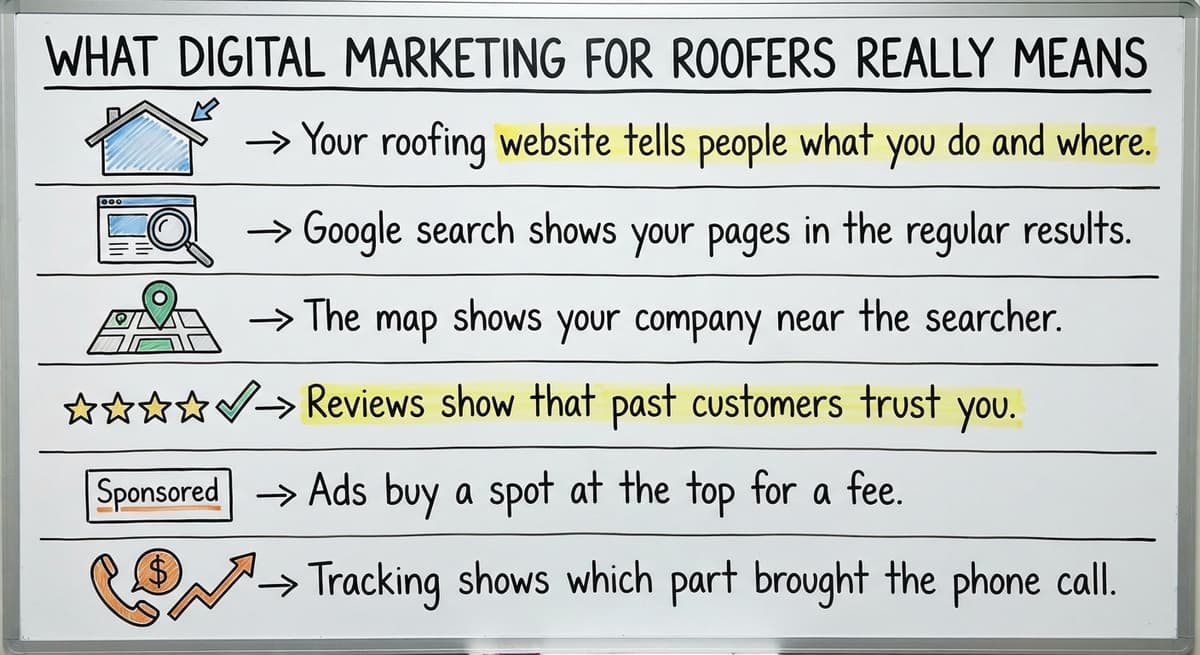
The main parts are simple:
- Your roofing website tells people what you do and where.
- Google search shows your pages in the regular results.
- The map shows your company near the searcher.
- Reviews show that past customers trust you.
- Ads buy a spot at the top for a fee.
- Tracking shows which part brought the phone call.
The goal is calls and booked jobs, not clicks or likes. A page with 1,000 visits and no calls did nothing for your crew.
See your new homepage before you pay anything
Send us your site and the towns you cover. We rebuild your homepage free and show you where you rank on the map today.
Book a callWhy Do Roofers Need Digital Marketing?
Roofers need digital marketing because homeowners search before they call anyone. A roof leaks at night. Hail hits on a Tuesday. The owner grabs a cell phone and types a search.
They look at Google results and the map first. They pick a company that shows up and looks real.
If your company does not appear, the call goes to a company that does. You never see that lost job. A missing listing costs you work you never knew existed.
What Are the Parts of a Roofing Marketing Plan?
A roofing marketing plan has 6 parts: a website, local SEO, a Google Business Profile, reviews, paid ads, and tracking. SEO means search engine tuning, the work of earning a spot in free search results.
The parts depend on each other. Ads send people to your website. Reviews help your map listing. Tracking tells you which part to fix next. A plan works when the parts work together, not when one part runs alone.
Start With a Roofing Website That Gets Calls
A roofing website is the place every other channel sends people, which is why roofing website design comes first. Your map listing, your ads, and your search results all point to it. If the site is weak, every other dollar leaks.
A site that gets calls has a few plain features:
- A phone number at the top that a person can tap to call.
- A short form that asks only for name, phone, and the roof problem.
- A clear list of your services and the towns you cover.
- Real photos of your own finished roofs.
Many homeowners search from a cell phone. Google also uses the mobile version of a page to rank it. Test your site on your own phone. If you cannot call in two taps, a worried homeowner will not either.
Find out where you show up on the map
We check your Google Maps position across your service area and walk you through it on a short call. Free, with no obligation.
Book a callService Pages: One Page for Each Roofing Job
Service pages are separate pages for each job you do. Make one for roof repair, one for roof replacement, one for storm damage, and one for each other service you offer.
Each page answers one search clearly. A homeowner who types "roof repair" wants to read about repair. They do not want a page that also covers gutters, siding, and windows.
A crowded page that tries to cover everything answers nothing well. Google asks for content made to help people first. Show the steps you take, the materials you use, and the signs that a roof needs this work. One clear page per job beats one long page for all of them.
Town Pages: Show Up Where You Work
Town pages are pages for each town you serve. They help you appear when someone searches for a roofer in that town.
Each page needs real local content. Do not copy one page and swap the town name. Google calls that kind of page a doorway page and treats it as spam.
Good local content looks like this:
- Jobs you finished in that town, with photos.
- Local weather or roof problems, such as hail or old shingles on older homes.
- The streets or neighborhoods you reach.
- Reviews from customers there.
Here is a real example. We work with a roofing and exteriors company in central Ohio. It has service pages and town pages for the 17 towns it serves. Each town gets its own page with its own facts.
How Local SEO for Roofers Works
Local SEO for roofing companies helps your company appear when people search for a roofer near them. It works in 2 places. One is the map results at the top, often called the Map Pack. The other is the regular list of web pages below it.
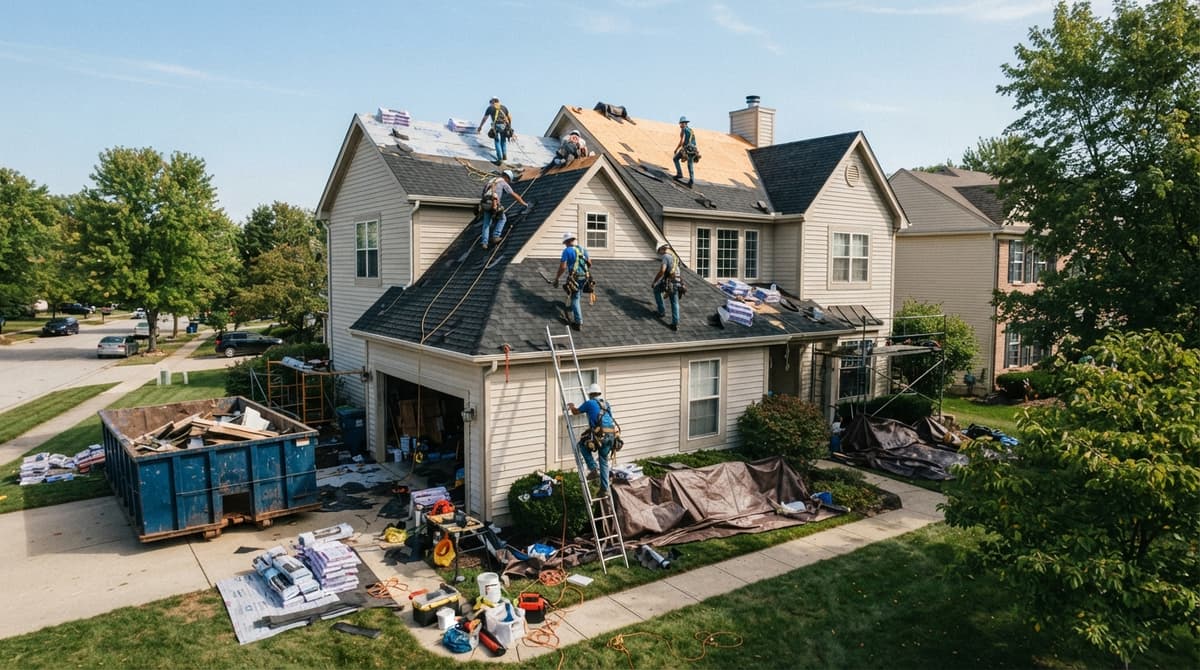
The map shows companies close to the searcher. The regular results show pages that match the search. You need both. We cannot promise any rank, because Google decides, and it changes.
What Google Says About Local Ranking
Google states how it picks local results. In its help page on local ranking, it says: "Local results are mainly based on relevance, distance, and popularity."
Here is what each word means:
- Relevance is how well your listing matches the search.
- Distance is how close you are to the person searching.
- Popularity is how well known you are, from reviews, links, and mentions.
You cannot change distance. You can improve the other 2. Match the search closely, and become a name people know.
How Do You Show Up in the Map Results as a Roofer?
You show up in the map results by filling out your Google Business Profile in full and keeping it true. This free listing is what Google shows on the map. Our page on a google business profile for roofers goes deeper.
Fill in each part:
- Your services, listed one by one.
- Your service area.
- Photos of real jobs and your crew.
- A phone number that matches your website.
Keep your name, address, and phone number the same everywhere online. A small change, like "Street" in one place and "St." in another, can confuse people and systems. List only what is true and what you can verify. Google's profile rules say to use your real-world name and details. A full, honest, matching profile is the base of every map result.
Talk to the person who would do the work
The person you talk to is the person doing the work. Bring your questions, your towns and the jobs you want more of.
Book a call
How Do Reviews Help Homeowners Pick You?
Reviews help homeowners pick you because they trust other homeowners more than an ad. A roof costs a lot. People want proof before they call. BrightLocal's 2026 Local Consumer Review Survey found 97% of consumers read reviews for local businesses and 74% look for reviews from the last three months.
Ask happy customers for a review once the job is done. Send a short text with a direct link. Google explains how to ask for reviews and warns against paying for them. The FTC also has rules on fake and bought reviews.
Reply to every review, good and bad. Stay calm. Thank the happy ones by name. For a bad one, say you are sorry, state the facts, and offer to talk by phone. Your reply is read by the next homeowner, not just the angry one.
Paid Ads for Roofers: When They Make Sense
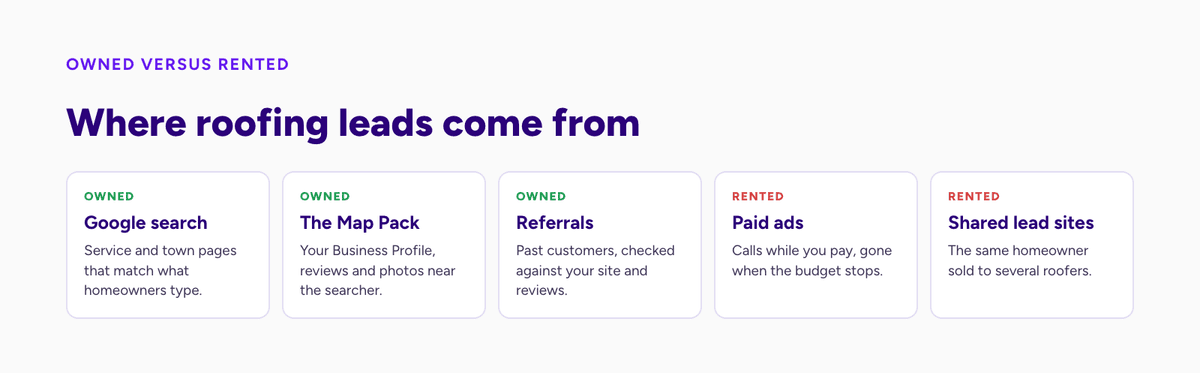
Paid ads for roofers make sense when you need calls fast. They place your company at the top of search for a fee. The calls start soon. They also stop the day the budget stops.
SEO works the other way. It builds slowly and keeps working as a steady source of calls. Many roofers use both.
Track each one on its own. Say you spend $2,000 on ads and get 20 calls. If 5 turn into booked jobs, each job cost you $400 in ads. Now you can compare that to your profit per roof. Google offers Google Ads help for setting up campaigns. Ads rent your spot, and SEO helps you own it.
Social Media and Other Channels: What Matters Less
Social media matters less for roofers than search does. Posts can show finished work. They can help neighbors remember your name. Most roof buyers still start with a search.
Put search and the map first. Then add a Facebook page or short project posts if you have time. Keep it tied to booked jobs. Ask each new customer how they found you. If nobody says social media after a few months, spend that hour on reviews instead. Search catches people who are ready to buy, and social media mostly does not.
Why Does Tracking Matter More Than Guessing?
Tracking matters because you cannot fix what you cannot see. If you do not know where calls come from, you cannot tell what works. You might cut the one thing that pays.
Track real calls and forms, not only visits. A visit is someone looking. A call is someone who may book. Free tools like Google Search Console show how people find your pages. Google Analytics shows what they do next. We cannot promise a number of leads. We can show you what you get. Count calls and booked jobs, and ignore the vanity numbers.
Track Calls and Forms by Source
Track calls and forms by source so you see which channel pays. Sort each one into one of 4 groups: search, map, ads, or bots.
Bots are programs that visit and fill out forms, but they are not people. Spam forms from bots can make a channel look better than it is. Pull them out so the numbers stay honest.
Then compare. If search brings 12 real calls and ads bring 4 for the same cost, you know where the money should go. The channel that pays for itself earns the next dollar.
Find out where you show up on the map
We check your Google Maps position across your service area and walk you through it on a short call. Free, with no obligation.
Book a callWhat Is a Map Pack Grid Scan?
A Map Pack grid scan is a check of your map position at many points across your service area. Your rank changes from street to street. One check from your office tells you little.
The scan drops a grid of points over a map. It checks where you appear at each point. You see strong areas and weak ones.
For the central Ohio roofing and exteriors company, we run a monthly Google Maps grid scan of its service area. Month to month, we can see where the map position grows and where it falls. A grid shows where you are missing, and one check cannot.
Watch Visits From AI Tools
Some homeowners now ask AI tools for roofer suggestions. They might use ChatGPT, Gemini, or Perplexity. A few of those answers link to company websites.
Track those visits as their own channel. Do not lump them in with search. Keep the claim modest. This is something to watch, not a promise. The numbers may be small today. Watch the channel now so you spot a change early.
What Mistakes Do Roofers Make With Digital Marketing?
Roofers lose money on digital marketing in a few common ways. Each one is easy to spot and easy to avoid.
- Paying for work without seeing how calls are tracked, so no one can prove it helped.
- Building one thin page for every service and town, with the same text on each.
- Running a slow website where a small change takes weeks.
- Chasing rankings instead of calls and booked jobs.
A rank is a means, not a result. Ask any provider to show you a real call, from a real source, that turned into a real job. If they cannot, they are guessing with your money.
How We Help Roofers Get Found
We build websites and run SEO for home service businesses across the United States. We use our own website platform, so changes take minutes. If you want a roofing marketing agency that shows its work, this is how we do it.
We rebuild your homepage free and show it to you before you pay anything. SEO is a paid monthly plan. The price depends on the towns, services, and pages a month that you need.
Our proof:
- Past SEO campaigns grew organic traffic 26x in 14 months, and 15x on another.
- We hold Top Rated Plus on Upwork with 99% job success.
- We have done work for brands like New Balance, Purina, and Aramark.
- We have done SEO for Planned Parenthood.
The person you talk to is the person doing the work. You deal with the one who builds your pages, not a sales rep.
Where to Start This Month
Start with one small step and finish it. A half-done plan helps no one. Here is a simple list to pick from:
- Fix the homepage so the phone number and form are clear on a phone.
- Claim your Google Business Profile and fill out every part.
- Plan your service pages and town pages.
- Set up call tracking so each call has a source.
The easiest first step is our free homepage rebuild. We build it, you look at it, and you pay nothing unless you like it. Ask for your free homepage rebuild today and take the first step toward more calls and booked jobs.
Frequently asked questions
How much should a roofer spend on digital marketing?
There is no single right figure, because it depends on how many towns you cover and how fast you need calls. A useful way to decide is cost per booked job: track every call by source, then put more into the channels that turn calls into signed work and less into the ones that only bring clicks.
How does a roofing website bring in calls?
A roofing website brings in calls when it is easy to use on a phone. It needs a tap-to-call number, a short form, and clear pages for your services and towns. Search and the map send people there. The site must then make calling simple.
How does Google decide which local results to show?
Google says local results are mainly based on relevance, distance, and popularity. Relevance is how well you match the search. Distance is how close you are. Popularity is how well known you are. You cannot change distance, but you can improve the other 2.
Should a roofer use SEO, paid ads, or both?
Many roofers use both. Ads bring calls fast but stop when you stop paying. SEO builds over time and keeps working. Track each one by source, so you can see which brings booked jobs for the money.
How can a roofer tell which channel brings calls?
Sort every call and form by source: search, map, ads, or bots. Remove bot traffic so the numbers are honest. Then compare the booked jobs from each channel to what you spent.
Should roofers track visits from AI tools?
Yes, as a separate channel. Some homeowners ask AI tools for roofer suggestions. The numbers may be small now. Tracking them early shows you if the channel grows. Treat it as something to watch, not a promise.
Where should a roofing company start with digital marketing?
Start with one step. Fix your homepage, fill out your Google Business Profile, plan service and town pages, or set up call tracking. A free homepage rebuild is an easy first move.
Start with a free homepage rebuild
Your homepage rebuilt, your map position checked and a clear plan for your market. Nothing to pay until you decide.
Book a callRelated guides
More on the same work.
Guides
- Roofing Marketing Agency
- Google Business Profile for Roofers
- Roofing SEO
- Roofing SEO Services
- Local SEO for Roofing Companies
- Roofing Website Design
- Roofing SEO Company
- Roofing Website Builder
- Roofing Leads
- Best Roofing SEO Companies
- How to Get More Roofing Reviews
- How to Get Roofing Leads
- Google Ads for Roofing Companies
- Roofing Landing Page