

How to Get Roofing Leads: Free and Paid Sources Compared
To get roofing leads, show up where homeowners search, make it easy to call, and track which source brings each call. The main sources are Google search, the Map Pack (the 3 local listings Google shows above the web results), referrals, and ads. The free, organic Google sources come first here.
Nobody can promise rankings or a set number of leads. What works is a loop. Get found, turn visits into calls, then track every call so you know what works.
Book a callWhere Roofing Leads Come From
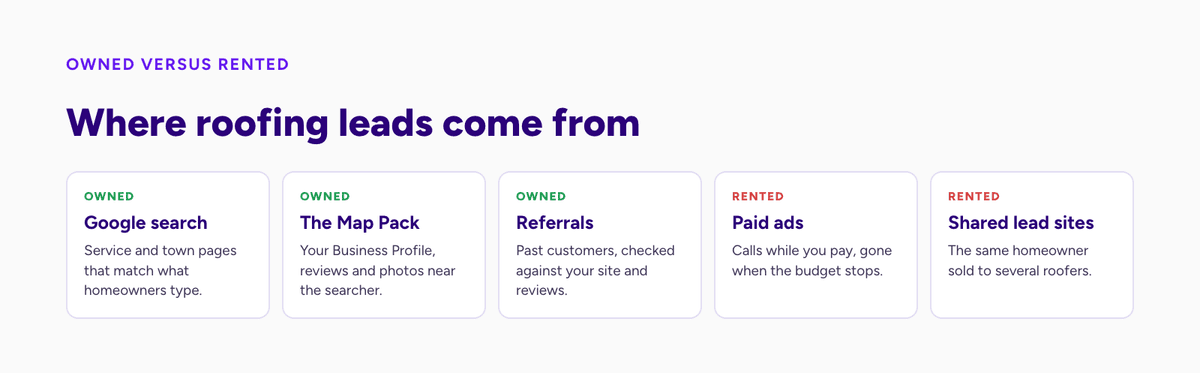
Most roofing leads come from 5 places. Each one costs a different amount and sends a different kind of caller.
- Search: A homeowner types "roof repair near me" or a town name and clicks your site. It costs time to build and little to keep.
- The map: The Map Pack lists nearby roofers with a phone button. Callers here often want a quote today.
- Ads: You pay for each click or call. They start fast and stop when the budget stops.
- Referrals: Past customers, neighbors, and builders send people who already trust you.
- Lead-selling sites: These sell one homeowner's request, often to several roofers at once.
A roofer should know which source rang the phone. Without that, you may pay for ads that bring weak calls while the map brings your best jobs. Knowing the source tells you where the next dollar and the next hour should go.
See your new homepage before you pay anything
Send us your site and the towns you cover. We rebuild your homepage free and show you where you rank on the map today.
Book a callWhy Do Google Search and the Map Matter Most for Roofers?
Google search and the map matter most because a homeowner with a leak or storm damage searches on a phone and calls the first roofer who looks right. Speed is the point. Water is coming through the ceiling, and no one waits a week.
These searchers also know what they want. They typed "roofer," so they are ready to book, not just browse. A person who sees a billboard may need a roof someday. A person who searches tonight needs one now.
The map and the search results also sit above most other ways to be found. Ads, social posts, and flyers all sit lower on the phone screen. If you win here, you meet the homeowner at the exact moment of need. That is why roofing leads from Google are the best place to start.
Step 1: Set Up Your Google Business Profile
Your Google Business Profile for roofers is the free listing that feeds the map. It is the first thing to fix. Google's own business profile guidelines say what is allowed, so read them before you edit anything.
Do these things in order:
- Claim the profile and verify it.
- Pick the right main category, such as roofing contractor.
- Add every service you really offer, like repair, replacement, and storm damage.
- Set your service area to the towns you truly cover.
- Add your phone number and hours.
- Upload real photos of your crew, trucks, and finished roofs.
Keep your name, address, and phone the same everywhere online. List only what is true. A made-up address or a fake service area can get a profile suspended. A clean, honest profile is the base for every other step.
How Google Ranks Local Results
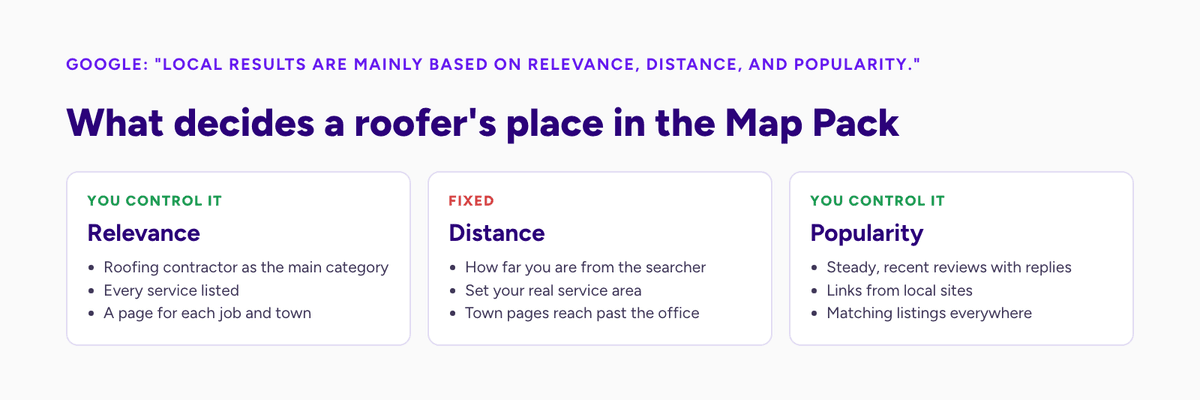
Google says how it ranks local results on its help page about local ranking: "Local results are mainly based on relevance, distance, and popularity." Each word has a plain meaning.
- Relevance is how well your listing fits what the person searched.
- Distance is how near you are to the searcher, or to the place they named.
- Popularity is how well known you are. Reviews, links, and mentions all help.
You cannot control distance. A homeowner 10 miles away may see a closer roofer first. You can work on the other two. Fill out your profile and build the right pages for relevance. Earn reviews and trusted mentions for popularity. Work on what you control and let distance be.
Find out where you show up on the map
We check your Google Maps position across your service area and walk you through it on a short call. Free, with no obligation.
Book a callStep 2: Build a Homepage That Turns Visits Into Calls
A good roofing website turns a visit into a call in a few seconds. Most visitors arrive on a phone, often stressed, so make the next move obvious.
- Put your phone number at the top of every page.
- Add a tap-to-call button that stays on screen on mobile.
- Keep the quote form short: name, phone, and what is wrong.
- Say in one line what you do and which towns you serve.
- Show real project photos, not stock images.
Speed matters too. Google's page experience guidance explains the load and response checks that shape how a page feels to use. A slow page loses the caller before they read a word.
We offer a free homepage rebuild. We rebuild it and show it to you before you pay anything. If you like it, we talk next steps. If not, you owe nothing.
Step 3: Make a Page for Each Roofing Service
A roofing site needs one page per service. Give roof repair, roof replacement, storm damage, gutters, and siding each their own page. Only list what the company really does.
Each page should answer what a homeowner asks before calling:
- What does this job involve?
- How do I know I need it?
- What affects the cost, without stating a price?
- What does the process look like, step by step?
- Which towns do you do it in?
One page that tries to cover everything ranks poorly for any single service. Google reads a page to find its main topic. A page about 6 things has no clear one. Google says it wants helpful, people-first content. A focused page for each service is the plainest way to give it that.
Step 4: Make a Page for Each Town You Serve
Roofer town pages exist because homeowners search with a town name, like "roof repair Dublin." If you have no page for that town, you give Google no reason to show you. This is the core of local SEO for roofers.
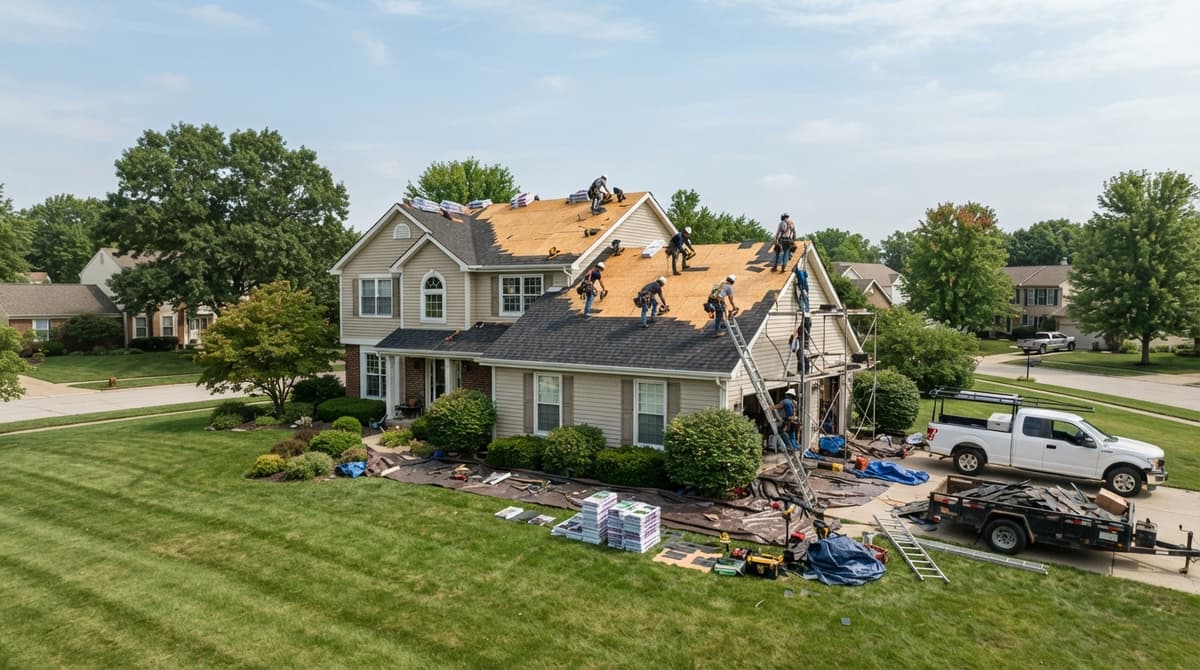
Each page must be useful on its own. Add local details, such as common roof types or weather the area sees. Show projects done in that town. List the services you offer there. Do not copy one page and swap the town name. Google's spam policies warn against thin pages made in bulk, and homeowners can tell.
Here is a real example, with no client named. A roofing and exteriors company in central Ohio has service pages and town pages for the 17 towns it serves. Each town page has its own content. Each page gives a searcher in that town a clear reason to call.
Step 5: How Do Reviews Help You Get Roofing Leads?
Reviews help you get roofing leads in 2 ways. They raise your popularity with Google, and they help a homeowner trust you before they call. A roof is a big buy, and people read reviews first.
Follow this routine:
- Ask every happy customer right after the job, while they are glad.
- Send a direct review link by text so it takes one tap.
- Reply to every review, good or bad, and stay polite.
Here is the math, with assumptions stated. Say you finish 20 jobs a month and 30% leave a review. That is 6 new reviews a month, or 72 in a year. Never buy reviews or write fake ones. The FTC has a final rule banning fake reviews. For more ideas, read how to get more roofing reviews. Google also explains how to read and reply to reviews.
Talk to the person who would do the work
The person you talk to is the person doing the work. Bring your questions, your towns and the jobs you want more of.
Book a callStep 6: Show Proof and Keep Your Details the Same
Proof on your site tells a nervous homeowner you are real. Details that match across the web tell Google the same thing.
For proof, show before and after photos, short project notes, and the town where each job was done. Show a license, insurance, or award only if the business holds it and can prove it. An unverified claim is a liability. A homeowner can check it, and one false line can cost you the job and your name.
For details, check your business name, address, and phone on directories and social pages. Fix mismatches and remove duplicate listings. Pick a few trusted directories instead of dozens of weak ones. Google also reads local business markup on your site, so keep it correct. Matching, honest details build trust with people and with search.
Should You Pay for Ads or Lead Sites?
Paid ads can bring calls fast, but they stop the day you stop paying. SEO builds slowly and keeps working, and no one can promise how fast. Many roofers use both. The right mix depends on what your tracking shows.
Here is a worked example. Say you spend $1,500 in a month and get 30 calls. That is $50 a call. If 6 calls become jobs, each job cost $250 in ads. Now compare that with the cost of a job from your organic calls. The comparison tells you what is worth the money.
Shared leads add another risk. A lead site may sell one homeowner's request to several roofers at once. You race 3 or 4 other companies, and the homeowner may be tired of calls before you dial. Leads you earn from search and the map are yours alone.
Track Calls and Forms by Source
You should track every call and form by where it came from: search, map, ads, bots, and AI tools. You cannot fix what you cannot see. If you only count total calls, you cannot tell which work paid off.
A simple setup does 3 things:
- Uses a different tracking phone number for each source.
- Tags form fills with the page and source they came from.
- Marks each lead as real, spam, or a wrong number.
Spam and bot calls can inflate your numbers. A month with 60 calls may hold 15 junk ones. If you do not separate them, you may think ads work when they mostly feed robots. Clean counts show the real roofing leads that came in. Google Search Console, a free tool, also shows which searches bring people to your site.
Check Your Map Pack Position on a Grid
A Map Pack grid scan is a map of dots that shows where your business ranks, block by block, across your service area. Position changes by location. One search from your office is misleading, because you will always rank well near your own shop.
The grid fixes that. It runs the same search from many points, like 49 dots in a 7 by 7 square. Each dot shows your rank from that spot. Green dots mean you show up near the top. Red dots mean you do not.
Here is a real example. The central Ohio roofing company above gets a monthly Google Maps grid scan of its service area. The scan shows which towns look strong and which look weak. Then we put new work, like a town page or fresh reviews, where the grid shows a gap. We never promise a top spot. The grid just shows where to work next.
Find out where you show up on the map
We check your Google Maps position across your service area and walk you through it on a short call. Free, with no obligation.
Book a callDo AI Tools Send Roofing Leads?
Yes, AI tools can send roofing leads, because homeowners now ask chat tools like ChatGPT, Gemini, and Perplexity for roofer ideas. The volume is often small today. It is worth watching.
Track visits from AI tools as their own channel. Do not mix them in with search. That way you see if the channel grows and which pages it sends people to.
You cannot control what an AI tool says. You can help it. Clear, specific pages with real answers are easier to quote. A page that says what you do, where, and how the job works gives a tool something solid to repeat. Vague pages give it nothing. Good pages for search tend to be good pages for AI too.
Common Mistakes That Cost Roofers Leads
Most lost roofing leads trace back to a short list of mistakes. Each one is cheap to fix.
- A slow site on mobile. Callers leave before the page loads.
- Missing town or service pages. Google has nothing to show for those searches.
- Ignored reviews and missed calls. A homeowner calls the next roofer after one unanswered ring.
- No source tracking. You spend money without knowing what works.
- Slow site changes. Waiting weeks to fix a phone number or add a photo costs calls every day.
The first four hurt you in plain view. The last hides in the process, and it is why a site you can edit in minutes beats one you must wait on.
Doing This Yourself vs. Getting Help
An owner can do many parts alone. You can claim the profile, ask for reviews, and take real photos. That work is free and it pays off.
The rest takes steady time. Writing service and town pages, setting up tracking, and reading monthly grid scans all keep going week after week. That is where many busy owners stall.
Our SEO is a monthly plan. We price it by the towns you serve, the services you offer, and the pages you need each month. We do not list a price here, because it depends on your plan. The person you talk to is the person doing the work.
Our websites run on our own platform, so changes take minutes. A new phone number or a new town page does not wait in a queue.
Why Work With The Software Society
We build websites and run SEO for home service businesses across the United States. Here is the proof we can share:
- Past SEO campaigns grew organic traffic 26x in 14 months, and 15x on another.
- We are Top Rated Plus on Upwork with 99% job success.
- We have worked for brands like New Balance, Purina, and Aramark.
- We have done SEO for Planned Parenthood.
We do not promise rankings or lead counts. No honest team can. We promise clear work, plain talk, and tracking that shows what brings in calls. To see how we would rebuild your homepage, ask for the free rebuild. We show it before you pay anything.
Frequently asked questions
How can I get free leads for my roofing business?
Start with your Google Business Profile, which is free. Fill it out fully, add real photos, and ask every happy customer for a review. Then build a page for each service and town. Referrals cost nothing too. Free sources take time, and no one can promise a set number of leads.
Is Google Business Profile free?
Yes. Claiming and managing a Google Business Profile costs nothing. You verify the business, add your details, and post photos and updates yourself. Paid help is optional. The profile is a core source of calls from the map, so it is the best free place to start.
How much does it cost to get roofing leads?
It depends on the source. Ads charge by click or call, and the price varies by area and season. Shared lead sites charge per lead. Organic work costs time or a monthly fee. Compare cost per booked job, not cost per call. Tracking shows that number.
Do roofing companies pay for leads?
Many do. Some buy ads, and some buy leads from sites that sell a homeowner's request, often to several roofers. Others rely mostly on search, the map, and referrals. Many mix them. Track which source turns into paid jobs to decide what to keep paying for.
How long does it take to get roofing leads from SEO?
It varies. It depends on your town, your competitors, and how much work goes in each month. Some fixes show results in weeks. Page and review growth takes longer. No one can honestly promise a date or a rank, so track calls by source and judge by what you see.
Do I need a new website?
Not always. If your site loads fast, shows your phone number, and has pages for each service and town, it may work well. If it is slow, hard to use on a phone, or slow to edit, a rebuild may help. We rebuild the homepage free first.
How do I know if leads are real?
Track every call and form by source, then mark each as real, spam, or wrong number. Listen to recordings where the law allows. Check that names and numbers look real. Bots and junk calls can inflate counts, so count only people who asked about roof work.
Start with a free homepage rebuild
Your homepage rebuilt, your map position checked and a clear plan for your market. Nothing to pay until you decide.
Book a callRelated guides
More on the same work.
Guides
- How to Get More Roofing Reviews
- Roofing Leads
- Roofing SEO
- Roofing SEO Services
- Local SEO for Roofing Companies
- Roofing Marketing Agency
- Roofing Website Design
- Roofing SEO Company
- Roofing Website Builder
- Best Roofing SEO Companies
- Google Ads for Roofing Companies
- Roofing Landing Page
Common questions
- How Long Does Roofing SEO Take
- How to Keep Track of Inventory
- How to Choose a Warehouse Management System
- How to Create a Warehouse Management System
- How to Build a Warehouse Management System
- How to Manage Inventory in a Warehouse
- How to Create a Barcode System for Inventory
- How to Keep Track of Inventory in Warehouse
- How to Design a Warehouse Management System
- How to Set up a Warehouse Management System
- How to Use a Barcode Scanner
- How Warehouse Management System Works