

Local SEO Expert
A local SEO expert is a specialist who helps nearby customers find you on Google. It also shows how to hire well in 2026.
Book a callWhat a Local SEO Expert Does for Your Business
A local search specialist is a partner who puts your business in top Google spots. The goal stays simple. You want more calls, booked jobs, and walk-in visits.
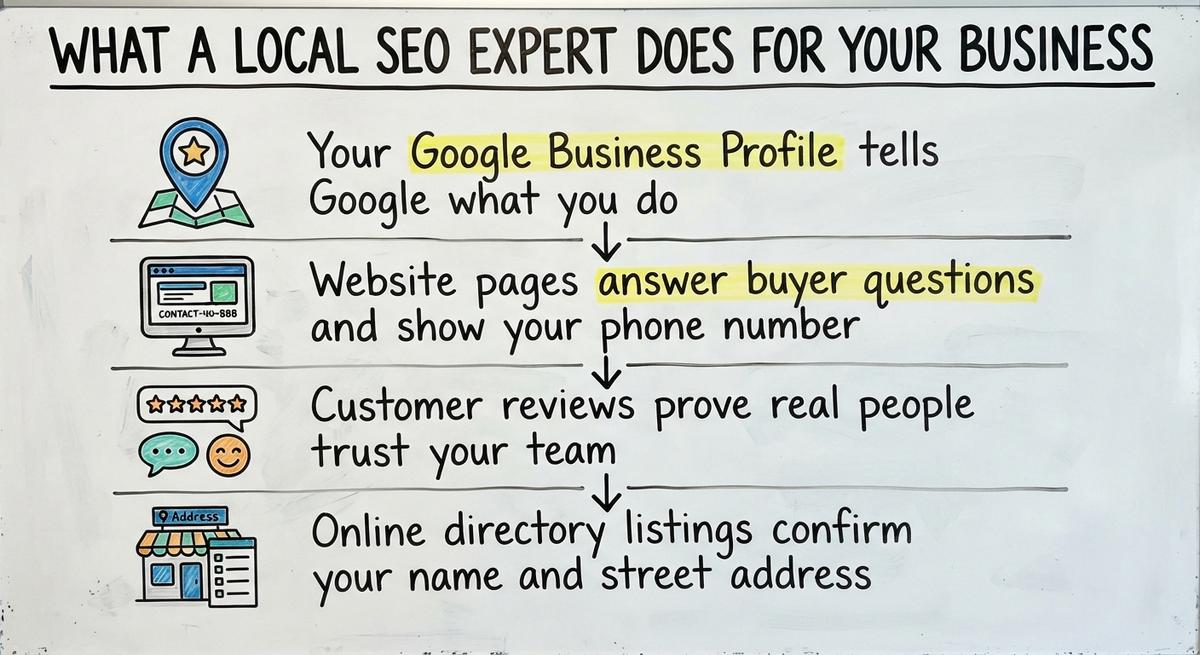
Local SEO is the work of tuning your web presence for nearby searches. Four main parts drive this work every month:
- Your Google Business Profile tells Google what you do.
- Website pages answer buyer questions.
- Customer reviews prove people trust you.
- Directory listings confirm your name and address.
A local SEO expert ties these four parts together. Each part supports the others.
Strong local search work makes your phone ring. You stop paying for every click.
Why Local Search Matters to Small Businesses
Local search is where urgent buyers go first. They need a plumber, dentist, or lawyer today.
Searchers type a need into Google Maps. Most pick from the first 3 names. Missing those spots hands the job to a rival.
Google Business Profile Help states: "Local results are mainly based on relevance, distance, and popularity." You cannot move a customer closer. You can prove relevance and popularity.
Top rankings put you first in line for local buyers.
See your new homepage before you pay anything
Your homepage, rebuilt free. You see it before you pay anything.
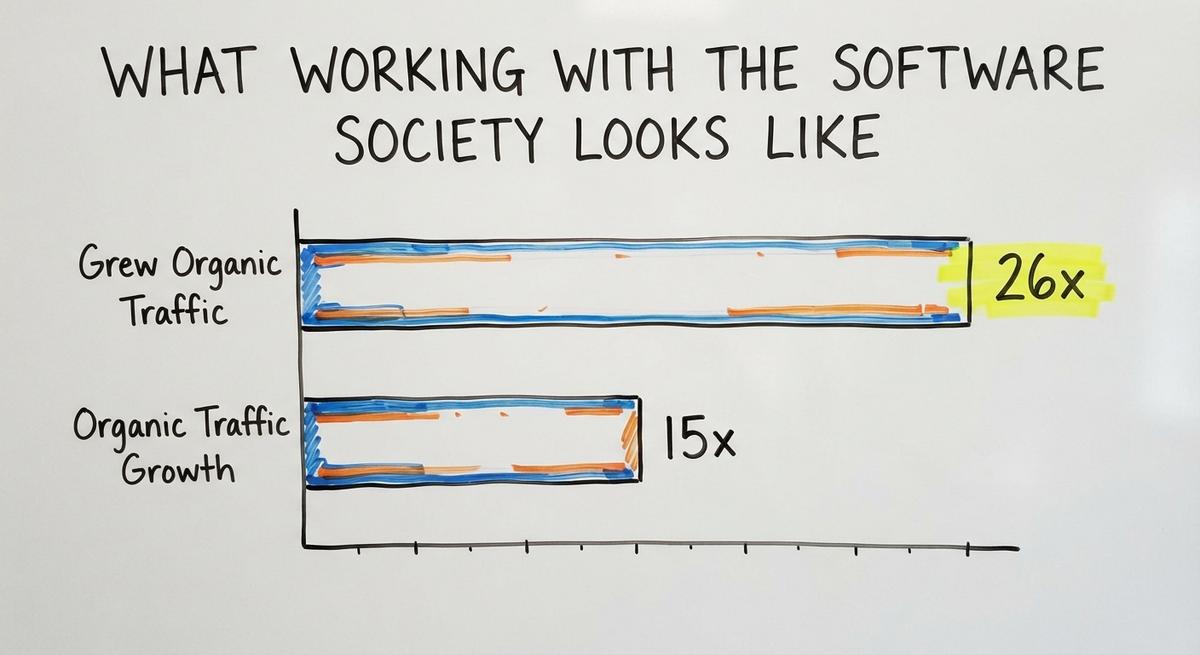
Past SEO campaigns grew organic traffic 26x in 14 months.
Book a callWhat Should You Get From a Local SEO Expert?
Finished SEO work is a service that brings calls. It is not software logins or homework. You hand off the technical setup. You focus on your business.
You never need to learn SEO tools. You never need to write code. Solid specialists build and run five core items:
- A complete Google profile for your trade.
- A fast site that turns visits into calls.
- A steady system for earning reviews.
- Clean listings across major directories.
- Plain monthly reports tied to leads.
You own every page, profile, and lead this work builds.
Your Google Business Profile, Set Up Right
Your Google Business Profile is the free box on Google Maps. It shows your hours, photos, and reviews. A specialist fills out every field.
Setup starts with your exact name, address, and phone line. Next come open hours and the right primary category. Secondary categories match every service you sell.
Google Business Profile Help asks for complete and accurate details. Empty fields leave Google guessing. Guessing rarely ends with your name on top.
Services use plain buyer words. Stiff trade labels confuse people. Fresh job photos keep the listing active. So do weekly posts.
A complete profile helps callers pick you over empty listings.
A Website That Turns Visits Into Calls
A strong small business website puts your phone number on mobile screens. Most local buyers check your site from a phone.
Buyers stand in a driveway or kitchen. They need fast help. Your homepage must say what you do. It must say where you work.
An on page SEO check list keeps every page clear. Separate service pages help Google match exact searches. Town pages connect you to nearby neighborhoods.
A good roofing website design shows the pattern well. Every page guides a busy homeowner to call.
Reviews and How You Answer Them
Reviews are public ratings that prove real customers trust your work. BrightLocal's Local Consumer Review Survey found: "97% of consumers still lean on reviews to guide their purchase decisions."
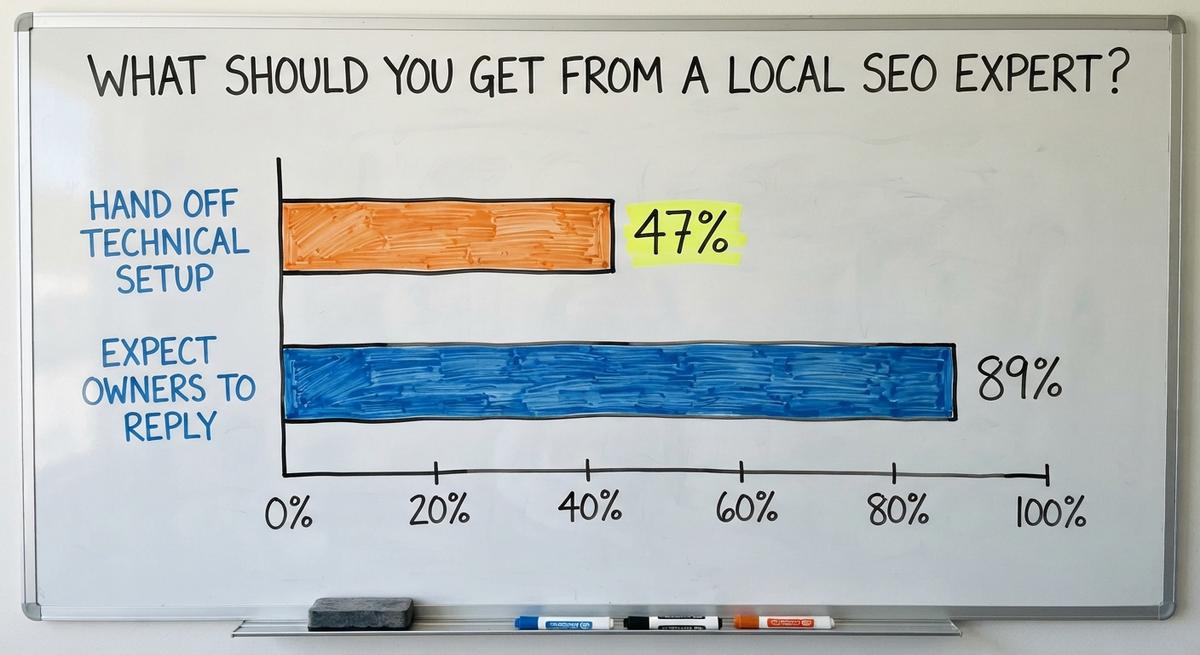
That survey also showed 47% of shoppers skip firms with under 20 reviews. BrightLocal also reports that 89% expect owners to reply.
A good expert sets up a quick text or email link. Happy customers leave feedback after each job. Never buy fake ratings. Never trade gift cards for stars.
Google's review policy states: "Reviews and other user contributions to Google Maps must reflect a genuine experience."
Polite replies show future buyers you care. These tips on how to get more roofing reviews work for most trades.
Listings That Match Everywhere
Local listings are directory pages on sites like Yelp, Bing, and Facebook. Search engines check them to confirm you are real.
Directories confirm your street address. Conflicting data hurts trust. One site shows an old phone number. Another lists a past address.
Wrong details send drivers to empty lots. They send calls to dead lines.
Each lost call is a lost job. Old listings from a past move are a common cause. So are old tracking numbers. A specialist finds duplicate listings. Then they merge them under one exact address.
Matching details give Google confidence to rank you.
Pages for Each Service and Each Area
Service area pages give each town and job type its own page. Ten services and 12 towns on one homepage confuse visitors.
Search engines also struggle with one crowded page. Each main service needs its own page. Each town page needs real local details. Think landmarks or neighborhoods.
Swapping city names on copied text breaks Google's spam policies. Google calls it "Doorway abuse." Near-copy pages built to rank for similar searches fall under that rule.
Google Search Central describes people-first content as content "for people." It should not exist to "manipulate search engine rankings."
Unique local pages earn top spots in every town you serve.
What Reports Should You Read in a Minute?
You should read a one-page summary of calls and leads in 60 seconds. Clear reports skip messy charts. They speak in plain owner terms.
Thick spreadsheets of raw clicks waste your time. Every monthly update answers three questions:
- How many people called from Google?
- What changed in the past 30 days?
- What new fixes start next month?
Tying numbers to real jobs shows what your budget buys. Ask for the same report format every month. Then trends are easy to spot. Rankings alone tell you little.
Can I Hire Someone to Handle My Google Profile Only?
Profile-only SEO is a short-term fix that hits a ceiling. Your Maps listing pulls trust from your website pages.
Reviews also feed your local Maps ranking. A slow site holds back even a clean profile. Rivals with strong sites will still outrank you.
Profile fixes bring an early bump in calls. Faster pages unlock stronger Maps rankings. So do better service pages.
Pair profile updates with website work and reviews. That drives lasting growth.
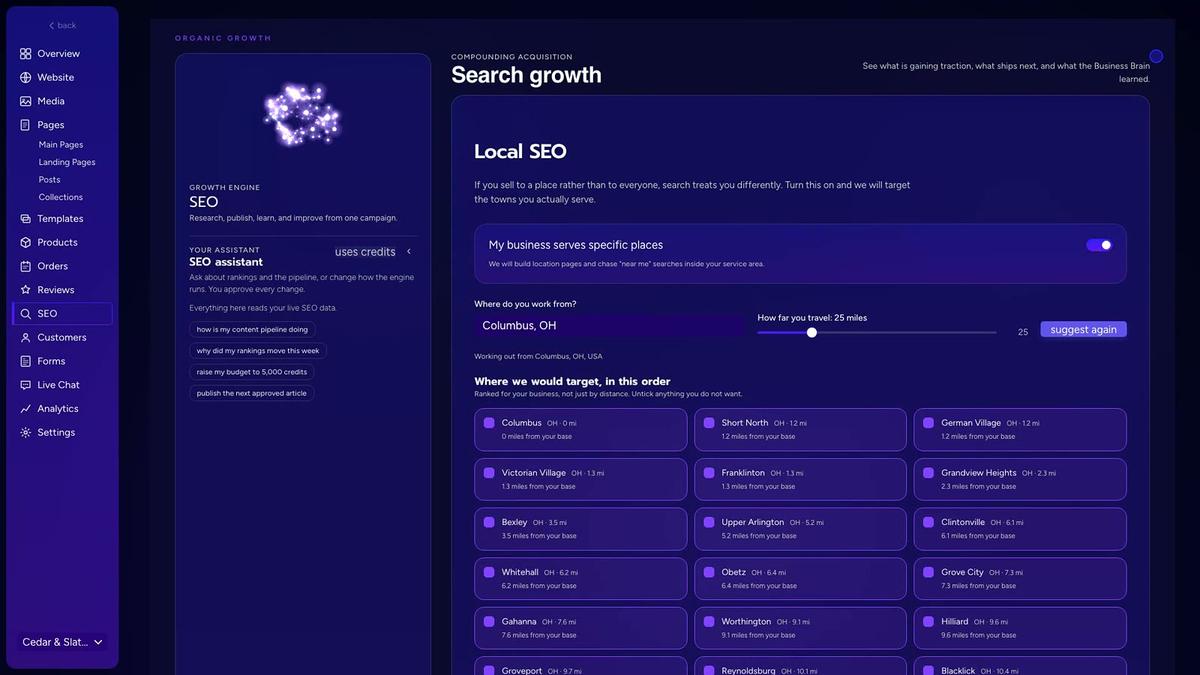
Find out where you show up on the map
A free map check for your company. See which towns find you and which call a competitor.
Book a callDoes a Local SEO Expert Help You Show Up in AI Search?
AI search tuning is the work of feeding clear facts to AI tools. More buyers now ask ChatGPT, Gemini, and Perplexity for local picks.
Searchers want a reliable roofer, clinic, or accountant nearby. AI answers now sit beside regular search results. Some buyers never scroll past them.
The same basics feed both. Accurate hours matter. Clear service names matter. Honest reviews matter most of all.
AI tools pull names from clean directory listings. They also read reviews. Plain service pages help them understand your trade.
No honest specialist promises an AI tool names you every time. Clean data still gives Google and AI systems reasons to pick you.
How to Vet a Local SEO Expert Before You Hire
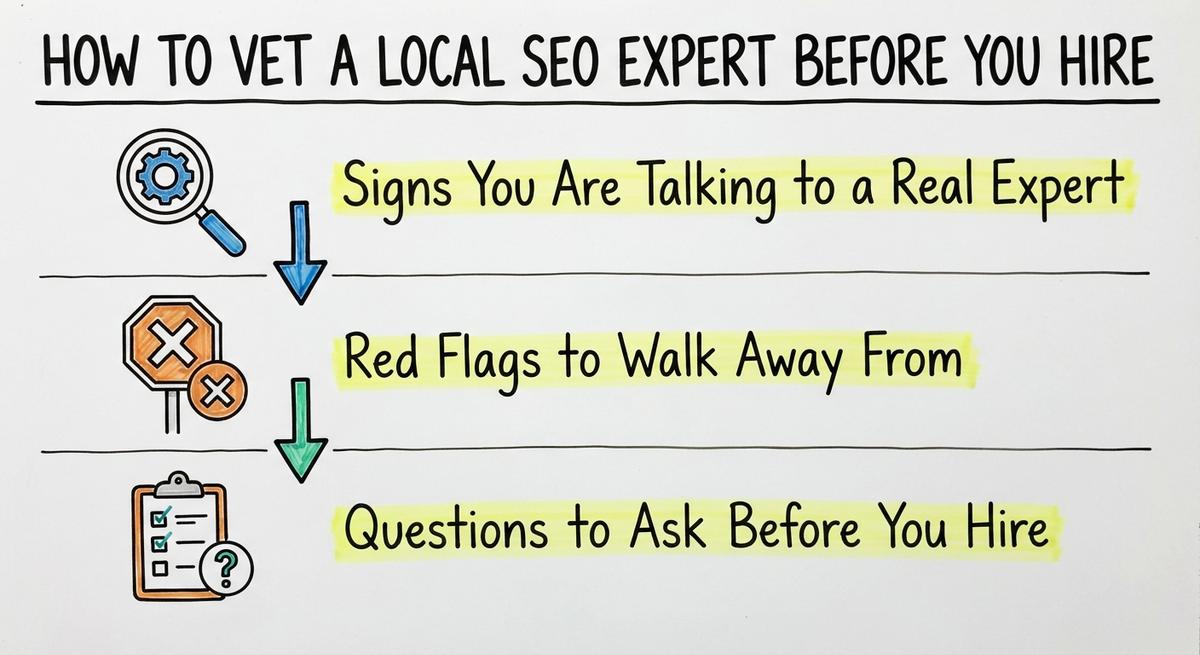
Vetting a specialist takes 1 short call and 3 direct checks. These checks protect your budget from wasted months.
Good experts welcome your questions. They show real proof right away. You spot true pros fast when you know what to watch.
Signs You Are Talking to a Real Expert
A real specialist is someone who audits your profile and site before pitching. They spot broken links on your first call. They spot missing categories too.
Thin service pages stand out to trained eyes. A pro also checks your reviews and listings. Watch for four green flags:
- They explain the plan in plain English.
- They share past results from similar businesses.
- They name exact tasks for the first 30 days.
- They confirm you own your domain.
Lists of the best roofing SEO companies show how to compare providers. Clear answers prove you found a pro.
Red Flags to Walk Away From
Guaranteed rankings are a classic sign of risky shortcuts. Nobody outside Google controls the ranking order.
Fake guarantees hide tactics that put your domain at risk. Watch for four warning signs:
- They refuse to show live examples.
- They push a 12-month contract with no task list.
- They suggest fake reviews or fake addresses.
- They send thick reports with zero call data.
Avoiding bad providers saves months of penalty cleanup.
Questions to Ask Before You Hire
Ask 4 direct questions before paying a single dollar. Write down each answer. Compare candidates fairly.
- What tasks happen in my first 30 days?
- Who owns my website, domain, and Google profile?
- How do I track new calls each month?
- What happens to my site if I leave?
Side-by-side notes reveal who dodges. An honest specialist answers all four clearly. Vague answers on ownership are a deal breaker. So are vague answers on reporting.
Cost and Timeline for Local Search Work
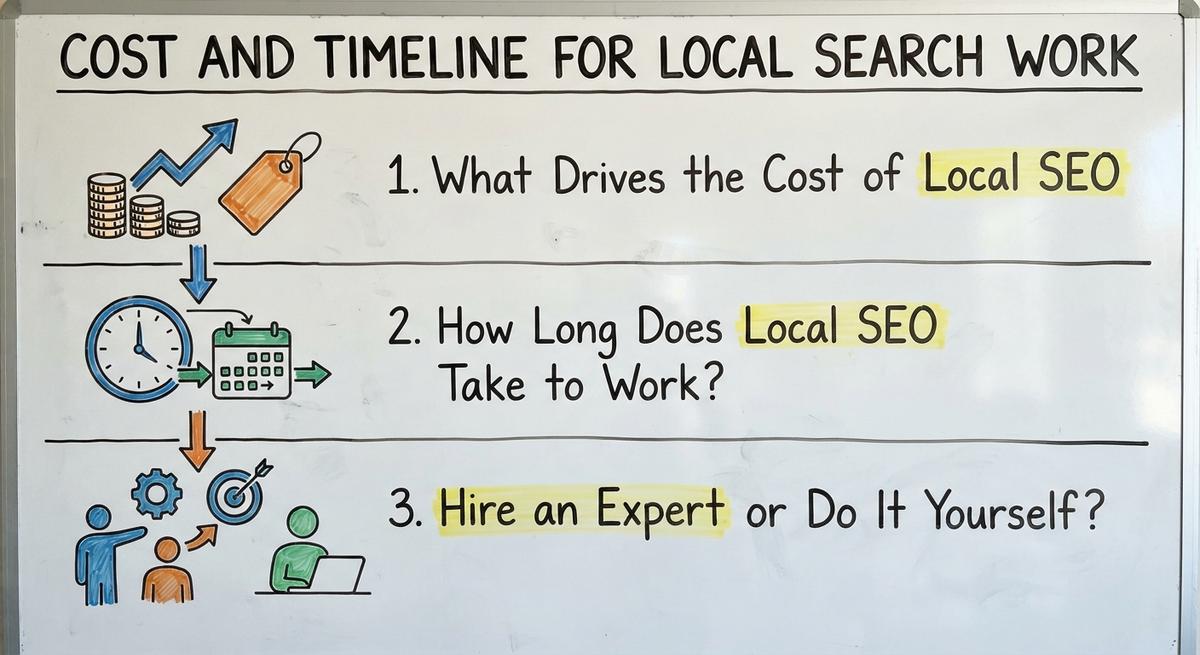
3 main factors set your local search cost and timeline. They are competition, location count, and site health.
These drivers help you budget before you hire. You avoid surprises when your plan fits your market.
What Drives the Cost of Local SEO
3 cost drivers set your monthly fee. First, your number of office locations shapes the workload.
Second, city competition sets how much content you need. A crowded market needs more pages. Third, your current site sets the early repair work. A broken site costs more to fix than a clean one.
A single-location shop needs less work than a 5-office practice. Some owners compare SEO against Local Services Ads. Others weigh Google Ads for roofing companies and other trades.
Google Local Services Ads Help says you "Pay only for leads related to your business and the services you offer." Ads stop when spending stops. SEO builds lasting assets.
Match your budget to market size. That keeps spending smart.
Results you can check
Past SEO campaigns grew organic traffic 26x in 14 months, and 15x on another. Top Rated Plus on Upwork with 99% job success.
Work for brands like New Balance, Purina and Aramark, and SEO for Planned Parenthood.
Book a callHow Long Does Local SEO Take to Work?
Local SEO speed is a mix of quick profile wins and steady growth. Fixing wrong hours sparks quick wins on Maps. So does fixing missing categories.
Simple profile fixes lift calls within weeks. Full organic growth in a competitive city takes several months.
Trades like roofing SEO depend on rival strength.
Steady monthly work compounds. Your site becomes a lead engine. Guides on how to get roofing leads show the same slow build.
Hire an Expert or Do It Yourself?
Doing local SEO yourself costs 4 hours a week or more. Say you spend 4 hours learning tools. You could bill $75 an hour instead.
That choice costs $300 a week in lost income. Over one year, you lose $15,600 in billable time.
A brand-new shop with free time can claim its own Google profile. Owners can ask early buyers for reviews. They can post weekly job photos too.
The harder parts take skill. Site speed, page structure, and listing cleanup eat hours. Once your schedule fills, hiring help costs less than missed calls.
Handing off search work frees you to run your crew or clinic.
Local SEO for Trades, Clinics, Law Firms and Shops
Trade-specific SEO is the practice of writing pages in your industry's words. A homeowner with a leaking roof searches differently. A patient needing a Saturday dentist does too.
- Trades: Roofers and plumbers need service pages and emergency buttons. A roofing SEO company or a broader roofing marketing agency handles both. Local SEO for roofing companies and HVAC SEO win storm calls.
- Clinics: Dental offices need clear service pages and booking forms.
- Law and Accounting Firms: Attorneys and CPAs need practice area pages.
- Shops and Studios: Stores and salons need exact hours and directions.
Each trade has its own search words. A roofing buyer types "storm damage repair." A clinic patient types "walk-in dentist." Pages should use those exact words.
Speak straight to your local buyer. Searchers turn into booked appointments.
What Working With a Good Local SEO Expert Looks Like
Working with a good local SEO expert is low-risk when you see the work first. Ask any provider to show you sample work before you pay. A homepage draft or a sample service page is a fair request.
You should see the look, wording, and layout for your business first. Then decide on a monthly plan.
A sound plan covers your website, service pages, and ongoing local work.
It should name who writes each page. It should follow Google's people-first content guidance. Ask how fast text edits and new pages go live. Good providers update pages in days, not months.
You should never need to touch a dashboard yourself.
Proof to Ask For
Past results are the best proof. Ask every expert for real numbers from past campaigns. Look for organic traffic growth and call counts over time.
Ask for results from businesses like yours. A roofer should see roofing results. A clinic should see clinic results.
Ask who did the work and who will do yours. Check reviews on independent sites too.
Real numbers and steady execution separate pros from talkers. Steady roofing leads are one example of proof worth asking about.

Get a second opinion on your current setup
Already paying for marketing? Get a free second opinion on what works and what wastes money.
Book a call
What to Do This Week and Your Next Step
Check 3 simple items on your phone this week. Act like a new customer:
- Confirm your name, phone, and hours match on Maps and your site.
- Count your Google reviews against your top 3 rivals.
- Tap your website link and see if the call button shows fast.
Slow mobile pages send buyers to rivals.
Compare against a strong roofing landing page for ideas. So do missing call buttons. If your site looks dated, talk to a local SEO expert. Ask them to show you what they would change first.


Frequently asked questions
How to do SEO for local business?
Start by claiming your Google Business Profile. Fill in your exact name, address, phone number, hours, and services. Next, build a fast mobile website. Give each service and town its own page. Earn genuine customer reviews. Keep your directory listings identical everywhere.
Who is the best SEO expert?
No single person or company is the best fit for every business. Your choice depends on budget and how hands-off you want to be. A freelancer fits small tasks. A marketing agency fits large brands. A done-for-you service fits busy owners.
Who owns my Google profile and website?
You should always own your domain name, website content, and Google Business Profile. Before hiring any local SEO expert, get ownership in writing. Your accounts should sit under your own email login. Then you never lose your rankings if you leave.
Do I need local SEO if I already run ads?
Yes. Local SEO builds long-term visibility. It keeps bringing calls even when you pause your ad budget. Many homeowners also skip sponsored ads. They click straight onto Google Maps results or organic listings.
Is a local SEO expert worth it?
A local SEO expert is worth it when you want steady phone calls. You skip evenings spent learning marketing software. One or two extra booked jobs a month often cover the monthly cost. That holds for many trades, clinics, and local firms.
How fast will I see calls?
Profile fixes can lift Google Maps calls within a few weeks. Think updated categories, hours, and photos. Bigger gains from new service pages build over several months. Google needs time to index your site.
Do I need a new website?
You need a new website if your current site loads slowly on phones. The same goes if it hides your phone number. Missing service and town pages is another sign. Ask to see a sample homepage before you decide.
Can you fix my Google profile?
Yes. Fixing your Google Business Profile is one of the first steps in local SEO work. A good expert updates your categories, services, hours, photos, and posts. They connect the profile to strong website pages. That helps the profile rank higher.
Start with a free homepage rebuild
Book a short call. Your new homepage is free to see and yours to keep.
Book a callRelated guides
More on the same work.
Guides
- Local SEO Optimization Services
- SEO Expert Near Me
- Local SEO for Roofing Companies
- Local SEO for Contractors
- SEO Expert for Hire
- Hiring an SEO Expert
- On Page SEO Check List
- Best Roofing SEO Companies
- Roofing SEO
- Roofing SEO Company
- Roofing SEO Services
- Dental SEO Companies
- HVAC SEO
- Pest Control SEO Company
- Electrician SEO Company
- Llm SEO Services
- Affordable SEO Company in USA
- Plumbing SEO Services
- Web Design and SEO Services
- Squarespace SEO Optimisation
- SEO Package for Small Business
- How Do I Get More Google Reviews