


Pest Control SEO Company
Pest control SEO companies are specialists. A pest control SEO company helps pest businesses win calls from Google. It works on your site, map listing, and reviews.
Worried homeowners do not scroll far. They call 1 of the first 3 companies on their phone.
Missed calls cost real money. Do the math. Losing 3 calls a week at $250 per job equals $750. Over 52 weeks, that adds up to $39,000 in lost work.
Many agencies promise top spots. Then they hide behind vague charts. You will learn what to ask. You will also learn to read a call report.
A good partner handles 5 jobs for you.
They also cover pricing, proof, and red flags. Read them before you sign. A fair contract protects you. A bad one can lock you in for 12 months. The difference shows up in the fine print.
It skips the sales pitch. It fits solo operators and multi-truck pest firms alike. Each section ends with something you can check yourself. You can test a provider's claims on your own phone. You can match their reports against your own call logs. No jargon is needed to judge the work. You only need to know where your calls come from.
Book a callWhat Is a Pest Control SEO Company?
A pest control SEO company grows your local visibility. More visibility brings calls from nearby homeowners.
General agencies chase social media likes. Local specialists focus on Google Maps and service-area pages.
A good SEO company for pest control measures success in booked jobs. Empty clicks never pay your technicians. They never cover truck fuel either.
"Local results are mainly based on relevance, distance, and popularity," says Google's help center for business listings.
Roofers and plumbers play by identical rules.
Who Should Hire a Pest Control SEO Company?
Owners who need more inbound calls should bring in a specialist. Pest firms serving 5 towns or more need dedicated local pages.
Owners tired of vague reports benefit too. A real partner counts every lead from phones and web forms.
Smaller shops can wait. Owners with 1 truck and 1 town can start with a well-built profile.
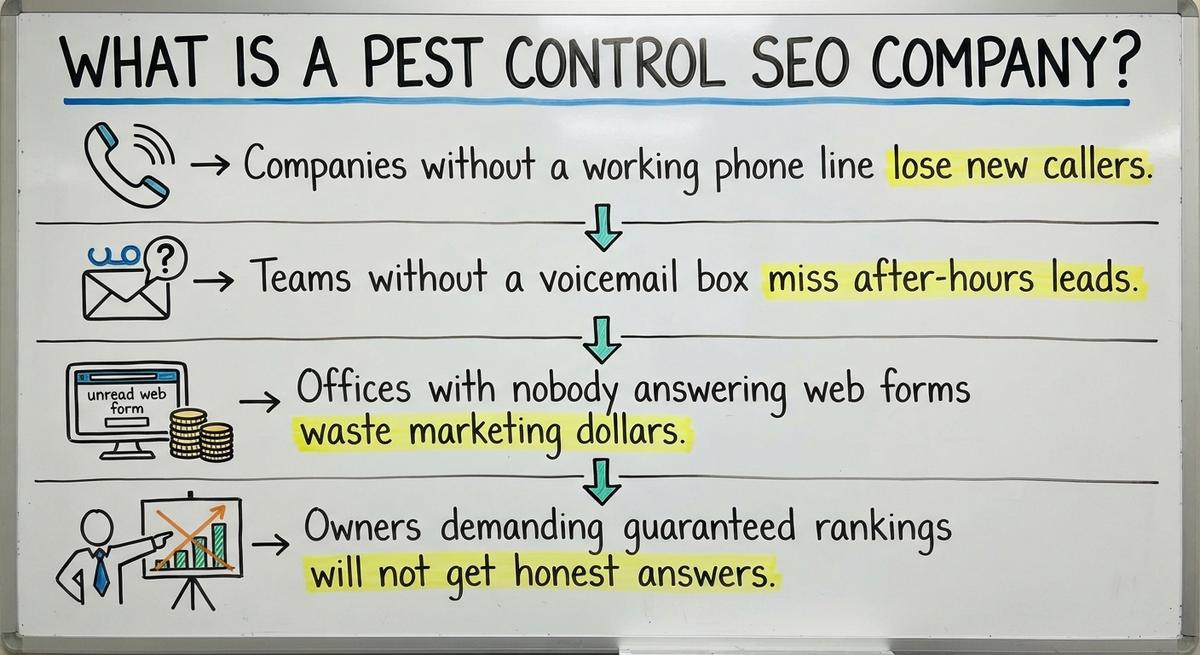
Some pest businesses are not ready for search campaigns yet.
- Companies without a working phone line lose new callers.
- Teams without voicemail miss after-hours leads.
- Unanswered forms waste ad dollars.
- Owners who demand guaranteed rankings will not hear honest answers.
Fix the phone line and intake first. Spend on marketing after that.
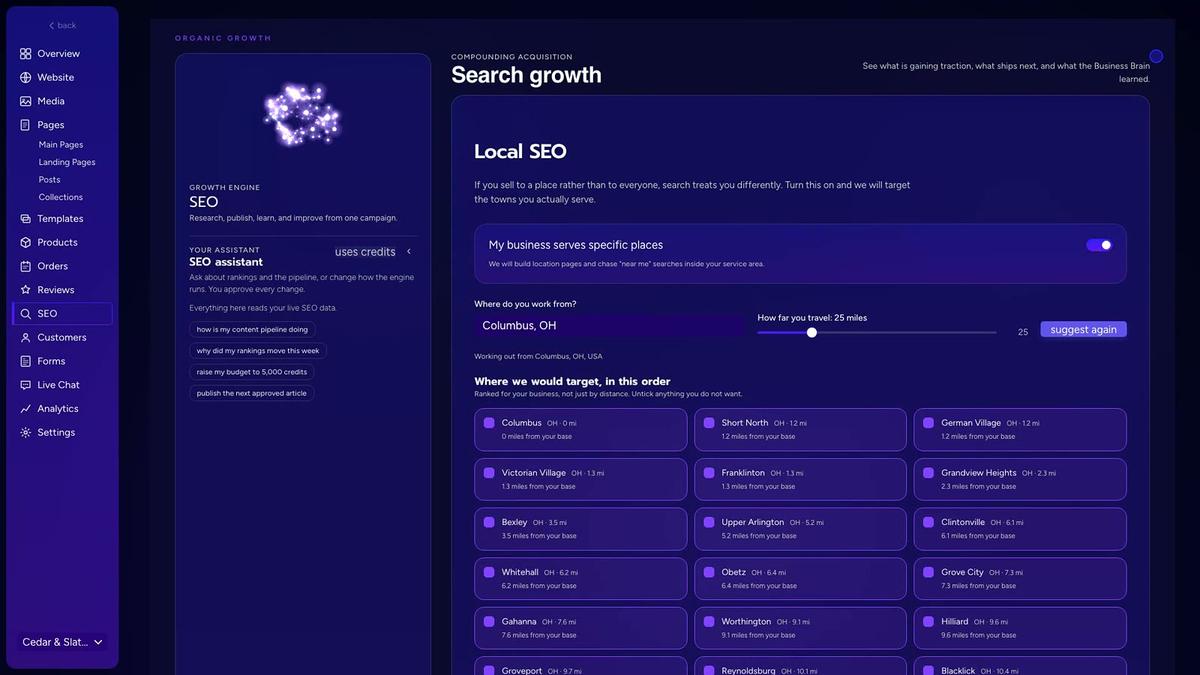
See your new homepage before you pay anything
Your pest control homepage, rebuilt free. You see it before you pay anything.
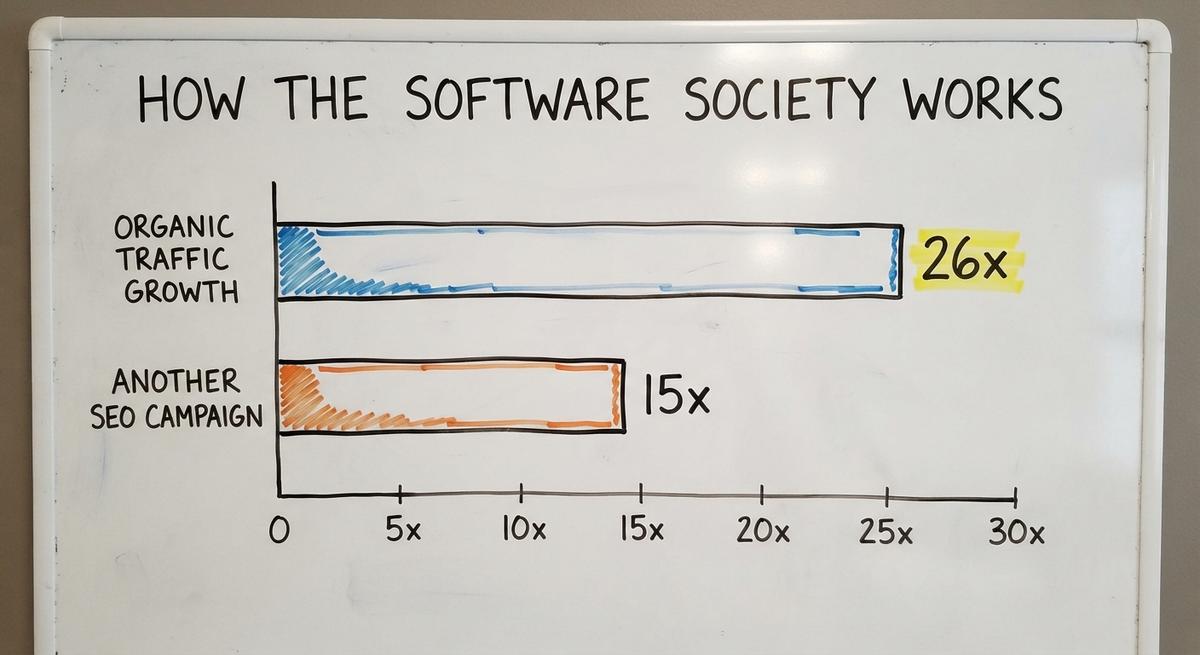
Past SEO campaigns grew organic traffic 26x in 14 months.
Book a callHow Do Customers Find Pest Control Companies on Google?
Local buyers type a pest problem and a town name. Most search on a phone. They want fast answers. They want a clear call button.
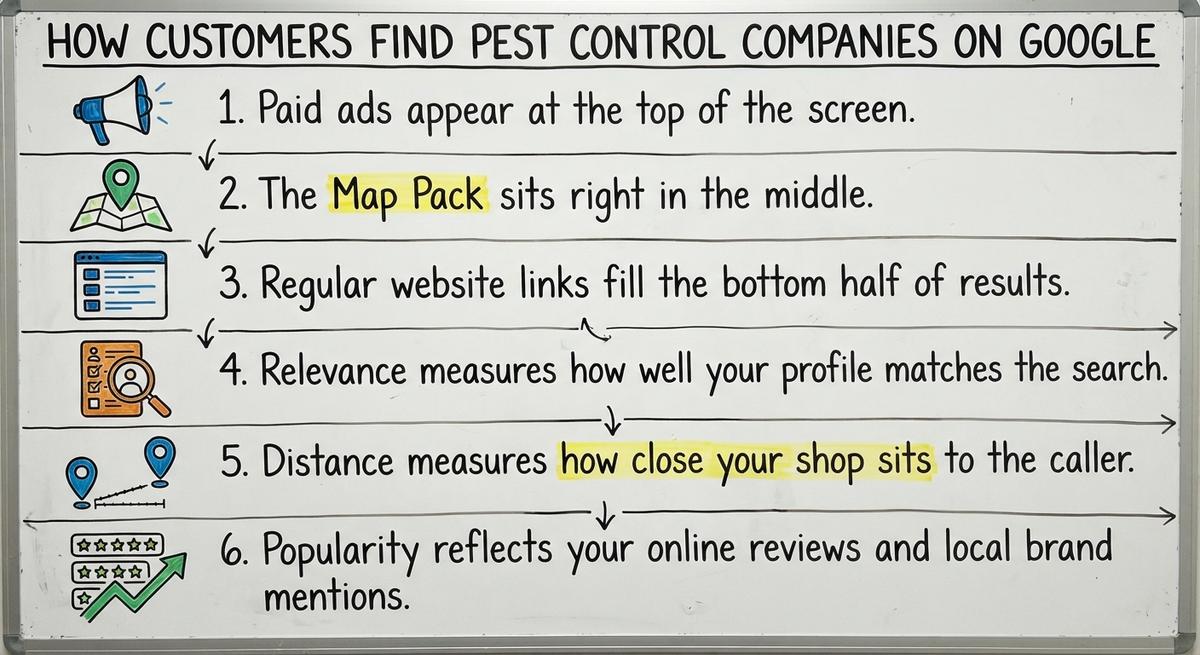
Google splits a local results page into 3 areas.
- Paid ads sit up top.
- Map Pack results sit in the middle.
- Regular website links fill the lower half.
Each area needs different work. Each pays off differently. A strong pest control SEO company handles listing and site together.
Paid ads include Google Local Services Ads. "Pay only for leads related to your business and the services you offer," Google tells advertisers.
Urgent callers with wasps tap fast. They want help today. Quarterly spray buyers read details first.
Winning both buyer types takes quick pages and plain copy. Roofers see the same split. This explainer on Google Ads for roofing companies covers it.
Why Does the Map Pack Matter for Pest Control?
Google's Map Pack shows 3 businesses. A small map sits beside those names.
Phone searchers see your rating and hours. They also see a tap-to-call button.
Many pest customers tap it without visiting your website. Track map calls apart from site calls. Splitting them shows your best channel.
Ignore your listing and your fastest leads go to a rival. That rival gets the job.
What Does Google Say About Local Ranking?
Google ranks local pest control firms on 3 core signals. Its ranking help page names them.
- Relevance: how well you match the search.
- Distance: how near you are to searchers.
- Popularity: your reviews and local brand mentions.
No agency controls where a homeowner lives. Distance is fixed.
Some buyers now ask AI tools like ChatGPT, Gemini, or Perplexity for names. Ask any provider to report AI visits as a separate channel.
Nobody can promise AI mentions. Good SEO companies for pest control work on relevance and popularity instead.
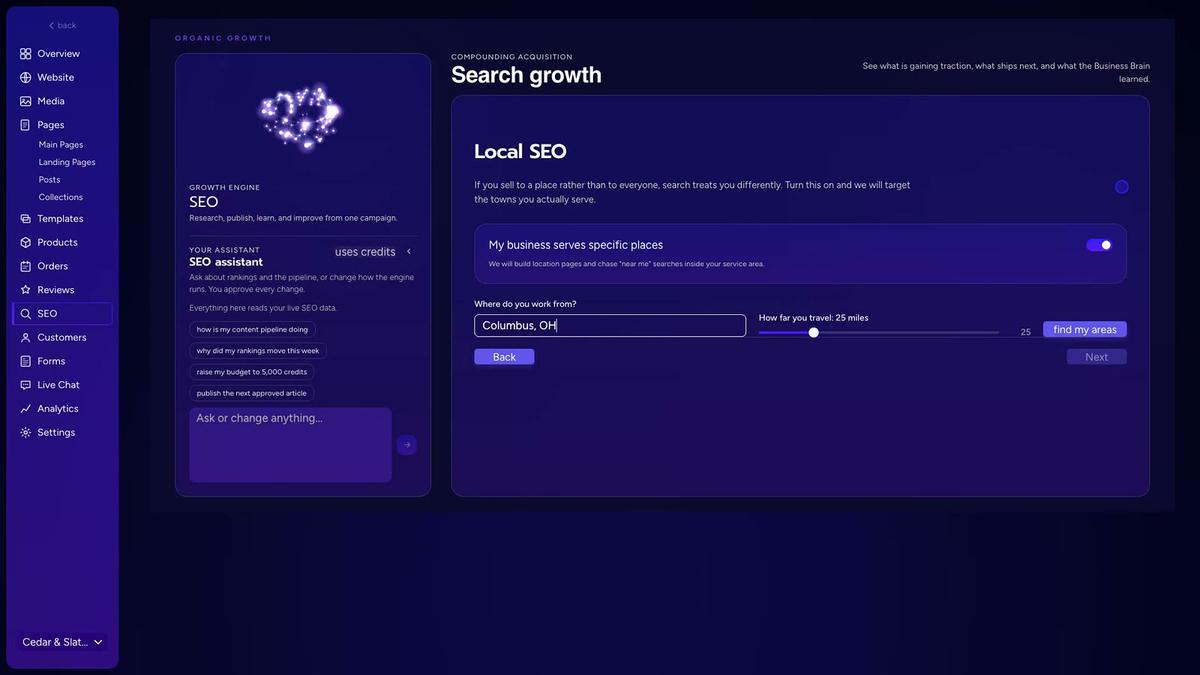
What Work Is Included in Pest Control SEO?
Any SEO company you hire should manage 5 core local assets.
- Website speed and mobile layout.
- A page for each pest.
- A page for each area you serve.
- Your business profile on Google.
- Lead tracking by source.
Fast pages keep urgent callers around. One slow screen sends a worried homeowner back to Google.
Put a call button high on every mobile page. Make it big.
Ask how long simple edits take. Some providers make owners wait 2 weeks for basic changes. Seasonal pest content cannot wait that long. Edits should take hours, not weeks.
Run each new page through an on-page SEO checklist before launch.
Which Service and Town Pages Does Your Area Need?
Service pages cover each pest you treat. Each one lists only treatments your technicians really perform.
Plan on 6 core service pages.
- Ants need a treatment plan page.
- Rodents need clear steps for mice and rat removal.
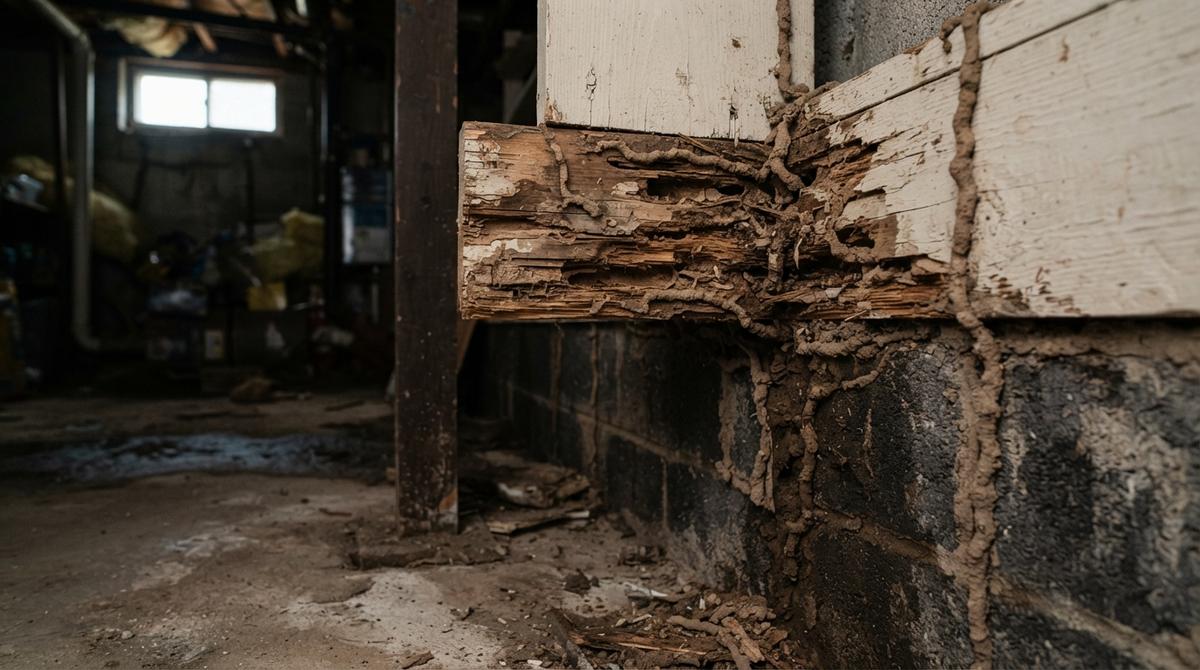
- Termites need inspection and barrier details.
- Bed bugs demand clear prep steps for nervous homeowners.
- Mosquitoes fit seasonal yard spray pages starting in April.
- Wildlife pages cover raccoons, squirrels, and attics.
Each page answers buyer questions. It also shows how to book.
Commercial work deserves its own pages. Restaurants and property managers search differently. They want service contracts and inspection logs.
A town page is a local landing page built for 1 specific city. Google warns against copying text and swapping place names.
"Doorway abuse is when sites or pages are created to rank for specific, similar search queries," Google's spam policies warn.
Real town pages include neighborhood details and seasonal pest timing. Spring ant swarms hit in April on many routes. Fall rodent calls ramp up in October.
Write seasonal topics before those peak months. Plan spring 2027 pages by early winter. Your exact page count depends on scope.
A landing page built for one service follows the same logic in any trade.
Find out where you show up on the map
A free map check for your pest control company. See which towns find you and which call a competitor.
Book a callHow Does Google Business Profile Help Local Rankings?
Google Business Profile feeds Map Pack results. Your pest company name, phone number, categories, and service area live there.
Consistent details build trust with search engines.
- Google needs your exact name and number.
- Bing pulls those contact details too.
- Yelp confirms your address and service hours.
- Facebook reinforces your number and site link.
Mismatched numbers confuse homeowners. They confuse search systems too. Fix them all at once.
For a full setup walk-through, read this primer on Google Business Profile for roofers. Those steps match for pest firms.
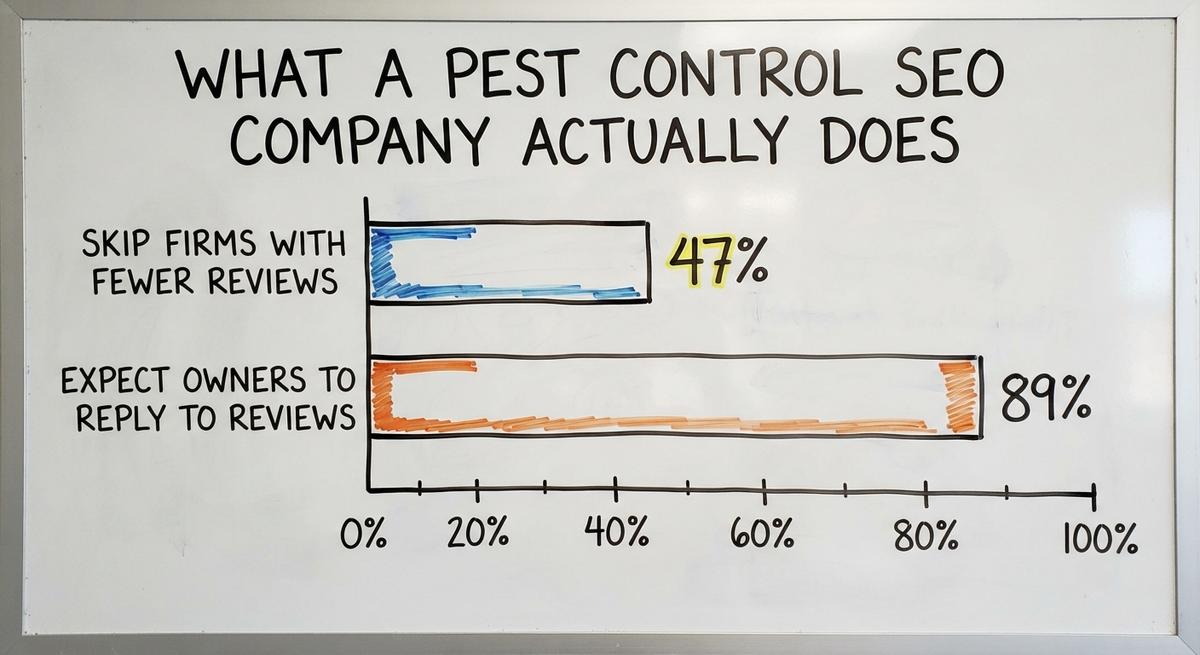
Reviews drive your popularity signal. "97% of consumers still lean on reviews to guide their purchase decisions," BrightLocal reported in 2026.
BrightLocal's 2026 survey adds 2 more numbers. 47% of consumers skip firms with fewer than 20 reviews. 89% expect owners to reply.
Follow Google's review policy on every request. "Reviews and other user contributions to Google Maps must reflect a genuine experience," that policy states.
Never offer discounts, cash, or gifts for reviews. These tactics for getting more reviews work in any home service trade.
Reply to new reviews within 2 days. Post fresh photos and weekly updates. Steady activity keeps a pest listing alive.
How Should Call and Form Tracking Work?
Turn on call tracking before search work. Every lead needs a source label.
Ask for leads split into 4 buckets.
- Organic search: calls from regular website pages.
- Google Maps: taps on your Map Pack phone button.
- Paid ads: leads you bought through ads.
- Bots: spam kept out of totals.
Bot traffic is a stream of junk submissions from spam scripts. Spam never counts as a real pest control lead.
Clean labels show which channel pays.
Ask to hear call recordings too. A recording shows if the caller booked. Guesswork ends.
What Do Good Pest Control Website Pages Look Like?
Good pest control pages speak to worried homeowners in plain words. Short sentences and 1 clear next step convert visitors fast.
Google Search Central sets the test. Good content is "created primarily for people". Rankings come second.
Homeowners and property managers ask different questions. Serve both? Build separate residential and commercial pages.
Every page needs a call button near the top on mobile. Add a short contact form with only 3 or 4 fields.
Never promise 24/7 service without overnight staff. Never promise arrival times your dispatch board cannot hit.
Strong home service website design follows these rules too.
Which Claims Need Proof Before They Go on Your Site?
Unverified claims put your pest control business at legal risk. Every promise needs proof behind it.
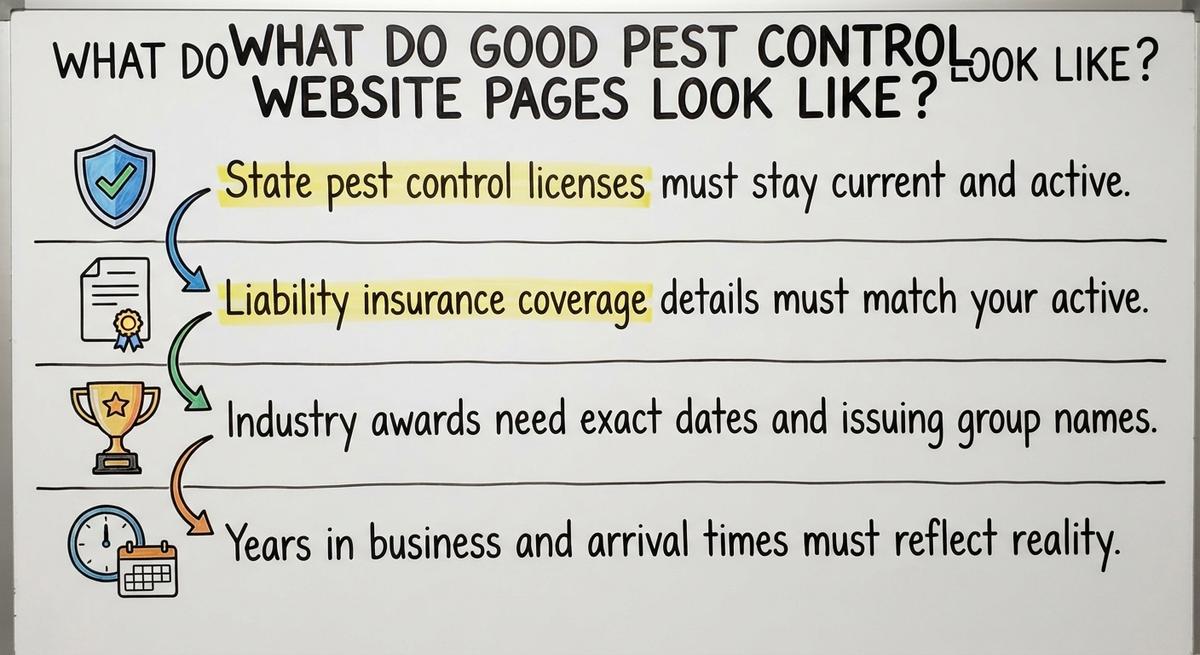
Verify 4 facts before publishing any page.
- State pest control licenses must stay current.
- Insurance details must match your active policy.
- Awards need exact dates and issuing groups.
- Years in business and arrival times must reflect reality.
Confirm each claim yourself. Do it before launch. Honest facts protect your local name.
Google's people-first guidance rewards accuracy.
How Do Map Pack Position and Grid Scans Work?
Google Maps rankings change block by block. Checking rank from 1 office desk gives a false picture.
Searchers 5 miles away see another order. Rank is local.
A grid scan is a map covered with evenly spaced ranking dots. Each dot shows your rank there.
Dots reveal strong pockets near your office. They also expose weak towns on the edge of your pest route.
How Should You Use a Grid Scan?
Run a grid scan every 30 days. Compare each scan with the last one.
Weak towns show as low dot clusters. Those are your targets. New local content and profile updates should target those spots first.
No honest pest control SEO company promises a specific dot rank. Searcher distance always plays a role.
Treat scans as a guide for the next round of work. This look at how long local SEO takes helps set fair timelines.
Results you can check
Past SEO campaigns grew organic traffic 26x in 14 months, and 15x on another. Top Rated Plus on Upwork with 99% job success.
Work for brands like New Balance, Purina and Aramark, and SEO for Planned Parenthood.
Book a callWhat Should Monthly Reports Show You?
Monthly reports must answer 1 question. Did the phone ring? Where did that caller find you?
Traffic charts mean nothing with empty trucks. Calls matter. Your pest control report should split leads into organic search, Google Maps, paid ads, and bots.
| Report Source | What It Tracks |
|---|---|
| Organic search | Calls and forms from website results. |
| Google Maps | Taps on your listing's call button. |
| Paid ads | Leads from Google Ads or pay-per-lead ads. |
| AI tools | Visits from AI assistants. |
| Bots | Junk fills left out of totals. |
Showing AI visits separately lets you watch new search habits. The channel is still small.
Trustworthy reports use plain language and real call logs. Match them against your phone records.
Compare 2026 calls with 2025 calls, month by month. Count booked jobs, not just rings. A call that never books is not a win. Every report should list finished work. It should list next steps too.
How Should You Choose a Pest Control SEO Company?
Smart pest control owners ask 4 direct questions before signing. A reliable firm answers plainly.
- What pages will you build each month, and for which towns?
- How will reports separate map calls, search calls, and bots?
- Will the person selling the plan do the daily work?
- Can I see real sample work first?
Vague answers are a warning. Clear answers separate real workers from smooth sales teams. Roofers use a similar list when they vet a roofing SEO company.
How Do You Compare Pest Control SEO Agencies and Case Studies?
Agency size and focus vary across the pest control market. Some national firms serve dozens of industries. Others work only with home service or pest companies.
Size matters less than proof. Proof is specific. Read each case study closely.
- Does it name a real metric, like calls or booked jobs?
- Does it give a time frame, like 12 months?
- Does it split map and website calls?
- Can the agency show the work behind the result?
Lists of the best roofing SEO companies show how to compare firms side by side. A roofing marketing agency faces identical tests.
Pick a local SEO company for pest control that fits your team.
What Should No Honest Firm Promise, and Who Owns Your Assets?
Honest SEO companies never guarantee top rankings. Nobody outside Google controls the algorithm.
Walk away from fixed lead guarantees too. Nobody can keep them.
Confirm asset ownership in writing before signing. You must own your domain name and Google Business Profile.
Full control protects you. It keeps you free. You can switch providers without losing your phone history.
How Is Pest Control SEO Priced, and What Proof Should You Expect?
Most providers sell pest control SEO on a monthly retainer. Here is how the main lead channels compare.
| Channel | How You Pay | Where It Shows | What To Track |
|---|---|---|---|
| Organic SEO | Monthly retainer. | Regular results. | Calls from site pages. |
| Map Pack | Profile work, no ad fee. | The 3-business map box. | Taps on call buttons. |
| Local Services Ads | Per lead. | Top of the page. | Booked leads. |
| Google Ads | Per click. | Top and bottom. | Cost per call. |
| Directories | Free or paid listings. | Yelp, Bing, and others. | Matching details. |
| Social media | Ad spend or staff time. | Feeds, not search. | Profile visits. |
Organic work builds an asset you keep. Price follows towns, services, and page count.
Ask for the scope in writing. It should list pages, profile updates, and reports for each month.
Value matters more than price. Run the math. An extra 10 calls a month, worth $250 each, adds $2,500. Over 12 months, that is $30,000.
Paid leads work differently. Local Services Ads charge per lead. There is no flat monthly fee.
Ask for proof from past campaigns. Look for organic growth measured over 12 months or more. Ask for call counts, not just traffic.
Check reviews on Google or freelance sites. A firm with real results will show them gladly.
Compare plans the way roofers compare roofing SEO services: line by line.
Get a second opinion on your current setup
Already paying for pest control marketing? Get a free second opinion on what works and what wastes money.
Book a callShould You See Sample Work First?
Yes. Ask to see sample work before signing. A sample homepage or service page shows real writing quality.
Test its speed on your phone. You judge it with zero risk.
Then decide if a retainer makes sense for your pest business.
What Do Town and Service Pages Look Like in Practice?
Picture a pest company serving 17 towns. That means 17 town pages.
Each one links to the termite, rodent, and ant pages. Grid scans show which pages need work.
No two town pages should read alike. Google's doorway rules explain why.
Organizing pages by pest and by town gives every searcher a match. The same layout powers strong roofing SEO and HVAC SEO campaigns.

How Do You Get Started With a Pest Control SEO Company?
Simple notes help any provider start fast. Gather 3 items before your first call.
- A list of pest services, your service area, and your site address.
- Admin login details for your Google listing.
- Monthly call counts for 2025 and 2026 from phone logs.
Those notes let a provider map your market on day 1.
Ask each SEO company what it will deliver in the first 30 days. Compare that answer with the lead sources roofers rely on. Then read these ways to get more leads in a home service trade. Ask how search fits your wider digital marketing plan.
What Do Owners Ask About Pest Control SEO Companies?
Owners also ask about software and business sale prices. Here are plain answers.
How much does a pest control company sell for?
Sale prices depend on recurring revenue and documented lead sources.
Steady annual contracts earn higher multiples. One-time spray jobs carry less resale value.
Clean books and strong ratings raise offers. So do predictable organic call logs. Buyers pay more when leads arrive without heavy ad spend.
What are some good pest control software programs?
The right choice depends on truck count and office staff. No single program fits every pest crew.
A solo operator can start with a basic website builder and a scheduling tool. Firms with 2 trucks or more compare freelancers, agencies, or a done-for-you service.
Pick tools your office can update daily. Simple wins.
What Should Your Pest Control Company Do Next?
Local search growth for a pest control company comes down to 3 habits. Build pages by town and pest service every month.
Keep your profile active with real reviews and photos. Track every call and form by source.
Start small. Stay steady. Each piece supports the others. Together they make nearby homeowners call your dispatch desk.
Frequently asked questions
What does a pest control SEO company do each month?
It builds pages for each pest and each town. It updates your Google listing. It tags every lead by source. Monthly work also includes grid scans to spot weak towns. Pest pages get refreshed before peak seasons.
How is pest control SEO priced?
Most pest control SEO is sold as a monthly retainer. The price follows your town count, your list of treatments, and how many pages get built. Ask any company for that scope in writing.
How do I know pest control SEO is bringing calls?
Clean tracking labels every pest lead: organic search, Google Maps, paid ads, or spam bots. Hold those monthly counts up against your own office phone log.
Can anyone promise a number one spot on Google?
No. No honest pest control SEO company can promise a number one ranking or a fixed lead count. Google controls its results. It also weighs distance from each searcher, and no agency can change that.
What sets the sale price of a pest control business?
Recurring contract revenue matters most. Customer retention and documented lead sources come next. Buyers pay more for a pest company with steady annual plans, strong ratings, and predictable organic calls.
Which pest control software programs are worth a look?
No single pest control program is best. Crew size and office time decide the fit. Solo operators can use a self-run site builder. Multi-truck teams weigh a freelancer, an agency, or a done-for-you service.
Should a free sample page have strings attached?
A sample page from any pest control marketing company should come with no obligation. Review the design and writing first. Sign only if the sample earns it. Confirm in writing that you own any work you pay for.
Start with a free homepage rebuild
Book a short call. Your new pest control homepage is free to see and yours to keep.
Book a callRelated guides
More on the same work.
Guides
- Inventory Control Software for Small Business
- Inventory Control with Excel
- Inventory Control for Small Business
- Types of Inventory Control
- Inventory Control Procedure
- Types of Stock Control Systems
- Procedure for Stock Control
- Inventory Control App for Android
- Inventory Control Example
- Free Inventory Control Software for Small Business
- On Page SEO Check List
- Best Roofing SEO Companies
- Local SEO Optimization Services
- Roofing SEO
- Roofing SEO Company
- Roofing SEO Services
- Local SEO for Roofing Companies
- Dental SEO Companies
- HVAC SEO
- Local SEO Expert
- Local SEO for Contractors