


Inventory Reserve Meaning
Reviewed and updated: July 2025
Reviewed September 2026. Figures are worked from the assumptions stated beside them, so you can substitute your own and the arithmetic still holds.
An inventory reserve is a dollar amount you record on your books to account for inventory you own but expect to lose value on. You still have the stock. You just acknowledge that some of it is worth less than you paid for it. It is an accounting estimate, not a physical removal of goods. Think of it as a warning flag on your balance sheet.
Book a callWhat Is an Inventory Reserve
An inventory reserve is a set-aside amount in your accounting records. It says: some of what we own is not worth full price anymore.
You do not move the stock. You do not throw it away. You simply record that a portion of its value is at risk. That record shows up on your balance sheet.
Picture a warehouse with 3 pallets of slow-moving product gathering dust in the back corner. The goods are still there. But they may never sell at full price. An inventory reserve captures that risk in your books before the loss becomes real.
Damaged boxes, expired product, or styles no one orders anymore all qualify. The reserve is your honest estimate of what that stock is actually worth today.
We build it for your operation, and the first look is free
If you would rather not compare products, describe how your operation already works and we build the system around it.
No build cost. You see it running on your own process first, and the monthly subscription starts only once it is live.
Book a callWhy Inventory Reserves Matter for Distributors and Warehouses
Without a reserve, your financial statements overstate what your inventory is worth. That creates real problems.
Imagine a wholesale distributor carrying $40,000 in dead stock. QuickBooks still shows it at full value. The owner looks at those numbers and thinks the business is healthy. Then they buy more product they do not need, or price aggressively because margins look fine. Neither decision holds up once the dead stock is written off.
Inventory Valuation Is a Legal Requirement
The IRS makes accurate inventory valuation a legal requirement, not a preference. IRS Publication 538 states directly: "To figure taxable income, you must value your inventory at the beginning and end of each tax year."
Accurate counts also protect your ability to fulfill orders on time. As GS1 notes in its barcode standards guidance, "GS1 standards enable businesses to identify, capture and share information about products," which means scan-based counts are only as reliable as the underlying data they feed.
Inflated inventory numbers lead to bad calls. A reserve keeps those numbers honest.
What Are the Different Types of Inventory Reserves?
Four main types of inventory reserves cover most of the losses a distributor or warehouse will face. Each one targets a specific kind of risk.
- Inventory obsolescence reserve covers stock that has gone out of date or out of demand. A distributor sitting on last season's product that no longer moves is a classic example.
- Inventory shrinkage reserve accounts for goods lost to theft, counting errors, or damage that goes unrecorded. Shrinkage happens in every warehouse; the reserve acknowledges it.

Damaged Goods and Lower-of-Cost-or-Market Reserves
- Damaged goods reserve applies to items that are still on the shelf but can no longer be sold at full price. Think dented packaging or water-damaged cartons.
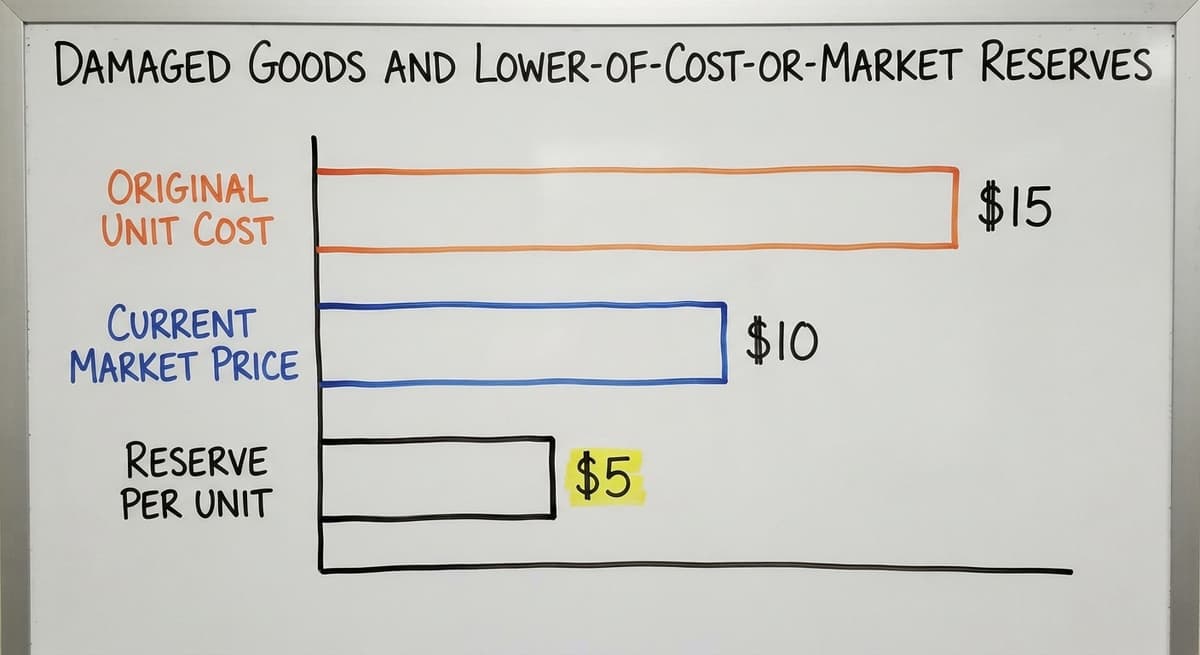
- Lower-of-cost-or-market reserve (sometimes called LCM) covers situations where the market price of a product drops below what you paid for it. If you bought 1,000 units at $15 and the market now pays $10, the reserve captures that $5 gap.
Naming the type of reserve you are using keeps your books clear and your review process consistent.
The comparison is easier when one option is built for you
Off-the-shelf means fitting your process to the software. We do it the other way round, and the first look costs nothing.
Book a callHow an Inventory Reserve Is Calculated
The math is straightforward. Identify the inventory at risk, estimate how much value you expect to lose, and record that amount.
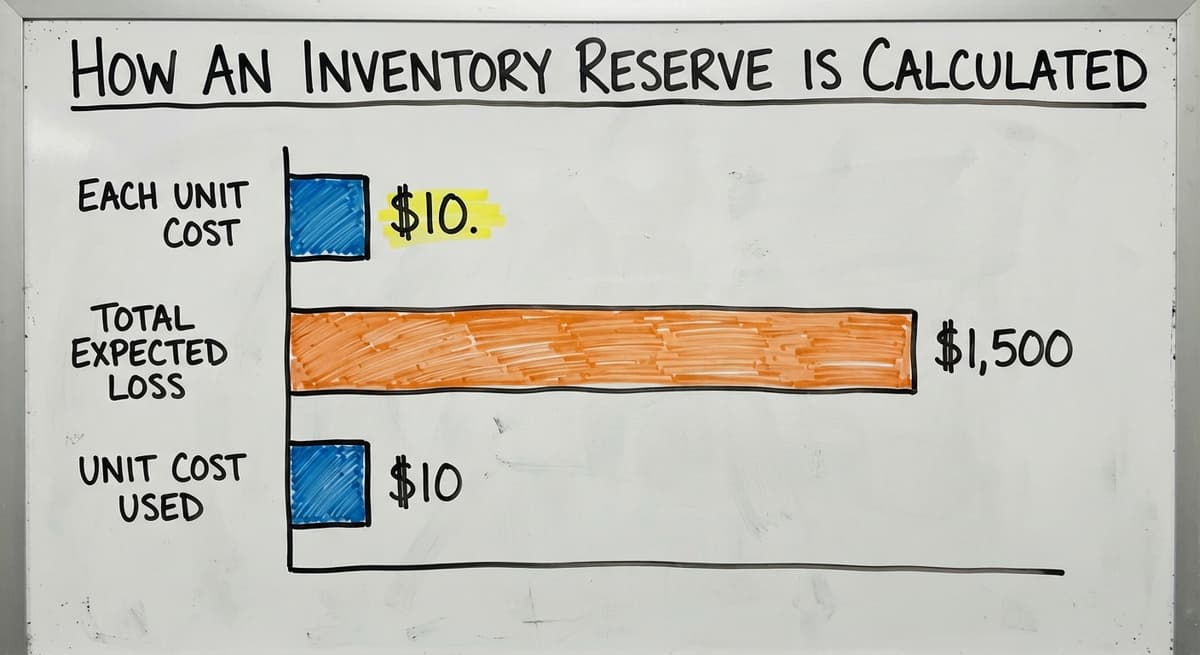
Here is a plain example. You have 500 units of a slow-moving product. Each unit cost $10. Based on past sales and current demand, you expect to recover only 70 cents on the dollar. That means a 30 percent expected loss, which works out to a $1,500 reserve: 500 units times $10 times 0.30.

Steps for Calculating Your Reserve Each Period
- List every product category where value is at risk.
- Assign a loss percentage based on sales history or age of stock.
- Multiply units by cost by that percentage.
- Record the total as your reserve.
The method should stay the same from one period to the next. Changing the formula every quarter makes it hard to spot trends. Good inventory management software can track aging stock and flag items that cross your threshold automatically, which removes most of the manual work from this step.
Inventory Reserve vs. Inventory Write-Off
An inventory reserve and an inventory write-off describe different moments in the same process.
A reserve comes first. It is a proactive estimate recorded before the loss is confirmed. You still own the goods. You are simply saying: we think some of this value is gone.
An inventory write-off comes later. It is the final removal of value once the loss is certain. The goods are gone, unsellable, or destroyed. At that point, you clear the reserve and remove the item from your books entirely.
Here is a concrete example. A pallet of food product is approaching its expiration date. You record a reserve now. Three months later, the product expires and you dispose of it. That is when the write-off happens. The reserve was the warning; the write-off is the close.

Where Inventory Reserves Show Up in Your Books
The reserve appears as a contra-asset on your balance sheet. A contra-asset is an account that reduces the value of another asset. In this case, it reduces the total inventory value shown.
So if your inventory is listed at $200,000 and your reserve is $8,000, the balance sheet shows $192,000 as the net inventory value.
The other side of that entry hits your income statement, usually as part of cost of goods sold or as a separate expense line. That is how the loss flows through your financials.
QuickBooks can hold these journal entries. However, it does not automatically track which products are aging or damaged. That data usually has to come from somewhere else, often a separate system or a spreadsheet. Your CPA or bookkeeper handles the actual journal entries. The operations team just needs to hand them accurate inventory data.
See it running on your own process first
No build cost. The subscription starts once it is live and doing the job, not before.
Book a callHow Inventory Management Software Supports Accurate Reserves
Good inventory management software flags slow-moving, damaged, or aging stock automatically. That matters because the reserve calculation is only as good as the data behind it.
When your system tracks every item in real time, you know exactly which SKUs have not moved in 90 days, which ones came back damaged, and which are approaching expiration. That visibility replaces guesswork with a reliable number.

Why Manual Tracking Falls Short for Reserve Accuracy
Small distributors relying on Excel or printed count sheets miss this layer entirely. A product can sit untouched for 6 months and never trigger a review because no one is looking at an aging report. By the time someone notices, the loss is larger than it needed to be.
Custom inventory tracking software for small distributors can surface this data without replacing QuickBooks. It feeds the right numbers into your existing accounting workflow. The reserve calculation becomes a routine output, not a year-end scramble. Accurate data is what separates a defensible reserve from a guess.
Signs Your Current System Is Making Reserves Hard to Track
Many small and mid-size operations struggle with this, and the signs are familiar.
If any of these describe your business, the reserve process is likely unreliable:
- Stock counts are done manually on clipboards or printed sheets, with no digital record.
- There is no aging report, so slow-moving inventory is invisible until someone physically walks the floor.
- Damaged goods are tracked in a separate spreadsheet that does not connect to the main inventory system.
- Reserve amounts are estimated once a year at the accountant's request, with no clear method behind the number.
- Dead stock sits on the shelf for months before anyone flags it for review.
These are common problems in 5-to-100-person operations. They are not signs of carelessness. They are signs that the tools have not kept up with the business. Better tooling closes these gaps without adding headcount.

How Do You Get Your Inventory Reserve Process Under Control?
Getting control of your reserve process starts with a clear audit and a consistent policy, and it does not need overhauling everything at once.
Here are 4 steps that work for most small distributors:
- Audit current at-risk inventory. Walk the warehouse and identify every product that is damaged, slow-moving, or aging past your normal turn rate. Assign a dollar value to each category.
- Set a written reserve policy. Decide what triggers a reserve for your business: 90 days without a sale, visible damage, a market price drop. Write it down so the method stays consistent.
Connecting Operations to Accounting and Reviewing Regularly
- Connect inventory data to your accounting records. The operations team tracks the stock; the bookkeeper records the reserve. Those two need to talk to each other on a regular schedule, not just at year-end.
- Review the reserve each quarter. Markets shift. Products age. A reserve set in January may be too low or too high by April. A quarterly review keeps the number current.
Inventory management software for wholesale distributors makes this repeatable. A custom system built around your existing workflows can automate the aging flags, generate the data your bookkeeper needs, and remove the manual steps that make reserves hard to keep.
If your current setup makes any of this feel difficult, that is worth a conversation. The right software does not add complexity. It removes the friction that is already there.
Not sure this is the right shape for your operation
Describe how the work runs today. We map it on a call and show you what it would look like built around that, before you spend anything.
Book a callFrequently Asked Questions
What does inventory reserve mean in plain terms?
An inventory reserve is a dollar amount recorded in your books to show that some of your stock is worth less than you paid for it. You still own the goods. The reserve is your honest estimate of expected loss, recorded before that loss is final.
Without a reserve, financial statements show inventory at full buy price even when some of it is damaged, obsolete, or unsellable. That overstated number leads to bad buying and pricing decisions. A reserve keeps the books honest.
In accounting more broadly, a reserve is an amount set aside from earnings or asset values to cover an expected future cost or loss. An inventory reserve specifically covers the expected decline in value of physical stock you already own. It is recorded as a contra-asset, meaning it reduces the value of an existing asset, your inventory, on the balance sheet. It does not represent money owed to anyone.
Why do wholesale distributors and warehouses need an inventory reserve?
Without a reserve, financial statements show inventory at full buy price even when some of it is damaged, obsolete, or unsellable. That overstated number leads to bad buying and pricing decisions. A reserve keeps the books honest.
What are the three types of reserves?
In accounting, reserves generally fall into 3 categories: capital reserves (funds set aside from profits for specific future use), revenue reserves (retained earnings held back rather than distributed), and specific provisions like an inventory reserve (an estimate of a known loss against a particular asset). The term is used differently depending on context, so it is worth confirming which type is being discussed.
Is reserve a liability or asset?
An inventory reserve is neither a liability nor a standalone asset. It is a contra-asset, meaning it reduces the value of an existing asset (your inventory) on the balance sheet. It does not represent money owed to anyone.
What does reserve mean in accounting?
In accounting, a reserve is an amount set aside from earnings or asset values to cover an expected future cost or loss. An inventory reserve specifically covers the expected decline in value of physical stock you already own.
What is an obsolete inventory reserve?
An inventory obsolescence reserve is the portion of your total inventory reserve that covers stock no longer in demand or no longer sellable. A distributor holding discontinued product that will never move at full price would record an obsolescence reserve against that stock.
Obsolescence is one of four main reserve types. The others cover shrinkage from theft or counting errors, damage to goods still on the shelf, and situations where the market price of a product drops below what you paid for it. Each type targets a specific kind of loss, and naming the type you are using keeps your books clear and your review process consistent.
How does inventory management software help with tracking reserves?
Inventory management software tracks aging, damage, and movement in real time. It flags stock that crosses your reserve thresholds automatically. That data feeds directly into the reserve calculation, replacing manual counts and year-end estimates with a consistent, repeatable process.
The difference between a reserve and a write-off matters here too. A reserve is recorded before the loss is confirmed, it is the estimate. A write-off happens after the loss is certain and the goods are gone or destroyed. Software that tracks stock continuously makes it easier to move from one stage to the other without missing the moment when a reserve should become a write-off.
What is the difference between an inventory reserve and an inventory write-off?
A reserve is recorded before the loss is confirmed. A write-off happens after the loss is certain and the goods are gone or destroyed. The reserve is the estimate; the write-off is the final accounting entry that closes it out.
Frequently asked questions
What does inventory reserve mean in plain terms?
An inventory reserve is a dollar amount recorded in your books to show that some of your stock is worth less than you paid for it. You still own the goods. The reserve is your honest estimate of expected loss, recorded before that loss is final.
Why do wholesale distributors and warehouses need an inventory reserve?
Without a reserve, financial statements show inventory at full buy price even when some of it is damaged, obsolete, or unsellable. That overstated number leads to bad buying and pricing decisions. A reserve keeps the books honest and satisfies the IRS requirement to value inventory correctly at the end of each tax year.
What are the three types of reserves?
In accounting, reserves generally fall into 3 categories: capital reserves (funds set aside from profits for a specific future use), revenue reserves (retained earnings held back rather than distributed), and specific provisions like an inventory reserve (an estimate of a known loss against a particular asset). The term is used differently depending on context.
Is reserve a liability or asset?
An inventory reserve is neither a liability nor a standalone asset. It is a contra-asset, meaning it reduces the value of an existing asset on the balance sheet. It does not represent money owed to anyone.
What does reserve mean in accounting?
In accounting, a reserve is an amount set aside from earnings or asset values to cover an expected future cost or loss. An inventory reserve specifically covers the expected decline in value of physical stock you already own.
What is an obsolete inventory reserve?
An inventory obsolescence reserve is the portion of your total inventory reserve that covers stock no longer in demand or no longer sellable at full price. A distributor holding discontinued product that will never move would record an obsolescence reserve against that stock.
How does inventory management software help with tracking reserves?
Inventory management software tracks aging, damage, and movement in real time. It flags stock that crosses your reserve thresholds automatically, replacing manual counts and year-end estimates with a consistent, repeatable process that feeds directly into your accounting records.
What is the difference between an inventory reserve and an inventory write-off?
A reserve is recorded before the loss is confirmed, while you still own the goods. A write-off happens after the loss is certain and the goods are gone or destroyed. The reserve is the estimate; the write-off is the final accounting entry that closes it out.
Start with a free first look
A 30 minute call, your operation mapped, and a clear picture of what we would build. No obligation and nothing to install.
Book a callRelated guides
The rest of this guide, for the parts of the job this page does not cover.
Guides
- Inventory Reserve Account
- Fnsku Meaning
- Classification of Inventory
- Excess Inventory
- Closed for Inventory
- Multi Location Inventory Management Software
- Inventory Management for Multiple Locations
- Costing Inventory
- Is Inventory a Long-term Asset
- Inventory Management System for Manufacturing
- Inventory Fixed Assets
- Inventory Management Pics
- Excel Inventory Template
- Push and Pull Inventory
- Consumable Inventory
- B2b Inventory Management
- Jewelry Inventory Management
- Dental Inventory Management