

Fnsku Meaning
FNSKU stands for Fulfillment Network Stock Keeping Unit. It is a barcode Amazon creates to tie a specific product to a specific seller inside its fulfillment network. If you run a warehouse, prep center, or fulfillment operation that handles Amazon inventory, FNSKU labels touch your workflow every day. This guide explains what FNSKU means, where it breaks down, and how a barcode inventory management system keeps it under control.
Published 18 July 2026. Reviewed and updated 15 September 2026.
Reviewed September 2026. Each figure comes from the assumptions stated beside it, so you can substitute your own and the arithmetic still holds.
Book a callWhat Does the FNSKU Meaning Tell You About How Amazon Works?
FNSKU identifies the product and the seller together. A UPC or EAN identifies a product globally, no matter who sells it. Two sellers listing the same item share one UPC. They do not share an FNSKU.
Each seller gets a unique FNSKU for that item, and that code follows the physical unit from your prep table to Amazon's fulfillment center shelf.
ASIN, Amazon's catalog ID, works differently. An ASIN groups all sellers of the same product under one listing. It lives in the catalog. FNSKU lives on the label. You need both: ASIN for the listing, FNSKU for the physical unit. Neither replaces the other.
Amazon generates the FNSKU automatically when you create an FBA listing in Seller Central. No external barcode authority, no registration fee. One FNSKU per seller per product variation. Download it, print it, apply it.
Would you rather have it built around your operation?
The first look is free. If you would rather not compare products, describe how your operation already works and we build the system around it.
No build cost. You see it running on your own process first, and the monthly subscription starts only once it is live.
Book a callWhy Does Amazon Require FNSKU Labels?
Amazon stores inventory from thousands of sellers in shared bins. Without FNSKU, the system cannot tell which unit belongs to which seller.
FNSKU prevents wrong-seller fulfillment, inventory mix-ups, and mismatched returns. When a customer returns an item, Amazon matches it back to the FNSKU seller account, not just to the product.
FNSKU labels are required for all FBA shipments. The label must cover any existing scannable barcode on the item.
A UPC left visible alongside an FNSKU causes a scan conflict at Amazon's receiving dock. For FBM (Fulfilled by Merchant) orders, where you ship directly to the customer, FNSKU labels are not required.
Amazon will apply labels for a per-unit fee if you prefer not to label yourself. Most prep centers handle labeling in-house to keep costs down and keep control.
What Is Commingled Inventory, and How Does FNSKU Prevent It?
Commingling means Amazon mixes identical units from different sellers in the same bin and ships whichever unit is closest. Commingled listings use the UPC rather than FNSKU.
The risk is real: a damaged or counterfeit unit from another seller can ship under your listing and land in your return rate. Applying FNSKU labels opts your inventory out of commingling. Your units stay yours.
How Do You Print and Apply FNSKU Labels Correctly?
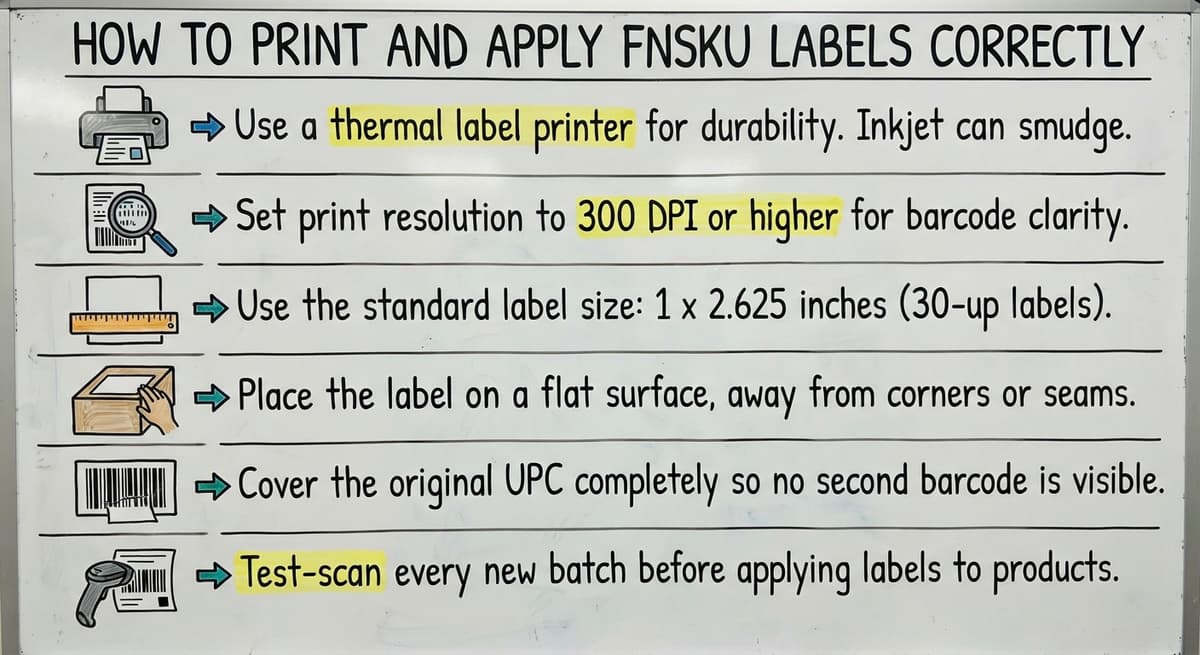
Print quality matters more than most sellers expect. A smeared or faded label causes a scan failure at Amazon's dock, which delays check-in and can create stranded inventory.
Follow these steps for clean, reliable labels:
- Use a thermal label printer for durability. Inkjet labels smear; laser labels crack under heat.
- Set print resolution to 300 DPI or higher.
- Use the standard label size: 1 x 2.625 inches (30 x 67 mm).
- Place the label on a flat surface, away from seams, windows, or curved edges where the scanner cannot read cleanly.
- Cover the original UPC completely so no second barcode is visible.
- Test-scan every new batch before applying labels to a full shipment.
The most common mistakes are placing labels over a seam, using the wrong FNSKU for a size or color variation, and forgetting to cover the original barcode. Each one creates a problem downstream that takes time to fix.
The IRS is clear that inventory accuracy is not optional. IRS Publication 538 states: "To figure taxable income, you must value your inventory at the beginning and end of each tax year." A mislabeled unit that lands in the wrong seller account throws off that count before it ever reaches Amazon.

How Do Warehouses and Prep Centers Use FNSKU Tracking?
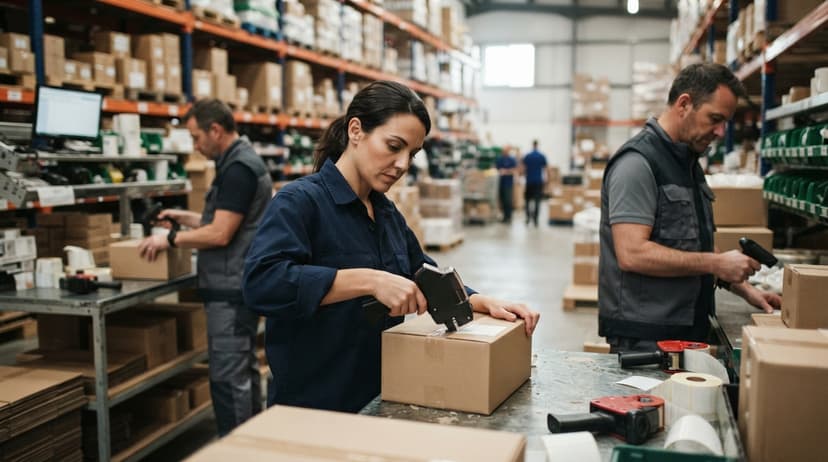
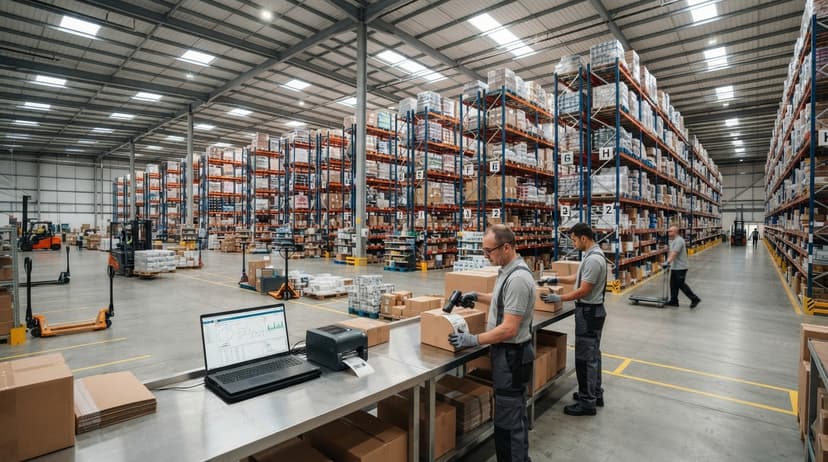
Third-party warehouses and prep centers handle FNSKU labeling on behalf of sellers every day. They receive unlabeled product, apply the correct FNSKU, and ship to Amazon. That sounds simple. It breaks down fast when staff are matching FNSKUs to products by eye, from a printed list, across dozens of SKUs.
A barcode inventory management system that reads and records FNSKUs removes that guesswork. Staff scan the product, the system confirms the correct FNSKU, and the label prints automatically.
Every scan event, receive, label, pick, ship, is recorded in real time. You can answer at any moment how many units are labeled and ready to ship.
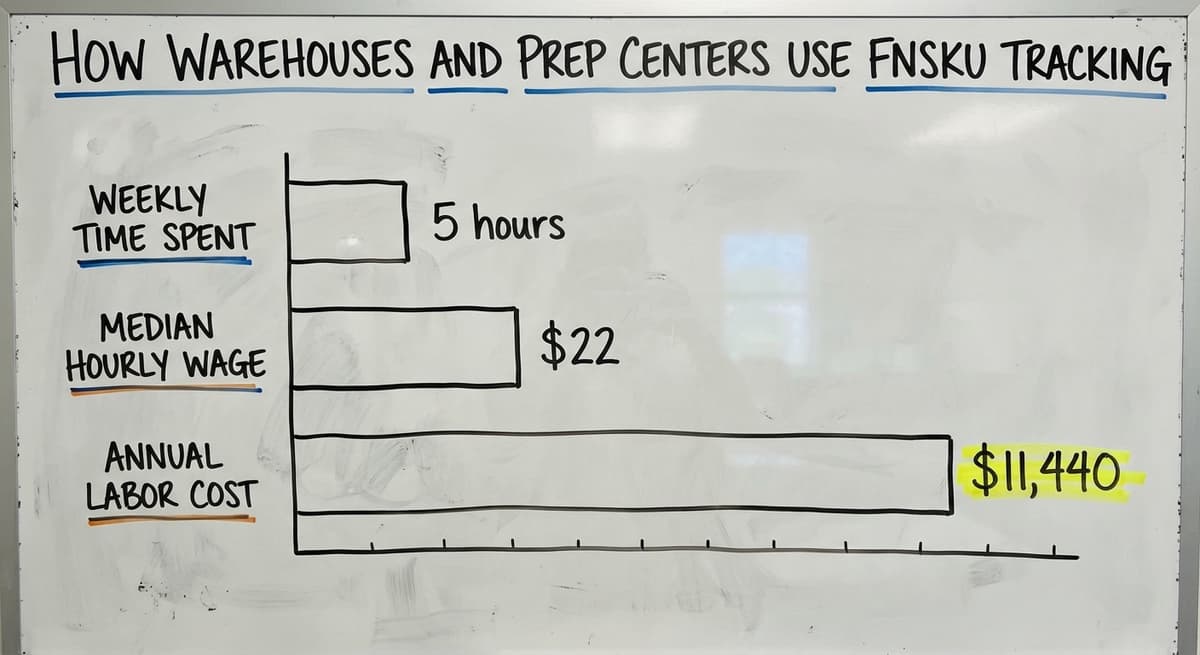
Consider the cost of doing this manually. If 2 staff members each spend 5 hours a week reconciling FNSKU counts against Amazon's inventory report, and the Bureau of Labor Statistics puts median warehouse worker pay at around $22 an hour, that is $11,440 a year in labor for a task a barcode system handles in seconds.
Is the comparison easier when one option is built for you?
Yes. Off-the-shelf means fitting your process to the software, and custom is the other way round. The first look costs nothing.
Book a callFNSKU vs Internal SKU: Do You Need Both?
Yes, and they serve different jobs. Your internal SKU is your own product code, used across all your sales channels, your accounting software, and your warehouse.
FNSKU is Amazon-specific and only appears on FBA inventory. A good inventory management system holds the mapping between the two so staff never have to look up which code to use.
Off-the-shelf software does not link FNSKU to your internal SKU or QuickBooks item natively. A custom system can map them without rebuilding your catalog.
Warehouse staff scan the FNSKU; the system updates your stock count and pushes the change to QuickBooks automatically. No double entry, no end-of-week matching session.

Signs Your FNSKU Process Needs a Better System
Most labeling problems are process problems, not people problems. Watch for these signs:
- Staff are writing FNSKU codes on paper logs instead of scanning them.
- Mislabeled shipments are causing Amazon check-in delays or stranded inventory.
- Reconciling your count with Amazon's count takes more than 30 minutes a week.
- You cannot quickly answer how many units are labeled and ready to ship right now.
- A product variation mix-up, wrong size, wrong color, has shipped to Amazon in the last 90 days.
Any one of these points to a gap between your physical workflow and your data. A barcode inventory management system that recognizes FNSKU closes that gap without requiring a full ERP migration.
Quick Reference: FNSKU Facts
Here is a plain summary you can share with your team:
- Stands for: Fulfillment Network Stock Keeping Unit
- Created by: Amazon, automatically, inside Seller Central
- Used for: FBA inventory only, not FBM
- Looks like: A standard 1D barcode, code starting with X00
- Differs from UPC: UPC identifies a product; FNSKU identifies a product and its seller
- Differs from ASIN: ASIN is a catalog ID shared by all sellers; FNSKU is a physical label tied to one seller's units
- Protects against: Commingled inventory risk, wrong-seller fulfillment, mismatched returns
- Printed at: 1 x 2.625 inches, 300 DPI, on a thermal label printer
Next Steps for Your Fulfillment Operation
Start with 3 quick checks. First, audit your labeling process: are staff scanning or guessing? Second, check whether your inventory system links FNSKU to your internal SKU. Third, confirm your QuickBooks item records match what Amazon shows as your on-hand count.
If any of those checks surfaces a gap, a custom barcode inventory system can handle FNSKU tracking without replacing the tools you already use.
The NIST Manufacturing Extension Partnership recommends aligning inventory processes to real working workflows rather than forcing operations to fit a generic system. That is the same principle behind a system that maps FNSKU to your existing codes and updates QuickBooks on every scan.
If your team is spending hours each week on matching that a scan should handle in seconds, that is worth a conversation. Talk with a team that builds around your existing operations rather than replacing them.
Frequently asked questions
What is an Fnsku on Amazon?
An FNSKU is a barcode Amazon creates for each seller's FBA product. It stands for Fulfillment Network Stock Keeping Unit.
Amazon uses it to track which physical units in its fulfillment centers belong to which seller. Every FBA item needs an FNSKU label before it ships to Amazon.
Is Fnsku the same as SKU?
No. An internal SKU is a product code you create for your own operations, used across all your sales channels.
An FNSKU is created by Amazon and used only for FBA inventory inside its fulfillment network. You need both: your SKU for your warehouse and accounting, the FNSKU for Amazon compliance.
Where do I find my Fnsku?
Log in to Amazon Seller Central, go to Manage Inventory, and select the product. From the product detail page, choose Print Item Labels.
Amazon generates the FNSKU automatically when you create an FBA listing. You download and print it from there. No external registration is needed.
What does SKU stand for on Amazon?
SKU stands for Stock Keeping Unit. On Amazon, sellers use their own SKU to identify products in their catalog. Amazon also assigns an ASIN (Amazon Standard Spotting Number) to each product listing. These are separate from FNSKU, which is specific to FBA physical inventory.
What is the difference between FNSKU and UPC?
A UPC identifies a product globally, regardless of who sells it. An FNSKU identifies the product and the specific seller together.
Two sellers listing the same item share a UPC but have different FNSKUs. This is how Amazon tracks which units in a shared warehouse belong to which seller.
What happens if I do not use FNSKU labels for FBA?
Amazon will reject or delay your shipment at the fulfillment center if items arrive without proper FNSKU labels.
Units may be flagged as stranded inventory until the labeling issue is resolved. Amazon can apply labels for a per-unit fee, but this adds cost and delays your inventory going live.
What is the difference between FNSKU and ASIN?
An ASIN is Amazon's catalog ID for a product, shared by all sellers who list that item. An FNSKU is seller-specific and tied to physical units in a warehouse.
The ASIN tells Amazon what the product is. The FNSKU tells Amazon who owns that specific unit on the shelf.
Do I need an FNSKU for every FBA product?
Yes, one per seller per product variation, unless the listing is commingled, in which case the manufacturer's UPC is used instead. Every unit that ships to a fulfilment centre under your account needs the label.
How do I print FNSKU labels?
Download the label PDF from Seller Central, print on a thermal label printer at 300 dpi, and apply one label per unit over any visible UPC. Laser-printed sheet labels work for small batches; thermal is cheaper past a few hundred a month.
How do I find my Amazon FNSKU?
In Seller Central under Manage Inventory, in the product's details, and on the label PDF. It starts with X00 and is unique to your seller account and that variation.
Can I use a UPC instead of an FNSKU?
Only on a commingled listing, where Amazon pools identical units from different sellers. Otherwise the FNSKU is required, and a visible UPC next to it causes scan conflicts at the receiving dock.
What is in a free first look?
A 30 minute call, your operation mapped, and a clear picture of what we would build. No obligation and nothing to install.
Book a callRelated guides
The rest of this guide, for the parts of the job this page does not cover.
Guides
- Barcode Words
- 2d Image Barcode Scanner
- Upc Scanner Gun
- Barcode Reader Description
- Alphanumeric Barcode
- Inventory Management Software with Barcode
- Mrp Barcode
- Online Barcode
- Sku Formats
- Scanner Inventory Software
- Barcode Systems for Warehouse
- Make Barcode
Common questions
- What is Inventory Management Meaning in Hindi
- What is Mean by Inventory Management
- Inventory Reserve Meaning
- 3pl Meaning
- What Does Receiving Mean in a Warehouse?
- Mro Inventory Meaning
- Meaning of Warehouse Management System
- Warehouse Meaning
- What Does a Barcode Look Like
- How Do I Create My Own Barcodes
- When Was Barcode Scanner Invented
- What is a Serial Number on a Product