


Contractor Advertising
Contractor advertising is the work of getting homeowners to call. In 2026, clicks cost more than ever, so the aim is booked jobs, not clicks. A good plan shows your name to people who need work done now. Then it gives them a reason to trust you and pick up the phone.
Below: each main channel, its cost, and how to track it, for roofers, remodelers, HVAC crews, painters, and electricians.
Book a call
What Is Contractor Advertising?
Contractor advertising is a paid or earned effort that gets your company seen by local homeowners so they call you. It covers remodelers, roofers, HVAC firms, painting crews, and electrical shops.
As of April 2026, home service firms face higher click costs on every major search platform. Ads are one part of marketing. Marketing also covers your brand, your prices, and how you treat customers.
Advertising has a narrow job: get seen and earn calls. Clicks and likes do not pay your crew. Only signed jobs count as a real return.
The market is worth the effort. One industry report on GlobeNewswire projects 5.0% yearly growth for US building through 2028. The report puts total output at USD 1.54 trillion by that year.
Why Contractor Advertising Differs From Other Businesses
Homeowners look for a contractor at the exact moment a storm tears off shingles or a furnace dies. In contractor advertising, urgent local demand means timing and location decide who gets the call.
Your service area covers a set list of towns. Reach outside those towns wastes money. One roof replacement at $12,000 can pay for months of ad spend.
Homeowners also let your crew inside the house. So trust matters more than a low price.
Google's Business Profile Help guide states, "Local results are mainly based on relevance, distance, and popularity." To win those calls, match your services to nearby buyers and earn a name they trust.
See your new homepage before you pay anything
Your homepage, rebuilt free. You see it before you pay anything.
Past SEO campaigns grew organic traffic 26x in 14 months.
New website plus 100 SEO pages in the first month: $397 a month, cancel anytime
Book a callWhat Are the Main Types of Advertising for Contractors?
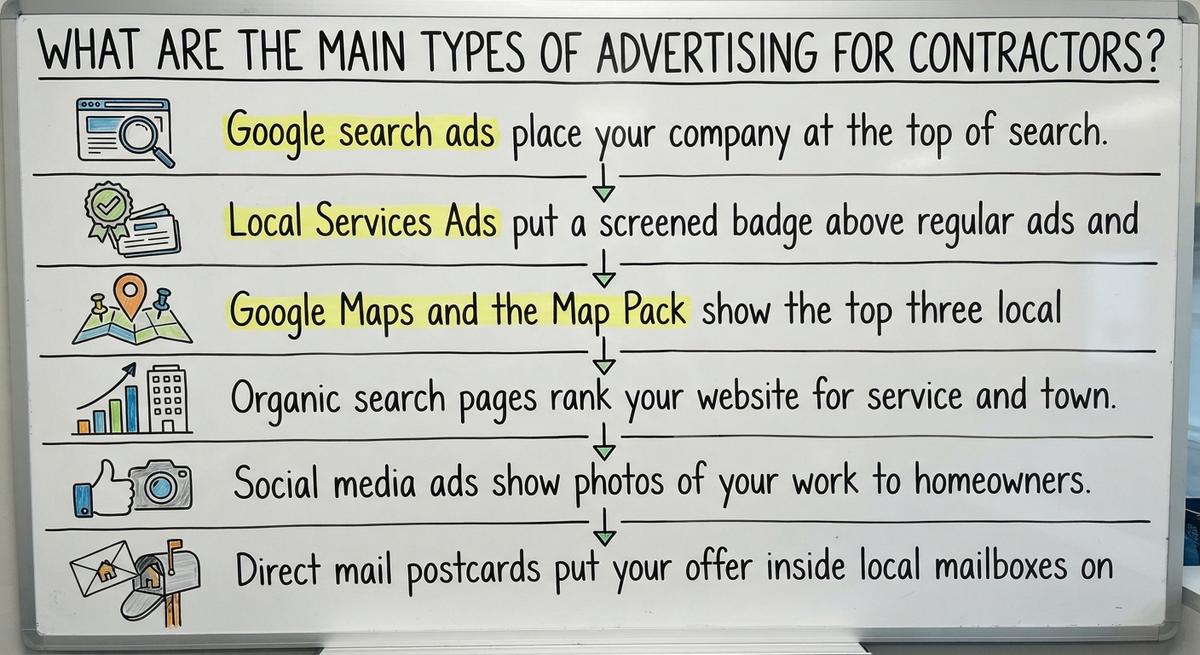
Every contractor channel falls into one of two groups. Some reach a homeowner who is searching right now. Others reach people long before a repair.
- Paid search places your firm above organic results for a fee per click.
- LSAs put a screened badge over regular ads and charge per phone lead.
- Maps listings show the top three nearby firms next to a map.
- Organic pages rank your site for service and town searches with no click fee.
- Social ads show photos of your work to people scrolling in your ZIP codes.
- Direct mail puts your offer inside local mailboxes on a set schedule.
- Yard signs and truck wraps turn job sites and daily drives into billboards.
- Word of mouth and ratings turn past buyers into your cheapest source of new calls.
Search catches demand that exists today. Offline and social channels build your name for most of next season's jobs.

Contractor Advertising That Reaches People Who Are Already Searching
Search reaches homeowners with a broken furnace or a leaking roof today. It is the core of most contractor lead generation. High-intent traffic turns into jobs faster than any other form of contractor advertising.
Paid search, LSAs, map listings, and organic pages all reach active buyers. A small crew should fix its search presence first. Billboards and social feeds can wait.
Solid local SEO for contractors helps your business appear the moment a nearby homeowner has a problem. If your shop seems invisible, start with why a business does not show up on Google.
Google Search Ads
Google Ads is a pay-per-click system. You pay each time a person clicks your link. Paid search brings fast calls as soon as a campaign goes live.
Traffic stops the minute your daily budget runs out. Many contractors bid on broad words like "roofing." A tighter phrase like "emergency roof repair" wastes far less.
Sending paid clicks to a plain homepage also kills results. Send each click to a page built for that exact repair and town. Our Google Ads guide for contractors covers bids, phrases, and budgets in more depth.
Local Services Ads (LSAs)
LSAs appear first on Google, over standard paid results. You pay per lead, not for each site visit.
Google checks your background, license, and insurance before the ad can run. Its Local Services Help article tells advertisers to "Pay only for leads related to your business and the services you offer."
You can dispute junk calls from the wrong area or the wrong trade. The badge and the per-lead billing make this a strong first channel for contractor advertising on urgent repairs.
Google Maps and the Map Pack as Advertising
The Map Pack is the box of three local listings shown first in Google Maps and local results. A top map spot acts like free storefront space in each town you serve.
Your rank shifts from block to block. Google's ranking guide names distance as 1 of 3 local factors. A contractor who ranks first near the office can vanish five miles away.
A grid scan is a map test that checks your rank at dozens of points across the area. Ask any provider to show you one before and after their work.
No agency can promise a permanent top spot on Maps. Roofers can find setup tips in our Business Profile guide for roofers. Steady profile updates keep your listing visible in more neighborhoods.
Organic Search as Long-Term Contractor Advertising
Organic search uses helpful pages that rank with no cost per click. Organic contractor advertising compounds instead of vanishing the day you pause ads. A GetResponse roundup says about 70% of digital marketers rate SEO as more effective than PPC.
A central Ohio roofing and exteriors firm built its own pages for all 17 towns it serves. A homeowner in any of those 17 towns finds a page written for their area and their repair.
Google Search Central says, "People-first content means content that's created primarily for people." Copied pages with swapped city names break Google's spam policies. Those rules warn against "doorway abuse."
Strong contractor SEO needs real local details on every page. Good contractor website design makes those pages easy to read on a phone. Then homeowners and search engines both trust the site.
Find out where you show up on the map
A free map check for your company. See which towns find you and which call a competitor.
Book a callAdvertising That Reaches People Before They Search
A clean truck on the street and a sign down the block build quiet trust. This kind of contractor advertising resists clean measurement. Few tools can tie a van seen in June to a name search in October.

Mailers, truck wraps, and social ads reach owners before anything breaks. A known name lowers resistance when the buyer needs a quote months later.
Use these awareness channels to back up search. Add them once ready callers can already find you on Google.
Truck Wraps and Yard Signs
A wrapped truck puts your name on every road your crew drives. A yard sign marks each finished job for the whole street. Signs and wraps work all day with no monthly click bill.
Pair the wrap with a tidy job site. Small ideas like these help you get more jobs as a contractor at low cost. Neighbors judge a contractor by the mess the crew leaves. Physical visibility turns daily routes into steady name recall.
Direct Mail for Contractors
Direct mail costs more per touch. It can still reach exact streets after a hailstorm or a freeze. Mailing 2,000 postcards at $0.65 each costs $1,300 for one neighborhood drop.
Put one clear offer and one phone number on each card. Plan at least 2 drops to the same streets. One card is easy to forget. For more data on print results, see this roundup of flyer marketing statistics.
Social Media Ads
Social ads let you show before-and-after photos to owners in set ZIP codes. Most of them are not shopping yet. So the goal is recall, not a call today.
Keep the ad simple: one photo, one town, one offer. Our Facebook advertising guide covers targeting and budget.
How Do Referrals and Reviews Work as Contractor Advertising?
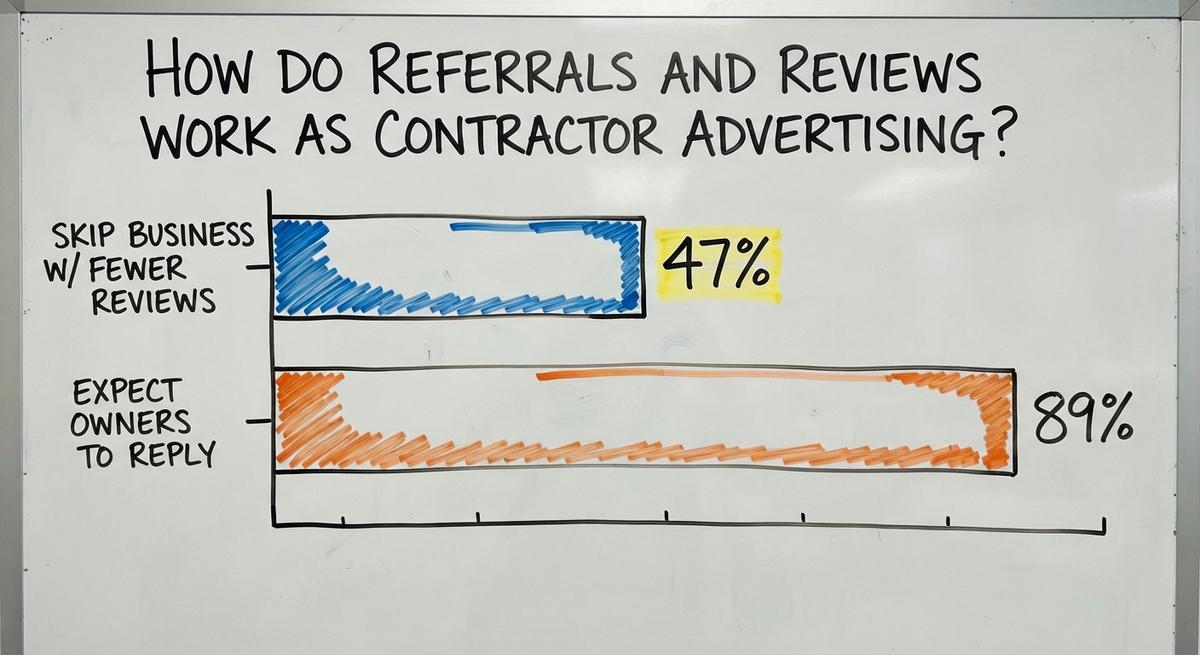
Ask happy homeowners for a review right after the final walk-through. The work is fresh in their minds then. BrightLocal's Local Consumer Review Survey reports that "97% of consumers still lean on reviews to guide their purchase decisions."
The same survey shows 47% skip a business with fewer than 20 reviews. It also finds 89% expect owners to reply.
Word of mouth and star ratings are low-cost contractor advertising. They prove your crew keeps its word. Peer proof closes jobs before your estimator reaches the driveway. Here is how to get more Google reviews the honest way.
What Not to Do With Reviews
Never buy fake reviews or trade gift cards for ratings. Google's review policy says, "Reviews and other user contributions to Google Maps must reflect a genuine experience."
Honest ratings from real neighbors protect a contractor's name. Every honest review also lifts the share of visitors who call.
Best Advertising for Contractors: How to Choose
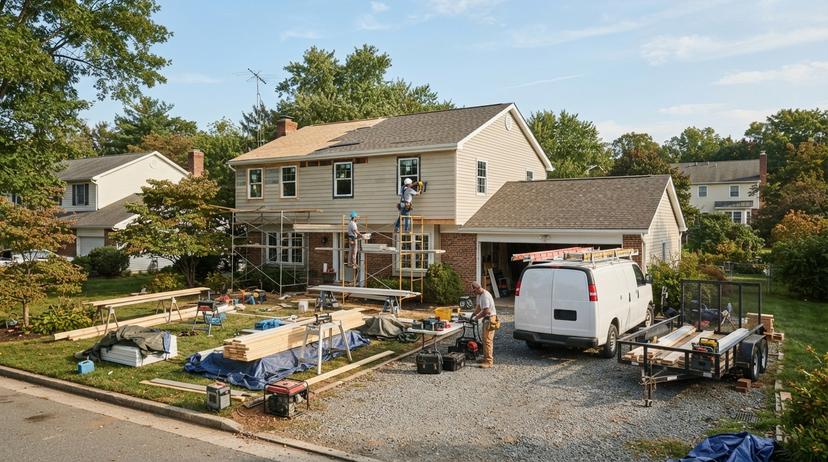
The best channel depends on your trade, your cash flow, and how fast the phone needs to ring. No single channel fits every contractor at every stage.
Match your budget to how fast your typical buyer decides. Furnace and roof leak calls favor search ads and the map. Big kitchen remodels favor photo galleries, referrals, and detailed project pages.
Start with the one or two channels closest to a buyer ready to dial today. Add mailers or social ads only after search brings steady calls. Our list of contractor marketing ideas has more channels to test later.
General Contractor Advertising for Remodels and Additions
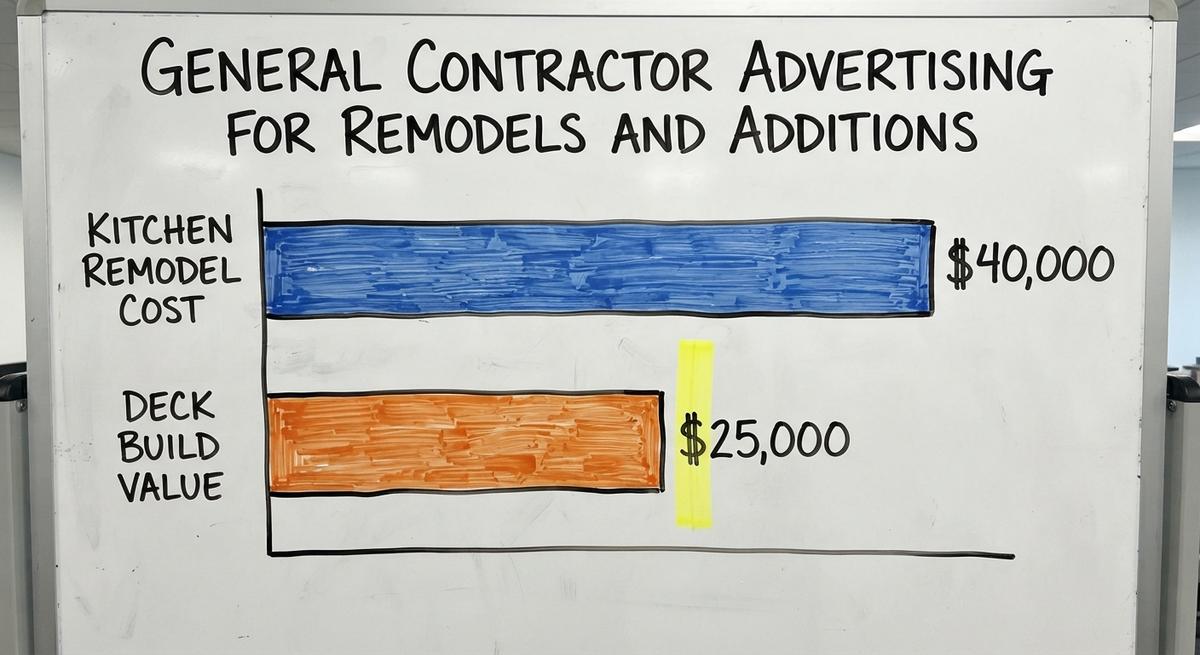
Homeowners comparing $40,000 kitchen remodels or $25,000 deck builds search many times before they call a general contractor. Long buying cycles demand deep trust and clear proof of craft.
Build a page for each line of work: kitchens, baths, basements, and additions. A strong general contractor website holds them all. Show real project photos and clear scope details. Answer common permit questions on each page.
Ties with local architects, electricians, and suppliers also send high-value leads. Good project pages plus trade referrals fill a remodel calendar with real consults.
Contractor Advertising for Roofers, HVAC, and Electrical Crews
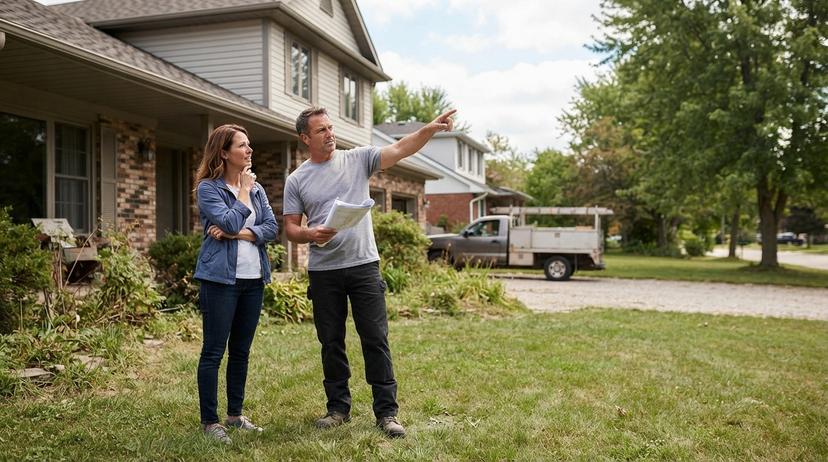
Roofers, HVAC techs, and electricians rely on fast calls. Weather or wear breaks a major home system, and the owner needs help that day. Urgent searches leave no room for slow sites or vague listings.
Roofing demand spikes after wind and hail. HVAC firms balance same-day repairs with seasonal tune-ups. Electricians field outage calls next to panel upgrades and EV charger installs.
Give each core service its own page, from leak repair to heat pump swaps. Point ads and listings at the matching page. Then a stressed owner can call your dispatch line at once.
For trade-specific detail, see our guides to roofing leads, HVAC contractor marketing, and the electrical contractor website. Painters can start with paint contractor marketing, and concrete crews with SEO for concrete contractors.
Results you can check
Past SEO campaigns grew organic traffic 26x in 14 months, and 15x on another. Top Rated Plus on Upwork with 99% job success.
Work for hundreds of small businesses and large clients like New Balance. Before The Software Society, our founders’ agency worked with Planned Parenthood.
Book a callWhy Your Website Decides If Contractor Advertising Pays Off
Every ad, mailer, and map listing sends homeowners to your site to check that you look real. A slow or confusing site wastes ad money. It drives ready callers straight to a rival.
A homeowner on a phone wants your number, your services, and your towns within three seconds. Hide the call button or load slowly, and paid clicks bounce away.
Google's advice on people-first content applies to every page a click lands on. Easy editing matters too. You should be able to add a winter special or drop a far town in minutes. A fast, clear site turns contractor advertising clicks into booked estimates. See what the best contractor websites have in common, or how a roofing contractor website lays out its pages.
What a High-Converting Service Page Needs
A service page is a single page built around one repair or install in your area. Focused pages convert more visitors than a crowded homepage.
- Clear headline names the repair and the towns you serve in plain words.
- Visible phone number stays tappable at the top of every mobile screen.
- Real job photos show your actual trucks, crews, and results on local streets.
- Short contact form asks only for a name, phone number, and a short note.
Build each page around these four parts. They protect every dollar you spend on contractor advertising.
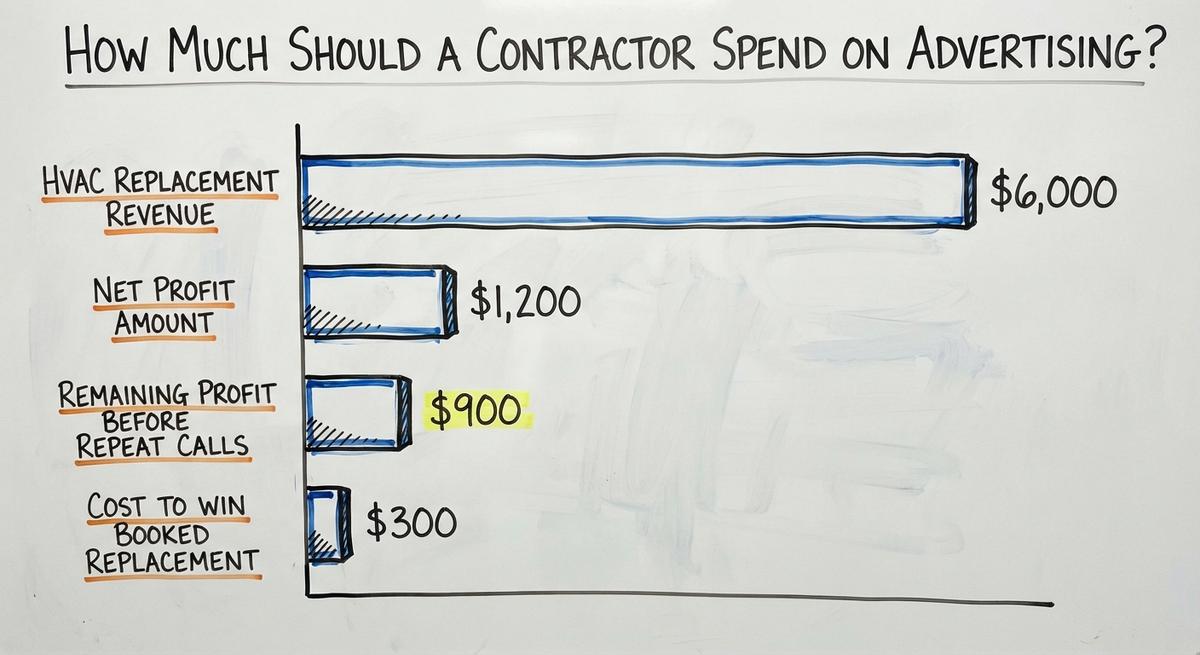
How Much Should a Contractor Spend on Advertising?
A contractor's budget depends on gross profit per job and how many open slots sit on the schedule. Job value sets your safe spend limit far better than a random industry percentage.
Say an HVAC replacement brings $6,000 in revenue and $1,200 in net profit. Spend $300 to win one booked job, and $900 of profit stays. Repeat tune-up calls add more later.
Start with a monthly amount you can hold for at least 6 months. Track what each signed job costs first. Then raise the budget on channels that beat your target.
How Do You Track Which Contractor Advertising Brings Calls?
Tracking means tying every contractor lead, call or web form, to the channel that produced it. Source tracking replaces guesswork with numbers you can review each month.
Sort new leads into four buckets: organic search, Google Maps, paid ads, and spam bots. Track visits from AI tools like ChatGPT, Gemini, and Perplexity as their own channel.
Train office staff to ask all new callers how they heard about you. Clean call logs show the channels that earn their keep and the ones that drain cash.
Why Call Tracking Beats Counting Clicks
Click counts measure curiosity. Call tracking measures intent to buy. Clicks never pay crew wages or cover material bills.
Bots and out-of-area shoppers click ads every day and never book. Call tracking gives your ads, map listing, and pages each a unique phone number.
You can then play back recordings and mark every call that turned into work. Judge each contractor advertising campaign by booked revenue, not traffic.
What to Review Each Month
Pull the same 3 numbers every month: calls per source, jobs won per source, and spend per job won. Compare each one with the month before.
Drop or fix any contractor channel that costs more per job than the job earns. Move that money to the channel that wins.

Common Contractor Advertising Mistakes
Many home service owners lose money on contractor ads. Most skip basic setup steps before launch. Fixing small setup errors can lift call volume with no extra spend.
- Spreading budget thin leaves five channels underfunded instead of one channel working well.
- Linking ads to homepages forces callers to hunt for the repair they searched.
- Ignoring your Google listing lets hours, photos, and categories go stale.
- Skipping call tracking leaves owners blind to the ads that bring real jobs.
- Quitting after two weeks stops campaigns before the platforms learn your market.
Avoid these five habits. Skipping them protects your cash as campaigns gain traction.
Get a second opinion on your current setup
Already paying for marketing? Get a free second opinion on what works and what wastes money.
Book a callHow to Spot Advertising Promises You Should Not Trust
Honest partners explain the risks. Bad vendors sell guarantees no one controls. No outside firm controls Google rankings or can promise an exact lead count.
Watch for these red flags before you sign with any advertising contractor:
- Number-one rank promises ignore how Google shifts map spots street by street.
- Lead quotas often rely on cheap, shared leads sold to five rival contractors.
- Hidden fee contracts mask how much money reaches Google versus the vendor.
- Click-only reports hide poor call quality behind big traffic charts.
Ask for open ad accounts and real call logs. That filters out risky vendors fast. If you buy leads, read our guide to contractor leads first. Shared lists differ a lot from exclusive contractor leads.
A Simple Advertising Plan for a Small Contractor
A small shop needs a clear order of tasks, not a complex playbook. Five steady steps build a call pipeline without wasted cash.
- Fix your site and Business Profile so your number, services, and towns are correct.
- Publish a page per service and per town that answers real questions owners ask before calling.
- Launch paid search ads only for your highest-margin job.
- Ask for ratings and referrals at the end of every finished job.
- Sort calls by channel each month and shift budget toward the ones that book work.
Work through these steps in order. Scattered contractor advertising turns into a full weekly schedule.

Should You Hire Someone for Contractor Advertising?
Doing ads yourself saves fees. Hiring help saves your nights and weekends after long days on site. Time versus budget decides which path fits.
Ask four direct questions before you hire any contractor marketing agency or freelancer:
- Who does the work? Find out if your account stays in-house or goes to anonymous subcontractors.
- Who answers your calls? Confirm a real strategist knows your trade and market.
- What gets tracked? Make sure they report booked calls by source, not vanity clicks.
- Who owns the accounts? Keep your site, domain, and ad accounts if you leave.
Never hand full ownership of your domain or Business Profile to an outside vendor. For a wider view of the whole plan, read our contractor marketing guide.

Key Takeaways for Contractor Advertising
Smart contractor advertising starts with buyers who already need help. Brand reach comes later. Clear pages and tracked calls turn ad spend into steady revenue.
- Start with active searchers using paid listings, the LSA badge, and your map spot.
- Build focused pages so every click lands on a matching answer.
- Log each lead's origin across search, maps, ads, and AI tools.
- Add channels slowly once your site and search campaigns prove profitable.
Then count your incoming calls over the next 30 days.

Frequently asked questions
How long does contractor advertising take to bring calls?
Paid search and LSAs can bring a contractor calls within a few days of launch. Organic pages and map growth take several months of steady updates to build call volume.
Do contractors need separate pages for every town they serve?
Yes. A contractor with real town pages helps owners in nearby areas find the business. Each page needs facts about that town and the work done there, not copied text with a swapped city name.
Why do contractor ads get clicks without bringing phone calls?
Contractor ads get clicks without calls when broad phrases pull in shoppers from far towns or other trades. Slow sites, hidden phone numbers, and ads that land on a generic homepage also stop ready buyers.
What should an advertising contractor report every month?
A good advertising contractor reports calls and forms by source: search, maps, ads, and bots. The report should also show map rank across your area and total spend per booked job.
Can a small contractor rely only on referrals?
Referrals bring a contractor high-trust jobs at low cost. Word of mouth rises and falls with the seasons, though. Pair referrals with search visibility to keep the crew busy in slow months.
How many Google reviews does a contractor need to compete?
Most owners compare a contractor's review count with nearby rivals on the map. BrightLocal found nearly half of buyers pass on firms under 20 reviews. So request one after every job.
Start with a free homepage rebuild
Book a short call. Your new homepage is free to see and yours to keep.
New website plus 100 SEO pages in the first month: $397 a month, cancel anytime
Book a callRelated guides
More on the same work.
- Concrete Contractor SEO
- General Contractor SEO
- Roofer Contractor Marketing
- How to Get More Jobs as a Contractor
- Website General Contractor
- Contractor Website Development
- Roofing Contractor Leads
- Free Leads for Contractors
- Facebook Ads for Contractors
- Contractor SEO Company
- SEO for Contractors
- Contractor Marketing
- Local SEO Services for HVAC Contractors
- Electrical Contractor SEO
- SEO for Concrete Contractors
- Digital Marketing for Roofing Contractors
- Google Ads for Contractors
- Contractor SEO Services
- Contractor SEO Marketing
- Independent Marketing Contractor
- Home Contractor Marketing
- Best App for Contractor Leads
- Contractor Marketing Agency
- Paint Contractor Marketing