


Distributor Rate
A distributor rate is the price a distributor pays or charges. Learn both meanings, how rates are set, and how to keep them right in QuickBooks.
Book a callWhat Is a Distributor Rate?
A distributor rate is the price or discount a distributor gets from a supplier. It can also be the price a distributor gives its own customers. People use the term for both.
We build it for your operation, and the first look is free
If you would rather not compare products, describe how your operation already works and we build the system around it.
Reviewed November 2026.
No build cost. You see it running on your own process first, and the monthly subscription starts only once it is live.
Book a callDistributor Rate vs. Retail and Wholesale Price
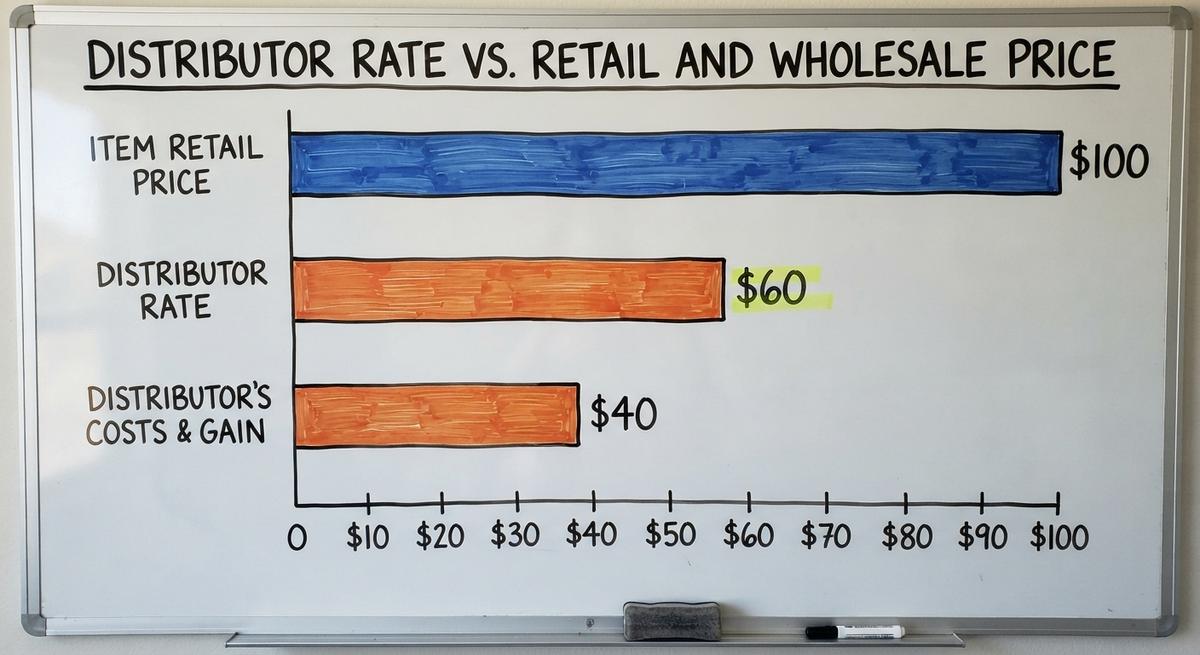
A distributor rate is lower than the retail price, and the gap pays for storage, shipping, handling and profit. Say an item sells for $100 at retail. The distributor rate is $60. The $40 gap covers the distributor's costs and gain. The IRS says, in Publication 538, "To figure taxable income, you must value your inventory at the beginning and end of each tax year."
Is a Distributor Rate the Same as a Wholesale Price?
Not always, but the terms overlap and people use them loosely. A wholesale price is a general bulk price. A distributor rate is a set deal with an approved distributor. A wholesale distributor may see both words in one contract. Check how your own supplier defines each word before you sign.
How Is a Distributor Rate Set?
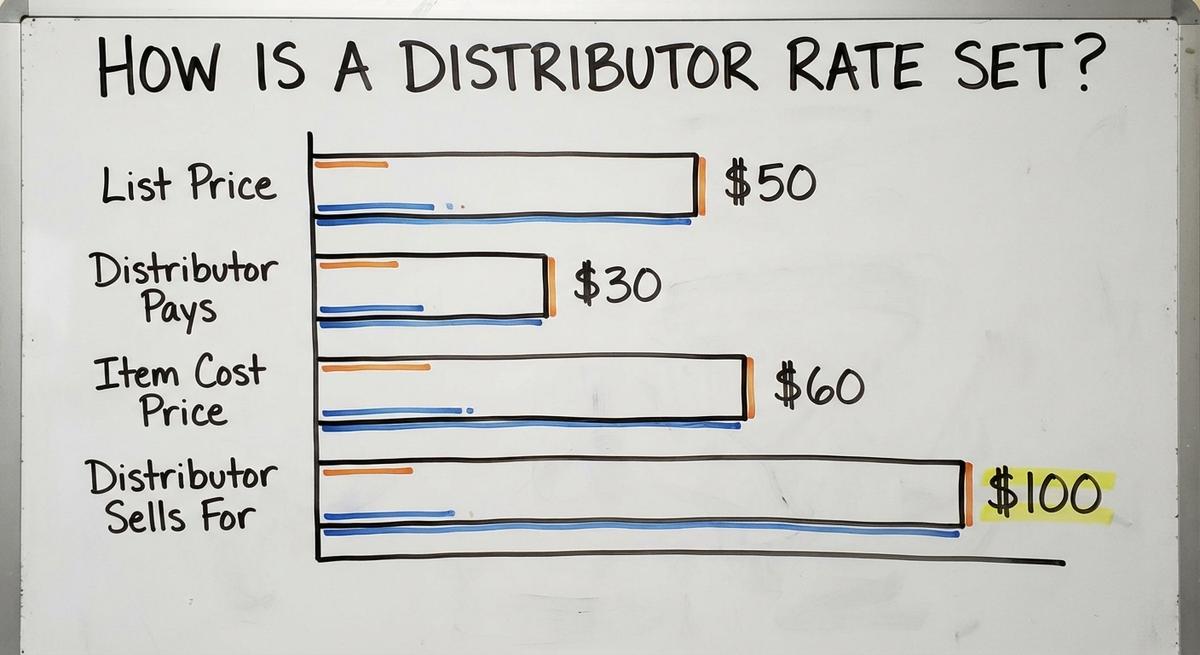
Suppliers set a distributor rate in three common ways: a percent off list price, a cost-plus markup, or a flat price per item. The supplier, the market and the contract all play a part. The next two parts cover the first two methods.
Percent Off List Price
The most common method gives the distributor a set distributor discount off the published list price. Take a $50 list price with 40% off. The distributor pays $30. Discounts can change by product line, so one price list may hold several percents. Keep each line's percent on file.
Cost-Plus Markup
Cost-plus means price equals cost plus a set percent. Markup vs. margin is where people slip. Markup is profit as a share of cost. Margin is profit as a share of price. An item that costs $60 and sells for $100 has a 66.7% markup but a 40% margin. Mixing them up is a common and costly mistake.
What Changes a Distributor Rate?
Several factors move a distributor rate up or down. Each one belongs in the contract.
- Order volume, buying promises and past orders can earn a better rate.
- Fast payment can earn a lower price than slow payment.
- Territory, exclusive rights and the distributor's role in the chain shape the deal.
- Supplier cost changes and freight push rates up or down.
Rates should follow costs, not sit still.
Not sure this is the right shape for your operation
Describe how the work runs today. We map it on a call and show you what it would look like built around that, before you spend anything.
Book a call
How Do Tiered Distributor Rates Work?
Tiered pricing gives bigger or more loyal buyers a better rate. A simple setup has three tiers:
- Standard: list price less 30%.
- Preferred: list price less 40%.
- Top tier: list price less 45%.
Tiers need clear rules, such as yearly spend. Then staff can apply them the same way every time. A tier that only one person understands is a risk.
Distributor Rate and Your Profit Margin
A lower rate on the buy side raises your profit margin. A lower rate on the sell side cuts it. Say you buy at $60 and sell at $100. Margin is 40%. Sell at $90 and it drops to 33%. Then take off freight, returns and handling, which are easy to forget. Check margin per customer, not only per product.

How to Work Out a Fair Distributor Rate
A fair rate covers your costs and leaves the profit you want. Work through four steps.
- Know your landed cost: the price paid plus freight and fees.
- Set a profit margin goal.
- Check the market for what rivals charge.
- Test the rate against your biggest accounts.
Then write the rate in a contract or price agreement. A rate that is not written down is just a guess.
The comparison is easier when one option is built for you
Off-the-shelf means fitting your process to the software. We do it the other way round, and the first look costs nothing.
Book a callWhere Distributor Rates Get Lost
Small distributors often run on accounting software, spreadsheet price sheets, printed lists and email threads. Each place can hold a different rate. A supplier raises costs, someone fixes the sheet, and the printed list stays old. Common mistakes follow:
- Old rates stay after supplier costs rise.
- Rates live in one person's head.
- Special deals never get written down.
- Two staff quote different rates to one customer.
When four places hold four rates, someone loses money.
Signs Your Rate Tracking Has Outgrown Spreadsheets
Spreadsheets fail in clear ways. Watch for these signs:
- Staff ask, "Which sheet is the right one?"
- Quotes are slow because someone must look up the rate.
- Customers get billed at the wrong rate, and the team learns later.
- Only one person knows how the tiers work.
Two or more signs mean the manual process costs you real time.

Can Your Accounting Software Handle Different Rates for Different Customers?
Accounting software handles the books well but can be stiff with customer-by-customer tiers and rules. Many distributors keep their accounting software and add a custom layer for the rate logic. Keep your accounting software where it works. Replace only the manual parts.
How to Keep Distributor Rates Accurate
- Keep one rate list with a named owner.
- Review it each quarter or when supplier costs change.
- Note who approved each special rate and why.
- Show the same rate on quotes, orders and invoices.
How often to review rates comes down to this: set a schedule and keep to it.
When Does a Distributor Need Custom Software for Pricing?
A distributor needs custom software when staff fix invoices often or rates differ across tools. Custom software fits how you already work, with no forced move. It can:
- Apply the right rate by customer, tier and product when an order is entered.
- Flag orders priced below a margin floor.
- Keep a history of rate changes.
- Work at small scale, for teams of 5 to 100.
First, ask a few questions. Who sets rates, and who can change them? How many price lists exist, and where? How often does an invoice need a price fix? The answer is often a small tool, not a long, costly project.
Next Steps for Your Distribution Business
Know your rate type. Set it with clear rules. Keep it in one place. Talk to a Columbus, Ohio team that builds around your current process. The same team builds the software, website and search presence.
Frequently asked questions
What is a good distributor rate?
A good distributor rate depends on the industry, product and volume. It covers your landed cost and leaves the profit margin you need. Compare it with your own costs, not a made-up average.
Is a distributor rate the same as a distributor discount?
Not quite. A distributor discount is a percent off list price. A distributor rate can be that discount or a flat price per item.
How often should distributor rates be reviewed?
Review rates every quarter. Also review them whenever supplier costs or freight change. Write down each change.
Who sets the distributor rate?
The supplier sets the buy rate, based on its costs, the market and the contract. The distributor sets the sell rate for its own customers.
Why do distributor rates get out of date in spreadsheets?
Spreadsheets get copied, printed and emailed. One copy gets fixed and the others do not. Soon each tool shows a different rate.
Can your accounting software handle different rates for different customers?
Accounting software can store some price levels, but tier rules by customer and product can be stiff. Many distributors add a custom layer and keep their accounting software for the books.
Start with a free first look
A 30 minute call, your operation mapped, and a clear picture of what we would build. No obligation and nothing to install.
Book a callRelated guides
More on the same work.
Guides
- Business Distributors
- Distributor Examples
- Company Distributor
- Dealer and Distributor
- Distribution Management Software
- Cloud-based Purchase Order System
- Dealer Distribution
- Distribution Inventory Management