


How Distributors Work
How distributors work: they buy in bulk, store stock, sell in smaller lots and ship. See each step, how they earn money, and where time leaks.
Book a callHow Do Distributors Work?
A distributor buys goods in bulk from makers and sells them in smaller amounts to retailers, contractors or other businesses. The distributor sits in the middle and makes buying easier for both sides. It earns money on the gap between what it pays and what it charges, after costs.
We build it for your operation, and the first look is free
If you would rather not compare products, describe how your operation already works and we build the system around it.
Reviewed November 2026.
No build cost. You see it running on your own process first, and the monthly subscription starts only once it is live.
Book a callWhat Is a Distributor and Where Does It Fit?
A distributor is a business that moves products from the maker to the buyer. Most sell to other businesses, not the public. The words "wholesaler" and "distributor" overlap, and many people use them the same way. Picture a firm that supplies plumbing parts to local contractors. IRS Publication 538 says, "To figure taxable income, you must value your inventory at the beginning and end of each tax year."
Where do distributors fit in the distributor supply chain?
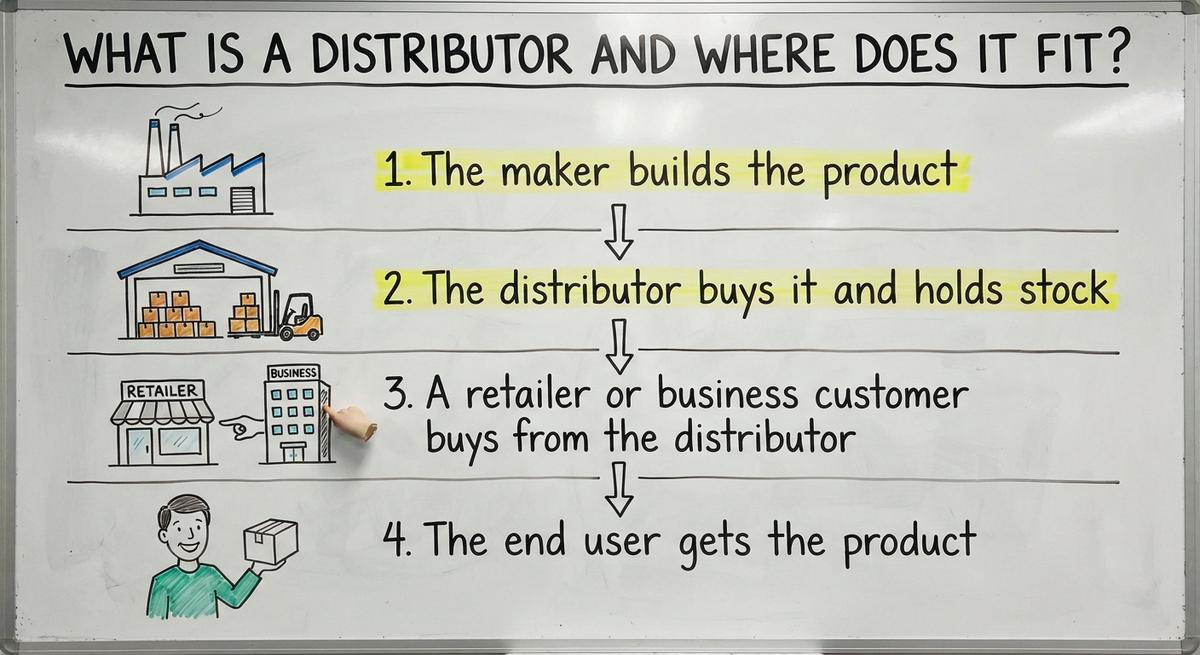
A distributor sits between the maker and the buyer. The chain runs in four steps:
- The maker builds the product.
- The distributor buys it and holds stock.
- A retailer or business customer buys from the distributor.
- The end user gets the product.
Makers save time with one big order in place of many small ones. Buyers get many brands in one place and fast delivery. The distributor holds the stock so no one else has to.
How Do Distributors Make Money?
Distributors make money on markup, the amount added to the price they paid. They buy at volume pricing and sell in smaller lots. The markup must cover rent, labor, trucks, insurance on goods and credit given to customers. Say a firm buys an item for $10 and sells it for $13. The gain is $3. If costs take $2.50, profit is $0.50. Small gains come from better pricing, fewer errors and less dead stock, which is stock that never sells.
Not sure this is the right shape for your operation
Describe how the work runs today. We map it on a call and show you what it would look like built around that, before you spend anything.
Book a callWhat Are the Main Steps in a Distributor's Day?
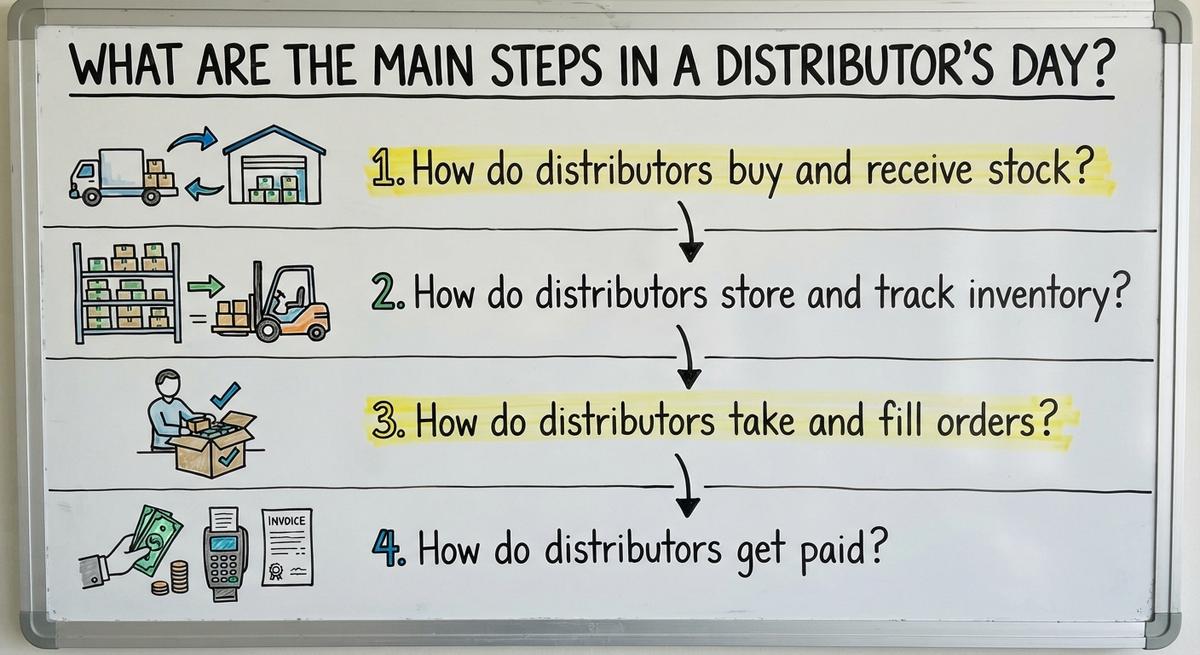
A distributor's day runs in eight steps: buy, receive, store, sell, pick and pack, ship, invoice and collect. Each step hands information to the next. A mistake early in the line travels all the way down.
How do distributors buy and receive stock?
Distributors send buy orders to suppliers. The orders follow what sells and what runs low. At receiving, staff check the delivery against the buy order, count it and note damage. The common trouble is a reorder point kept in someone's head or on a sheet. When that person is out, the reorder is missed.
How do distributors store and track inventory?
Stock lives in warehouse space, bins and shelf locations. Good inventory management means the counts match the books. A once-a-year count finds drift late. A cycle count checks a few bins each week, so errors show up fast. The common trouble is a stock count that drifts from what sits on the shelf. Guidance on how to keep track of inventory starts with this habit.
How do distributors take and fill orders?
Orders arrive by phone, email, text, sales reps or a customer portal. Staff then pick, pack and ship them. Each customer may have its own pricing and terms. The common trouble is order fulfillment built on retyping. Someone copies an email into another system and prints a pick sheet. Each copy is a chance for a wrong item or price.
How do distributors get paid?
Distributors get paid on terms, and many business customers pay on net 30. Net 30 means payment is due 30 days after the invoice. Cash comes later than the sale. Accounting software such as a popular small-business bookkeeping program handles the books well. The real work is follow-up: watch what is overdue and call early.

What Types of Distributors Are There?
Five types cover most of wholesale distribution:
- Exclusive distributors hold the only right to sell a brand in an area, such as one boat engine line.
- Intermediate distributors sell between larger firms and smaller ones.
- Industrial or MRO distributors sell repair and upkeep supplies, such as belts and bearings.
- Specialty distributors serve one niche, such as dental supplies.
- Value-added distributors add a service, such as kitting or light assembly.
Distribution business operations differ by type. The buy, store, sell and ship cycle stays the same.
The comparison is easier when one option is built for you
Off-the-shelf means fitting your process to the software. We do it the other way round, and the first look costs nothing.
Book a callWhere Do Small Distributors Lose Time and Money?
Small distributors lose time where data moves by hand. A common setup uses your accounting software for the books. Excel, Access databases, printed sheets and email carry the rest. Four pains follow:
- Double entry happens at the selling step, when orders get retyped.
- Stock mismatches come from the storing step.
- Missed reorders come from the buying step.
- Slow quotes come from prices kept in scattered files.
Say 3 people spend 6 hours a week on retyping at $22 an hour. That is $20,592 a year. The Bureau of Labor Statistics lists pay for this kind of work.

Do You Need a Big ERP to Run a Distribution Business?
No. A small operation can fix the manual parts without replacing everything. An ERP is one large system that runs buying, stock, sales and books together. Keep your accounting software where it works. Build software only for the manual steps, shaped around how the operation already runs. The Software Society takes this approach. It builds custom software around the existing operation and works at small scale. The team is local to Columbus, Ohio. Your accounting software stays in place for the books.

What Should You Do Next?
Write down each step from buy order to payment. Mark every spot where data is retyped or lives on paper. Those marks show what to fix first. The Software Society can talk through which manual steps to fix first. One team builds the software, the website and the search presence. Reach out and bring your list.
Frequently asked questions
How do distributors work?
A distributor buys goods in bulk from makers and sells them in smaller amounts to retailers, contractors or other businesses. It earns money on the gap between cost and price.
What is a distributor?
A distributor is a business that moves products from the maker to the buyer. Most sell to other businesses, not the public.
How do distributors make money?
Distributors add a markup to goods bought at volume pricing. The markup pays for rent, labor, trucks, insurance and credit given to customers. What is left is profit.
How do distributors get paid?
Many business customers pay on terms such as net 30. The distributor sends an invoice, then collects payment about 30 days later.
What is the difference between a distributor and a wholesaler?
The words overlap and many people use them the same way. Both buy in bulk and sell to businesses. A distributor often holds a close tie to certain brands.
How do distributors manage inventory?
They keep stock in bins and shelf locations and match counts to the books. Cycle counts check a few bins each week, so errors show up early.
What types of distributors are there?
The main types are exclusive, intermediate, industrial or MRO, specialty and value-added distributors.
Does a small distributor need an ERP?
Not always. A small firm can keep its accounting package and build software only for the manual steps, such as order entry and reorders.
Start with a free first look
A 30 minute call, your operation mapped, and a clear picture of what we would build. No obligation and nothing to install.
Book a callRelated guides
More on the same work.
Guides
- Business Distributors
- Distributor Examples
- Distributor Rate
- Company Distributor
- Dealer and Distributor
- Distribution Management Software
- Cloud-based Purchase Order System
- Dealer Distribution
- Distribution Inventory Management