


Distribution Inventory Management
Distribution inventory management is knowing what stock you have, where it sits, and what is on the way. It covers receiving, storing, picking, shipping and reordering. Reviewed November 2026.
Book a callWhat Is Distribution Inventory Management and Why Is It Hard?
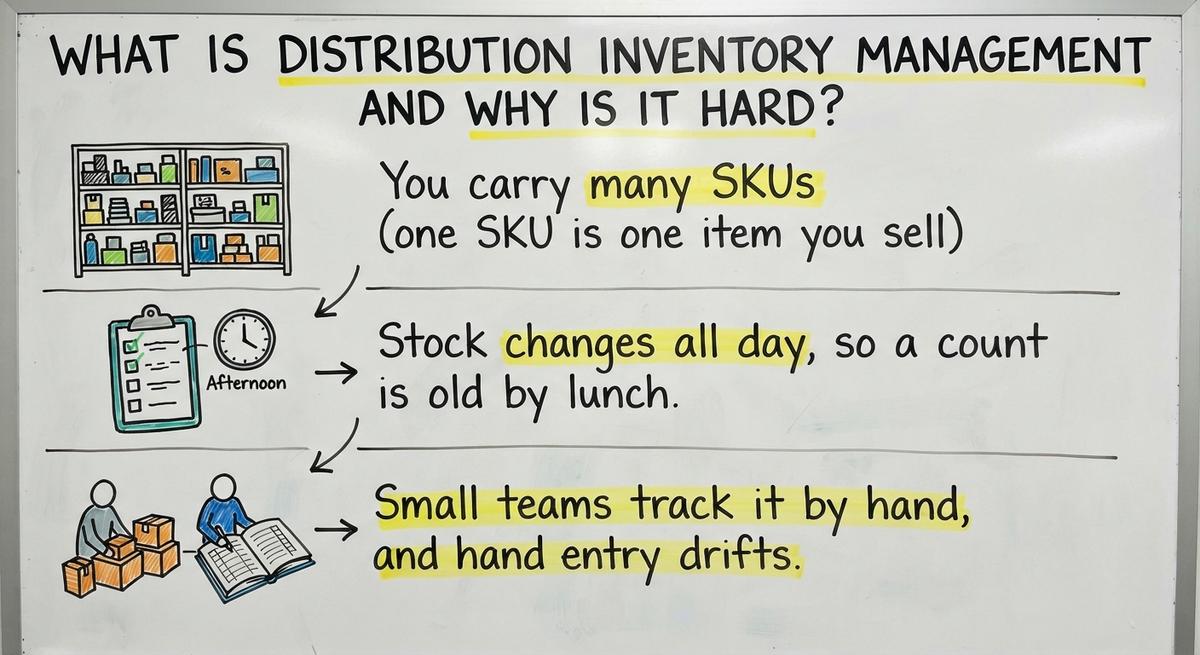
Distribution inventory management is the work of keeping your stock records true. Every box that comes in, moves, or ships must show up in the count. Inventory management for distributors is hard for 3 reasons:
- You carry many SKUs (one SKU is one item you sell), many suppliers and many customers.
- Stock changes all day, so a count is old by lunch.
- Small teams track it by hand, and hand entry drifts.
Barcodes cut that drift. The GS1 barcode standards are the shared rules behind most scan-based counts. A scan beats a keystroke every time.
We build it for your operation, and the first look is free
If you would rather not compare products, describe how your operation already works and we build the system around it.
No build cost. You see it running on your own process first, and the monthly subscription starts only once it is live.
Book a callWhat Does a Distributor Need to Track?
A distributor needs to track items, quantities, locations and costs. Add open buy orders (what you bought) and open sales orders (what you sold). Put all of it in one simple list that every team member trusts. Wholesale inventory management fails when 3 people keep 3 lists.
The law also cares. IRS Publication 538 says: "To figure taxable income, you must value your inventory at the beginning and end of each tax year."
On-Hand, Available and On-Order Stock
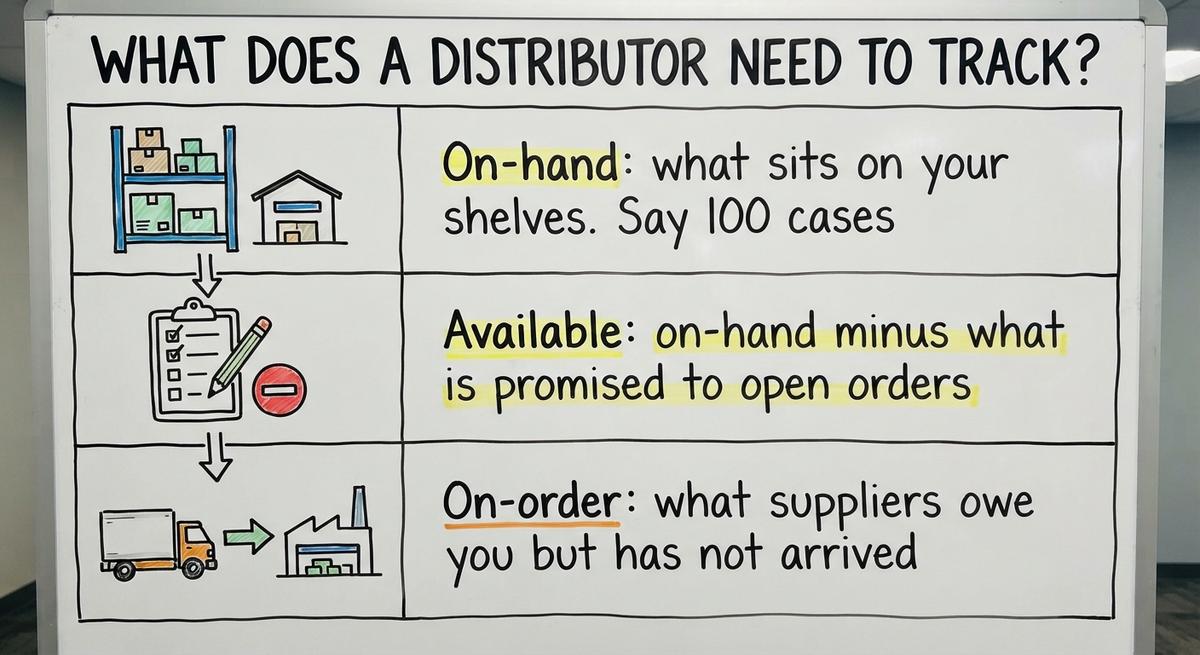
Available stock is the number sales should quote. Three terms matter here:
- On-hand: what sits on your shelves. Say 100 cases.
- Available: on-hand minus what is promised to open orders. If 30 cases are promised, 70 are available.
- On-order: what suppliers owe you but has not arrived. Say 50 cases.
Quote on-hand and you oversell. You promise 100 cases and own 70 free ones. The FTC mail order rule holds sellers to the ship dates they state, so a true count protects you.
Lot Numbers, Serial Numbers and Expiration Dates
Track by lot when a batch can go bad or be recalled. Food, chemicals and parts are the usual cases. A lot number marks one production batch. Without lot records, a recall means opening every box by hand. With them, you find the affected customers in minutes. Track only what your business needs. A fastener bin does not need serial numbers.
Core Methods for Warehouse Inventory Control
Four methods cover most needs. Pick the one that fits your product type and volume. Many shops mix two or three.
FIFO and FEFO
FIFO means first in, first out. The oldest stock ships first. FEFO means first expired, first out. The stock that expires soonest ships first. Use FIFO for parts and goods that age slowly. Use FEFO for food, chemicals and anything with a date. Both cut waste and dead stock. Old goods stop hiding behind new pallets.
ABC Analysis
ABC analysis ranks items by sales value into 3 groups. A items bring in most of your money. C items bring in little. You can build the list from sales data you already have. Then count and watch the A items more often. A stockout on a top seller costs far more than one on a slow mover.
Is Cycle Counting Better Than a Yearly Physical Count?
Yes for most distributors, because cycle counting finds errors weeks sooner. You count a small set of items each week instead of everything once a year. You avoid shutdown days. Set rules by item group. Count A items monthly, B items each quarter, and C items twice a year. Each count should match the book, or you fix the cause.
Not sure this is the right shape for your operation
Describe how the work runs today. We map it on a call and show you what it would look like built around that, before you spend anything.
Book a callHow to Set a Reorder Point and Safety Stock
A reorder point is the stock level that triggers a new order. Safety stock is the extra cushion for surprises. The formula is: daily use x supplier lead time + safety stock.
Here is an example. You sell 20 units a day. The supplier takes 7 days. You keep 40 units of safety stock. So 20 x 7 + 40 = 180. When stock hits 180, you order.
Review each point when demand or lead times shift. A late supplier means a bigger cushion. The NIST Manufacturing Extension Partnership offers neutral guidance on supply chain process.

Why Spreadsheets and Accounting Software Fall Short
Small distributors hit the same problems: stockouts, overstock, counts that never match the books, pick errors, returns, and data split across Excel, Access, paper and email. Spreadsheets stop working when you see these signs:
- Only one person knows how the file works.
- Staff keep private copies.
- Sales cannot see real stock.
- Month-end takes days to reconcile.
An accounting package is great for the money side. It tracks costs and books. Teams often stretch it past warehouse detail like bins, lots and pick paths. Keep it where it helps. Do not rip it out.
The cost of manual work is real. Say 2 people spend 5 hours a week fixing counts at $22 an hour. That is $11,440 a year. The Bureau of Labor Statistics publishes pay for this kind of work, so you can test your own numbers.
The comparison is easier when one option is built for you
Off-the-shelf means fitting your process to the software. We do it the other way round, and the first look costs nothing.
Book a callDo You Need an ERP to Manage Distribution Inventory?
Most small distributors do not need a big ERP (a large system that runs a whole company). Long, costly rollouts are a real worry, and they pull staff off the floor. A middle path exists. Fix only the manual parts and leave the rest alone.
That is where custom inventory management software fits. It is built around how your team already works. It syncs with your accounting software, so your accounting software inventory data stops needing re-entry. It works at small scale. Examples include:
- Receiving screens that log stock at the dock.
- Pick lists that guide staff to the right bin.
- Low-stock alerts that fire at the reorder point.
- A live stock view that sales can trust.
One well-aimed tool beats a full system nobody learns.

How Do You Improve Your Inventory Process Step by Step?
You improve it in 5 steps, and you start with a map of how stock moves today.
- Map the path from dock to truck.
- Clean up item and location data.
- Set count rules and reorder points.
- Automate the most repeated manual task first.
- Measure the results.
Watch 5 numbers. Inventory turnover shows how often you sell through stock. Fill rate is the share of order lines you ship in full. Count the stockouts each month. Track count accuracy. Watch days of stock on hand. The Census Bureau posts wholesale inventory-to-sales ratios for comparison.

How to Choose the Right Approach for Your Size
Ask 3 questions of any option. Does it fit how we work? What does it cost in total? How long until staff use it? Start small and grow. Involve warehouse staff early, since they know where the process breaks. If your team has outgrown its files, a custom software development firm builds inventory tools around your floor and keeps your accounting software in place. Book a short review of your process today.
Frequently asked questions
What is the purpose of inventory management?
The purpose of inventory management is to have the right stock at the right time at the lowest cost. It prevents stockouts and overstock. It also gives you true counts for orders, pricing and tax records.
What is the role of distribution in supply chain management?
Distribution moves goods from makers to buyers. A distributor buys in bulk, stores stock, breaks it into smaller orders and ships it. This saves makers and buyers time, space and money.
How often should a warehouse do cycle counts?
Count every week, but count different items each time. Count high-value A items monthly, B items each quarter, and C items twice a year. Adjust the rules if errors show up in a group.
Can an accounting package manage distribution inventory?
It handles costs and books well. It is weak on bins, lots, pick paths and live available stock. Many small distributors keep it for money and add a light tool for the warehouse.
When do spreadsheets stop working for inventory tracking?
Spreadsheets stop working when one person owns the file, staff keep private copies, sales cannot see real stock, or month-end takes days. Any one of these signs means errors are costing you money.
What is the best method for distribution inventory management?
No single method is best. The right one depends on product type and volume. Use FEFO for dated goods, FIFO for slow-aging parts, ABC analysis to focus counts, and reorder points for steady sellers.
Start with a free first look
A 30 minute call, your operation mapped, and a clear picture of what we would build. No obligation and nothing to install.
Book a callRelated guides
More on the same work.
Guides
- Distribution Management Software
- Warehouse Inventory Management Software
- Warehouse Inventory Management Systems
- Quickbooks Inventory Management Software
- Inventory and Warehouse Management Software
- Custom Inventory Management Software
- Warehouse Inventory Management System
- Retail Inventory Management
- Multi Location Inventory Management Software
- Inventory Management for Multiple Locations
- Manufacturing Inventory Management Software
- Cost of Inventory Management Software
- Manufacturing Inventory Management
- Retail Inventory Management Systems
- Inventory Management Software Freeware
- Inventory Management Small Businesses
Common questions
- Why is Warehousing and Inventory Management Important
- What is the Difference Between Aggregate and Item Inventory Management
- How to Manage Inventory in a Warehouse
- What is the Best Warehouse Inventory Management System?
- What is the Difference Between Warehousing and Inventory Management
- What is B Type of Inventory in Warehouse Management
- What is Warehousing and Inventory Management
- What is Jit Inventory Management