

Wholesale Distributors Definition
The wholesale distributors definition in plain words: what a wholesale distributor does, how it differs from retailers and makers, and how it earns.
Book a callWhat Is a Wholesale Distributor? The Wholesale Distributors Definition
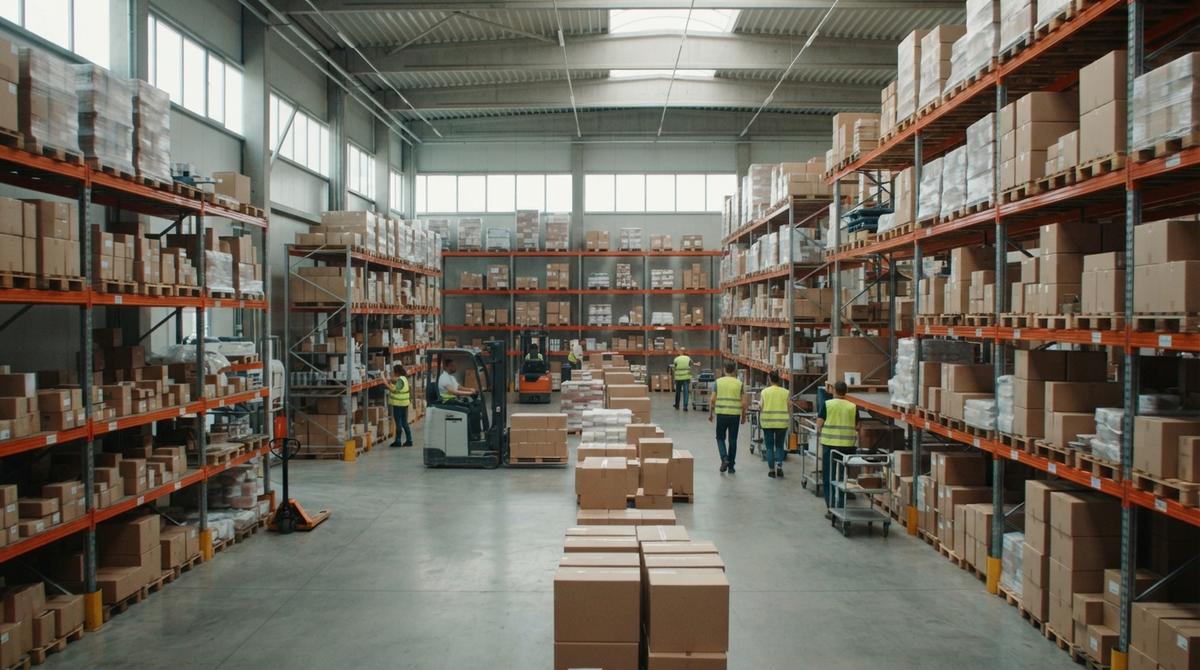
A wholesale distributor buys goods in bulk from makers and sells them in smaller lots to other businesses. The buyers are retailers, contractors, restaurants and repair shops. The general public is not the customer. Think of the distributor as the middle step. The maker builds. The distributor stocks. The business buys what it needs this week. That is wholesale distribution.
We build it for your operation, and the first look is free
If you would rather not compare products, describe how your operation already works and we build the system around it.
Reviewed November 2026.
No build cost. You see it running on your own process first, and the monthly subscription starts only once it is live.
Book a callWhat Does a Wholesale Distributor Do?
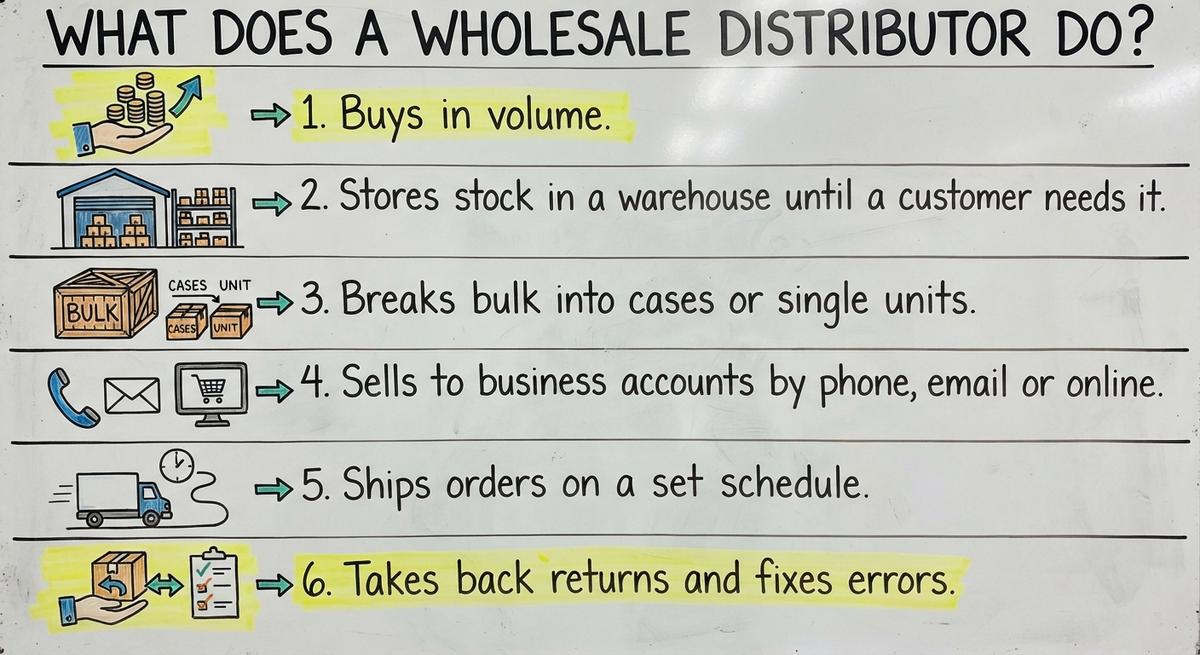
A wholesale distributor does six jobs. Each one sits between the maker and the buyer.
- Buys in volume, often by the pallet or truckload, to win a lower price.
- Stores stock in a warehouse until a customer needs it.
- Breaks bulk into cases or single units.
- Sells to business accounts by phone, email or online.
- Ships orders on a set schedule.
- Takes back returns and fixes errors.
Makers gain, because they deal with a few big buyers and not thousands of small ones. Buyers gain too. A shop owner orders from one distributor and skips full pallets from every maker.
Stock is also a tax matter. A stock inventory definition is simple: goods held for sale. IRS Publication 538 says, "To figure taxable income, you must value your inventory at the beginning and end of each tax year." Under that rule, the inventory asset definition applies to every shelf in the warehouse.
A Simple Example
Picture a distributor that buys pallets of cleaning supplies from a maker. The pallets sit in its warehouse. A local restaurant orders 4 cases of degreaser. An office orders 2 cases of glass cleaner. The distributor picks, packs and ships each order. The flow is maker, distributor, business customer. Each customer gets a small, fast order. The maker sold one big load.

How Is a Distributor Different From a Retailer, a Manufacturer or a Wholesaler?
A distributor sells to businesses, a retailer sells to the public, and a manufacturer makes the goods. Each one holds a different spot in the chain. Those who ask about wholesale vs distributor are asking about the last of these.
Distributor vs Retailer
The table shows four gaps. Business distributors build around accounts, not walk-in shoppers.
| Area | Retailer | Wholesale distributor |
|---|---|---|
| Customer | The public | Other businesses |
| Order size | One or a few items | Cases and pallets |
| Price | One shelf price | Tiers by volume |
| Payment | Paid at checkout | Net terms on an account |
Many customers hold a standing account and place repeat orders. The account, not the single sale, is the unit of business.
Not sure this is the right shape for your operation
Describe how the work runs today. We map it on a call and show you what it would look like built around that, before you spend anything.
Book a callDistributor vs Wholesaler and Manufacturer
A manufacturer makes the product. A distributor moves it. The terms in distributor vs wholesaler overlap. Many people use both words for the same firm. A distributor may have closer ties to a brand, such as an exclusive territory or support duties. No legal rule splits the two words.
Types of Wholesale Distributors
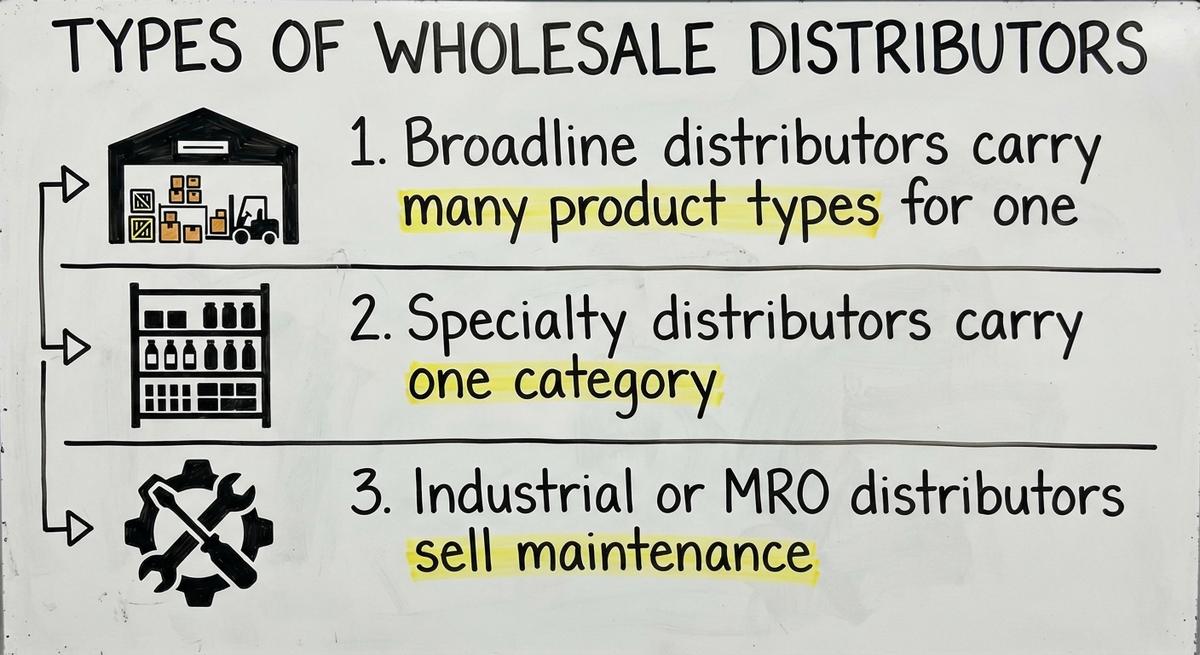
There are 3 main types of wholesale distributors. The type depends on how wide the product range runs.

- Broadline distributors carry many product types for one customer base.
- Specialty distributors carry one category, such as tile or auto parts.
- Industrial or MRO distributors sell maintenance, repair and operations supplies to plants and shops.
Food service and building supply are the familiar distributor examples. A food service firm stocks groceries for restaurants. A building supply firm stocks lumber and fittings for contractors. Fulfillment centers and warehouses are related. They store and ship goods for others but may not own the stock.
How Wholesale Distributors Make Money
The core of the model is the gap between buy price and sell price. A distributor buys low, adds a markup and keeps the margin. Other income comes from volume discounts, maker rebates and service fees, such as delivery or kitting. Margins are small. The US Census Bureau tracks wholesale inventories against sales each month. A small error in cost or count wipes out a thin margin. Accurate stock, cost and price records protect the profit.
What Systems Do Wholesale Distributors Run On?
Many small distributors, from 5 to 100 staff, run on an accounting package, spreadsheets, a few databases, printed pick sheets and email. The setup works until volume grows. Three pains show up first:

- Staff re-key the same order into 2 or 3 places.
- Stock counts drift from what sits on the shelf.
- Pricing lives in one person's head.
The cost adds up. Take 2 people who spend 5 hours a week re-keying orders at $22 an hour. That is $11,440 a year. NIST offers neutral guidance on inventory process.
Custom software fixes the manual parts only. It can connect to your accounting software where that tool works well. It is built around how the team already works. No big system swap is needed. A definition of warehouse management system is software that tracks stock location and movement. What is the definition of inventory management? It is the work of knowing what you hold and what it costs.
Do Wholesale Distributors Sell to the Public or Make Products?
No. A wholesale distributor sells to businesses and does not make the goods. Here are the other quick answers.
Is a distributor the same as a wholesaler? Mostly yes. Distributors can hold closer brand ties.
Do small distributors need big software? No. A fit-for-purpose tool that replaces manual steps is enough.
If your team re-keys orders or guesses at stock, talk to The Software Society. We review your daily work and build around it.
Frequently asked questions
What is a wholesale distributor?
A wholesale distributor buys goods in bulk from makers and sells them in smaller lots to other businesses, such as retailers, contractors and restaurants.
What do wholesale distributors do?
They buy in volume, store stock, break bulk into smaller orders, sell, ship and handle returns.
How do wholesale distributors make money?
They buy low and sell at a markup. Volume discounts, rebates and service fees add to the margin.
Is a distributor the same as a wholesaler?
Mostly yes, since people use both words for the same firm. A distributor may have closer ties to a brand, such as an exclusive territory.
Do wholesale distributors sell to consumers?
No. Their customers are businesses, not the general public.
Do wholesale distributors make products?
No. Manufacturers make the goods. Distributors buy, store and move them.
Do small distributors need big software?
No. Custom tools can replace the manual steps and keep an accounting package where it works, with no large system migration.
Start with a free first look
A 30 minute call, your operation mapped, and a clear picture of what we would build. No obligation and nothing to install.
Book a callRelated guides
More on the same work.
Guides
- Business Distributors
- Distributor Examples
- Distributor Rate
- Company Distributor
- Dealer and Distributor
- Distribution Management Software
- Cloud-based Purchase Order System
- Dealer Distribution
- Distribution Inventory Management
Common questions
- Wholesale Distribution Definition
- Wholesale vs Distributor
- What is the Distributor
- Difference Between a Wholesaler and a Distributor
- Distributors vs Suppliers
- Dealer vs Distributor
- How Distributors Work
- Definition of Warehouse Management System
- What is the Definition of Inventory Management
- Inventory Asset Definition
- Stock Inventory Definition
- Inventory Economics Definition
- Inventory Account Definition