

What is Stock Out Cost in Inventory Management
Stock out cost is the money lost when an item is not on the shelf. Learn what it includes, how to estimate it, and how to cut it.
Book a callWhat Is Stock Out Cost in Inventory Management?
Stock out cost is the money a business loses when it does not have an item a customer wants. A stock out happens when demand shows up and the shelf is empty. People also call it the cost of a stockout or shortage cost. Part of it shows on the books, such as rush freight. Part of it does not, such as a buyer who quietly goes elsewhere. Reviewed November 2026.
We build it for your operation, and the first look is free
If you would rather not compare products, describe how your operation already works and we build the system around it.
No build cost. You see it running on your own process first, and the monthly subscription starts only once it is live.
Book a callWhat Does Stock Out Cost Include?
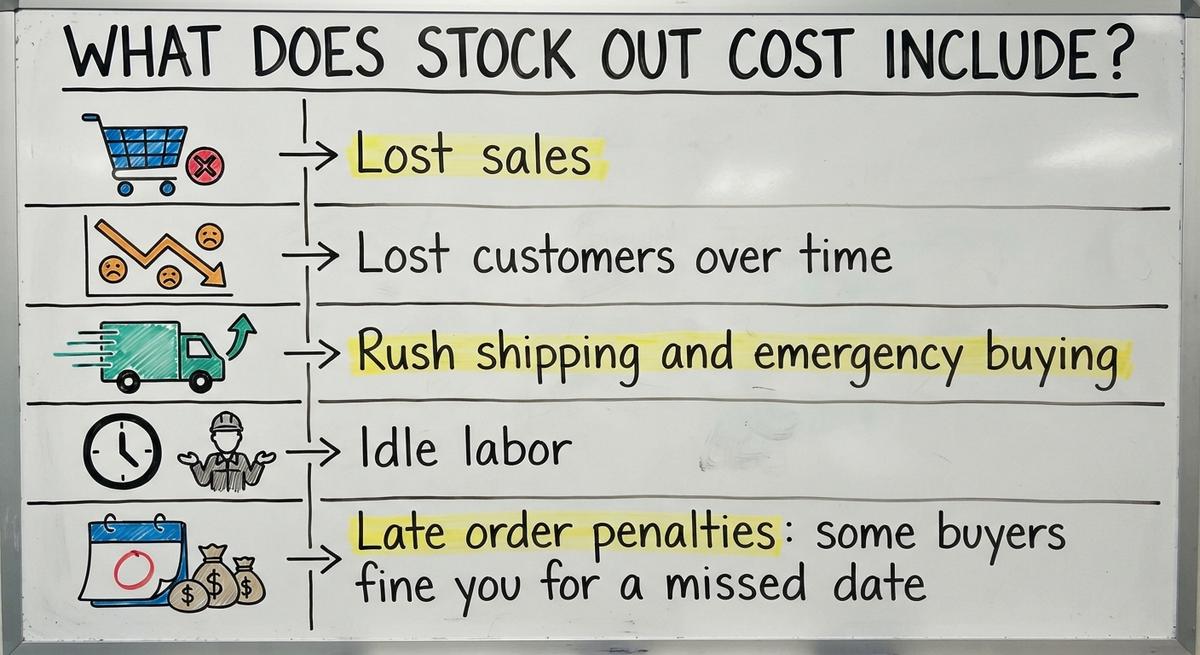
Stock out cost has 5 main parts. Some are easy to see. Others hide.
- Lost sales: the order you could not fill is revenue you never booked.
- Lost customers over time: a buyer who gets burned twice stops asking.
- Rush shipping and emergency buying: you pay extra to restock fast.
- Idle labor: pickers and drivers wait while someone hunts for stock.
- Late order penalties: some buyers fine you for a missed date.
Good counts also protect your promises. The GS1 barcode standards give every item one scannable ID, so a count matches the shelf. The first 2 items are the costliest, and the first is the easiest to miss.
What Are the Direct Costs of a Stock Out?
Direct costs are the bills and lost sales you can point to. They include the lost sale on the item and on anything else the customer would have bought with it. They also include rush freight or premium pricing to restock fast. Staff time spent calling customers and suppliers counts too.
Here is a simple wholesale case. A customer has a standing order for 10 cases each week. You are 1 case short of a fast moving item. You pay for a rush delivery and the customer cancels the whole line. The missing case cost far more than the case.
What Are the Hidden Costs of a Stock Out?
Hidden costs are the ones nobody writes down. Customer trust drops. Buyers move part of their order to another distributor and may not move it back. A backorder, which is an order held until stock arrives, adds paperwork and errors. Staff work around the gap with extra picking, substitutions and re-planning.
These costs rarely show up as a line item in your accounting software. The loss lands in a slow month, not on a receipt. You feel it long before you can measure it.
How Do You Calculate Stock Out Cost?
Add three things: units short times profit per unit, extra costs to fix it, and an estimate of future sales lost. Use round numbers.

Say you are 40 units short. Each unit earns $12 profit. That is 40 x $12 = $480. You pay $150 for rush freight. A buyer moves 2 later orders worth $150 profit each, so that is $300. The total is $480 + $150 + $300 = $930 for one stock out.
This is an estimate. The future loss is a guess. A rough number is still useful. It tells you which items deserve attention first.
Stock Out Cost vs. Holding Cost
Holding cost is what extra stock costs you. It covers space, tied-up cash and spoilage. Stock out cost is what too little stock costs you. The two pull against each other.
Safety stock is the cushion between them. It is the extra units you keep in case demand jumps or a supplier runs late. A bigger cushion cuts stock outs and raises holding cost. The goal is a balance. Zero stock outs at any price will bury you in held inventory.
Not sure this is the right shape for your operation
Describe how the work runs today. We map it on a call and show you what it would look like built around that, before you spend anything.
Book a callWhy Stock Outs Happen in Small Warehouses and Distributors
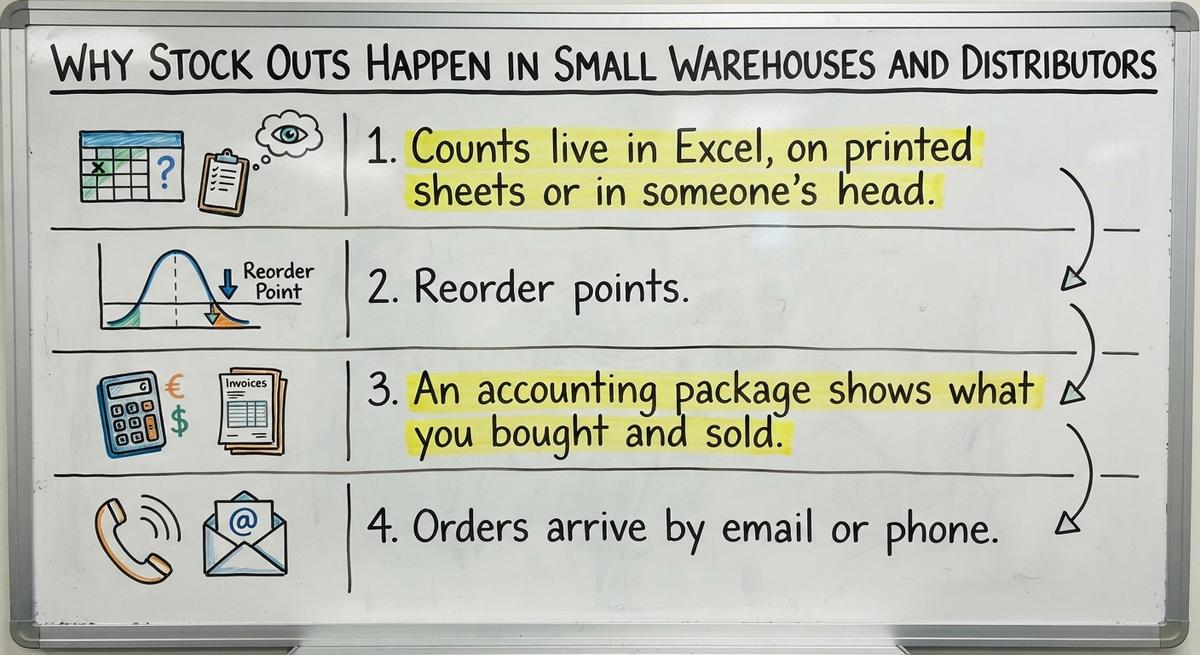
Stock outs in small operations come from process gaps, not from careless people. Most teams do their best with the tools they have.

- Counts live in Excel, on printed sheets or in someone's head. The numbers drift from the shelf.
- Reorder points, the stock level that triggers a new buy, are guessed or not tracked.
- An accounting package shows what you bought and sold. It is not always built for live stock levels across locations and bins.
- Orders arrive by email or phone. They tie to stock only after the fact.
Each gap is small. Together they let an empty shelf surprise you. The IRS already expects a count: Publication 538 says, "To figure taxable income, you must value your inventory at the beginning and end of each tax year." A count you trust serves both the tax office and the shelf.

How to Reduce Stock Out Cost
A team of 5 to 100 can start these steps without a big ERP project. ERP means a large system that runs the whole company.
- Set a reorder point for the items that matter most. Start with your top 20.
- Count stock on a set schedule. Fix gaps that repeat. This is the heart of what is stock taking in inventory management work, and NIST offers neutral guidance on supply chain process.
- Log each item that runs out and what it cost.
- Share stock levels with sales and purchasing in one place.
- Review supplier lead times every quarter. A slow supplier needs a bigger cushion.
The log in step 3 pays off fastest. It shows which few items cause most of the loss.
When Does Software Help With Stock Out Cost?
Software helps when manual steps cause the gaps. Re-keying counts, spreadsheet reorder lists and emailed orders are the usual culprits. Each one is a place where a number goes stale.
The Software Society builds custom software around how your operation already works. It keeps your accounting software where it is useful and replaces only the manual parts. This works at small scale. You do not need a full migration.
Cost is a fair worry. Read about the cost of inventory management software before you decide. Then list your three costliest stock outs and see which manual step caused each one. If you want a second pair of eyes, talk to our Columbus, Ohio team.
Frequently asked questions
What are the four types of inventory costs?
The four types are ordering cost, holding cost, stock out cost and buy cost. Some sources list setup cost in place of buy cost. Ordering cost is the price of placing an order. Holding cost is the price of storing stock. Stock out cost is the loss when an item is not on hand.
What is the difference between stock out cost and holding cost?
Stock out cost is what you lose when stock runs out. Holding cost is what you pay to keep stock on hand. Safety stock sits between them. The goal is a balance of the two.
How do you calculate stock out cost?
Multiply units short by profit per unit. Add the extra cost to fix the problem. Add an estimate of future sales lost. The result is an estimate, and a rough number is still useful.
Why do stock outs happen in small warehouses and distributors?
Counts drift from the shelf when they live in spreadsheets or on paper. Reorder points are guessed. Orders arrive by email or phone and do not tie to stock until later.
What costs are included in a stock out?
Lost sales, lost customers over time, rush shipping, idle labor and late order penalties. The first 3 are the easiest to name. Lost customers are the hardest to see.
How can a small distributor reduce stock outs without a big ERP?
Set reorder points for top items. Count on a schedule. Log each stock out and its cost. Share stock levels in one place. Review supplier lead times.
When does it make sense to use software to track stock levels?
Use software when manual steps cause the gaps. Re-keyed counts, spreadsheet reorder lists and emailed orders are signs. Custom software can replace only those parts and leave the rest alone.
Start with a free first look
A 30 minute call, your operation mapped, and a clear picture of what we would build. No obligation and nothing to install.
Book a callRelated guides
More on the same work.
Guides
- Cost of Inventory Management Software
- Warehouse Management Cost
- Total Cost of Inventory Formula
- Inventory Management Software Costs
- Warehouse Management Costs
- Costing Inventory
- Warehouse Stock Management Software
- Cloud Stock Management Software
- Warehouse Stock Management System
- Small Business Stock Management Software
- Hospital Stock Management System
- Retail Stock Management Software
- Medical Stock Management System
- Inventory Management Software Freeware
- Free Inventory Management Software for Small Business
- Price of Inventory Management Software
- Simple Inventory Management Software Free
- Inventory Stock Software