


What Is Stock Taking In Inventory Management
Stock taking in inventory management means physically counting every item in your warehouse and comparing those counts to your system records. It confirms what you actually have on hand versus what your records say you have. Operations managers call it a physical inventory count or stocktake. It is a checkpoint, not a daily routine.
Reviewed and updated: October 2026
Book a callWhat Is Stock Taking in Inventory Management?
Stock taking is the process of counting every item in a storage location and checking those counts against your records. The goal is simple: find the gap between what the system says and what is actually on the shelf. When those numbers match, your team can buy, sell, and ship with confidence. When they do not, every downstream decision is built on bad data.
We build it for your operation, and the first look is free
If you would rather not compare products, describe how your operation already works and we build the system around it.
No build cost. You see it running on your own process first, and the monthly subscription starts only once it is live.
Book a callWhy Stock Taking Matters for Distributors and Warehouses
A gap between your records and your physical stock causes real problems fast. You oversell items you do not have. You reorder products already sitting in a back corner. You ship the wrong quantity and damage a customer relationship that took years to build.
For wholesale distributors running on an accounting package and spreadsheets, those gaps compound quietly. A small error in January becomes a costly unwind by Q4.
Barcode-based scanning is one of the most reliable ways to close that gap at the point of count. As GS1 explains, standardized barcodes are "the foundation of supply chain efficiency," enabling accurate item spotting at every stage. Without that foundation, a count is only as good as whoever is reading a handwritten label.
Inaccurate Stock Counts Carry Legal Risk Too
The US Federal Trade Commission makes the stakes clear: businesses must ship orders when promised. An inaccurate stock count is often the first link in the chain that leads to a late or wrong shipment.
Accurate counts protect revenue, customer trust, and legal standing.
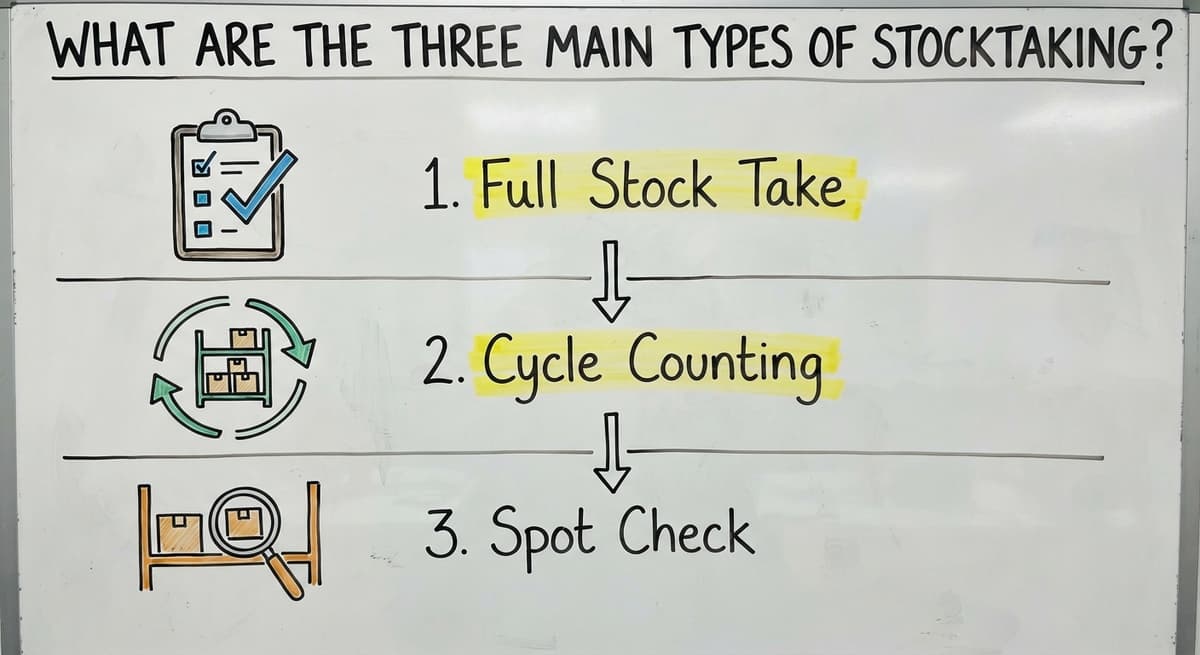
What Are the Three Main Types of Stocktaking?
What are the three main types of stocktaking, and which one fits a small or mid-size warehouse? The 3 types are a full stock take, cycle counting, and a spot check. For most lean warehouse operations, cycle counting is the right answer because it spreads the work across the year without stopping operations.
Full Stock Take
A full stock take counts every SKU at once. Operations usually pause during the count. Most businesses run a full count once or twice a year, often tied to a fiscal period. The IRS is direct on why this matters: "To figure taxable income, you must value your inventory at the beginning and end of each tax year," as stated in IRS Publication 538. A full count satisfies that requirement cleanly.
The downside is disruption. Stopping a warehouse for a full day costs real money in labor and lost throughput.
Cycle Counting
Cycle counting is a rolling schedule where staff count a small section of inventory each day or week. Over time, every location gets counted without a single shutdown. For a 10- to 50-person operation, this approach keeps counts current and keeps the warehouse moving.
Cycle counting vs. full physical inventory is a decision worth making carefully. Cycle counting wins on continuity; a full count wins on a clean point-in-time snapshot.
Spot Check
A spot check targets one product or one location. A customer complaint, a buy order that does not add up, or a receiving discrepancy can all trigger a spot check. It is fast and focused, not a substitute for the other two types.
The right type depends on how often your records drift and how much downtime your operation can absorb.
The comparison is easier when one option is built for you
Off-the-shelf means fitting your process to the software. We do it the other way round, and the first look costs nothing.
Book a callHow a Stock Take Works Step by Step
A physical inventory count follows a clear sequence. Skipping any step is where errors enter. Here are the 5 steps in order:
- Freeze transactions. Stop receiving and shipping during the count window. Numbers that move while you are counting make the final tally meaningless.
- Assign zones. Divide the warehouse into sections. Give each team member one zone and one zone only. Overlapping assignments cause double counts and missed areas.
- Count and record. Staff count items and log quantities. A device that feeds directly into the inventory system removes the transcription step where most errors happen.
- Compare to records. The system flags every variance between the counted quantity and the expected quantity. Large gaps go to a manager before anything is accepted.
- Investigate and adjust. Research variances before posting adjustments. A big discrepancy often has a cause: a receiving error, a mislabeled bin, or product stored in a second location.
What a Manual Stock Take Actually Costs
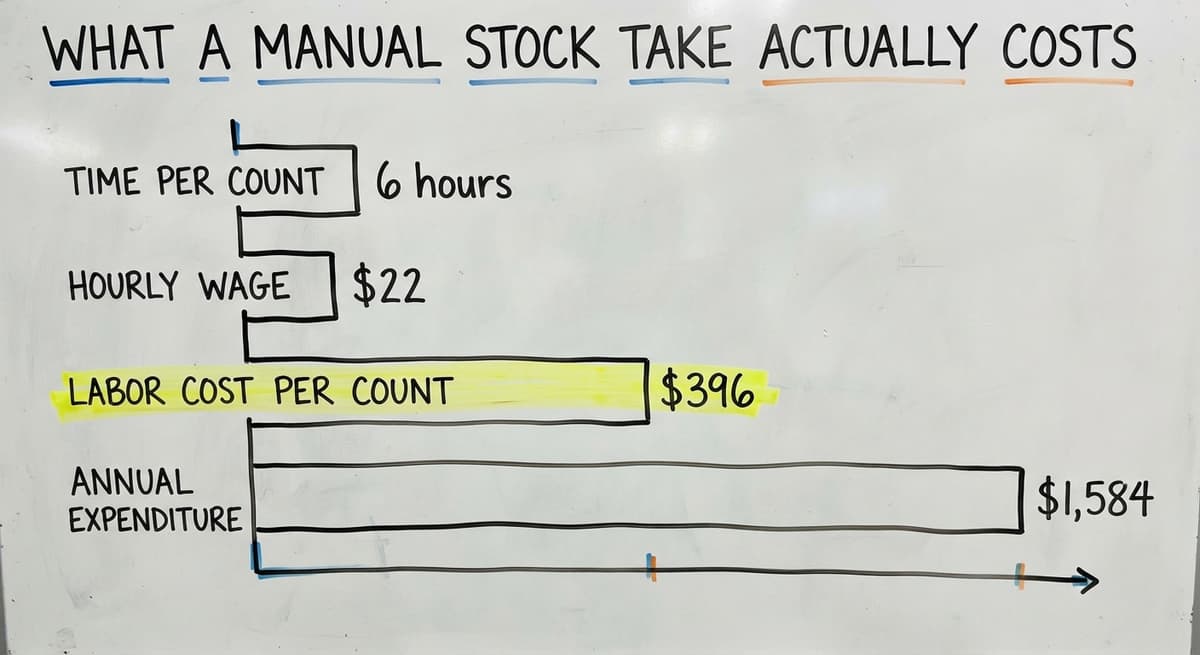
Three people spending 6 hours each on a manual count, at the median material recording clerk wage of around $22 per hour, costs about $396 in labor for a single event. Run that 4 times a year and you spend roughly $1,584 before accounting for the errors that still slip through on paper tally sheets.
A clean process with digital recording cuts both the time and the error rate.

Common Reasons Stock Counts Go Wrong
Most stock count errors trace back to process gaps, not careless staff. The problems below are almost universal in operations still running manual processes on printed sheets.
- Counting while receiving or shipping is still active means the numbers change mid-count and the final tally reflects a moving target.
- Paper tally sheets get transcribed incorrectly into an accounting package or spreadsheet, and a single transposed digit creates a variance that takes hours to trace.
- Items stored in multiple bin locations get counted only at one location, leaving the rest of the stock invisible to the count.
- No clear zone assignments mean some aisles get counted twice and others get skipped entirely.
- Handwritten counts passed between shifts introduce a second layer of transcription risk before anyone enters a single number.
The Easiest Stock Count Error to Fix
Replacing spreadsheets and printed sheets in warehouse operations does not need a full platform overhaul. Fixing the transcription step alone removes the most common source of inventory discrepancy.
The paper-to-system transfer is where accuracy goes to die, and it is also the easiest step to fix.
See it running on your own process first
No build cost. The subscription starts once it is live and doing the job, not before.
Book a call
Stock Taking vs. Inventory Management: Understanding the Difference
Inventory management is the daily system: buying, receiving, tracking movement, and filling orders. It runs continuously. Stock taking is a single check event inside that system. It checks whether the daily records are still accurate.
Neither works without the other. A warehouse with strong daily tracking but no periodic count will drift. Small errors in receiving or picking accumulate until the records no longer reflect reality. A team that counts frequently but has no reliable tracking system between counts just keeps finding the same errors without fixing what causes them.
Why Annual Counts Are Not Enough
Think of inventory management as the engine and stock taking as the instrument check. The US Census Bureau's Monthly Wholesale Trade data shows that wholesale inventories move constantly relative to sales. A system that only checks accuracy once a year cannot keep pace with that volume.
Stock taking gives your daily system a reference point it can correct toward.

How Software Makes Stock Taking Faster and More Accurate
The right inventory software removes the steps where errors enter, without replacing the workflow your team already knows. Here is what that looks like in practice:
- Mobile or tablet-based counting apps let staff record counts on a device that writes directly to the system. The paper tally sheet and the transcription step disappear together.
- Real-time variance flagging shows managers discrepancies as counts come in, not 2 days later when the tally sheets finally reach the office.
- Accounting software inventory integration means adjusted counts flow into your financials automatically. No second round of data entry, no second opportunity for a typo.
- Custom workflow design matches the software to how your warehouse already operates. Staff do not need to relearn their jobs; they just stop writing things down by hand.
What to Look for in Inventory Software for Distributors
Inventory management software for wholesale distributors does not have to be an enterprise platform with a 6-month rollout. The goal is to close the gap between the count and the record, and a focused tool does that without disrupting everything else.
Software earns its place by cutting the time between a count and a correct record.

Stock Taking for Small and Mid-Size Wholesale Operations
Enterprise inventory platforms are built for thousands of SKUs across dozens of locations. For a 10- to 50-person wholesale operation, that scale means high licensing costs, long setup times, and features the team will never use.
A custom-built solution can do something an off-the-shelf platform cannot: match the count process the team already runs, add digital recording and automatic variance reporting, and leave your existing accounting software in place. How custom warehouse software integrates with your accounting software is a practical question, not a technical one. The answer is that a well-built integration posts adjusted counts directly to the ledger without a second data entry step.
Not sure this is the right shape for your operation
Describe how the work runs today. We map it on a call and show you what it would look like built around that, before you spend anything.
Book a callWhy Supply Chain Improvements Should Fit Your Operation
The NIST Manufacturing Extension Partnership frames this well: supply chain improvements work best when they align with how a business already operates rather than forcing a new operating model on top of an existing one. The goal is not to rebuild the operation. The goal is to fix the manual parts that create errors and slow the team down.
A lean team gets more from a focused tool than from a platform built for a business ten times its size.
What Metrics Should a Warehouse Track After Every Stock Take?
Track at least 4: inventory accuracy rate, shrinkage rate, count duration, and variance by location. Each one points to a specific working decision, not just a number on a report.
- Inventory accuracy rate is the percentage of SKUs where the counted quantity matches the system record. An industry target of 95% or higher is common. Below that, the records are unreliable enough to cause real ordering and shipping errors.
- Shrinkage rate measures the difference between expected and actual inventory value, expressed as a percentage of total value. It captures loss from damage, theft, or receiving errors that never got corrected.
How to Use Stock Take Metrics to Drive Decisions
- Count duration tracks how long the full count or cycle count took. Comparing duration across counts shows whether process changes are actually saving time.
- Variance by location or product category reveals whether errors cluster in a specific zone or product type. A consistent variance in one aisle often points to a storage or labeling problem, not a counting problem.
These 4 metrics connect directly to decisions: whether to reorder, whether to investigate a zone, whether the current count process is improving. Tracking them after every count turns stock taking from a one-time event into a tool for steady working improvement.
The metric that matters most is whichever one your team is not currently measuring.
Ready to Fix Your Stock Count Process?
If your team is still reconciling counts on paper and entering results by hand into an accounting package, the errors are not a people problem. They are a process problem. A focused digital tool removes the transcription step, flags variances in real time, and keeps your existing accounting workflow intact.
If you want to see what a custom-built count process looks like for a lean wholesale or warehouse operation, reach out. Bring a description of how your team currently runs a count and what breaks down. That is enough to start a useful conversation.
Frequently asked questions
Is inventory the same as stock-taking?
No. Inventory refers to the goods a business holds for sale or use. Stock-taking is the act of physically counting that inventory and comparing the result to system records. Inventory is the thing; stock-taking is the check on whether the records about that thing are still accurate.
What are the three main types of stocktaking?
The 3 main types are a full stock take, cycle counting, and a spot check. A full stock take counts everything at once, usually once or twice a year. Cycle counting spreads counts across the year in small sections so operations keep running. A spot check targets one product or location in response to a specific discrepancy or complaint.
What are the duties of a stocktaker?
A stocktaker counts items in an assigned zone, records quantities correctly, flags anything that looks out of place, and reports results to a supervisor or into the inventory system. In a small warehouse, one person may cover multiple zones. The core duty is an honest, complete count with no items skipped and no quantities guessed.
What is stock inventory management?
Stock inventory management is the ongoing process of tracking what a business buys, receives, stores, and sells. It covers purchasing, receiving, warehouse location tracking, and order fulfillment. Stock taking is one part of that system: the periodic physical count that confirms the daily records are still accurate.
Why do inventory counts become inaccurate over time?
Records drift because small errors accumulate. A receiving shipment logged at the wrong quantity, a product moved to a second bin without a system update, or a return processed incorrectly each add a small gap. Over weeks and months those gaps grow. Without a regular physical count to catch and correct them, the records become unreliable.
How can a business keep its accounting software and still improve its stock taking process?
A business can keep its existing accounting software and add a separate counting tool that integrates with it. When a count is completed and variances are approved, the adjusted quantities post directly to the accounting software without a second data entry step. The accounting workflow stays the same; only the counting step changes from paper to digital.
Is stock taking software practical for a small wholesale or distribution operation?
Yes, provided the software matches the way the team already works. Enterprise platforms built for large operations are often too complex and too expensive for a 10- to 50-person business. A focused tool or custom-built solution that handles digital recording, variance flagging, and accounting integration can deliver most of the benefit at a fraction of the cost and setup time.
Start with a free first look
A 30 minute call, your operation mapped, and a clear picture of what we would build. No obligation and nothing to install.
Book a callRelated guides
The rest of this guide, for the parts of the job this page does not cover.
Guides
- Cloud Stock Management Software
- Hospital Stock Management System
- Make to Stock Examples
- Types of Stock Control Systems
- Stock Software
- Low Stock Alert
- Procedure for Stock Control
- Multi Location Inventory Management Software
- Inventory Management for Multiple Locations
- Inventory Management System for Manufacturing
Common questions
- What is Inventory Management and Its Types
- What is the Main Purpose of Inventory Management
- What is Information Technology Inventory Management
- What is Risk Pooling in Inventory Management
- What is Bin Number in Inventory Management
- What is Inventory Listing
- What is Inventory
- What is the Best Warehouse Inventory Management System?
- What is the Difference Between Warehousing and Inventory Management
- What is B Type of Inventory in Warehouse Management
- What is Warehousing and Inventory Management
- What is the Best Inventory Management Software for Small Business
- What is the Best Inventory Management System for Small Businesses?
- How to Calculate Cycle Stock