

Warehouse Management Costs
Warehouse management costs are every dollar spent on inventory. That means receiving, storing, tracking, picking, packing, and shipping it, and for most small distributors it runs between 2 and 5 percent of revenue. The biggest lines are labour at $22 an hour, space at $8 to $15 a square foot a year, errors at $50 to $150 each, and software at $300 to $2,000 a month. This guide, reviewed in September 2026, itemises the costs and shows where software moves them.
Reviewed August 2026. Each figure comes from the assumptions stated beside it, so you can substitute your own and the arithmetic still holds.
Published 7 August 2026. Reviewed and updated 15 September 2026.
Book a callWhat Do Warehouse Management Costs Actually Cover?
Warehouse management costs fall into 2 buckets. The first bucket holds your direct costs: labor, rent, equipment, and software. These show up on your profit and loss statement.
The second bucket holds your indirect costs: errors, delays, and manual rework. These rarely appear as a line item, but they drain time and money every day.
Direct Costs You Can See
Direct warehouse operating costs are easy to find. Pull your rent invoice, your payroll report, and your equipment lease. Add them up. That number is real, but it is only part of the story.
Most operations managers know their direct costs within a few thousand dollars. The surprise is almost always in the second bucket.
Indirect Costs That Hide on Your Books
Indirect warehouse costs show up as lost time, short shipments, and customer complaints. A picker who spends 20 minutes searching for a mislocated item does not log that as a cost.
A coordinator who re-keys the same order into 3 different systems does not flag that as waste. But those hours add up fast. For a 20-person warehouse, even 30 minutes of daily rework per person is 200 hours a month gone.
Would you rather have it built around your operation?
The first look is free. If you would rather not compare products, describe how your operation already works and we build the system around it.
No build cost. You see it running on your own process first, and the monthly subscription starts only once it is live.
Book a callThe Main Categories of Warehouse Management Costs
Breaking costs into clear groups makes them easier to measure and fix. Operations managers who try to cut costs without this map end up squeezing the wrong things.
As OSHA notes, "The warehousing and storage industry includes establishments operating facilities for general merchandise, refrigerated goods, and other products." Each type of facility carries its own cost profile, but the categories below apply across all of them.
Warehouse Labor Costs: Direct Time
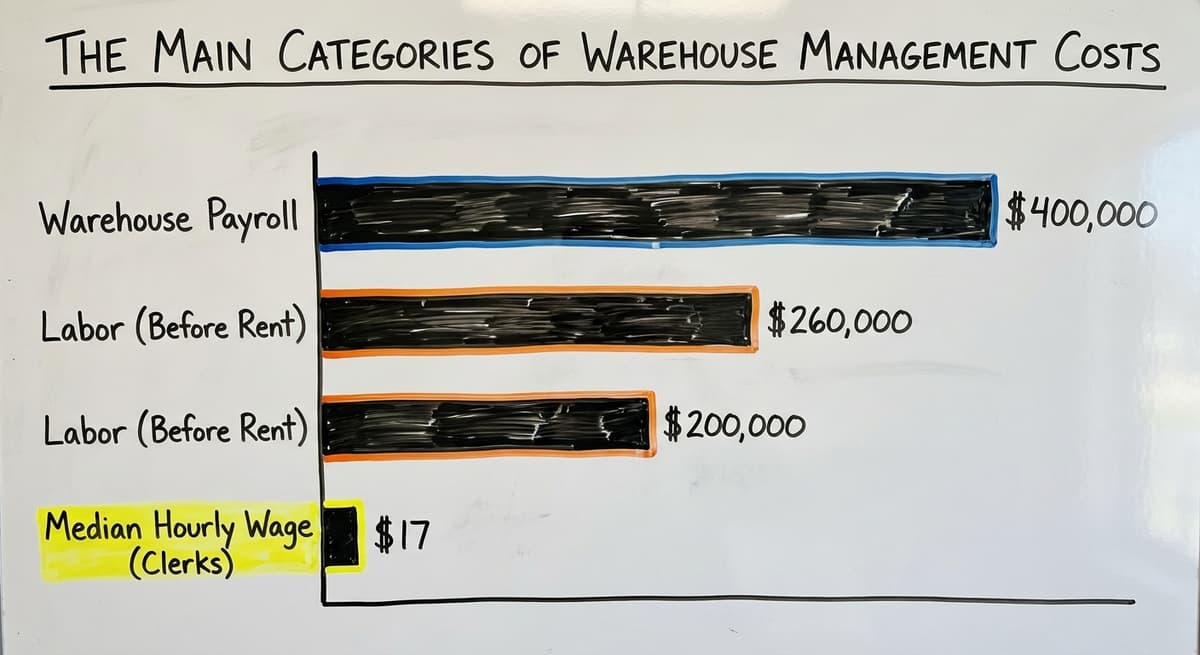
Labor is the biggest line item in almost every warehouse. It runs 50 to 65 percent of total warehouse operating costs. Direct labor covers picking, packing, receiving, putaway, and cycle counts. These tasks create value. They move product toward the customer.
The math is straightforward. If your warehouse payroll is $400,000 a year, you are spending $200,000 to $260,000 on labor alone before you pay a dollar of rent.
Warehouse Labor Costs: Indirect Time
Indirect labor is where small warehouses bleed money quietly. This covers time spent looking for items, correcting errors, and re-keying data from paper into QuickBooks or Excel. None of that work moves product. It just fixes problems that a better system would prevent.
According to the US Bureau of Labor Statistics, stock clerks and order fillers earn a median hourly wage around $17 to $19.
If 3 people spend 2 hours each day on manual data entry, that is roughly $23,000 a year in labor that adds no value.
Warehouse Labor Costs: The Small Team Problem
Small warehouses with 5 to 30 staff feel indirect labor costs most sharply. One person handles receiving, picking, and data entry in the same shift.
Every hour spent on clerical work is an hour not spent on the floor. The team is not slow. The system is slow. Replacing manual steps with connected workflows is the fix, not hiring more people.
Space and Facility Costs: The Fixed Overhead
Rent, utilities, insurance, and maintenance tied to your building are largely fixed. You pay them whether the space is full or empty.
For most small distributors, this accounts for 10-20 percent of total warehouse operating costs. The building cost itself is hard to cut without moving. But how well you use that space is entirely within your control.
Space and Facility Costs: What Poor Visibility Costs You
Poor inventory visibility leads to overstocking. Overstocking wastes expensive square footage. Dead stock and slow-moving SKUs sit on shelves that could hold profitable inventory. Knowing exactly what is on hand lets you right-size your footprint.
Some operations discover they can avoid renting overflow space simply by clearing out items they did not know were sitting there. Real-time inventory data is not just an operational tool. It is a space planning tool.
Inventory Carrying Costs: What It Costs to Hold Stock
Inventory carrying costs are the total cost of holding inventory over time. The standard range is 20 to 30 percent of inventory value per year. That figure includes capital tied up in stock, storage space, insurance, shrinkage, and obsolescence.
If you are holding $500,000 in inventory, you are paying $100,000 to $150,000 a year just to keep it on the shelf.
Inventory Carrying Costs: How Inaccurate Records Drive Them Up
Inaccurate inventory records cause over-ordering. Over-ordering drives carrying costs up. This is one of the most common patterns in small warehouse operations: QuickBooks handles the financials, a separate spreadsheet tracks stock levels, and the two never fully agree. The gap between them leads to buying stock you already have.
The IRS states in Publication 538 that "to figure taxable income, you must value your inventory at the beginning and end of each tax year." That legal obligation means your inventory records have to be accurate.
Most operators know this. The challenge is keeping them accurate without a manual count every week.
Warehouse Error Costs: The Multiplier Effect
Picking errors, wrong shipments, and returns all carry a cost multiplier. You pay labor to fix the mistake. You pay shipping to reship the order. You lose customer goodwill that is hard to price but easy to feel.
The cost to fix a warehouse error is often 5 to 10 times the cost of getting it right the first time.
A $15 pick error can easily cost $100 to resolve once you add labor, reshipping, and the time spent on the phone with the customer.
Warehouse Error Costs: Where Mistakes Come From
Manual processes are the primary source of picking errors. Printed pick sheets go out of date the moment they are printed. Handwritten counts get misread. Staff working fast in a noisy warehouse make mistakes that no one can blame them for.
The hidden cost is the staff time spent on calls and emails resolving order disputes. One customer complaint call can take 30 minutes to resolve. At scale, this becomes a real budget line that never appears on any report.
Technology and System Costs: What You Are Already Paying
Software subscriptions, scanners, printers, and computers all carry a cost. So does IT support, even informal support from whoever on the team is best with computers.
Most small distributors are already paying for several tools. The question is whether those tools are working together or working against each other.
Technology and System Costs: The Hidden Cost of Cobbled Systems
A stack of disconnected tools like QuickBooks plus Excel plus a shared drive plus email is not free. It costs staff time every day. Licensing fees for systems that are never fully used because they were too complex to implement properly are a real drain.
Many small distributors are paying for tools they barely use while still doing most work manually. The goal is not more software. It is the right software, connected in a way that matches how the operation actually works.
The comparison is easier when one option is built for you
Choosing between off-the-shelf and custom software is easier when one option follows your process. Off-the-shelf means fitting your process to the software. We do it the other way round, and the first look costs nothing.
Book a callWhy Are Warehouse Management Costs Higher Than They Look?
Warehouse management costs work like an iceberg. The visible part is what you can measure: hours billed, rent paid, software invoices. The part below the waterline is larger and harder to see.
The Iceberg: What You Cannot See on a Report
The real costs in a small distribution operation sit below the waterline: time lost to manual data entry, decisions made on stale inventory numbers, stock-outs that cost sales, and overtime caused by inefficient workflows.
None of these show up as a clean line item. They show up as a vague feeling that costs are too high and margins are too thin, but the source is hard to name.
The Operations Manager Who Knows Something Is Wrong
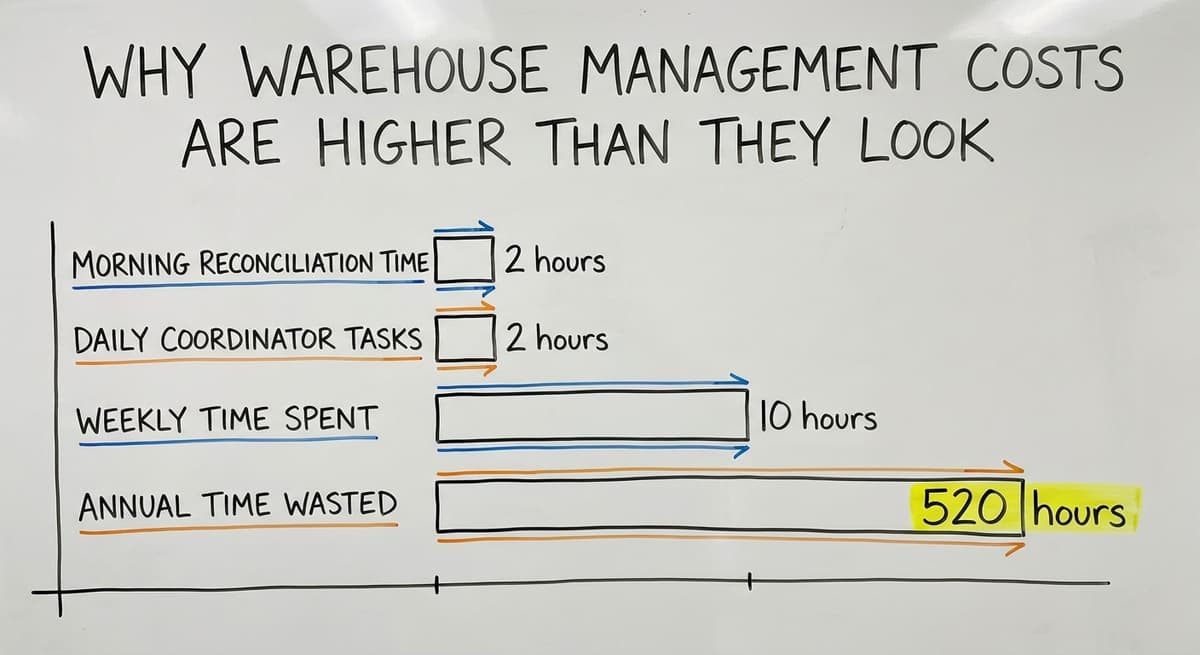
If you are the person who runs this warehouse, you already know something is off. You feel it when the morning reconciliation takes 2 hours before the day can start.
You feel it when a customer calls about a short shipment and no one can explain how it happened. You feel it at month end when the numbers do not quite add up.
That feeling is real. The costs are real. They are just not labeled.
A Relatable Example: The Morning Reconciliation
Consider a warehouse coordinator who spends 2 hours every morning comparing the previous day's pick sheet to what QuickBooks shows. That is 10 hours a week, 520 hours a year, spent on a task that exists only because 2 systems do not talk to each other.
At $20 an hour, that is $10,400 a year in labor that produces nothing. Fix the connection between the systems and that time goes back to the floor.

How Do Manual Processes Drive Up Warehouse Management Costs?
Manual warehouse processes do not just slow things down. They create cost at every step.
A Typical Day in a Manual Warehouse
Here is how a typical day runs in a manual warehouse. A shipment arrives. Staff count it by hand. Someone enters the count into a spreadsheet. Someone else updates QuickBooks separately. A pick list is printed.
A picker works from the list. After shipping, quantities are re-entered by hand. Each of those steps is a handoff. Each handoff is a chance for an error. Each error is a cost.
This Is a Systems Problem, Not a People Problem
The people doing this work are not slow or careless. They are doing their best with the tools they have. The system is the problem.
When the system requires 6 manual steps to complete one transaction, errors are not a failure of effort. They are a predictable outcome of the design. Fixing the system changes the outcome without asking more of the team.
Why Do Owners Feel Stuck?
Many owners know manual processes are costing them money. They feel stuck because the alternative seems to be a massive ERP project that takes a year, costs a fortune, and disrupts everything. That is a real fear and a reasonable one.
But it is not the only option. Replacing just the broken parts, while keeping QuickBooks in place for financials, is a practical path that many small distributors have taken successfully.
See it running on your own process first
Nothing to pay upfront. The subscription starts once it is live and doing the job, not before.
Book a call
What Drives Warehouse Management Costs at Small and Mid-Size Operations?
Small and mid-size operations face a specific set of cost drivers that enterprise tools are not designed to solve.
Reliance on Individual Knowledge
In a 5 to 100 staff warehouse, the system lives in one person's head. One person knows where the slow-moving SKUs are stored. One person knows which supplier ships short.
One person knows the workaround for the inventory count that never quite reconciles. When that person is sick, on vacation, or leaves, the whole operation slows down. That is a real cost and a real risk.
No Real-Time Data and No Automated Triggers
Small operations rarely have real-time inventory data. They work from counts that are days or weeks old. There are no automated reorder triggers.
Someone has to remember to check stock levels and place orders. When they forget, or when the count is wrong, the result is a stock-out.
A stock-out costs a sale and sometimes a customer. The US Census Bureau's Monthly Wholesale Trade data tracks inventory-to-sales ratios across wholesale firms, and the pattern is consistent: operations with poor inventory visibility carry more stock than they need and still run out of the wrong items.
Enterprise Tools Built for Enterprise Teams
Most warehouse management software is built for operations with IT departments and implementation budgets. A 20-person distributor does not have a project manager, a systems integrator, and 6 months to go live.
Enterprise tools designed for that context are the wrong fit. The right tool for a small operation is one that sets up quickly, targets the specific pain points, and works alongside the systems already in place.

How Does Warehouse Inventory Management Software Affect Costs?
Warehouse Inventory Management Software replaces the manual steps that cost time and cause errors with automated, connected workflows. The value shows up in 3 places.
Labor Efficiency: Less Time on Clerical Work
When receiving, picking, and shipping data flows automatically between systems, staff spend less time on data entry and more time on the floor.
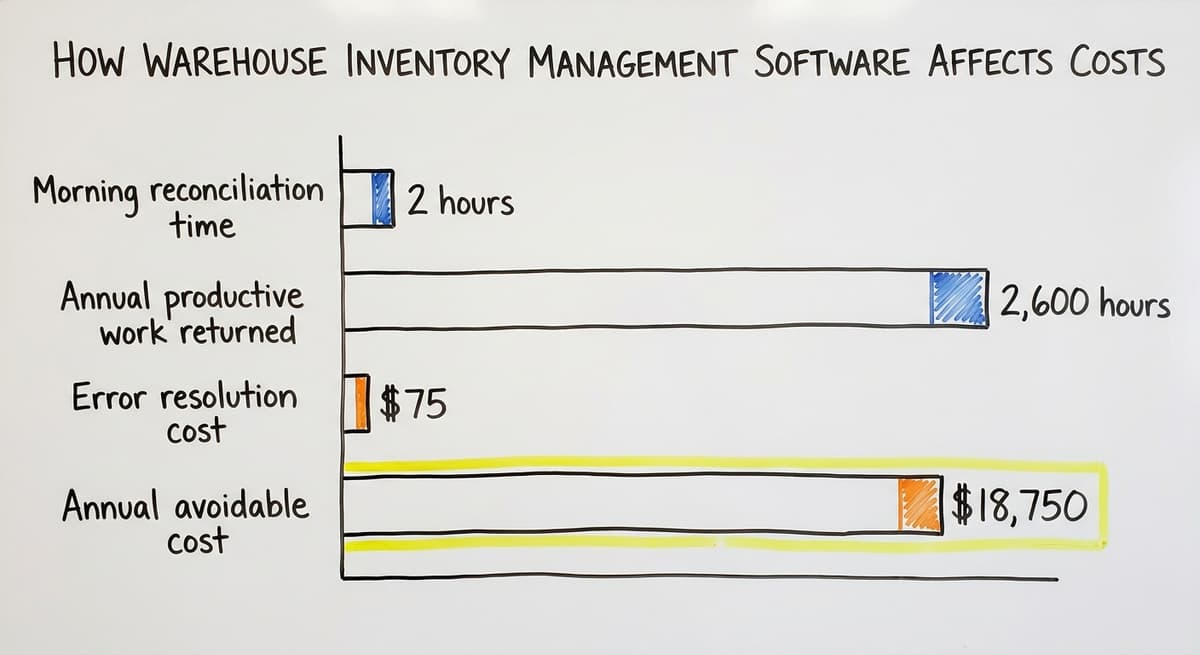
The coordinator who spent 2 hours on morning reconciliation now spends 20 minutes reviewing a dashboard. That time goes back to the operation.
For a team of 10, even 1 hour saved per person per day adds up to 2,600 hours a year returned to productive work.
Inventory Accuracy: Less Overstock and Fewer Stock-Outs
Accurate inventory records mean you order what you need and not what you think you need. Overstock drops. Carrying costs drop with it. Stock-outs become rare because reorder triggers fire automatically when stock hits a set level.
The NIST Manufacturing Extension Partnership offers vendor-neutral guidance on inventory process improvement, and the consistent finding is that accuracy gains from connected systems reduce both overstock and stock-out events significantly.
Error Reduction: Fewer Costly Mistakes
When pick lists are generated from live inventory data and confirmed by scan rather than by eye, picking errors drop. Fewer errors mean fewer returns, fewer reshipping costs, and fewer customer calls.
For an operation shipping 50 orders a day with a 2 percent error rate, that is 1 error per day.
At $75 to resolve each error, that is $18,750 a year in avoidable cost. Cut the error rate by half and you recover nearly $10,000 without adding a single staff member.

Custom Software Versus Off-the-Shelf Systems: What Small Distributors Should Know
Not all warehouse management software is the same. The choice between off-the-shelf and custom software matters more at small scale than it does at enterprise scale.
Off-the-Shelf WMS: Fast to Start, Built for Someone Else
Off-the-shelf warehouse management software is faster to start. It is tested, documented, and supported. The downside is that it is built for a generic warehouse, not your warehouse. Your workflow has quirks. Your customers have specific requirements.
Your team has habits that took years to build. Off-the-shelf tools require you to change your workflow to match the software rather than the other way around. That friction slows adoption and creates workarounds that become their own source of errors.
Custom Software: Built Around How You Actually Work
Custom warehouse software is built around the actual workflow. That means faster adoption and fewer workarounds.
For a 10 to 50 person operation, a focused custom build targeting the specific pain points, receiving, picking, and inventory sync, can be faster and cheaper than a full ERP project.
The common fear is that custom means expensive and slow. For a targeted build that solves 3 or 4 specific problems, that fear is wrong. Custom software for wholesale distributors built by a team that understands your operation can go live in weeks, not months.
Keeping QuickBooks and Replacing Only the Broken Parts
The best path for smaller distribution teams is to keep QuickBooks in place for financials and add a layer that handles what QuickBooks was never designed for.
QuickBooks integration for warehouse operations means your financial records stay accurate without double entry. Your team does not have to learn a new accounting system.
The warehouse side gets the tools it needs. The finance side keeps the tools it trusts. Working with a local team that understands your operation and can adjust the system as the business changes adds value that a remote software vendor cannot match.
What is in a free first look?
A 30 minute call, your operation mapped, and a clear picture of what we would build. No obligation and nothing to install.
Book a call
Questions to Ask Before Investing in Warehouse Management Software
The questions below are a self-assessment tool, not a sales checklist. Answer them honestly and the right path becomes clearer.
Questions About Your Current Pain
- Where are you losing the most time right now?
- How accurate is your inventory count on any given day?
- How many hours per week does the team spend on data entry and reconciliation?
- What would it cost if the one person who knows where everything is left tomorrow?
That last question is worth sitting with. If the answer is "we would struggle for weeks," that is a systems risk, not just an operational inconvenience. Inventory tracking for small warehouses that captures location and quantity data removes that single point of failure.
Questions About the Fix
- Do you need to replace everything or just fix the parts that are broken?
- Will the new system work with QuickBooks or force a migration?
- Who will implement this and support it after launch?
The implementation question matters as much as the software question. A system that goes live and then sits without support is not a solution. It is a new problem.
Fulfilment centre software solutions that come with ongoing support and a team that can adjust the system as you grow are worth more than a lower license fee with no implementation help.
Questions About Readiness
- Can you describe the 3 workflows that cost you the most time?
- Is the team ready to change how they work, or does the system need to match current habits first?
- What does success look like in 90 days?
A good software partner will ask these questions before writing a line of code. If they do not, that is a signal.

Reducing Warehouse Management Costs Without a Full Overhaul
You do not have to buy software to start cutting costs. These steps work before any technology investment and make any future investment more effective.
Start With a Time Audit
Have staff log where their hours go for one week. Not a formal study. Just a simple sheet: task, time started, time finished. The results are almost always surprising.
Most operations find that 20-30 percent of labor hours go to tasks that exist only because systems do not connect. That data is the starting point for every improvement conversation.
Map the Data Handoffs
Every time information moves from one place to another by hand is a cost. Map those handoffs. Draw them on a whiteboard if that helps. Count them.
A typical manual warehouse has 8 to 12 handoffs between receiving a shipment and updating the inventory record. Each one is a chance for an error. Reducing handoffs reduces errors and labor at the same time.
Fix the Biggest Problems First
Start by identifying the 3 biggest error sources and address those first. Start with the highest-volume, highest-cost workflow rather than trying to fix everything at once. Incremental improvement is more sustainable than a full replacement for small operations.
A good software partner will help with this analysis before any build begins. The Warehousing Education and Research Council publishes benchmark data for distribution centre performance that can help you compare your current metrics to industry norms and identify where the gap is largest.
Frequently Asked Questions About Warehouse Management Costs
Frequently asked questions
Frequently asked questions
What is a typical warehouse management cost as a percentage of revenue?
For most distributors, warehouse operating costs run between 2 and 5 percent of revenue. The range is wide because it depends on product type, order volume, and how much manual labor the operation relies on.
High-touch operations with many SKUs and small orders tend to sit at the higher end.
How do I calculate my warehouse cost per order?
Divide your total warehouse operating costs for a period by the number of orders shipped in that same period.
If you spent $50,000 running the warehouse in a month and shipped 1,000 orders, your warehouse cost per order is $50. Tracking this number monthly shows whether improvements are working.
Can small warehouses afford warehouse management software?
Yes, especially custom-built tools that target specific pain points rather than full enterprise suites. A focused build that fixes picking, receiving, and inventory sync for a 20-person operation costs far less than a full ERP project and delivers results faster.
The question is not whether you can afford it. It is whether you can afford to keep running without it.
Does warehouse management software replace QuickBooks?
Not necessarily. The best approach for many smaller operations is to keep QuickBooks and add a layer that handles what QuickBooks cannot.
QuickBooks is built for accounting. It was not built to manage bin locations, pick sequences, or real-time stock levels. A connected system handles the warehouse side and syncs the data QuickBooks needs without requiring a migration.
How long does it take to see cost savings after implementing warehouse software?
Many operations see measurable time savings within the first 30 to 60 days on the workflows that are automated. Labor hours saved on data entry are visible immediately.
Inventory accuracy improvements show up in the first full cycle count after go-live. Error rate reductions take a little longer to measure but are clear within a quarter.
How do I find out where my warehouse is losing money?
Start with a one-week time audit. Have every team member log their tasks and time. Then map every point where data moves by hand from one place to another. Those two exercises will surface the biggest cost sources faster than any software tool.
Once you know where the waste is, you can decide whether to fix it with process changes, software, or both.
What are inventory carrying costs and why do they matter?
Inventory carrying costs are the total cost of holding stock over time, 20-30 percent of inventory value per year. That includes capital tied up in stock, storage space, insurance, shrinkage, and obsolescence.
If you hold $500,000 in inventory, you are paying $100,000 to $150,000 a year just to keep it on the shelf. Inaccurate records make this worse by causing over-ordering.
How much of my warehouse cost is labor?
Labor runs 50-65 percent of total warehouse operating costs. That includes both direct labor, picking, packing, receiving, and putaway, and indirect labor like data entry, error correction, and manual reconciliation.
For a $400,000 annual warehouse payroll, you are spending $200,000 to $260,000 on labor before paying a dollar of rent.
What is the average cost to operate a warehouse?
Warehouse management costs include every dollar spent to receive, store, track, pick, pack, and ship inventory. Most small distribution operations see this fall between 2 and 5 percent of revenue, with labor alone making up the largest share, 50-65 percent of that total.
Costs that feel higher than they should point to manual, disconnected processes rather than the work itself.
How much does a warehouse management system cost?
The page does not list fixed prices for warehouse management software, since costs depend on how a system is built and implemented.
Rather than charging upfront, one approach described is building the system around your existing operation first, with no build cost, and only starting a monthly subscription once it is live and running on your actual process.
What are the main warehouse cost-saving strategies?
The main strategies involve reducing indirect costs that hide on the books, such as time lost to searching for items, re-keying data, and fixing errors. Improving inventory visibility helps avoid overstocking and lets you right-size your footprint.
Replacing manual, disconnected tools with connected workflows reduces rework and errors, since the cost to fix a mistake is far higher than getting it right the first time.
How do 3PL warehouse storage fees work?
Third-party logistics storage fees are charged for the space and services a provider uses to hold and manage a client's inventory, covering costs like space, handling, and system access.
As with running your own warehouse, these fees tend to reflect both direct costs, such as space and labor, and indirect costs tied to accuracy and efficiency, so well-managed inventory and processes help keep them in check.
Not sure this is the right shape for your operation?
The call is free. Describe how the work runs today. We map it on a call and show you what it would look like built around that, before you spend anything.
Book a callRelated guides
The rest of this guide, for the parts of the job this page does not cover.
Guides
- Cost of Inventory Management Software
- Inventory Management Software Costs
- Warehouse Inventory Management Software
- Warehouse Inventory Management Systems
- Warehouse Stock Management Software
- Warehouse Management System Top 10
- Software for Warehouse Management System
- Inventory and Warehouse Management Software
- Small Business Warehouse Management System
- Cloud Based Warehouse Management
- Warehouse Management System Types
- Warehouse Inventory Management System
- List of Warehouse Management Software
- Warehouse Management Cloud
- Warehouse Management System Examples
- Warehouse Management System Implementation
- Online Warehouse Management Software
Common questions
- What Are the Benefits of Warehouse Management System
- What is the Point of Warehouse Management System
- How to Choose a Warehouse Management System
- What Are the Top 5 Warehouse Management Systems?
- What is Asn in Warehouse Management System
- How to Create a Warehouse Management System
- What is a Warehouse Management System