


What Is Fluctuation Stock In Inventory Management
Reviewed and updated: October 2026
Fluctuation stock is the extra inventory a business holds to cover unexpected spikes in demand or sudden gaps in supply. It sits above your normal working stock. When an unusually large order lands or a supplier ships late, fluctuation stock keeps your orders moving. Without it, you face a stockout before your next replenishment arrives.
Book a callFluctuation Stock Defined in Plain Terms
Fluctuation stock is the cushion that keeps orders shipping when something unpredictable happens. It is not the inventory you plan to sell this week. That is cycle stock, the regular working supply that turns over on a set schedule. Fluctuation stock is also not the same as safety stock, which is a calculated buffer built around known lead-time risk. Fluctuation stock covers the demand-side surprises that your forecast never sees coming. Operations managers can think of it simply: it is the extra units on the shelf for the day a customer orders twice as much as usual.
We build it for your operation, and the first look is free
If you would rather not compare products, describe how your operation already works and we build the system around it.
No build cost. You see it running on your own process first, and the monthly subscription starts only once it is live.
Book a callWhy Demand and Supply Are Never Perfectly Predictable
Customer orders rarely arrive at a steady pace. A single large order from a new buyer, or a seasonal spike driven by weather or a promotion, can drain a week of stock in a single afternoon. Supply is just as unpredictable. Carrier delays, short shipments, and vendor production issues stretch lead times without warning. These are everyday realities for wholesale distributors and fulfillment centers, not rare edge cases.
Accurate, real-time item counts are the foundation of any response to these swings. As GS1 notes in its barcode standards records, scan-based spotting systems exist precisely to give operators a reliable count at every point in the supply chain. You can read more at gs1.org/standards/barcodes. Without a reliable count, you cannot know how fast your fluctuation stock is being drawn down until it is already gone.

Fluctuation Stock vs. Safety Stock: What Is the Difference?
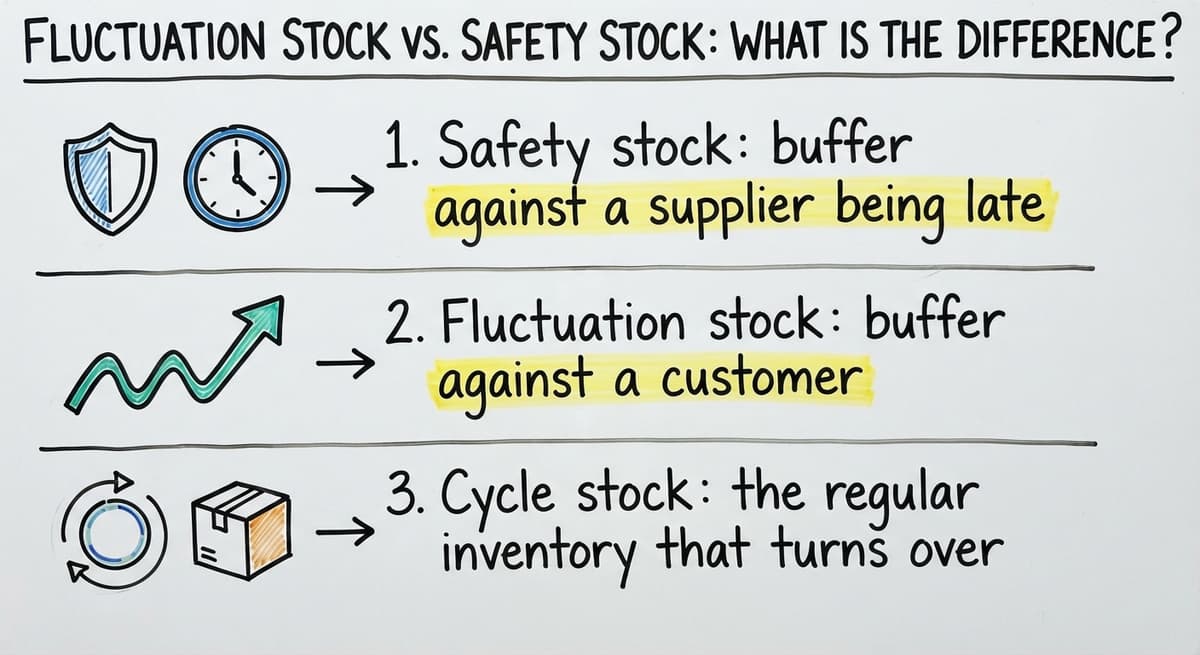
Fluctuation stock and safety stock are not the same thing, and the distinction matters when you set reorder rules. Safety stock covers known, calculated risk. You look at historical lead-time variability, set a buffer, and hold it. Fluctuation stock covers demand-side volatility, the unpredictable order peaks that fall outside your normal forecast range entirely.
Some businesses use the terms interchangeably. That causes problems when the reorder point is set too low, because the safety stock calculation assumes predictable lead time, not an unexpected demand spike. A simple way to keep them straight:
- Safety stock: buffer against a supplier being late
- Fluctuation stock: buffer against a customer ordering far more than expected
- Cycle stock: the regular inventory that turns over on a planned schedule
Using the wrong term in your reorder rules means you are solving the wrong problem.
How Reorder Point Connects to Both
Your reorder point is the inventory level that triggers a new buy order. It should account for both safety stock and fluctuation stock. If it only accounts for one, you will hit a stockout during the exact scenario the other was meant to cover. Set the reorder point by adding average demand during lead time, your safety stock quantity, and your fluctuation stock quantity together. That total is your floor.
The comparison is easier when one option is built for you
Off-the-shelf means fitting your process to the software. We do it the other way round, and the first look costs nothing.
Book a callHow to Calculate How Much Fluctuation Stock You Need
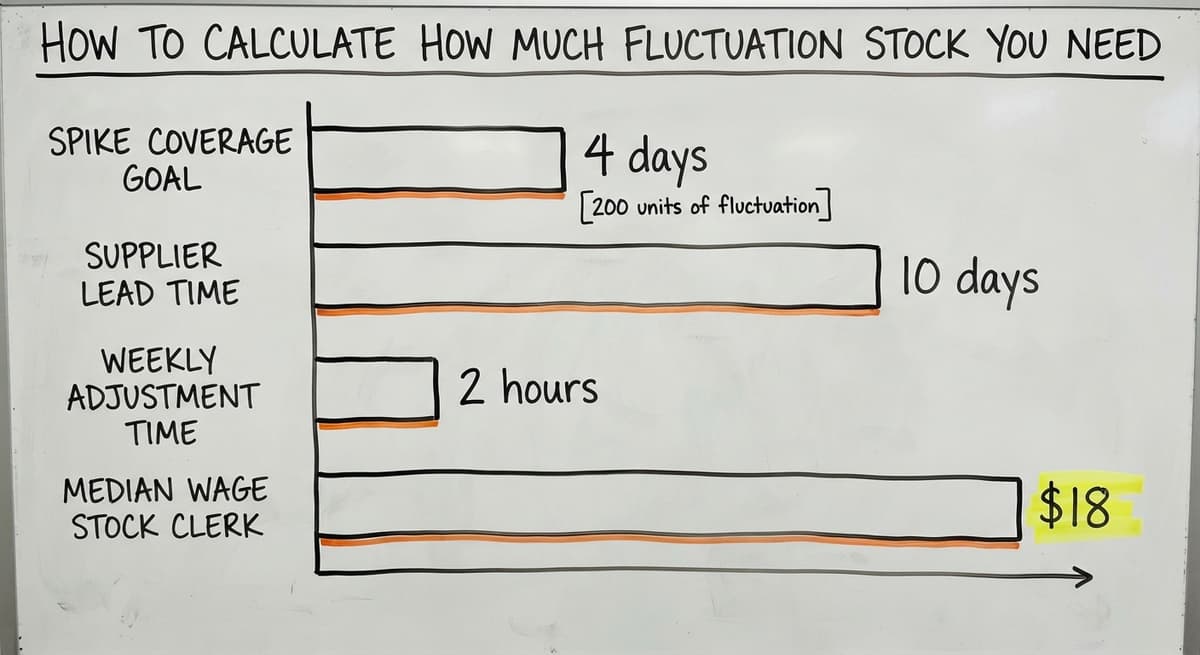
Start with your average daily demand for a given item. Multiply that by the number of days of coverage you want to hold during a demand spike. If you sell 50 units a day on average and you want 4 days of spike coverage, that is 200 units of fluctuation stock for that item.
Next, factor in how long it takes to restock once you place a reorder. A supplier with a 10-day lead time means you are exposed for 10 days if a spike hits just after you reorder. That exposure window should influence how much fluctuation stock you keep.
Most small distributors start with a rule of thumb: hold 10 to 20 percent above average demand as fluctuation stock, then refine it by item over time. A fast-moving product with an unreliable supplier needs more. A slow, steady item from a local vendor needs less. There is no single formula that fits every SKU, every supplier, and every customer base. The right number comes from watching what actually happens and adjusting.
Worked Example
Suppose 3 warehouse staff each spend 2 hours a week manually checking and adjusting fluctuation stock levels. At the current median wage for stock clerks of around $18 an hour, according to BLS occupational data, that is roughly $5,616 a year spent on a task that software can handle in real time. That cost does not include the orders lost when the check happens a day too late.
The Real Cost of Holding Too Much or Too Little
Too little fluctuation stock means stockouts. A stockout means a missed shipment. A missed shipment means a frustrated customer, and often a lost one. The US Federal Trade Commission needs businesses to ship orders within the time promised or notify the customer and offer a refund, as outlined in its Mail, Internet, or Telephone Order Merchandise Rule. Running out of stock is not just an inventory metric problem. It is a compliance and customer retention problem.

Too much fluctuation stock creates a different set of costs. Cash tied up in excess inventory cannot be used elsewhere. Warehouse space fills with stock that may not move for weeks. Seasonal or perishable items risk obsolescence before they ship. Every operations manager faces this balancing act daily. Getting it wrong in either direction has a direct business impact, not just a line on an inventory report.
Where Spreadsheets and Manual Tracking Break Down
Many small distributors track fluctuation stock levels in spreadsheets or on printed count sheets. The process works until it does not. Manual tracking means reorder triggers get missed when the person who owns the spreadsheet is out sick. Stock counts lag reality because entries happen at the end of a shift, not at the moment of a transaction.

An accounting package alone does not alert staff when fluctuation stock is being drawn down toward the reorder point. It records what was sold. It does not watch what is left and warn you before the shelf goes empty. The US Census Bureau's Monthly Wholesale Trade data tracks the inventories-to-sales ratio across wholesale firms nationally, and the pressure on that ratio is real. Small distributors operating on thin margins cannot afford the gap between when stock runs low and when someone notices.
Decisions made from a spreadsheet that was last updated yesterday are decisions made on yesterday's reality.
See it running on your own process first
No build cost. The subscription starts once it is live and doing the job, not before.
Book a callHow Inventory Software Manages Fluctuation Stock Automatically
Inventory management software for wholesale distributors can set item-level fluctuation stock thresholds and send a reorder alert the moment on-hand quantity drops to that level. No one has to remember to check. The system checks continuously.

Real-time inventory counts replace the lag that comes from manual entry. Every transaction updates the count at once. Staff see the current number, not the number from last night's batch update.
Custom-built systems can mirror the rules an operation already uses. You do not have to change your workflow to fit the software. The software fits your workflow. For distributors already running an accounting package, keeping that in place while adding automated stock monitoring is a practical path. Integrating your accounting software with your warehouse operations platform means your financial data and your inventory data stay in sync without a double-entry process.
The NIST Manufacturing Extension Partnership offers vendor-neutral guidance on supply chain process improvement, and a consistent theme in that guidance is that the right tool is the one that matches the operation's actual process, not the one with the most features. Automating works best when it runs the rules you already trust.
Practical Tips for Setting Fluctuation Stock Levels by Product Type
Not every item on your shelf needs the same cushion. The right fluctuation stock level depends on how the item moves and where it comes from. Here are the factors that should drive your decision by product type:
- Fast movers with unpredictable demand need higher fluctuation stock. A single large order can wipe out days of supply in one transaction.
- Items with long or unreliable lead times warrant more buffer stock than goods sourced locally, because restocking takes longer when supply runs short.
- Seasonal products need fluctuation stock set before the peak period starts, not after the first spike hits. Adjusting mid-season means you are already behind.
- Slow, steady items from reliable local suppliers can run with a smaller cushion. Holding excess buffer stock on these items ties up cash with little benefit.
Review levels quarterly rather than setting them once and forgetting. Demand patterns shift, suppliers change, and a level that was right six months ago may leave you short or overstocked today. The review cadence is what keeps your fluctuation stock calibrated to your actual business, not a number you set during onboarding.
A Note on Buffer Stock for Seasonal Items
Seasonal buffer stock is the most time-sensitive version of fluctuation stock. The window to build it is before demand arrives. Once a peak period starts, lead times often stretch because every distributor in your category is reordering at the same time. Build the cushion early, and set a hard date on your calendar to review it before each season.
Do Small Distributors Need an ERP to Manage Fluctuation Stock Properly?
No. Managing fluctuation stock well does not need a large, expensive ERP system. Many small and mid-size distributors run effective inventory operations with tools built around their existing processes, not systems that demand a full migration and months of retraining.
A custom working tool can add automated stock monitoring, item-level reorder alerts, and real-time inventory counts without replacing the accounting package or the workflows your team already knows. Custom working software for small distributors is built to fit the operation, not the other way around.
The IRS requires that businesses value inventory at the start and end of each tax year. As IRS Publication 538 states directly: "To figure taxable income, you must value your inventory at the beginning and end of each tax year." You can read the full guidance at irs.gov/publications/p538. Accurate, ongoing inventory tracking is not optional. The question is whether you do it manually or let a system do it for you.
If your current process relies on spreadsheets and memory, a focused working tool can close that gap at a fraction of the cost and disruption of a full ERP rollout. The right partner builds around what you already have, not around what they prefer to sell.
If you want to explore what that looks like for your operation, start with a straightforward conversation about how you currently track fluctuation stock and where the gaps are. No commitment required, and no pitch for software you do not need.
Frequently asked questions
What is fluctuation stock in inventory management?
Fluctuation stock is the extra inventory held above your normal working supply to cover unexpected spikes in customer demand or sudden gaps from a supplier. It keeps orders shipping on days when something unpredictable happens, before your next replenishment arrives.
How is fluctuation stock different from safety stock?
Safety stock is a calculated buffer against a supplier delivering late, based on historical lead-time data. Fluctuation stock covers demand-side surprises, order peaks that fall outside your normal forecast range. Using the wrong buffer for the wrong risk means your reorder point is set incorrectly.
How do you calculate how much fluctuation stock to keep on hand?
Multiply your average daily demand by the number of days of spike coverage you want. Then factor in your supplier lead time, since that is how long you are exposed if a spike hits right after a reorder. Most small distributors start with 10 to 20 percent above average demand and refine by item over time.
What happens if a business holds too little fluctuation stock?
Too little fluctuation stock leads to stockouts, missed shipments, and lost customers. The FTC needs businesses to ship within the time promised or notify the buyer, so running out of stock is a compliance issue as well as a customer service one.
Why do spreadsheets and manual tracking fail to manage fluctuation stock reliably?
Manual tracking lags reality because entries happen at the end of a shift, not at the moment of a transaction. Reorder triggers get missed when the person who owns the spreadsheet is unavailable. An accounting package records what was sold but does not alert staff when stock is approaching the reorder point.
How does inventory management software handle fluctuation stock automatically?
Software sets item-level thresholds and sends a reorder alert the moment on-hand quantity drops to that level. Real-time counts replace batch updates, so staff always see the current number. Custom-built systems can run the rules an operation already uses without forcing a new workflow.
How often should fluctuation stock levels be reviewed and adjusted?
Review levels at least quarterly. Demand patterns shift, suppliers change, and a level that was accurate six months ago may leave you short or overstocked today. Seasonal items need a dedicated review before each peak period, not during it.
Start with a free first look
A 30 minute call, your operation mapped, and a clear picture of what we would build. No obligation and nothing to install.
Book a callRelated guides
The rest of this guide, for the parts of the job this page does not cover.
Guides
Common questions
- What is Stock Taking in Inventory Management
- What is the Difference Between Aggregate and Item Inventory Management
- What is Abc Classification in Inventory Management
- What is Inventory Management and Its Types
- What is the Main Purpose of Inventory Management
- What is Information Technology Inventory Management
- What is Risk Pooling in Inventory Management
- What is Inventory Management Mary Kay
- What is Bin Number in Inventory Management
- What is the Goal of Inventory Management Quizlet
- What is the Implication of Proper Inventory Management
- What is Inventory Management and Its Importance
- What is the Importance of Eoq in Inventory Management
- What is the Importance of Quality Inventory Management
- What is Inventory Management Explain Techniques of Inventory Management
- What is Mean by Inventory Management
- What is Inventory Management Meaning in Hindi
- What is Inventory Management and Why is It Important
- What is the Rationale for Inventory Management Quizlet
- What is the Purpose of Inventory in Operations Management
- What is Inventory Management Whiteboard Wednesday
- What is the Management and Non Managerial Human Resources Inventory