

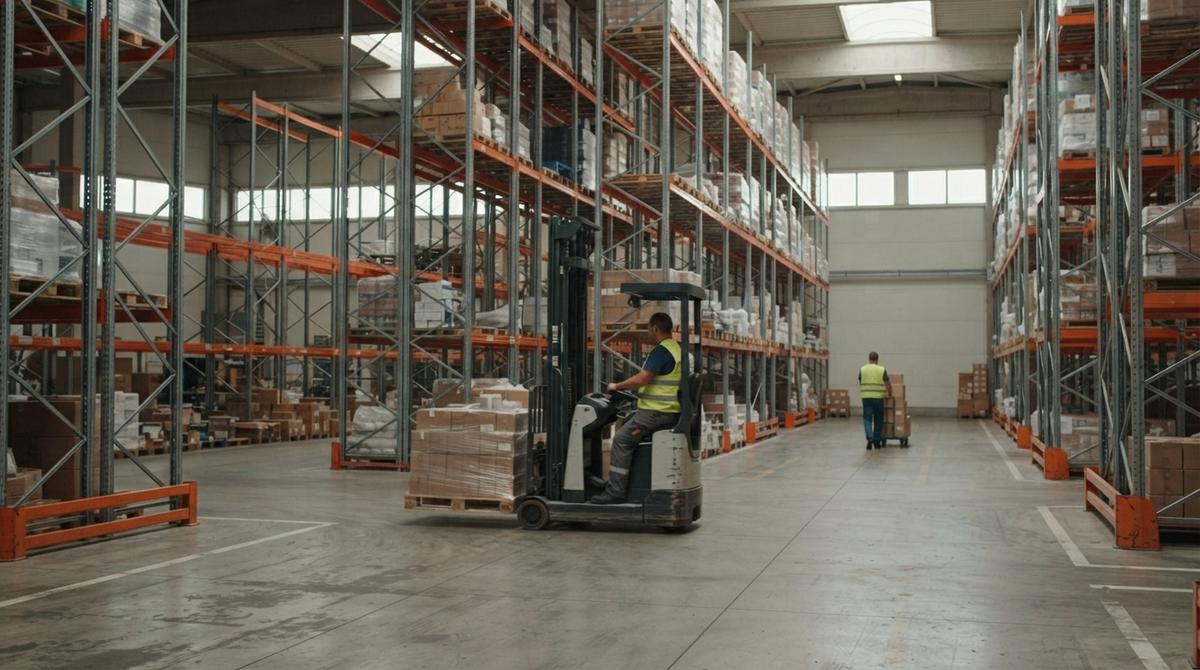
Warehouse Management Cost
Warehouse management cost has two parts: one-time setup and ongoing fees. The total depends on your size, how many tasks you need to fix, and whether you rent, buy, or build the software. No honest price exists without a quote.
Book a callWhat Does Warehouse Management Cost?
Warehouse management cost is everything you spend to track, move, and count stock, plus what weak tracking costs you. Software is one part. Setup, hardware such as barcode scanners, training, and staff time make up the rest. Exact dollar figures vary by shop, so ask for quotes and ignore any list price that skips your details.
Reviewed November 2026.
The cost of doing nothing counts too. Wrong picks, miscounts, and rework drain cash every week. The scope here is the floor: receiving, putting away, picking, shipping, and counts. General office software stays out of it.
People work among moving stock, so a system has to fit the floor. The OSHA warehousing page states, "The warehousing and storage industry includes establishments operating facilities for general merchandise, refrigerated goods, and other products." Sites differ a lot inside that wide definition. Your own floor decides what you need to buy.
We build it for your operation, and the first look is free
If you would rather not compare products, describe how your operation already works and we build the system around it.
No build cost. You see it running on your own process first, and the monthly subscription starts only once it is live.
Book a callWhich Ways Can You Pay for Warehouse Management Software?
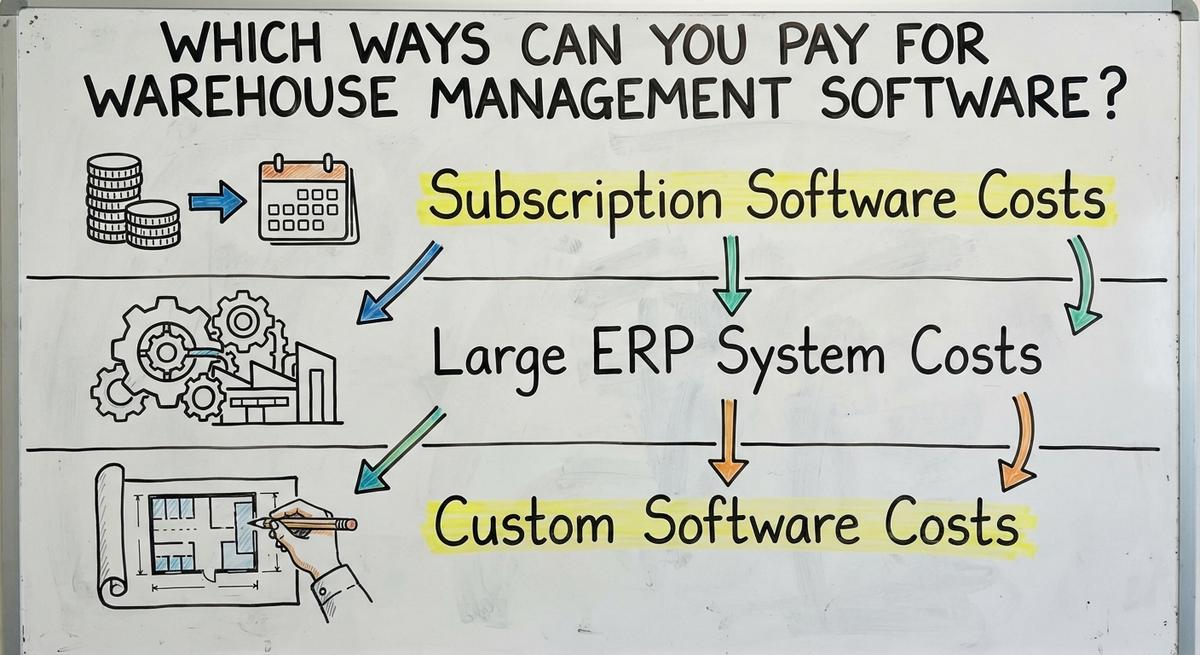
You have 3 paths: a monthly subscription, a large ERP system, or custom software. Each path has its own cost shape. This table shows the shape only, with no prices.
| Path | Start cost | Ongoing cost | Best fit |
|---|---|---|---|
| Subscription | Low | Monthly, grows with staff | Standard process |
| Large ERP | High | Support and upgrades | Big, complex firms |
| Custom | Medium to high | Small support fee | Unusual process |
Subscription Software Costs
Subscription software has a low start and a fee that never stops. Vendors charge per user or per site each month. Add 5 workers and the bill grows. Over 5 years, the sum can pass what a one-time build costs.
These tools are built for a standard process. If your work differs, you change how you work. That change has a price too, in training and slower days. Small warehouse software in this group fits shops with plain, common steps.
Check the full warehouse software pricing sheet, not just the entry plan. A cheap first month can hide a pricey year.
Large ERP System Costs
A large ERP system, which ties finance, stock, and sales into one package, has the highest setup cost. You pay for a long rollout, outside consultants, and data migration. Data migration means moving old records into the new system.
Wary buyers fear long, costly projects. The fear is fair. Big rollouts run over schedule when the scope is loose. Ask for a fixed scope and a written timeline before you sign.
Why do large systems cost so much to set up? They cover every department, so each one needs mapping, testing, and training. A 5 to 100 person operation rarely needs all of that. Most pay for more system than they use.
Custom Software Costs
Custom warehouse software is built around how your team already works. Most of the cost comes upfront, in the build. Support after launch costs less.
You can replace only the manual parts and keep your accounting software in place. A team might swap printed pick sheets and a stock spreadsheet, and leave the books alone. That keeps the project small.
Scope controls price. A build with 2 workflows costs less than one with 8. Is subscription software cheaper than custom software? It is cheaper on day one. Over several years, the gap can close or flip, so compare the full span.
Hidden Costs and What Drives the Price
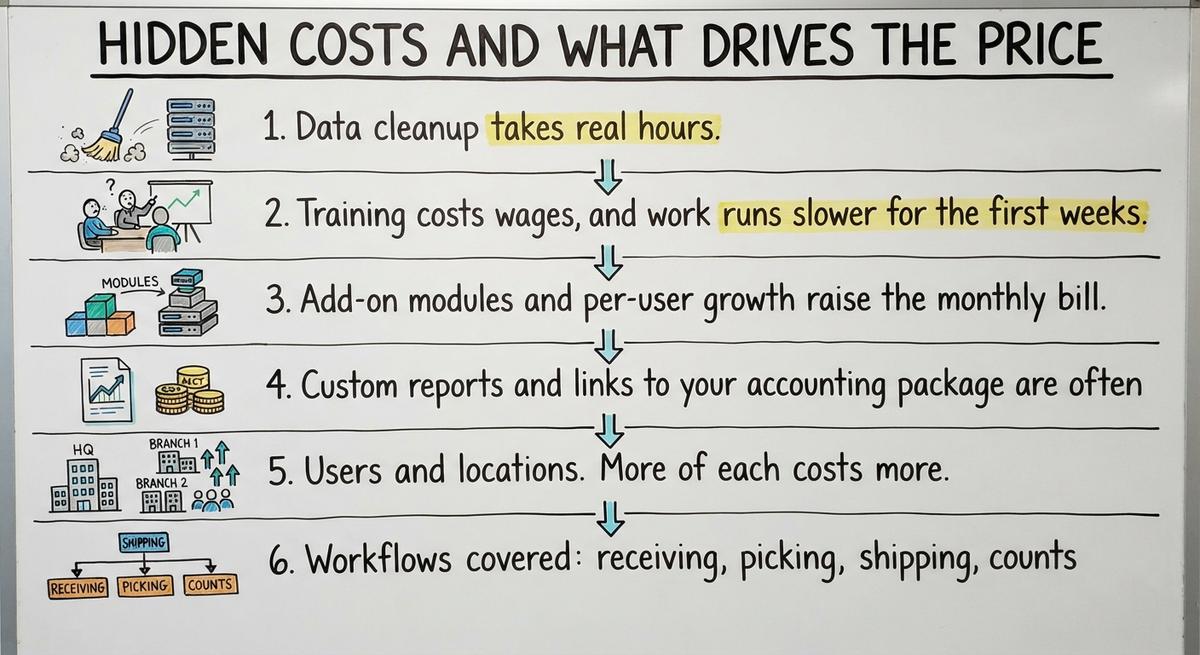
Hidden software costs are fees and labor that never show on the first quote. Plan for these:
- Data cleanup takes real hours. Old item lists hold duplicates and wrong counts.
- Training costs wages, and work runs slower for the first weeks.
- Add-on modules and per-user growth raise the monthly bill.
- Custom reports and links to your accounting package are often extra.
Several things move the price up or down:
- Users and locations. More of each costs more.
- Workflows covered: receiving, picking, shipping, counts.
- Connections to other tools.
- Hardware. Scanners help, and the GS1 barcode standards explain why a label printed by one firm scans at another. RFID tags cost more, and the Auburn University RFID Lab publishes research on them.
A clear scope is the cheapest feature you can buy.
Not sure this is the right shape for your operation
Describe how the work runs today. We map it on a call and show you what it would look like built around that, before you spend anything.
Book a callHow Much Does Manual Work Cost My Warehouse?
Manual work costs hours you can count. Spreadsheets, Access files, printed sheets, and email all need a person to retype, check, and chase. The cost shows up as picking errors, stock miscounts, rework, and slow answers to customers.
Here is a worked example with assumed numbers. Say 3 people spend 6 hours a week on manual stock tasks. Pay is $22 an hour. That is 3 × 6 × $22 × 52 weeks, or $20,592 a year. The Bureau of Labor Statistics lists what stock clerks and order fillers earn, so check your own rate there.
Use your numbers, not mine. List your problem spots: wrong shipments, recounts, calls about late orders. Give each a weekly hour count. Then compare that yearly total with each quote. Return on spend is the hours saved and errors cut, set against the price.

Do You Have to Replace Your Accounting Software?
No. Most owners keep their accounting package and fix only the manual work around it. Your accounting software is good at accounting. It is not built to run a pick list or a bin count.
Good accounting software warehouse integration passes orders, items, and costs between the two tools. You replace the spreadsheets and paper, not the books. Keeping the package lowers migration cost and risk. Your tax records stay in one place.
That matters. The IRS says in Publication 538, "To figure taxable income, you must value your inventory at the beginning and end of each tax year." Your count has to match your books, and a link between the two keeps them in step.
What a Small Warehouse Should Expect to Pay For
A small warehouse should pay to fix its biggest pain first, not to buy a full feature list. Pick one or two workflows. Receiving and picking are common starts. Add more later, once the first ones work.
No one can promise a price without scoping. Be wary of any site that does. Scope means a written list of what the system will and will not do.
How can a small warehouse keep costs down? Follow these steps:
- Fix the costliest problem first.
- Keep tools that already work.
- Skip features you will not use.
- Phase the project in small steps.
- Use NIST supply chain guidance for vendor-neutral advice on process.
Small steps keep the bill small and the lessons cheap.
The comparison is easier when one option is built for you
Off-the-shelf means fitting your process to the software. We do it the other way round, and the first look costs nothing.
Book a callHow to Compare Quotes Fairly
Ask for one-time and monthly costs as separate lines. Then add them over 3 to 5 years, not just year one. A low entry fee loses to a flat build when the span grows. Ask who owns the software and the data. If you leave, you need your records back.

To compare quotes, line them up on the same terms. One quote may include training and another may not. Ask each vendor what the price covers: setup, training, support, and later changes.
Set a baseline before you buy. The WERC distribution center measures are a standard set of benchmarks. Track a few, such as order accuracy, before and after launch.
Questions to Ask Before You Buy
Four questions expose the real fit and the real cost. Put them to every vendor in the same words:
- Will it fit how we already work, or must we change?
- What happens if we grow or change our process?
- Who do we call for help, and are they local?
- What does leaving cost, in fees and in lost data?
Write the answers down. A vendor who dodges one has answered it.
When Custom Software Makes Sense
Custom software makes sense when your process is unusual and off-the-shelf tools force workarounds. It also fits when you want to keep your accounting software and prefer a small, staged project over a big rollout. If a simple subscription fits your work, use it. It costs less and starts faster.
The Software Society is a Columbus, Ohio team. We can meet you in person and see your floor. The same team builds software, your website, and your search presence. We work at small scale, not just for large firms. A walk through your floor shows which path fits.

A Simple Way to Budget Your Project
A budget for a warehouse project is a ceiling for phase one, plus a small reserve. Follow these 5 steps:
- Map your current work, from dock to truck.
- Rank the problems by hours and errors.
- Pick one problem to fix first.
- Get scoped quotes for that one fix.
- Review the results after launch.
Set a spending limit for phase one before you ask for quotes. Hold back a small amount for changes after real use. Staff find gaps in the first weeks that no plan shows. That reserve turns surprises into small fixes.
Next Steps
Warehouse management cost depends on the path you pick, the scope you set, and the hidden items you plan for. Start with your biggest pain and keep what works. Want a second pair of eyes? Walk through your current process with our team. We will show where the manual work sits and what fixing it would take.
Frequently asked questions
How much does a warehouse management system cost?
No single price applies. Cost depends on users, sites, workflows, hardware, and whether you subscribe, buy a large system, or build custom. Subscriptions start low and bill monthly. Large systems and custom builds cost more upfront. Get scoped quotes and compare them over 3 to 5 years.
How much does a 3,000 sq ft warehouse cost?
Space cost depends on your local market, so ask local brokers for the rent per sq ft. As an example with an assumed $8 per sq ft per year, 3,000 sq ft is $24,000 a year. Software and setup cost extra.
How much does a 10,000 square foot warehouse cost?
Check local rates for the real figure. Using an assumed $8 per sq ft per year, 10,000 sq ft is $80,000 a year. Add utilities, insurance, racking, and management tools. Size alone does not set software cost. Workflows and users do.
How much would a 5000 sq ft warehouse cost?
Multiply your local rent per sq ft by 5,000. At an assumed $8 per sq ft per year, the rent is $40,000 a year. That excludes software, scanners, and staff. Ask for real local quotes before you plan.
What hidden costs should I plan for?
Plan for data cleanup, training time, slower work in the first weeks, add-on modules, per-user growth, custom reports, and links to your accounting package. Ask each vendor to list these on the quote.
Is subscription software cheaper than custom software?
Subscription software costs less on day one. Fees continue and grow with staff. Custom software costs more upfront and less to support. Over 3 to 5 years the totals can be close, so compare the full span.
Do I have to replace my accounting software to add warehouse software?
No. Keep your accounting package and replace only the manual stock work around it. A link between the two passes orders and items, and it lowers migration cost and risk.
Start with a free first look
A 30 minute call, your operation mapped, and a clear picture of what we would build. No obligation and nothing to install.
Book a callRelated guides
More on the same work.
Guides
- Cost of Inventory Management Software
- Warehouse Management Costs
- Inventory Management Software Costs
- Costing Inventory
- Warehouse Inventory Management Software
- Warehouse Inventory Management Systems
- Warehouse Stock Management Software
- Warehouse Management System Top 10
- Software for Warehouse Management System
- Inventory and Warehouse Management Software
- Small Business Warehouse Management System
- Cloud Based Warehouse Management
- Warehouse Management System Types
- Warehouse Inventory Management System
- List of Warehouse Management Software
- Warehouse Management Cloud
- Warehouse Management System Examples
- Warehouse Management System Implementation
- Online Warehouse Management Software