


Stock Inventory Definition
Stock inventory is the goods a business holds on hand to sell, use, or ship to customers. Reviewed November 2026.
The term covers two things. One is the physical items on the shelves. The other is the record of how many there are.
Picture a wholesale warehouse. Pallets sit in rows. A sheet or screen says how many pallets exist. When the two match, the count is right.
When they differ, orders go wrong.
Book a callWhat Counts as Stock Inventory?
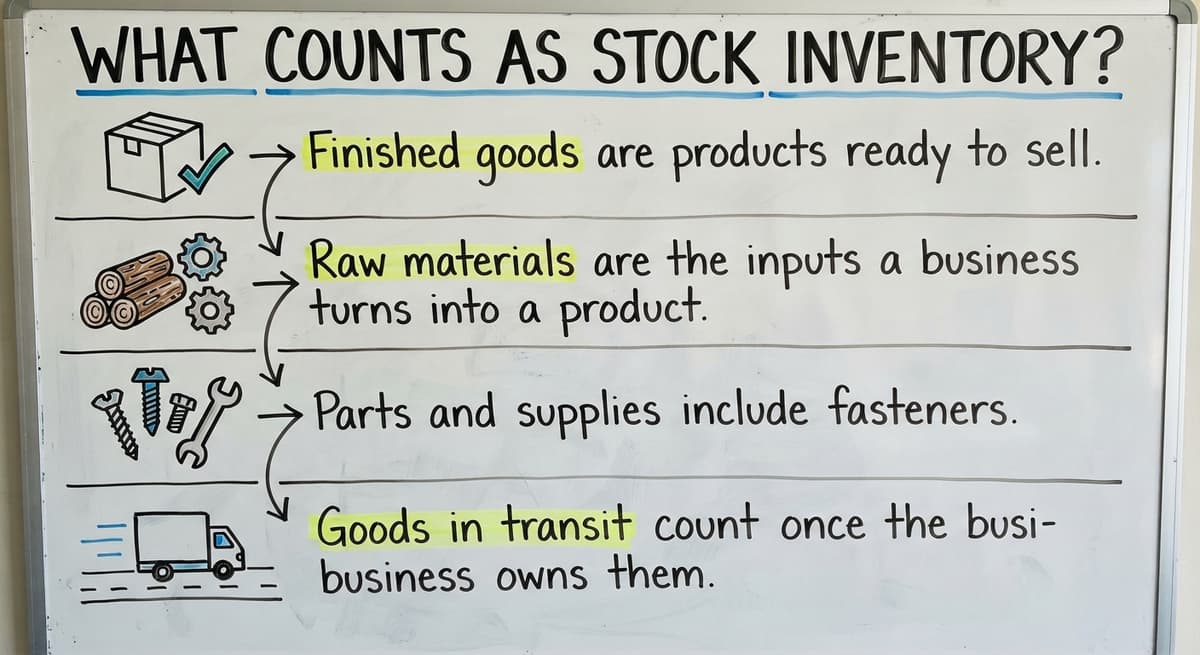
Four kinds of goods count as stock inventory. Each one is owned by the business and sits on hand or on its way.
Types of stock
- Finished goods are products ready to sell, such as pallets of canned food or cases of work gloves.
- Raw materials are the inputs a business turns into a product, such as bulk resin or steel bar.
- Parts and supplies include fasteners, labels, tape, boxes, and other packing materials.
- Goods in transit count once the business owns them, even while a truck still holds them.
Ownership decides what counts. Barcode labels follow GS1 barcode standards, which let a scanner read each item the same way everywhere.
What does not count
Items on consignment (goods a supplier leaves with you but still owns) do not count. Customer returns waiting for a decision stay out until you accept them. Your books hold only what you own.
We build it for your operation, and the first look is free
If you would rather not compare products, describe how your operation already works and we build the system around it.
No build cost. You see it running on your own process first, and the monthly subscription starts only once it is live.
Book a callIs Stock Inventory the Same as Inventory?
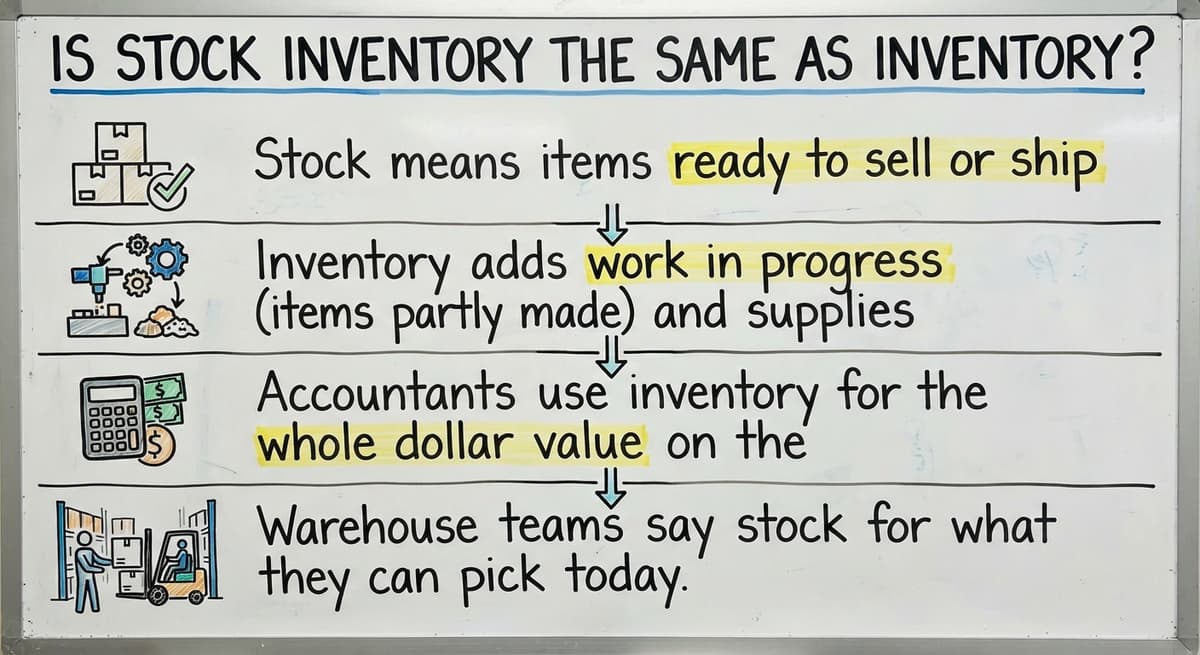
Most people use the two words to mean the same thing. Stock is the narrower term when a team wants to be exact.
- Stock means items ready to sell or ship.
- Inventory adds work in progress (items partly made) and supplies.
- Accountants use inventory for the whole dollar value on the books.
- Warehouse teams say stock for what they can pick today.
For a deeper look, see what is the definition of inventory management. The short answer for a distributor: stock is the part of inventory a customer can order right now.
Why Stock Inventory Matters to a Distributor
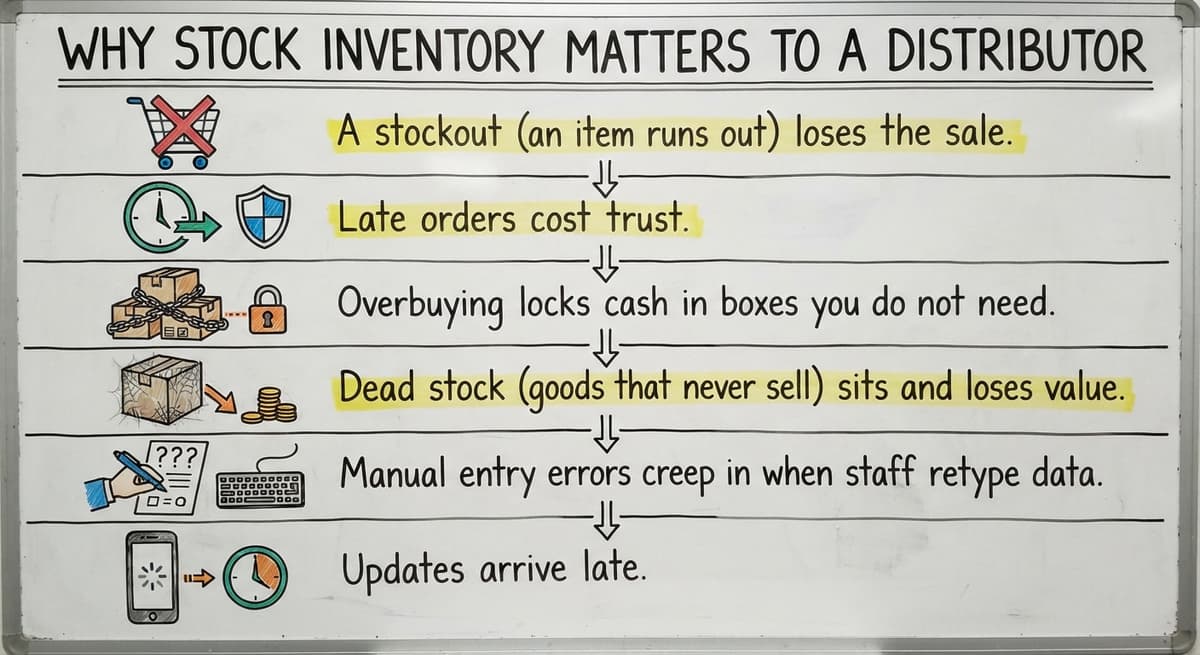
Stock is often the biggest pile of cash a wholesaler has tied up. A wrong count wastes that cash in 4 ways.
- A stockout (an item runs out) loses the sale.
- Late orders cost trust. The FTC mail order rule says you must ship when you said you would.
- Overbuying locks cash in boxes you do not need.
- Dead stock (goods that never sell) sits and loses value.
An accurate count protects cash flow and keeps customers coming back.
Why counts go wrong
Counts split across accounting software, spreadsheets, printed sheets, and email. No one number gets trusted.
Other causes are plain:
- Manual entry errors creep in when staff retype data.
- Updates arrive late.
- Shrinkage (loss from damage, theft, or mistakes) goes unseen.
Time adds up too. Say 2 people spend 5 hours a week fixing counts at $20 an hour. That is $10,400 a year. Scattered data is a cost, not just an annoyance.
Not sure this is the right shape for your operation
Describe how the work runs today. We map it on a call and show you what it would look like built around that, before you spend anything.
Book a callHow Is Stock Inventory Counted and Valued?
There are 2 ways to count stock. Each fits a different kind of warehouse.

- Periodic counts are a full count at set times, such as once a quarter.
- Perpetual tracking updates the count each time an item moves.
- A cycle count is a small, regular count of part of the stock, such as one aisle a day.
Teams often call a full count stock taking. Learn more at what is stock taking in inventory management.
How stock gets a dollar value
The IRS says in Publication 538: "To figure taxable income, you must value your inventory at the beginning and end of each tax year."
Three common methods exist:
- FIFO (first in, first out) assumes the oldest goods sell first.
- LIFO (last in, first out) assumes the newest goods sell first.
- Average cost spreads the total cost across all units.
Ask an accountant which one fits your business.
A simple example
Start with 200 cases. You receive 100 more. You ship 150.
200 + 100 = 300. Then 300 - 150 = 150. You have 150 cases on hand.
Now say no one logs the receipt. The sheet shows 200 - 150 = 50. The shelf holds 150. The record is off by 100 cases, and a buyer might reorder stock you already own.

How to Keep Stock Inventory Accurate
Five habits keep a count true. Each is easy to start this week.
- Record every receipt and shipment the same day.
- Label every bin location so staff know where goods live.
- Run a cycle count on a set schedule.
- Set a reorder point, the stock level that triggers a new order.
- Keep one shared record of stock on hand.
Good inventory tracking follows how your team already works. Tools that fight daily habits get skipped.
A custom tool can replace only the manual steps. Your accounting package, such as a popular small-business bookkeeping program, can stay where it helps. You do not need a big ERP move. If you are weighing warehouse inventory management software, start by listing the manual steps that cause errors.

Is Stock Inventory an Asset?
Stock inventory is an asset, because it is owned goods that turn into cash when sold. The inventory asset definition covers it. Keep warehouse inventory right, and the books stay right too.
If your counts live in too many places, The Software Society can map your process and replace the manual parts with one connected system.

The comparison is easier when one option is built for you
Off-the-shelf means fitting your process to the software. We do it the other way round, and the first look costs nothing.
Book a call


Frequently asked questions
What is the difference between inventory and stock?
Most people use the words as one. Stock is the narrower term: items ready to sell or ship. Inventory is wider and can also include work in progress and supplies. Accountants use inventory for total value, while warehouse teams say stock for what they can pick.
What is the difference between stock on hand and available stock?
Stock on hand is every unit physically in the building. Available stock is what remains after you subtract units already promised to open orders. If you hold 150 cases and 40 are reserved, 150 is on hand and 110 is available.
How often should a warehouse count its stock?
Count fast-moving items weekly or even daily with cycle counts, and slow items less often. Many firms also run one full count a year. The IRS needs you to value inventory at the start and end of each tax year.
Is stock inventory an asset?
Yes. Stock inventory is an asset because the business owns it and expects to turn it into cash. It sits on the balance sheet at its cost value. Consigned goods owned by someone else stay off your books.
What causes stock counts to be wrong?
Wrong counts come from late updates, manual entry errors, and shrinkage from damage or theft. Data split across spreadsheets, accounting software, and paper makes it worse. A missed receiving entry alone can throw a count off by a full shipment.
What is the definition of stock inventory?
Stock inventory is the goods a business holds on hand to sell, use, or ship to customers. It includes the physical items and the record of how many there are. Both must match for the count to be right.
Start with a free first look
A 30 minute call, your operation mapped, and a clear picture of what we would build. No obligation and nothing to install.
Book a callRelated guides
More on the same work.
Guides
- Cloud Stock Management Software
- Hospital Stock Management System
- Make to Stock Examples
- Types of Stock Control Systems
- Stock Software
- Low Stock Alert
- Procedure for Stock Control
- Warehouse Stock Management Software
- Warehouse Stock Software
- Warehouse Stock Management System
- Small Business Stock Management Software
- Best Inventory Software
Common questions
- What is the Definition of Inventory Management
- Inventory Asset Definition
- What is Stock Taking in Inventory Management
- What is Fluctuation Stock in Inventory Management
- How to Stock Control
- How to Calculate Cycle Stock
- How to Maintain Stock Levels
- How to Prevent Stock Discrepancies
- Why is Stock Rotation Important in Relation to Food Safety
- Why is Safety Shot Stock Dropping
- How to Resolve Stock Discrepancy?
- Definition of Warehouse Management System