


How to Calculate Cost of Goods Sold Without Ending Inventory
Yes, you can estimate cost of goods sold (COGS) without ending inventory. Reviewed November 2026. Multiply net sales by 1 minus your past gross profit percentage. You cannot get the exact number without a count or a running record.
Book a callCan You Calculate Cost of Goods Sold Without Ending Inventory?
The standard formula is beginning inventory plus buys minus ending inventory. Take away the last piece and the formula breaks.
Yes, you can estimate COGS without a count. You cannot get the exact figure. The exact figure needs either a physical count or a running record of every item.
Two workarounds exist:
- Estimate COGS from sales with the gross profit method.
- Add up the unit cost of each item as it sells.
An estimate is fine for monthly reports, quick checks, and cases where records were lost or damaged. It is not a stand-in for a year-end count.
We build it for your operation, and the first look is free
If you would rather not compare products, describe how your operation already works and we build the system around it.
No build cost. You see it running on your own process first, and the monthly subscription starts only once it is live.
Book a callWhy Ending Inventory Is Part of the Normal Formula
Ending inventory is the value of goods still on your shelves at the end of a period. Goods you bought but did not sell are not an expense yet. They sit on the books as an asset.
Beginning inventory plus buys equals goods available for sale. Subtract what is left, and the rest is what sold.
Without the left-over number, you cannot split sold goods from unsold goods. Clean counts start with clean item labels, and GS1 calls its barcode standards "the global language of business".
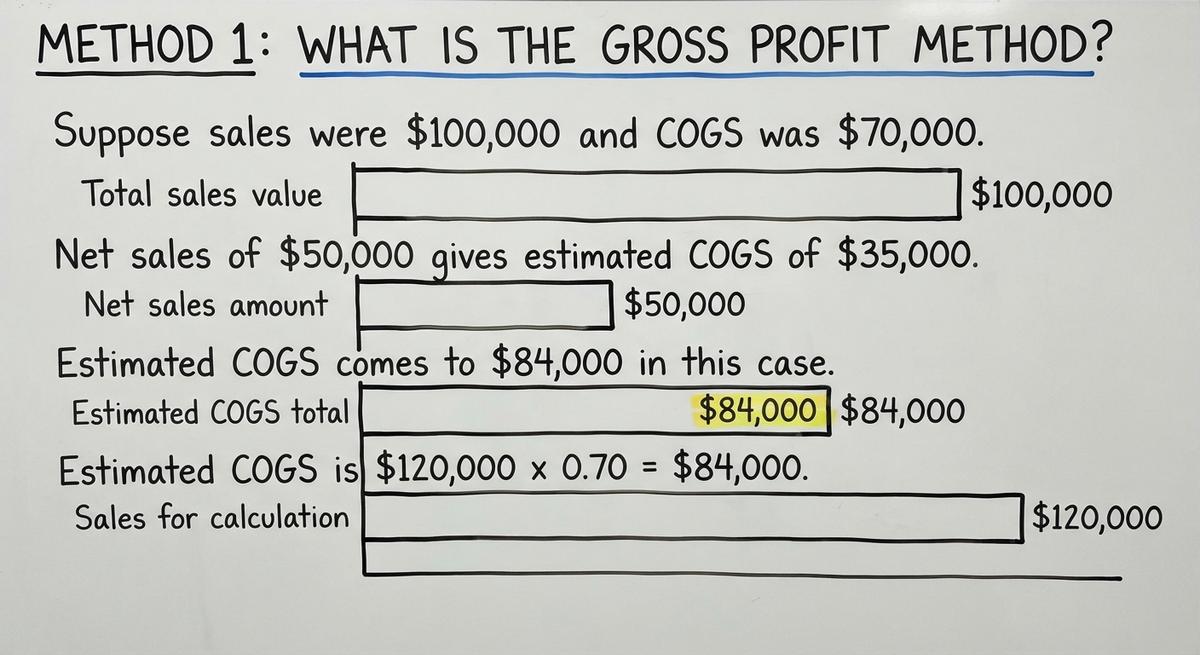
Method 1: What Is the Gross Profit Method?
The gross profit method is a way to estimate COGS from sales and a past margin, with no count needed. It is the best-known fix for this problem.
You take your gross profit percentage from a period with a real count. Then you apply it to this period's net sales.
The method fits three cases:
- Interim months between counts.
- Insurance claims after a fire, flood, or theft.
- Quick sanity checks on a number that looks off.
The next four parts walk through the steps and one full example.
Step 1: Find Goods Available for Sale
Goods available for sale is beginning inventory plus buys for the period. Beginning inventory is last period's ending value. You already have it from your last close.
Pull buys from vendor bills in your accounting package, or from the invoices themselves. Add freight-in if you normally count shipping costs as part of the cost of goods.
Keep the rule the same every month. A change in what you include will shift your margin and spoil the estimate.
Step 2: Estimate Your Gross Profit Percentage
Gross profit percentage is (sales minus COGS) divided by sales. Gross profit is what you keep after paying for the goods you sold.
Pick a recent period that had a real inventory count. Run the math on that period only. Suppose sales were $100,000 and COGS was $70,000. Gross profit is $30,000. The percentage is 30.
If your product lines earn very different margins, work out one percentage per line. A single blended number hides too much.
Step 3: Estimate Cost of Goods Sold from Sales
To estimate COGS, multiply net sales by (1 minus the gross profit percentage). Net sales means gross sales less returns and discounts.
With a 30 percent margin, the cost share of each sales dollar is 70 cents. Net sales of $50,000 gives estimated COGS of $35,000.
The result is your estimate. It is only as good as the margin you fed in. Use the same math for each product line if you split them in Step 2.
Worked Example With Simple Numbers
Here is the whole method with round numbers. Estimated COGS comes to $84,000 in this case.
- Beginning inventory is $40,000.
- Buys are $60,000, so goods available for sale are $100,000.
- Net sales are $120,000. Your past margin is 30 percent.
- Estimated COGS is $120,000 x 0.70 = $84,000.
Now work backward. Goods available of $100,000 minus COGS of $84,000 leaves an implied ending inventory of $16,000. That is also how you estimate ending inventory from COGS. Walk the shelves and compare. A big gap points to theft, damage, or a stale margin.
Not sure this is the right shape for your operation
Describe how the work runs today. We map it on a call and show you what it would look like built around that, before you spend anything.
Book a callMethod 2: Add Up the Cost of Each Item Sold
This method records the unit cost on every sale line, then totals it for the period. COGS is the sum. No ending count is needed.
It needs two things. You need cost data for each item. You also need a log of what shipped.
The method beats the margin estimate because it uses real sales, not a past ratio. A price change cannot throw it off.
It works with first in, first out (FIFO), average cost, or specific cost. FIFO assumes the oldest stock sells first. Average cost spreads the total cost over all units. Specific cost tracks each unit by name. Pick one and stay with it.
For LIFO (last in, first out), the newest costs go to COGS first. The oldest layers stay in ending inventory. Confirm any cost method with your CPA before you switch.

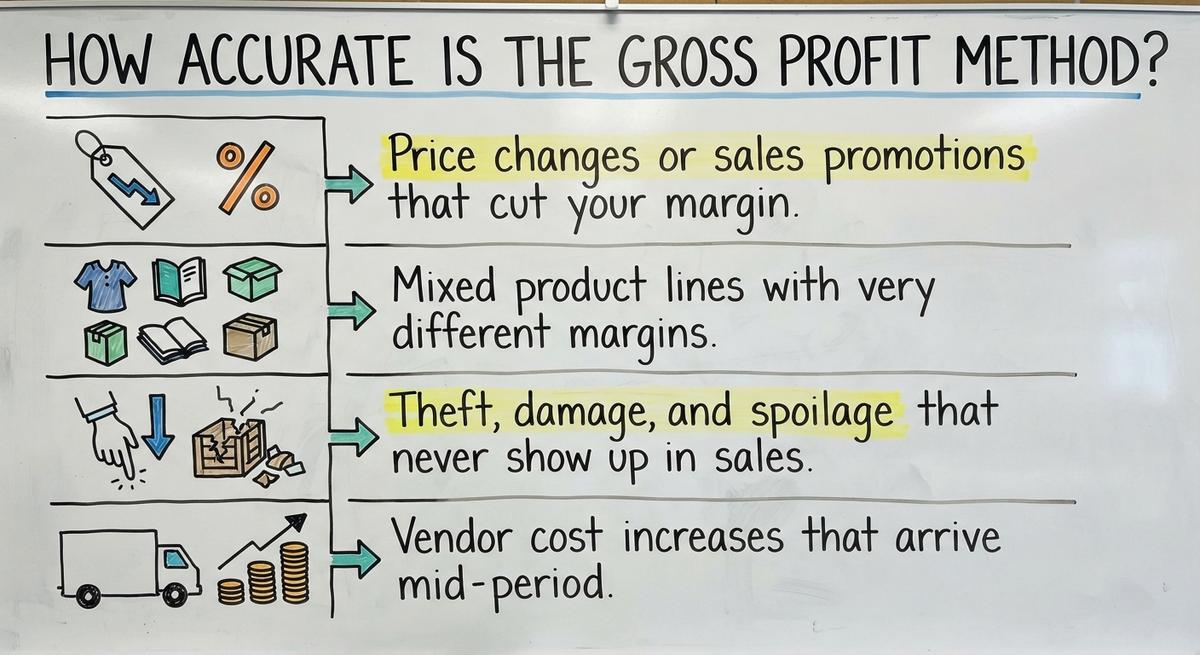
How Accurate Is the Gross Profit Method?
The gross profit method is only as accurate as your margin is steady. If prices and costs hold still, it lands close. If they move, it drifts.
Several things throw it off:
- Price changes or sales promotions that cut your margin.
- Mixed product lines with very different margins.
- Theft, damage, and spoilage that never show up in sales.
- Vendor cost increases that arrive mid-period.
Tax rules are strict. IRS Publication 538 says, "To figure taxable income, you must value your inventory at the beginning and end of each tax year." An estimate does not replace that in most cases. Ask your CPA.
Treat the estimate as a check. Do not treat it as a final answer.
The comparison is easier when one option is built for you
Off-the-shelf means fitting your process to the software. We do it the other way round, and the first look costs nothing.
Book a callCommon Mistakes to Avoid
Four errors spoil most gross profit estimates. Each one is easy to avoid.
- Using gross sales instead of net sales inflates COGS, since returns and discounts never left the shelves.
- Using an old margin after prices or vendor costs changed gives a number from a different business.
- Leaving out freight-in or returns makes goods available for sale too small or too large.
- Mixing cost methods from month to month makes periods impossible to compare.
Write your rules down once. Then follow them every close.

What If I Have No Inventory Records at All?
The result is rough. It is still far better than a blank page. Start a simple log today so the gap never opens again. A guide on how to keep track of inventory can help you set one up.
With no records, rebuild from outside paper. Gather vendor invoices, bank statements, and sales reports for the period. Add the buys to find goods available for sale.
Then use a margin from your last good period, or from a similar business. Apply it to net sales. Walk the shelves and value what you find at cost. Compare that to the implied ending inventory.
When Spreadsheets and Accounting Packages Stop Being Enough
If you keep needing estimates, the real problem is a missing running inventory record. The estimate is a patch over that hole.
Watch for these signs:
- Counts live in spreadsheets, on printed sheets, or in email.
- Month-end close takes days.
- Two people give two different answers for stock on hand.
Manual work also costs money. Say 2 people spend 5 hours a week on counts and fixes at $22 an hour. That is 2 x 5 x 52 x $22 = $11,440 a year. The Bureau of Labor Statistics tracks pay for these roles if you want your own figure.
A custom tool can track items as they move. It can still feed your accounting software where that works well. The Software Society builds it around how your team already runs, with no big ERP move. Learn more about how to keep track of inventory in warehouse settings, or how to create a barcode system for inventory.

How Can a Distributor Track COGS All Month Without a Physical Count?
A distributor tracks COGS all month by recording cost on every shipment. Each pick, pack, and ship event updates stock and cost at once.
This needs item labels, a scan at receiving, and a scan at shipping. It also needs a cost field on each item. The US Census Bureau publishes monthly wholesale sales and inventory data. It shows how much stock these firms carry, and why a running record matters.
The NIST Manufacturing Extension Partnership offers vendor-neutral guidance on inventory process. Accurate stock also helps you ship on time. The FTC mail order rule requires that. Use cycle counts, which check a few items each week, to keep the record honest.
Frequently asked questions
What is the formula for calculating the cost of goods sold (COGS)?
COGS equals beginning inventory plus buys minus ending inventory. If you have no ending count, estimate it instead. Multiply net sales by 1 minus your gross profit percentage.
How to calculate ending inventory and cost of goods sold using LIFO?
LIFO means last in, first out. Assign the newest buy costs to COGS first. Whatever units remain are valued at the oldest costs. Check with your CPA first, since tax rules limit LIFO use.
How to calculate closing stock if cost of goods sold is not given?
Count the stock and value it at cost. If you cannot count, estimate COGS from net sales and your past margin. Then subtract that COGS from goods available for sale to get closing stock.
How can I calculate ending inventory if I don't have the cost of goods sold?
Count the shelves and price each item at cost. Or work from sales with the gross profit method. Estimate COGS first, then subtract it from beginning inventory plus buys.
Can I use the retail method instead?
Yes. The retail method values stock at retail prices. Then it applies a cost-to-retail ratio to convert that value to cost. It suits stores with many items and marked prices.
Will the IRS accept an estimate?
Not as a stand-in for a year-end count in most cases. Ask a CPA before you file. Rules vary by business type and size.
How often should I count inventory?
Count on a steady schedule. Many firms use cycle counts, which check a small group of items each week, plus a full count each year. Your CPA can advise on what fits.
Start with a free first look
A 30 minute call, your operation mapped, and a clear picture of what we would build. No obligation and nothing to install.
Book a callRelated guides
More on the same work.
Guides
- Cost of Inventory Management Software
- Warehouse Management Cost
- Good Inventory Apps
- Calculate Beginning Inventory
- Costing Inventory
- Inventory Management Software Costs
- Warehouse Management Costs
- Inventory Management Software Freeware
- Free Inventory Management Software for Small Business
- Warehouse Inventory Management Software
- Warehouse Inventory Tracking Software
- Warehouse Inventory Management Systems
- Best Inventory Software
- Quickbooks Inventory Management Software
- Warehouse Inventory Systems
- Classification of Inventory
- Inventory and Warehouse Management Software
- Custom Inventory Management Software
- Excess Inventory
- Closed for Inventory
- Warehouse Inventory Management System