


Costing Inventory
Reviewed and updated: June 2025
Reviewed September 2026. Figures are worked from the assumptions stated beside them, so you can substitute your own and the arithmetic still holds.
Costing inventory means putting a dollar value on every item you hold for sale. That number drives your cost of goods sold, your reported profit, and your tax bill. Get it wrong and every pricing decision you make is built on bad data. This guide explains the main methods, what true inventory cost includes, and how to keep your numbers accurate without replacing QuickBooks.
Book a callWhat Costing Inventory Means for Your Business
Inventory costing assigns a dollar value to the goods you hold, so you know what you paid to have them on the shelf. That value flows into your cost of goods sold when you make a sale, which directly sets your gross margin. The IRS also needs it: IRS Publication 538 states plainly, "To figure taxable income, you must value your inventory at the beginning and end of each tax year." For a wholesale distributor, accurate costing is not optional. It shapes every price you quote and every order you place.
We build it for your operation, and the first look is free
If you would rather not compare products, describe how your operation already works and we build the system around it.
No build cost. You see it running on your own process first, and the monthly subscription starts only once it is live.
Book a callWhy Getting Inventory Costs Wrong Is Expensive
Wrong costs hurt in both directions. Undercosting makes a product look cheaper than it is, so you price too low and sell below your true cost. Overcosting inflates your balance sheet and makes you look more profitable than you are, which distorts buying decisions.
A common scenario: a distributor runs pricing from a spreadsheet. Months later, a supplier raised prices but the sheet was never updated. Every sale in that window eroded margin. QuickBooks showed revenue. The spreadsheet showed the old cost. The gap was invisible until someone ran a physical count.
GS1, the global standards body behind supply chain barcodes, notes that scan-based receiving is the foundation of reliable cost capture: their barcode standards, documented at gs1.org/standards/barcodes, exist precisely because manual data entry is where errors enter the system. The same principle applies to cost data: if it is typed in, it will eventually be typed wrong.
What Are the Four Inventory Costing Methods, and How Do They Differ?
The 4 primary inventory costing methods are FIFO, LIFO, Weighted Average Cost, and Specific Spotting. Each one decides which buy price gets matched to a sale. QuickBooks supports FIFO and Weighted Average natively, but not LIFO or Specific Spotting without add-ons. Choosing the right method depends on your product type, how often supplier prices change, and what your CPA recommends for tax purposes.
FIFO: First In, First Out
FIFO assumes the oldest stock sells first. Your cost of goods sold reflects the prices you paid earliest, which usually means lower costs in a rising-price environment. Reported profit looks higher, which is good for the balance sheet but means a larger tax bill.
FIFO fits most wholesale distributors well. It matches the physical flow of rotating stock, especially for perishable or date-sensitive goods. Fast-moving consumer products and distributors who rotate inventory by receipt date are natural FIFO users.
The main drawback is timing. When supplier prices are climbing fast, FIFO can make margins look better than they really are at current replacement cost.
LIFO: Last In, First Out
LIFO assumes the newest stock sells first. Cost of goods sold reflects your most recent buy prices, which lowers taxable income when costs are rising because you are matching higher recent costs against current revenue.
LIFO is a US-only method. International Financial Reporting Standards do not allow it, so companies with overseas reporting obligations cannot use it. The balance sheet risk is real: inventory values can lag years behind current prices, making the company look like it holds cheaper stock than it does. LIFO is less common in distribution and is worth discussing with your CPA before adopting it.
Weighted Average Cost
Weighted Average Cost divides the total dollar value of your inventory by the total number of units. Every unit carries the same average cost, regardless of when it was purchased or at what price.
This method suits bulk commodities and distributors who mix buy lots together in the same bin. It smooths out price swings, which makes reporting more stable. The tradeoff is that it does not reflect what you actually paid for any specific unit, which can mask buy price variance when supplier pricing is volatile.
Specific Identification
Specific Spotting tracks every unit individually, matching each sale to the exact cost of that item. It is the most accurate method because there is no averaging or assumption about which unit sold.
It works well for high-value, low-volume goods: specialty equipment, serialized products, or items with distinct lot costs. For high-volume distributors, it is impractical without software that can track serial numbers or lot codes at every movement. Without that system support, the admin burden makes it unsustainable.
The comparison is easier when one option is built for you
Off-the-shelf means fitting your process to the software. We do it the other way round, and the first look costs nothing.
Book a callHow to Choose the Right Costing Method for Your Operation
Three questions narrow the field quickly. First: how many SKUs do you carry? High-volume operations need a method that does not need individual tracking. Second: do your supplier prices change often? Volatile pricing makes FIFO or LIFO more consequential than Weighted Average. Third: what does your CPA recommend for tax purposes?
Match the method to your product type and your reporting needs, not to what is easiest to set up today. Switching methods later needs an accounting adjustment and IRS disclosure. Per IRS Publication 538, your chosen method must be applied consistently from year to year. A change needs IRS approval in most cases. Choose carefully upfront and document the decision.

What Does Inventory Cost Actually Include?
Inventory cost is more than the price on the supplier invoice. It includes every dollar spent to get that product to your warehouse shelf. Many small distributors count only the buy price and miss the rest, which means their inventory value is understated from day one.
The full picture includes:
- Buy price from the supplier
- Freight and shipping charges paid to bring goods in
- Receiving labor at your warehouse
- Import duties and customs fees
- Inspection or quality-check costs
This total is called landed cost: the complete cost to receive one unit into sellable inventory. The NIST Manufacturing Extension Partnership identifies landed cost tracking as a core supply chain discipline, not an advanced one. Skipping it is a structural gap, not a minor oversight.
Landed Cost and Why It Changes Your Margin Math
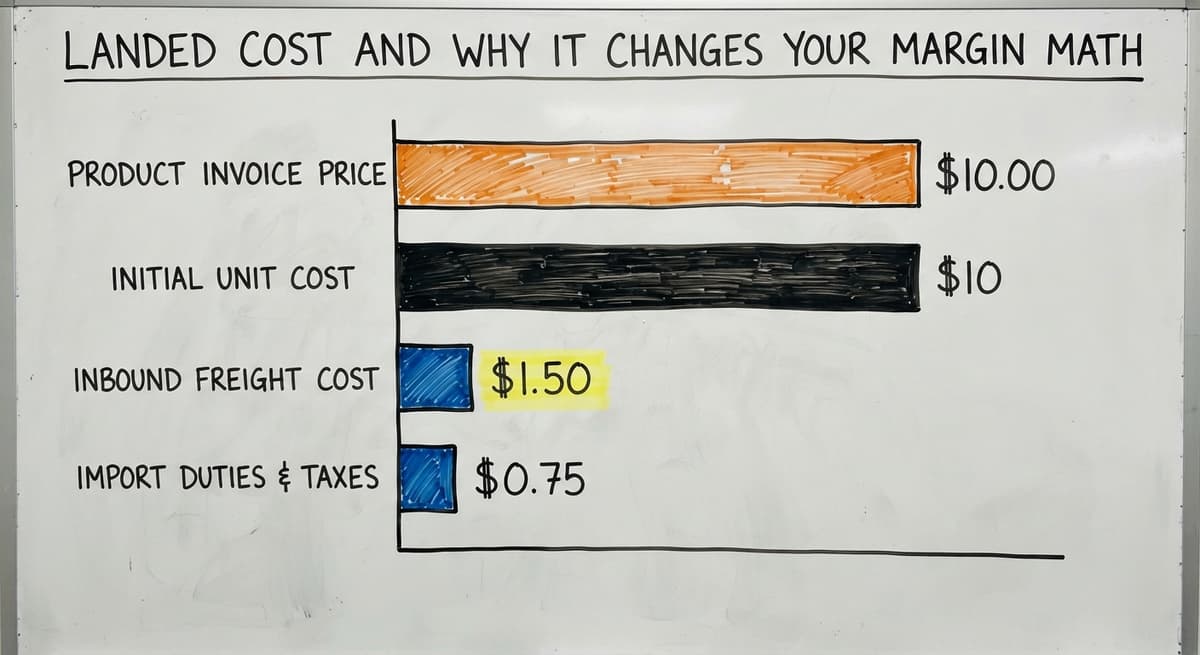
The arithmetic is simple and the impact is not. A product invoiced at $10.00 per unit looks like a $10 cost. Add $1.50 in inbound freight and $0.75 in import duties and the true cost is $12.25. If you price that item at $13.00 using the invoice cost, your margin looks like 23%. Using landed cost, it is under 6%.
That gap compounds across hundreds of SKUs and thousands of transactions. Tracking landed cost manually in Excel means allocating freight across line items by hand, updating duty rates when tariffs change, and hoping the person who built the sheet is still around. Each of those steps is a place where the number goes wrong. The error is not usually dramatic. It is a slow, consistent understatement that makes every margin report slightly optimistic.

How Inventory Costing Connects to Your QuickBooks Data
QuickBooks tracks inventory value, but it only knows what you tell it. If buy orders, receiving records, and cost adjustments live in spreadsheets outside QuickBooks, the inventory value QuickBooks shows is already wrong. It reflects what was entered, not what actually happened in the warehouse.
This is a systems problem, not a bookkeeping problem. The gap between what QuickBooks shows and what is on the shelf is where margin disappears. A sale posts at the wrong cost. An adjustment never makes it into the system. A freight charge sits in a spreadsheet and never reaches the inventory record.
The US Census Bureau's Monthly Wholesale Trade data tracks the inventories-to-sales ratio across wholesale firms, and the firms with the tightest ratios are the ones with the tightest working data. Loose data means loose inventory, and loose inventory means you are guessing at cost rather than knowing it. QuickBooks is a capable financial ledger. It cannot fix data that never reaches it.
Common Costing Mistakes Distributors Make
Most costing errors are not dramatic. They are small, repeated, and invisible until a margin report stops making sense. The most common ones follow a pattern:
- Using buy price instead of landed cost understates every item's true value from the moment it arrives.
- Mixing costing methods across product lines without realizing it produces results that cannot be compared period to period.
- Failing to update costs when supplier prices change means old prices stay in the system long after they expired.
- Running a physical count once a year instead of tracking perpetually leaves months of errors uncorrected.
- Keeping cost data in a spreadsheet that only one person understands creates a single point of failure that most operations discover at the worst possible time.
Any one of these is manageable. All five together make accurate costing nearly impossible without a system change.
See it running on your own process first
No build cost. The subscription starts once it is live and doing the job, not before.
Book a call
Perpetual vs. Periodic Inventory Costing
Perpetual inventory costing updates in real time with every receipt, sale, and adjustment. Periodic costing calculates costs at set intervals, often monthly or at year-end. Perpetual is more accurate because errors surface at once rather than accumulating until the next count.
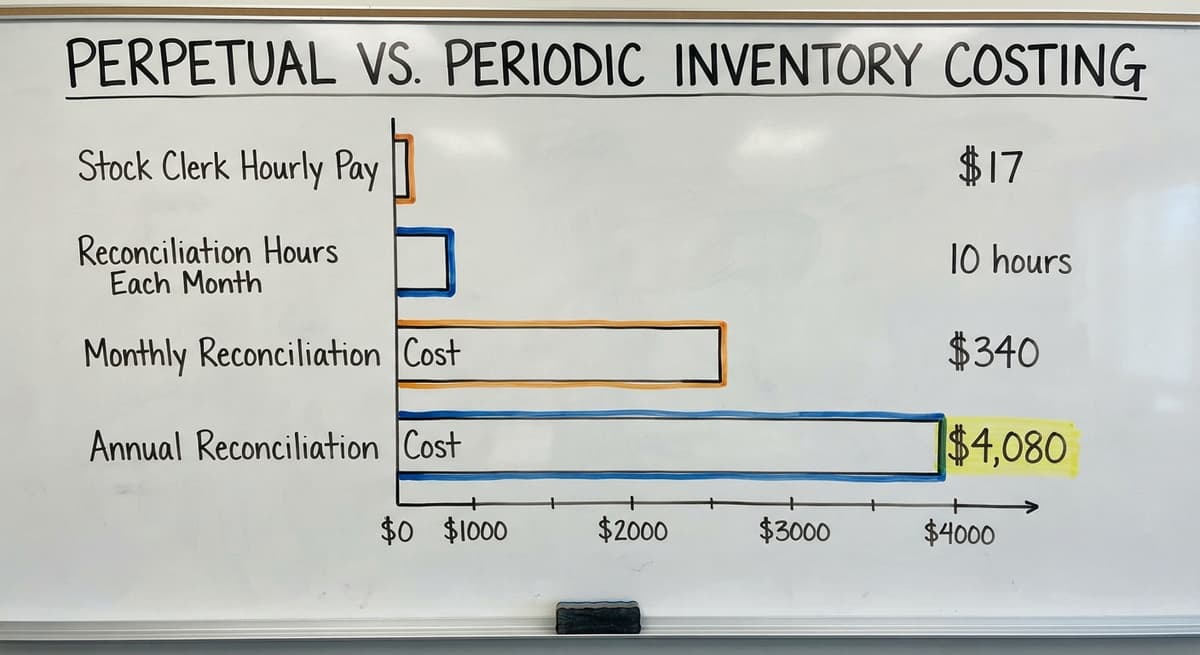
Most distributors above a few hundred SKUs need perpetual costing to stay accurate. The US Bureau of Labor Statistics puts median pay for stock clerks and order fillers near $17 per hour. If 2 people spend 10 hours each month reconciling periodic cost records, that is $340 a month, or $4,080 a year, just to catch up to where a perpetual system would have been automatically. Periodic tracking is not cheaper. It just moves the cost to labor instead of software.
When Does a Spreadsheet Stop Being Enough for Inventory Costing?
The signs appear before the spreadsheet actually breaks. Costs are often wrong by the time someone checks them. Margin reports do not match what the team expects. Staff spend hours each week reconciling numbers that should already agree. A pricing error gets caught after it has been live for weeks.
This is a growth inflection point. The spreadsheet worked when there were 50 SKUs and one buyer. At 300 SKUs with 3 buyers and 4 suppliers changing prices quarterly, the manual process cannot keep up. The hidden cost is not just staff time. It is the pricing decisions made on bad data and the margin left on the table as a result. The fix is not a full ERP. It is a targeted system that handles the working detail the spreadsheet was never built for.

What Should Good Inventory Costing Software Do?
Good inventory costing software solves the data problem before it reaches QuickBooks. It captures landed cost at the time of receipt, applies your chosen costing method without manual calculation, and flags cost changes when supplier prices shift. Here is what that looks like in practice:
- Landed cost is allocated automatically across line items at the point of receiving, not reconstructed later from a freight invoice.
- The costing method, whether FIFO, Weighted Average, or another, runs consistently without someone applying it by hand.
- Cost data syncs to QuickBooks so the financial ledger reflects actual warehouse activity.
- Operations managers see live inventory value without waiting for month-end.
- Buy price variance, the difference between what you expected to pay and what you actually paid, surfaces at once so pricing can be adjusted.
Inventory management software for wholesale distributors built around these functions removes the manual steps where errors enter. The result is a QuickBooks file that reflects reality.
How Custom Operational Software Handles Costing Without Replacing QuickBooks
Custom working software sits between your warehouse floor and QuickBooks. It captures the data QuickBooks cannot collect on its own: receiving details, lot-level costs, freight assigning by line item, and supplier price changes. QuickBooks stays as the financial ledger. The custom layer handles the working detail.
How custom working software connects to QuickBooks is a common question, and the answer is straightforward. The two systems share data through a sync, not a replacement. No rip-and-replace. No six-month ERP rollout. The custom layer is built around how the operation already runs, which means a small team without an IT department can adopt it without a long learning curve.
Warehouse management for small and mid-size operations does not need enterprise software. It needs the right data captured at the right moment. A targeted fix to the costing layer protects margin without disrupting the rest of the business.

A Costing Inventory Checklist and Next Steps
Before changing anything, audit where you stand. Ask these questions:
- Is your current costing method documented and applied consistently, as IRS rules need?
- Does your landed cost calculation include freight, duties, and receiving labor, or just the invoice price?
- How long does it take your team to produce an accurate cost report?
- Would a pricing error be caught before it costs you money, or after?
If the answers are uncomfortable, the checklist below is a practical starting point:
- Choose and document your costing method
- Define what your landed cost calculation includes
- Set up a process to update costs when supplier prices change
- Decide between perpetual and periodic tracking
- Confirm cost data flows correctly into QuickBooks
- Review costing accuracy at least quarterly
Accurate inventory costing protects every margin dollar and makes every pricing decision more reliable. Fixing it manually is hard without the right system. If your costs are often wrong and your team spends hours reconciling numbers that should already agree, replacing Excel with custom software built around your operation is worth a conversation. Reach out to talk through what a targeted fix could look like for your specific setup, no long commitment required.
Frequently asked questions
How do I calculate the cost of inventory?
Add your beginning inventory value to all buys made during the period, then subtract your ending inventory value. That gives you cost of goods sold. For each unit's cost, use your chosen method: FIFO uses the oldest buy price, LIFO uses the newest, and Weighted Average divides total inventory cost by total units. To get true cost, include freight in, duties, and receiving labor, not just the supplier invoice price.
What are the four inventory costing methods?
The 4 methods are FIFO (First In, First Out), LIFO (Last In, First Out), Weighted Average Cost, and Specific Spotting. FIFO matches the physical flow of most goods. LIFO lowers taxable income when costs rise but is only allowed in the US. Weighted Average smooths price swings and suits bulk commodities. Specific Spotting tracks each unit individually and works best for high-value, low-volume items.
What is the best rule for valuing inventory?
There is no single best rule. The right method depends on your product type, how often supplier prices change, and your tax situation. FIFO works for most wholesale distributors because it matches the physical flow of stock. Weighted Average suits operations that mix buy lots. Specific Spotting is most accurate but only practical with software support. Your CPA should confirm which method fits your tax and reporting needs before you commit, because IRS rules need you to apply it consistently year to year.
What are the three categories of inventory costs?
The 3 categories are ordering costs (the cost to place and receive a buy order), holding costs (storage, insurance, and the capital tied up in stock), and shortage costs (lost sales or rush-order premiums when stock runs out). For costing inventory on the balance sheet, the most relevant category is the cost to acquire and receive each unit, which includes buy price, inbound freight, duties, and receiving labor.
What is landed cost and why does it matter for distributors?
Landed cost is the full amount you spend to get one unit onto your warehouse shelf: buy price plus inbound freight, import duties, and receiving labor. A product invoiced at $10 with $1.50 freight and $0.75 in duties has a landed cost of $12.25. Pricing against the invoice cost instead of the landed cost makes every product look more profitable than it is, and the error compounds across hundreds of SKUs.
Can I improve inventory costing without replacing QuickBooks?
Yes. QuickBooks works well as a financial ledger. The problem is usually the data that reaches it, not QuickBooks itself. A custom working layer can capture landed cost, apply your costing method consistently, and sync accurate cost data to QuickBooks without replacing it. This approach targets the working gap between the warehouse floor and the books without a full ERP rollout.
What is the difference between perpetual and periodic inventory costing?
Perpetual costing updates inventory values in real time with every receipt, sale, and adjustment. Periodic costing calculates values at set intervals, such as monthly or at year-end. Perpetual is more accurate because errors surface at once. Periodic is simpler to run manually but lets errors accumulate between counts. Most distributors above a few hundred SKUs need perpetual costing to keep margin data reliable.
Which inventory costing method is right for a wholesale distributor?
FIFO is the most common choice for wholesale distributors because it matches how most operations physically rotate stock and is supported natively in QuickBooks. Weighted Average is a good fit if you mix buy lots or deal in bulk commodities. LIFO can reduce taxable income when costs are rising but needs IRS-consistent application and is not allowed under international standards. Discuss the tax implications with your CPA before choosing.
Start with a free first look
A 30 minute call, your operation mapped, and a clear picture of what we would build. No obligation and nothing to install.
Book a callRelated guides
The rest of this guide, for the parts of the job this page does not cover.
- Inventory Management Software Costs
- Cost of Inventory Management Software
- Warehouse Management Costs
- Inventory Management for Multiple Locations
- Inventory Management System for Manufacturing
- Excel Inventory Template
- Jewelry Inventory Management
- Dental Inventory Management
- Qr Code for Inventory Management
- Inventory Formulas
- Hvac Inventory Management Software
- Inventory Management Software for Schools
- Nonprofit Inventory Management
- Manual Inventory Management
- Manual Inventory System
- Hvac Inventory Management
- Warehouse Inventory Management Software
- Warehouse Inventory Tracking Software
- Warehouse Inventory Management Systems
- Quickbooks Inventory Management Software
- Warehouse Inventory Systems
- Inventory and Warehouse Management Software
- Custom Inventory Management Software
- Warehouse Inventory Management System