


Dead Stock
Dead stock is inventory that has not sold in a long time and will not sell soon. Most warehouses call an item dead after 6 to 12 months with no sales. Your products set the right cutoff. A last-sold date report finds dead stock fast.
You run on an accounting package and spreadsheets. You already hold the data you need. They cover how to find dead stock, what it costs, how to clear it, and how to keep it from coming back.
Book a callWhat Is Dead Stock?
Dead stock is inventory that has not sold and is not likely to sell. Picture a wholesale shelf with 40 cases of floor cleaner in the old label. The maker changed the label 2 years ago. Buyers now ask for the new one. No one has ordered the old cases since. Those cases are dead stock. They hold a pallet slot and earn nothing. Slow stock still sells, just rarely. Dead stock has stopped selling.

Dead Stock vs. Slow-Moving Stock vs. Obsolete Inventory
Slow-moving stock, dead stock, and obsolete inventory are three different problems. Each one needs its own fix.
| Type | What it means |
|---|---|
| Slow-moving | Still sells, but only a few units a month |
| Dead | No sales for a long set period, such as 12 months |
| Obsolete | Cannot be used or sold, such as expired or discontinued items |
All three sit in your count. The IRS says in Publication 538 that "To figure taxable income, you must value your inventory at the beginning and end of each tax year." Dead stock inflates that value if you leave it at full cost. Name the type first, then pick the fix.
Why Dead Stock Hurts Your Business
Dead stock hurts in two ways: it ties up money, and it costs money to keep. Both harms start the day an item stops selling.
Why Is Dead Stock a Problem?
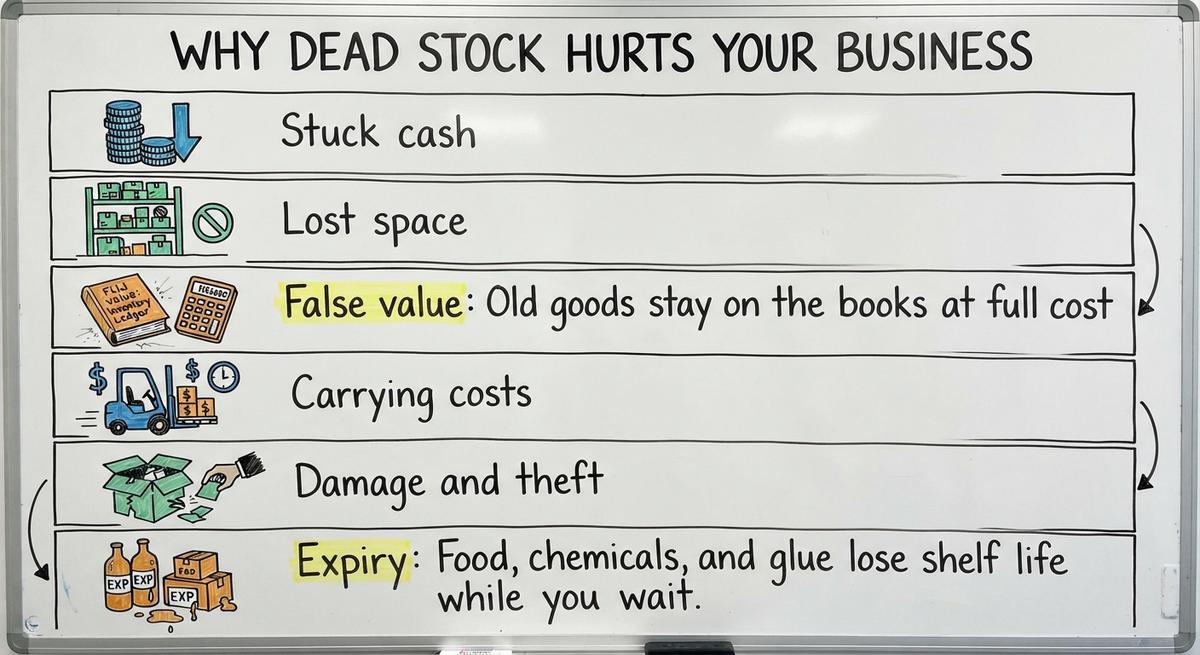
Dead stock is a problem because it locks up cash, space, and honest numbers. Three harms show up fast:
- Stuck cash: The money you paid for the goods cannot pay a supplier, cover payroll, or fund a new order. Dead stock holds that cash until you move the goods.
- Lost space: Every pallet slot held by dead stock is a slot a fast seller cannot use. Your best items wait at the dock while old goods fill the racks.
- False value: Old goods stay on the books at full cost. Your stock looks worth more than it is, and your reports hide the real loss.
A shelf full of old goods looks like an asset. It is a bill that has not come due yet.
We build it for your operation, and the first look is free
If you would rather not compare products, describe how your operation already works and we build the system around it.
No build cost. You see it running on your own process first, and the monthly subscription starts only once it is live.
Book a callWhat Dead Stock Really Costs
Dead stock cost is real even when no single line on your books shows it. The costs hide inside rent, pay, and insurance. Four costs add up:
- Carrying costs: Rent, labor, insurance, and handling all charge you for every pallet. They charge you whether the pallet sells or not.
- Damage and theft: Goods that sit for months get crushed, stolen, or lost in the wrong aisle. You pay for each loss twice, once to buy and once to replace.
- Expiry: Food, chemicals, and glue lose shelf life while you wait. A pallet worth money in March can be worth nothing by fall.
- Missed buys: Cash tied up in dead stock cannot buy items that sell. Every dollar parked on a shelf is a dollar missing from a better order.
Here is a worked example. Assume 2 workers spend 5 hours a week moving and counting dead stock at $20 an hour. That is 2 x 5 x 52 x $20, or $10,400 a year in labor alone. The Bureau of Labor Statistics tracks pay for stock clerks, so check the wage in your area.
Common Causes of Dead Stock
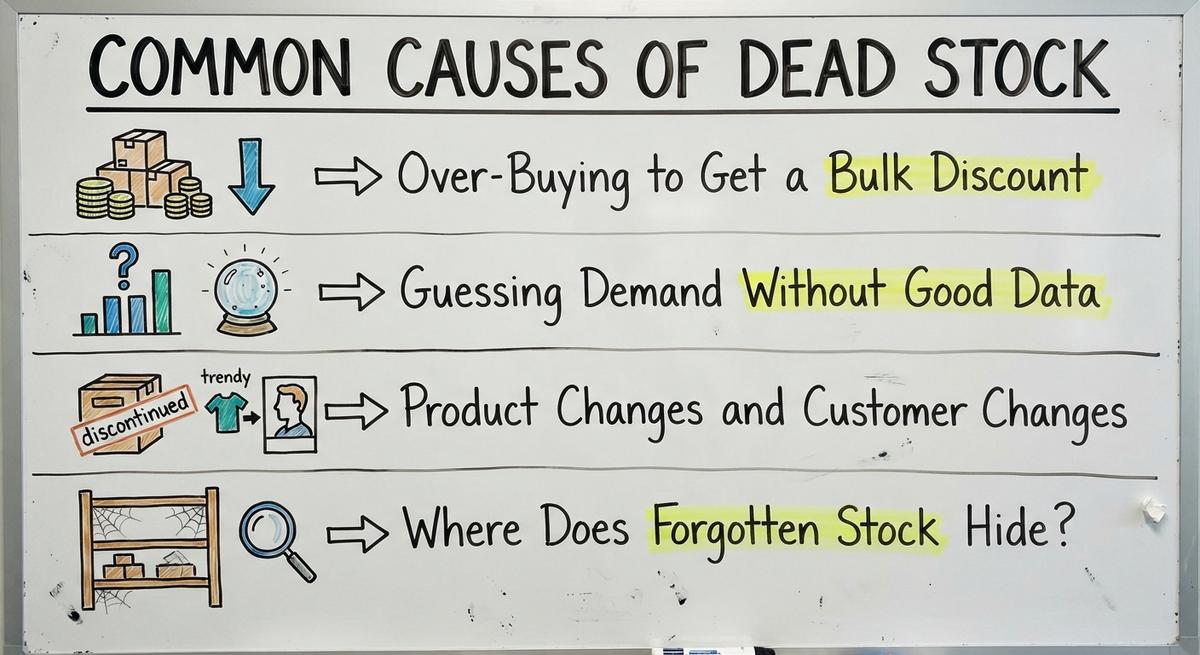
Four causes explain most dead stock: buying too much, guessing demand, changes in products or customers, and goods no one tracks. Each cause has a plain fix.
Over-Buying to Get a Bulk Discount
Over-buying is the top cause of excess inventory, which is stock above what you need. A low unit price hides a high holding cost. A 20 percent discount means little if half the pallets sit for a year. Buy only what your sales history supports. Count rent and handling as part of the price. Bulk deals that end in dead stock cost more than a fair price on goods that ship.
Guessing Demand Without Good Data
Guessing demand means buying from memory or gut feel. Memory fails. A product that sold well last spring may have lost its best account. Sales data split across Excel files, printed sheets, and email makes dead stock more likely. No one sees the full picture. Pull sales into one place before you place an order. A forecast is only as good as the records behind it.
Product Changes and Customer Changes
Product and customer changes turn good stock into dead stock overnight. Three common triggers appear:
- New packaging: Buyers want the new box, and the old one sits. The goods inside are fine, but no one orders them.
- New models: A new version replaces the old one on every order. Leftover units of the old model stop moving the same week.
- Lost accounts: Stock bought for one big buyer stays when the buyer leaves. Nobody else wants the same mix of items.
Special orders add to the pile when a customer never picks them up. Ask for a deposit on every special order.
Where Does Forgotten Stock Hide?
Forgotten stock hides in two places: the returns corner and the shelf no system shows. Returned goods wait for a decision no one makes. Items counted once and lost sit in a back aisle with no record. That is how dead stock grows unseen. You cannot sell what you cannot find. Give every return a bin, a tag, and a date. Walk the building each quarter to match what you see with what you list.
Not sure this is the right shape for your operation
Describe how the work runs today. We map it on a call and show you what it would look like built around that, before you spend anything.
Book a callHow to Find Dead Stock in Your Warehouse
You can find dead stock with data you already have, plus a walk through the aisles. The data points you to the pallets. The walk proves what the data says.
Pull the Data You Already Have
Four steps find dead stock in your warehouse:
- Pull the last-sold date for every item from your sales records. Export it from your accounting package into one sheet, with one row per item.
- Pick a cutoff such as 6 or 12 months. Fast-moving goods need a short one. Parts and seasonal goods need a long one.
- Sort by dollars tied up, not just item count. One pallet of costly parts matters more than 50 cheap boxes, so rank by value first.
- Walk the shelves and check the numbers. Your list will miss items that a person can see, such as boxes in the wrong aisle.
Start with the top 20 items by dollars. The biggest dead stock hides there.
What to Track to Spot Dead Stock Early
Four numbers warn you before stock dies. Track each one every month:
- Last sale date: This is the day an item last left the building on an order. An old date is the first clue that stock has stalled.
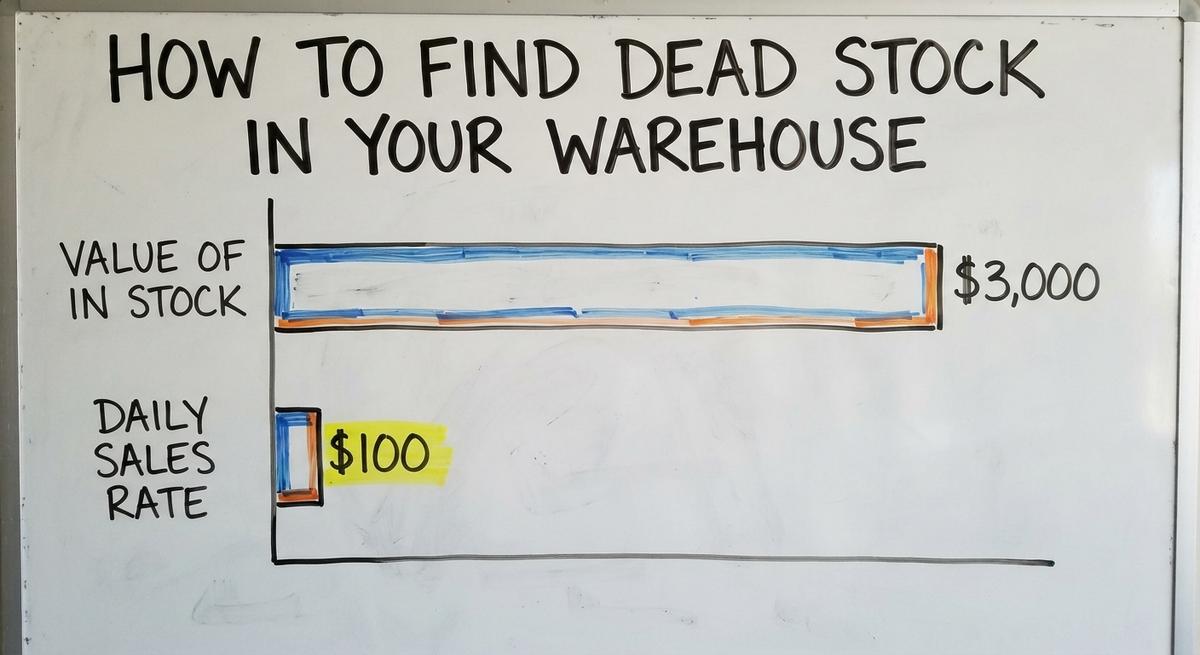
- Days of stock on hand: Divide stock value by average daily sales. A sample from one inventory guide shows $3,000 in stock and $100 a day in sales gives 30 days.
- Inventory turnover: This is how many times a year you sell through an item's stock. Low turnover is the early sign that a slow seller is turning dead.
- Stock age: This is how long each lot has sat since you received it. Old lots with no recent sales are your best targets.
The Census Bureau publishes wholesale inventory and sales data each month. Use it to compare your ratio. These four numbers turn a surprise into a warning.
How to Get Rid of Dead Stock
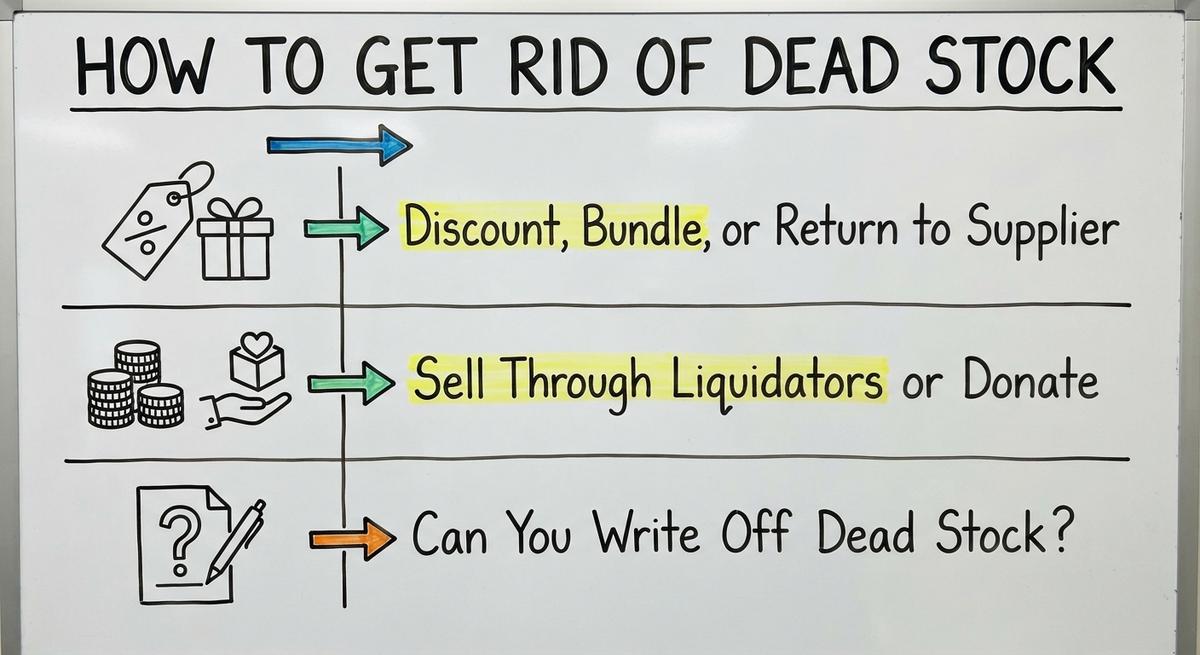
There are four ways to clear dead stock: discount, return, liquidate, or write off. Start with the highest dollar items. They free the most cash and space.
Discount, Bundle, or Return to Supplier
A markdown is the fastest way to turn old goods into cash. Cut the price until the items move. Bundle slow items with fast sellers so one order carries both. Then ask your supplier about returns. Some suppliers give a restocking credit, less than full price. A credit still beats a pallet of dead stock that earns nothing. Ask early. Supplier terms get harder as goods age.
Sell Through Liquidators or Donate
A liquidator is a buyer who pays cents on the dollar for bulk leftover goods. Liquidation recovers some cash and clears dead stock fast. Donation is the other path. Gifts to a qualified charity can count toward a deduction. The IRS says "the amount of charitable cash contributions taxpayers can deduct on Schedule A as an itemized deduction is limited to a percentage (usually 60 percent) of the taxpayer’s adjusted gross income (AGI)." Read the charitable contribution rules and check with your accountant before you give. Either way, the shelf is clear and the cost stops.
Can You Write Off Dead Stock?
Yes, you can write off dead stock that cannot be sold, and your accountant sets how you record it. A write-off means you remove the goods from your books and accept the loss. Scrap what has no buyer. Clear the space the same week. Ask your accountant whether to book it as a loss or a markdown. A clean write-off beats paying rent on goods for another year.
The comparison is easier when one option is built for you
Off-the-shelf means fitting your process to the software. We do it the other way round, and the first look costs nothing.
Book a call
How to Prevent Dead Stock From Coming Back
Prevention takes four rules and one monthly habit. A reorder point is the stock level that triggers a new order. Set it from real sales, not memory.

Four Rules That Stop the Build-Up
- Use real history: Set each reorder point from the last 12 months of sales, not from a hunch. Real numbers keep you from buying more than the shelf can sell.
- Review slow items: Check items with falling sales on a set schedule. You act while the goods still sell, before they turn into dead stock.
- Add an approval step: Need a second sign-off on special orders and on bulk buys over a set dollar amount. A second pair of eyes catches bad buys.
- Keep one record: Hold one shared list of stock instead of many copies in many files. One list means everyone sees the same counts.
The NIST Manufacturing Extension Partnership offers vendor-neutral guidance on supply chain and inventory process. Four rules keep the build-up small.
A Simple Monthly Dead Stock Routine
A monthly routine keeps dead stock small. Name one owner. Give that person 1 hour on the same day each month:
- Run the last-sold report from your sales records. Save a copy each month so you can compare results over time.
- Flag every item past your cutoff. Mark each one with its dollar value so the big ones stand out.
- Pick an action for each flagged item: discount, return, sell, or write off. Set a due date for every action.
- Record the result and the cash freed. A running total shows the team that the routine pays off.
- Review reorder points for the items you flagged. Lower them so the same mistake does not repeat.
One owner and one hour beat a yearly clean-up nobody wants.

See it running on your own process first
No build cost. The subscription starts once it is live and doing the job, not before.
Book a call
When Spreadsheets Stop Being Enough
Manual tracking is the real cause of dead stock when your records cannot keep up with your shelves. Watch for these signs:
- Counts disagree: Your list says 40 and the shelf holds 31. Gaps like that hide dead stock from your reports.
- Slow reports: A last-sold report takes hours to build by hand. Reports that slow get skipped, and stale goods go unseen.
- Manual math: Turnover and stock age come from copy and paste. Each paste adds a chance for a wrong number.
You have three options. Better spreadsheet habits fix small gaps. Add-on tools cover the next step. Custom software fills only the manual gaps you name. Keep your accounting package for the books, where it works well. Ask any provider to fit your current process first. Fix the gap, not the whole building.


Your Next Step on Dead Stock
Pick one report this week: last-sold date by item, sorted by dollars. That single list shows where your dead stock sits. Run it before December 31, 2025, so your year-end books show true values. Clear the top 5 items first, then set the monthly routine. If the report takes hours by hand, talk with a software partner about automating only that step. Start with the data you have today.

Frequently asked questions
What does "dead stock register" mean?
A dead stock register is a running list of items that have passed your no-sale cutoff. Each line shows the item, quantity, cost, last sale date, and the action you chose to take.
How long before stock is dead?
No fixed rule exists. Most distributors use 6 to 12 months with no sales. Fast goods need a short cutoff. Parts and seasonal goods need a longer one. Pick the number that fits your sales pattern.
Is dead stock the same as excess inventory?
No. Excess inventory is more stock than you need, but it still sells over time. Dead stock has stopped selling. Excess can turn dead if left alone for long enough.
Can dead stock be written off?
Yes, in most cases. You remove goods that cannot be sold and book the loss. Rules vary by situation, so ask your accountant how to record each write-off.
How much dead stock is normal?
No single figure fits every business. A small share is normal, since some items fail. Track your own dead stock as a percent of total stock value each month and push the trend down.
What is a reorder point?
A reorder point is the stock level that tells you to buy more. Set it from average daily sales times supplier lead time, plus a small cushion for surprises.
Where should I start if I have no data tools?
Start with a sales export from your accounting package. Sort by last sale date and by dollar value. A plain spreadsheet with those two columns finds most dead stock in an afternoon.
Start with a free first look
A 30 minute call, your operation mapped, and a clear picture of what we would build. No obligation and nothing to install.
Book a callRelated guides
More on the same work.
Guides
- Apics Safety Stock Formula
- Stock Turnover Ratio Formula
- Stock Shrinkage
- Replenish Stock
- Retail Stock Management Software
- Medical Stock Management System
- Stock and Inventory Simple
- Stock Software
- Make to Stock Examples
- Perpetual Stock System
- Inventory Stock Software
- Hospital Stock Management System
- Cloud Stock Management Software
Common questions
- How to Calculate Safety Stock in Excel
- Reorder Point vs Safety Stock
- What is Free Stock in Inventory Management
- What is Stock Out Cost in Inventory Management
- How to Manage Stock Effectively
- Stock Inventory Definition
- How to Resolve Stock Discrepancy?
- What is Fluctuation Stock in Inventory Management
- Why is Safety Shot Stock Dropping
- How to Stock Control
- How to Maintain Stock Levels