


Make To Stock Examples
Make to stock (MTS) means building or buying inventory before a customer places an order. Reviewed and updated June 2025.
Reviewed September 2026. Figures are worked from the assumptions stated beside them, so you can substitute your own and the arithmetic still holds.
Products sit ready in the warehouse so orders ship the same day. Every example in this guide comes from wholesale distribution, warehousing and fulfillment, the settings where MTS runs every day, often informally, on spreadsheets and gut feel.
Book a callWhat Make to Stock Means and How It Works
Make to stock is the practice of producing or purchasing goods before demand arrives. A distributor forecasts how much stock it will need, buys or builds that quantity, and holds it in the warehouse until orders come in. The opposite model, make to order (MTO), waits for a confirmed order before starting production or purchasing.
MTS relies on demand forecasting to set inventory levels. Forecast well, and you fill orders fast. Forecast poorly, and you end up with too much stock or too little.
We build it for your operation, and the first look is free
If you would rather not compare products, describe how your operation already works and we build the system around it.
No build cost. You see it running on your own process first, and the monthly subscription starts only once it is live.
Book a callThe Four Steps of the Make to Stock Cycle
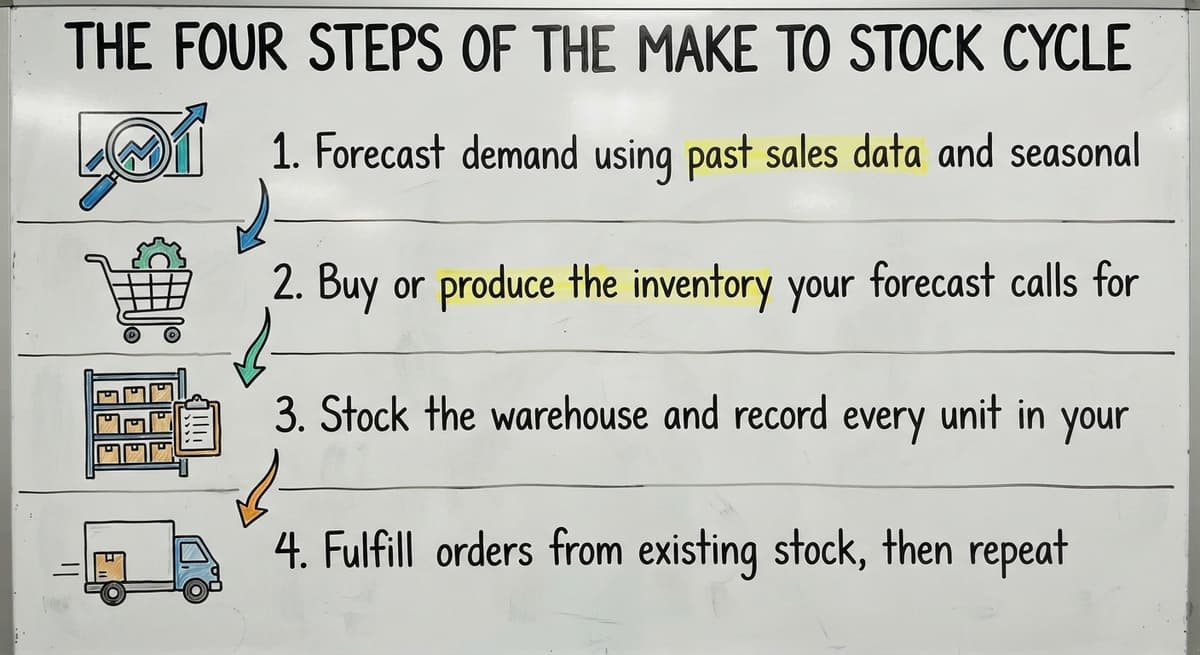
The MTS cycle runs in 4 steps:
- Forecast demand using past sales data and seasonal patterns.
- Buy or produce the inventory your forecast calls for.
- Stock the warehouse and record every unit in your system.
- Fulfill orders from existing stock, then repeat the cycle.
Accuracy at step 1 work out everything that follows. As IRS Publication 538 states, "To figure taxable income, you must value your inventory at the beginning and end of each tax year." That legal requirement makes accurate stock counts a business obligation, not just a best practice. The cycle repeats continuously, updated by real sales data each time it runs.
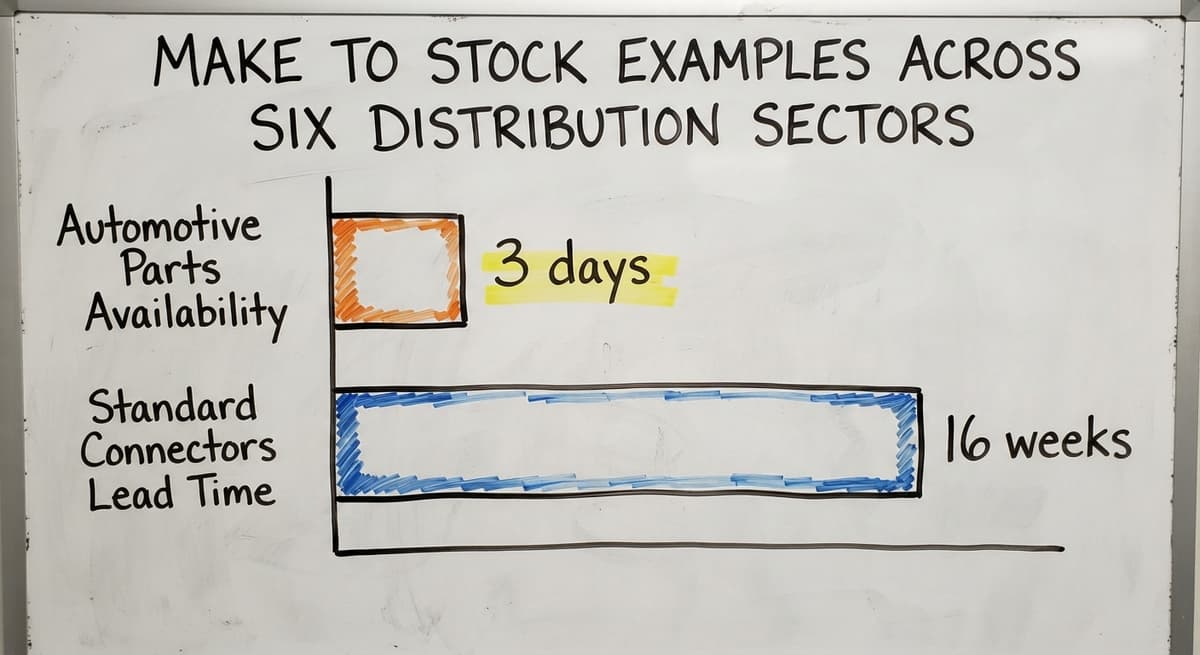
Make to Stock Examples Across Six Distribution Sectors
MTS shows up in nearly every wholesale and distribution setting. The six examples below cover the most common ones. Each one follows the same logic: stock is held before the order arrives so the customer gets what they need the same day.
- Industrial supplies: Fasteners, safety gear and cutting tools move in predictable volumes. Distributors stock standard sizes based on historical usage so contractors and plant managers can order and receive same-day.
- Food and beverage: Shelf-stable goods such as canned goods, condiments and dry ingredients are produced and warehoused ahead of retailer buy orders, with stock levels tied to promotional calendars and seasonal demand.
- Janitorial and sanitation: Cleaning chemicals and paper products turn quickly and carry low unit cost, making MTS the default model. Stockouts in this category stop facility operations, so distributors hold buffer stock as a matter of course.
- Electrical and HVAC: Breakers, wire, fittings and filters are stocked in standard setups. Custom assemblies may use assemble to order, but commodity components are always held in advance.
- Automotive aftermarket: High-velocity parts such as filters, belts and brake pads are stocked regionally so repair shops can get same-day delivery and keep bays running.
- Office and packaging supplies: Cartons, labels, tape and standard office consumables are replenished on fixed cycles tied to customer usage rates, with reorder points set to cover supplier lead times.
Consumer Packaged Goods: Is Paper Towels a Make to Stock Product?
Yes, paper towels are a textbook make to stock product, and so is canned soup, laundry detergent and every other household staple on a grocery shelf. Manufacturers produce large batches based on years of historical sales data. Distributors then stock regional warehouses weeks ahead of retailer buy orders. A retailer does not wait for a factory run when it reorders. Stock is already sitting in a warehouse, ready to ship. Stable demand and zero customization make consumer packaged goods the clearest MTS example in distribution.
Wholesale Apparel: Seasonal Inventory Before Orders Arrive
A wholesale clothing distributor buys spring inventory in January, months before retail buyers place orders. Size and color variants multiply the planning challenge: a single style might need 12 size-color combinations, each tracked as its own SKU. Get the mix wrong and you end up with 200 units of a size that did not sell and zero units of the size that did. Overstock risk rises sharply when a season underperforms. For small to mid-size distributors, accurate pre-season forecasting is the difference between a profitable quarter and a clearance problem.
Automotive Parts: Same-Day Availability Is Non-Negotiable
A mechanic who needs a brake pad or a serpentine belt cannot wait 3 days for a special order. Automotive parts distributors stock high-turnover SKUs like filters, belts and brake pads in advance because shops expect same-day availability. In a well-run system, a reorder point triggers a new buy order automatically when stock drops to a set level. No one has to remember to reorder. The reorder point is what keeps the shelves full without manual checking, and it is the single most important setting in an automotive parts MTS operation.
Food and Beverage Wholesale: Expiration Dates Change the Stakes
A food wholesaler stocking shelf-stable goods uses weekly order patterns to set inventory levels. Restaurants and grocery buyers expect same-day fulfillment, so stock must be on hand before the order arrives. Expiration dates add a layer of urgency that most other sectors do not face. Slow-moving stock does not just tie up cash; it spoils. Accurate forecasting is especially important here because the cost of a bad forecast is not just overstock, it is waste. First-in, first-out (FIFO) rotation and tight reorder discipline are standard practice in food distribution for exactly this reason.
Janitorial and Safety Supply: Consistent Demand Makes MTS Easy
Facilities managers expect gloves, cleaners and paper goods to ship the same day they order. Demand for these items is steady and predictable across the year, which makes MTS the natural fit. A janitorial supply distributor with 10 to 50 staff can run MTS well without enterprise software. The SKU list is manageable, the order patterns are stable, and customers rarely ask for custom setups. Consistent demand is the clearest signal that MTS is the right model, and janitorial supply is one of the cleanest examples of that signal in small distribution.
Electronics Components: MTS as a Buffer Against Supply Chain Delays
A distributor stocking standard connectors, cables or batteries faces a different problem: supplier lead times from overseas manufacturers can run 8 to 16 weeks. B2B customers, by contrast, want stock within days. Holding local inventory bridges that gap. MTS here is not just a fulfillment strategy; it is a buffer against supply chain delays. When a supplier misses a shipment, local stock keeps orders moving. Long lead times force early purchasing decisions, and that makes accurate demand data more valuable, not less.
The comparison is easier when one option is built for you
Off-the-shelf means fitting your process to the software. We do it the other way round, and the first look costs nothing.
Book a callHow Does a Fulfillment Center Use Make to Stock?
A third-party fulfillment center uses make to stock when a brand client ships inbound inventory ahead of customer orders. The brand does the forecasting and decides how much stock to send. The fulfillment center receives it, stores it and picks orders as they arrive. The fulfillment center's job is accurate picking and shipping, not forecasting. Speed and accuracy at the pick-and-ship stage are what the brand is paying for. A fulfillment center that runs MTS well gives its brand clients a same-day or next-day ship promise they could not deliver from their own facility.

When to Use Make to Stock and When to Avoid It
MTS works well under specific conditions. It works poorly in others. Knowing the difference saves cash and warehouse space.
MTS is the right choice when:
- Demand is stable and predictable across weeks or months
- Products are standard with no customization required
- Customers expect immediate availability and will not wait
- SKU count is manageable and volume per SKU is high
MTS is the wrong choice when:
- Demand swings sharply and unpredictably
- Products have short life cycles or go out of style quickly
- Goods are expensive or perishable and carrying cost is high
- Each order needs a custom setup
Alternative Models When Make to Stock Does Not Fit
For variable or custom products, make to order (production starts after the order) or assemble to order (components are stocked but final assembly waits for the order) usually fit better. Carrying excess inventory when demand is unpredictable ties up cash and can create a spoilage or obsolescence problem that takes quarters to work through. The right model depends on your specific SKU mix, not a general rule.

The Biggest Risks in Make to Stock: Overstock and Stockouts
MTS lives or dies on forecast accuracy. Two failure modes show up when forecasting breaks down.
Overstock means you bought too much. Excess inventory ties up cash, fills warehouse space and, in food or seasonal goods, may become worthless. Stockouts mean you bought too little. A stockout costs you the sale and, often, the customer relationship.
Manual spreadsheet-based forecasting increases both risks. A spreadsheet does not alert you when stock crosses a reorder threshold. It does not update in real time as orders ship. It reflects what someone typed last, not what is actually on the shelf. 3 staff members each spending 4 hours a week reconciling inventory in spreadsheets, at the Bureau of Labor Statistics median wage for shipping and receiving clerks, adds up to a measurable annual labor cost before you count the errors those hours still produce.
Reorder Points, Safety Stock and How They Work Together
Two settings keep MTS running without constant manual attention.
Reorder point is the inventory level that triggers a new buy order. Calculate it by multiplying average daily usage by supplier lead time in days, then adding safety stock. For example, if you sell 20 units a day and your supplier takes 5 days to deliver, your base reorder point is 100 units. Drop to that level and a new order goes out automatically in a well-configured system.
Safety stock is a buffer held above that reorder point to cover demand spikes or supplier delays. Set it based on how much demand and lead time vary. Too much safety stock wastes cash. Too little causes stockouts when a supplier runs late or a customer orders more than usual.
See it running on your own process first
No build cost. The subscription starts once it is live and doing the job, not before.
Book a call
Why Accurate Inventory Data Is the Foundation of Reorder Settings
Real-time inventory data is what makes both settings useful. If your stock count is wrong because receiving was logged a day late, your reorder point fires at the wrong moment. Accurate, current data is the foundation that reorder points and safety stock are built on, and it is the first thing to fix before adjusting any other setting in your MTS system. See the reorder point calculation guide for step-by-step math on setting these numbers for your operation.
Make to Stock vs. Make to Order vs. Assemble to Order
How Is Make to Stock Different from Make to Order?
Make to stock and make to order differ on one question: does production or purchasing start before or after the order arrives? In MTS, stock is built before orders come in. In MTO, the order triggers the work. MTS favors speed of delivery. MTO favors customization and lower carrying cost. Some distributors run both models at the same time: MTS for their top 20 high-volume SKUs and MTO for specialty or low-volume items. Running both models is common and practical; the key is knowing which SKUs belong in each bucket.
Assemble to Order: The Middle Ground
Assemble to order (ATO) sits between MTS and MTO. Components are stocked in advance, but final assembly or kitting waits until a customer order arrives. A distributor that pre-picks standard components but assembles custom kits only after an order is placed is running ATO. This model reduces finished-goods inventory risk while still keeping lead times short. ATO makes more sense than pure MTS when customers want some setup but not full custom builds. If your operation already kits products after orders arrive, you are likely running ATO today without calling it that.

How Inventory Software Supports Make to Stock Operations
MTS depends on accurate, real-time inventory counts and clean demand data. Spreadsheets and printed pick sheets cannot provide either reliably at scale.
Inventory management software for wholesale distributors replaces those manual tools with a system that tracks every unit as it moves. Key features that matter for MTS:
- Automated reorder alerts fire when stock hits the reorder point, so no one has to watch a spreadsheet
- Buy order generation creates and sends orders to suppliers without manual entry
- Demand reporting shows which SKUs are trending up or down so forecasts stay current
- Warehouse location tracking tells pickers exactly where stock sits, cutting pick time and errors
The software does not need to replace QuickBooks. A connected system pulls sales and cost data from QuickBooks for accounting while handling warehouse workflows separately. Many small distributors run both side by side.
Can You Run Make to Stock Without a Big ERP?
Small distributors with 5 to 100 staff do not need a six-figure ERP rollout to run MTS well. Enterprise systems are built for companies with hundreds of users, complex manufacturing lines and multi-entity accounting. Most wholesale distributors do not have those problems.
A lightweight or custom inventory system can handle MTS workflows: reorder alerts, buy orders, receiving, picking and real-time stock counts. It connects to QuickBooks for accounting and invoicing. Your existing QuickBooks setup stays in place. Custom warehouse software for small operations is built around the workflows your team already runs, not around a feature list designed for a different industry.

Start With Process Before You Start With Software
The NIST Manufacturing Extension Partnership offers vendor-neutral guidance on supply chain process improvement for smaller operations, and its consistent message is that process clarity comes before software. Get your reorder points and safety stock levels defined first. Then add the system that enforces them.
Common Mistakes, Key Metrics and Signs You Need Better Tools
The Most Common MTS Planning Mistakes
Operations managers running MTS manually tend to make the same fixable mistakes:
- Using gut feel instead of sales data to set reorder points, which works until demand shifts
- Setting reorder points once and never updating them, even as lead times and sales velocity change
- Ignoring seasonality, so stock levels are wrong at the start of every peak period
- Not tracking supplier lead time changes, which throws off every reorder calculation downstream
- Treating all SKUs the same, when a small number of fast movers deserve tighter controls than slow movers
Each mistake is fixable with better data habits and a system that flags when inputs change.
Not sure this is the right shape for your operation
Describe how the work runs today. We map it on a call and show you what it would look like built around that, before you spend anything.
Book a callKey Metrics to Track in a Make to Stock System
Five numbers tell you whether a make to stock operation is healthy. They are hard to see clearly when data lives in email threads and spreadsheets.
| Metric | What It Measures |
|---|---|
| Inventory turnover rate | How many times stock sells through in a period; higher is generally better |
| Fill rate | The share of order lines shipped complete on the first attempt |
| Days of supply | How many days current stock will last at the current sales rate |
| Stockout frequency | How often a SKU hits zero before a replenishment order arrives |
| Carrying cost | The total cost of holding inventory, including storage, insurance and tied-up cash |
Tracking these numbers monthly gives you an early warning before a small imbalance becomes a cash problem. According to US Census Bureau wholesale trade data, inventories-to-sales ratios shift across sectors and seasons, which means a static target for any of these metrics will eventually be wrong.
Does QuickBooks Work for Make to Stock, and Where Does It Fall Short?
QuickBooks works well for what it was built to do: invoicing, accounts payable, basic item counts and financial reporting. Many small distributors rely on it for all of those tasks, and that does not need to change. Where QuickBooks falls short for MTS is in the warehouse itself. It does not automate reorder alerts. It does not track bin or shelf locations. It does not give pickers real-time visibility into where stock sits. It does not generate buy orders based on reorder points. QuickBooks integration for warehouse operations solves this by connecting a dedicated inventory layer to the accounting data already in QuickBooks, filling the gap without replacing the tool your bookkeeper already knows.
Signs Your MTS Process Needs Better Software
Run through this short self-assessment. If more than 2 of these describe your operation today, the manual process is costing you more than a software change would.
- Stockouts happen regularly on SKUs that should always be in stock
- Overstock is building up on items that moved slower than expected
- Staff spend several hours a week reconciling inventory counts in spreadsheets
- Buy orders are created from memory or by walking the warehouse
- You find out about a stockout when a customer calls, not before
- Receiving errors show up days later when a count does not match an invoice
Each sign points to the same root cause: the system cannot see what is happening in real time, so people fill the gap manually.
Next Steps for Your Make to Stock Operation
MTS is not complicated in concept. Stock the right products in the right quantities before orders arrive, and customers get what they need the same day. The hard part is the data: accurate forecasts, current stock counts and reorder points that reflect real lead times and real sales velocity.
Audit Your Data Before You Add Any Software
Before adding any software, audit your current inventory data. Check whether your stock counts match physical counts. Verify that your reorder points reflect current supplier lead times. Those two checks will tell you more about where your MTS process breaks down than any software demo will.
When you are ready to look at tools, talk to a partner who understands wholesale distribution workflows specifically, not a generic ERP vendor who will size you up for a system built for a company ten times your size. Fulfillment center software solutions and lightweight inventory systems built for distributors exist at a scale and price point that fits a team of 10 to 50. If you want to talk through whether a connected inventory system fits your operation, reach out and describe what you are running today.
Frequently asked questions
What is a simple make to stock example in wholesale distribution?
A janitorial supply distributor that keeps gloves, cleaners and paper goods on the shelf before orders arrive is running make to stock. Stock is purchased based on past order patterns, held in the warehouse and shipped the same day a facilities manager places an order. No waiting for a production run or a special buy.
How is make to stock different from make to order?
Make to stock builds or buys inventory before an order arrives. Make to order starts purchasing or production only after a confirmed order comes in. MTS delivers faster because stock is already on hand. MTO reduces carrying cost and works better for custom or low-volume products.
What is a reorder point and how do I calculate it?
A reorder point is the stock level that triggers a new buy order. Calculate it by multiplying your average daily sales by your supplier lead time in days, then add your safety stock. For example, 20 units per day times a 5-day lead time equals a base reorder point of 100 units, plus whatever safety stock you carry.
Can a small distributor run make to stock without an ERP system?
Yes. A distributor with 5 to 100 staff does not need enterprise software to run MTS. A lightweight inventory system handles reorder alerts, buy orders, receiving and real-time stock counts. It connects to QuickBooks for accounting so your existing financial setup stays in place.
What is safety stock and why does it matter for MTS?
Safety stock is extra inventory held above your reorder point to cover demand spikes or supplier delays. It acts as a buffer so a late shipment or an unusually large order does not cause a stockout. Set it based on how much your demand and lead times vary week to week.
What metrics should I track in a make to stock operation?
Track inventory turnover rate, fill rate, days of supply, stockout frequency and carrying cost. Together these numbers show whether your stock levels are too high, too low or well-matched to demand. Reviewing them monthly gives you an early warning before a small imbalance becomes a cash flow problem.
When does make to stock fail, and what should I use instead?
MTS fails when demand is highly variable, products have short life cycles or goods are expensive to hold. In those cases, make to order or assemble to order usually fit better. Assemble to order is a good middle ground when customers want some setup but not full custom builds, because components are stocked but final assembly waits for the order.
Start with a free first look
A 30 minute call, your operation mapped, and a clear picture of what we would build. No obligation and nothing to install.
Book a callRelated guides
The rest of this guide, for the parts of the job this page does not cover.
Guides
- Cloud Stock Management Software
- Hospital Stock Management System
- Warehouse Management System Examples
- Examples of Warehouse Management System
- Make Barcode
- Warehouse Stock Management Software
- Warehouse Stock Software
- Warehouse Stock Management System
- Small Business Stock Management Software
- Excess Inventory
- Closed for Inventory
- Multi Location Inventory Management Software
- Inventory Management for Multiple Locations
- Costing Inventory
- Is Inventory a Long-term Asset
- Inventory Management System for Manufacturing
- Inventory Fixed Assets
- Pick Lists
- Inventory Management Pics
- Excel Inventory Template