


How To Stock Control
Stock slipping through the cracks costs money twice: once when you run out, and again when you over-order to compensate. This guide covers how to stock control a warehouse or distribution operation using process discipline first and software second. Whether you are running five staff or fifty, the steps are the same.
Book a callWhat Stock Control Actually Means in a Warehouse
Stock control is knowing what you have, where it is, and when to reorder, at any point during the day, not just after a year-end count. It is an ongoing discipline that connects every receipt, pick, return, and adjustment to a single running record of on-hand quantity.
Reviewed October 2026.
Counting inventory once a year satisfies an accounting requirement. It does not tell you whether bin 14B is about to run dry on a Tuesday afternoon. Good stock control closes that gap by making inventory accuracy a daily habit rather than an annual event.
We build it for your operation, and the first look is free
If you would rather not compare products, describe how your operation already works and we build the system around it.
No build cost. You see it running on your own process first, and the monthly subscription starts only once it is live.
Book a callWhy Stock Control Breaks Down as Order Volume Grows
The pattern is familiar: an accounting package handles the financials, a spreadsheet tracks warehouse stock, and printed pick sheets circulate on the floor. Each tool works in isolation. None of them talk to each other in real time.
As order volume climbs, the gaps between those records widen. Staff spend hours reconciling numbers instead of fulfilling orders. That is a systems problem, not a people problem. The IRS recognizes the working weight of inventory tracking directly: IRS Publication 538 states that "a business must keep records that are enough to work out the correct amount of inventory on hand at the beginning and end of each tax year." Meeting that standard while running three disconnected tools becomes harder with every new SKU.
The fix is not to work harder at matching. It is to remove the conditions that make matching necessary.
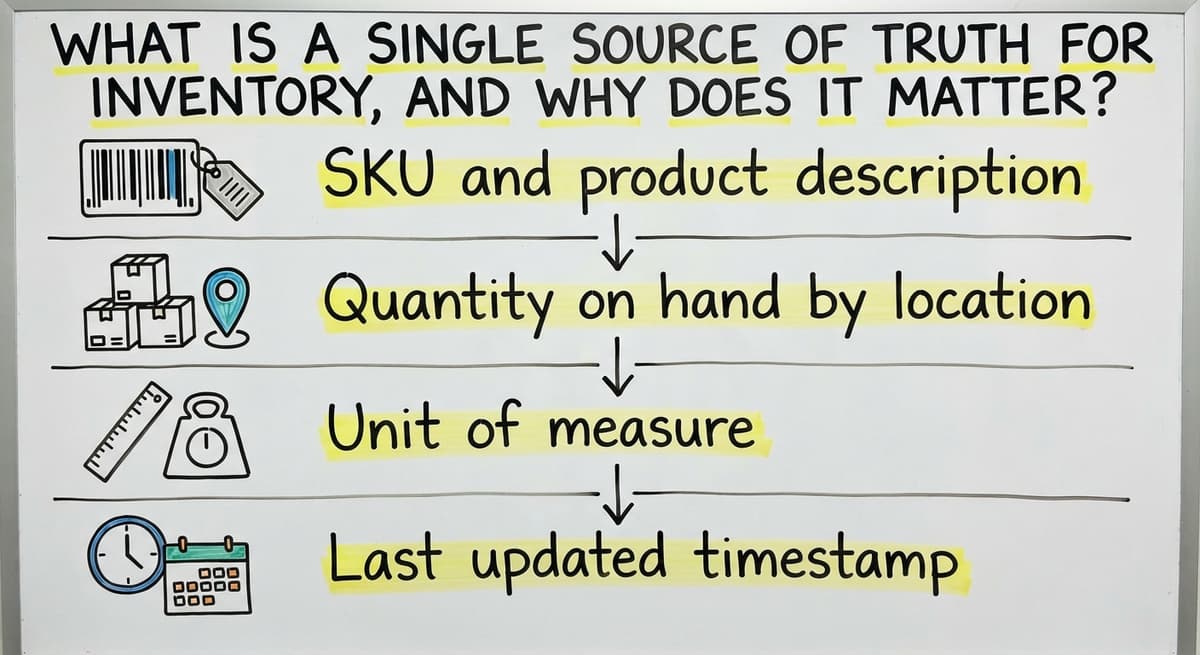
What Is a Single Source of Truth for Inventory, and Why Does It Matter?
Stock control starts with one authoritative record that every team member reads from and writes to. Without that, two people can look at two different numbers for the same SKU and both believe they are correct.
That record must capture at minimum:
- SKU and product description
- Quantity on hand by location
- Unit of measure
- Last updated timestamp
Maintaining parallel records in an accounting package and a spreadsheet without a documented sync process guarantees drift. When a discrepancy appears, no one knows which number is right. The moment your team stops trusting the inventory record, they stop using it, and the process collapses into guesswork. Inventory management software for small distributors is built around this principle: one record, updated at the point of transaction.
Step 2: Define Reorder Points and Safety Stock for Every SKU
A reorder point is the on-hand quantity at which a new buy order should be triggered, before stock runs out, not after. The basic calculation is:
Reorder Point = Average Daily Usage x Lead Time (in days)
For example, if you sell 20 units per day and your supplier takes 5 days to deliver, your reorder point is 100 units. When stock hits 100, the buy order goes out.
High-velocity items and those with long or unpredictable lead times need a safety stock buffer added on top. Safety stock absorbs the variation that averages cannot predict.
Reorder points are not permanent. Seasonal demand, supplier changes, and new product lines all shift the numbers. Build a quarterly review into your process so the triggers stay accurate. A reorder point set once and never revisited is a stockout waiting to happen.
Steps 3 and 4: Track Every Movement and Count Regularly
Inventory accuracy depends on recording every receipt, pick, return, and adjustment at the moment it occurs. A gap opens the instant receiving is logged in one system and picking is logged in another, or when a transaction is noted on paper and entered into the record at the end of a shift. By then, two more picks may have happened against stock that the system still shows as available.
Barcode scanning or simple mobile entry at the point of transaction eliminates that delay. The record reflects reality continuously rather than catching up to it.
The comparison is easier when one option is built for you
Off-the-shelf means fitting your process to the software. We do it the other way round, and the first look costs nothing.
Book a callWhy Cycle Counting Outperforms Annual Physical Counts
Counting reinforces accuracy. Cycle counting means counting a rotating subset of SKUs on a regular schedule rather than shutting down operations once a year for a full physical count. Annual counts catch problems months after they started and disrupt fulfillment for days. Cycle counts surface discrepancies early, while the cause is still traceable.
Count high-value and fast-moving items more frequently. A weekly count on your top 20 SKUs takes less time than a single annual count and produces far more reliable data across the year.

Step 5: Assign Ownership
Stock control fails when no one is accountable for the numbers. Designate a specific person or role to review discrepancies, approve adjustments, and enforce the process. In a lean team, this does not need a dedicated inventory manager. A warehouse lead who owns the record for two hours a week is enough, provided the responsibility is explicit and consistent.
Ownership without a documented process is just pressure. The person responsible needs clear procedures, not just accountability.
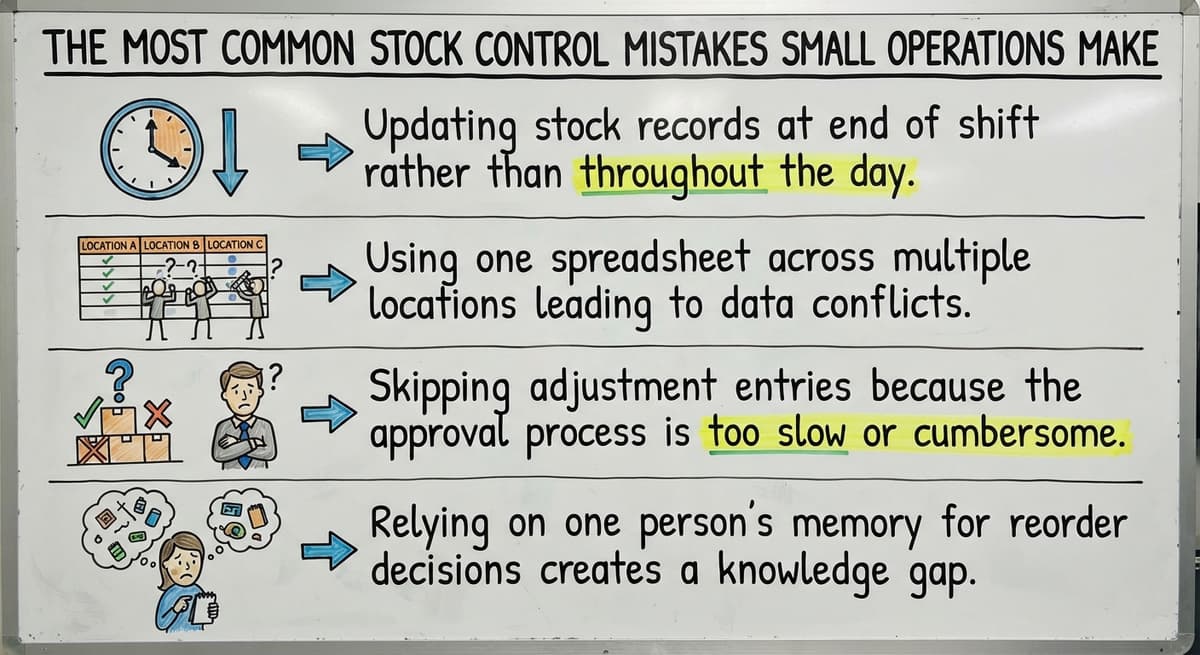
The Most Common Stock Control Mistakes Small Operations Make
Most mistakes share a single root: the process is treated as optional when things get busy.
The patterns that cause the most damage:
- Updating stock records at end of shift rather than at the point of transaction, so picks and receipts stack up unrecorded
- Using one spreadsheet across multiple locations without location codes, making it impossible to know where stock actually sits
- Skipping adjustment entries because the approval process is too cumbersome, leaving the record wrong indefinitely
- Relying on one person's memory for reorder triggers instead of documented reorder points
When Should a Small Distributor Move Beyond Spreadsheets?
Spreadsheets work at low volume. They break down as SKU count grows, because every new product adds another row that can be edited by anyone, overwritten accidentally, or simply missed during a busy shift. Errors compound rather than cancel out.
The warning signs that a spreadsheet has become a liability:
- Stockouts on items you thought were well-stocked
- Oversells on products that show available in the record but are not on the shelf
- Staff spending more than an hour a day reconciling counts across tools
See it running on your own process first
No build cost. The subscription starts once it is live and doing the job, not before.
Book a call
How to Decide When the Math Has Answered the Question
The decision to move beyond spreadsheets is a capacity question, not a technology preference. When the manual process costs more in staff time and error correction than a purpose-built system would cost to run, the math has already answered the question. The right system fits the operation; it does not need the operation to reorganize itself around new software.
Custom warehouse software for wholesale operations can be scoped to match an existing workflow rather than replacing it wholesale.
How to Control Stock Without Replacing Your Accounting Package
Many small distributors and warehouses rely on an accounting package for financials and have no intention of migrating to a full ERP. That is a reasonable position. Accounting packages are not designed to manage real-time warehouse stock movements, but they do not need to be replaced to solve that problem.
The practical approach is to keep the accounting package for financial records while adding a purpose-built stock control layer that handles receipts, picks, adjustments, and cycle counts.
How a Stock Control Layer Syncs with Your Accounting Software
That layer syncs financial data back to the accounting package without requiring double entry. Your accounting software integration for warehouse operations works exactly this way: inventory transactions flow through the warehouse system and post to the ledger automatically.
Fulfillment center software without ERP is built on this model. It solves the working problem without the cost or disruption of a platform migration. The goal is accurate stock data at the working level and clean financial data at the reporting level, handled by tools suited to each job.

Getting Started with Stock Control
The five steps covered here follow a deliberate sequence:
- Set up one authoritative inventory record with SKU, quantity, location, and unit of measure
- Set reorder points for every SKU based on usage and lead time, with safety stock where needed
- Record every transaction at the moment it happens, not at the end of the shift
- Run cycle counts on a regular schedule, prioritizing high-value and fast-moving items
- Assign clear ownership so discrepancies are caught and corrected, not ignored
Map Your Process Before Selecting Any Software
Before selecting any software, start with a clean count and map your current process on paper. Know where transactions are recorded today, where the gaps are, and what the record looks like when it is accurate. That map tells you what a new system needs to do.
An operation that understands its own process selects better tools and implements them faster. If your team is ready to move beyond manual tracking, a conversation with a local rollout partner is a practical next step.
Frequently asked questions
What does stock control mean in a warehouse or distribution operation?
Stock control means knowing what you have on hand, where it is located, and when to reorder, at any point during the workday. It is an ongoing process of recording every receipt, pick, return, and adjustment so that your inventory record always reflects what is physically on the shelf. A single annual count does not qualify as stock control because it only captures one moment in time.
What is a reorder point and how do you calculate it?
A reorder point is the on-hand quantity at which you trigger a new buy order, before stock runs out. Calculate it by multiplying average daily usage by your supplier's lead time in days. If you use 20 units per day and lead time is 5 days, your reorder point is 100 units. Add a safety stock buffer for items with high demand variability or long lead times.
What is cycle counting and why is it better than an annual physical count?
Cycle counting means counting a rotating subset of SKUs on a regular schedule rather than counting everything once a year. Annual counts disrupt operations for days and catch problems months after they started. Cycle counts surface discrepancies while the cause is still traceable, and they keep inventory accuracy high without shutting down fulfillment. Count your fastest-moving and highest-value items most frequently.
How do you control stock without replacing your accounting package?
Keep your accounting package for financial records and add a purpose-built stock control layer for warehouse transactions. That layer handles receipts, picks, adjustments, and cycle counts, then syncs the financial data back to the accounting package automatically. This avoids a costly platform migration while giving your operation real-time inventory accuracy at the warehouse level.
When should a small distributor move beyond spreadsheets for stock control?
Move beyond spreadsheets when you experience frequent stockouts on items that appeared available, oversells on products that show in the record but are not on the shelf, or staff spending more than an hour a day reconciling counts. Those symptoms mean the manual process is costing more in time and errors than a purpose-built system would cost to operate.
Start with a free first look
A 30 minute call, your operation mapped, and a clear picture of what we would build. No obligation and nothing to install.
Book a callRelated guides
The rest of this guide, for the parts of the job this page does not cover.
Guides
- Types of Stock Control Systems
- Procedure for Stock Control
- Types of Inventory Control
- Cloud Stock Management Software
- Hospital Stock Management System
- Make to Stock Examples
- Stock Software
- Low Stock Alert
Common questions
- How to Calculate Cycle Stock
- How to Maintain Stock Levels
- How to Prevent Stock Discrepancies
- What is Stock Taking in Inventory Management
- How to Keep Track of Inventory
- How to Record Inventory on Hand
- How to Improve Inventory Management
- How to Manage Fba Inventory
- How to Manage Pharmacy Inventory
- How to Manage Hardware Inventory
- How to Manage Food Inventory
- How to Manage Inventory Efficiently
- How to Manage Consignment Inventory
- How to Keep Track of Ebay Inventory
- How to Resolve Inventory Discrepancies
- Warehouse Management System vs Warehouse Control System