


Stock Shrinkage
Stock shrinkage is inventory your records show but you cannot find or sell. It is the gap between the book count and the shelf count. Also called inventory shrinkage or inventory loss, it hits wholesale, distribution and warehouse stock, not retail alone.
Reviewed November 2026.
It shows how to measure the gap, find the cause and fix it. Most fixes need a label maker and a few new habits.
You will also learn when spreadsheets and paper stop working. At that point a lighter system is worth a look.
Book a call
What Is Stock Shrinkage?
Stock shrinkage is the difference between the inventory your records claim and the inventory you can actually count. Say the system shows 500 cases of a product. The shelf holds 470. The 30 missing cases are shrinkage.
Shrinkage is a result, not a single cause. A typo, a cracked pallet, a short delivery and a theft all end up as the same missing number. The job is to work out which one hit you.
Shrinkage is a symptom you can trace, and tracing it is the whole job.
Why Stock Shrinkage Matters to a Warehouse
Stock shrinkage matters because every missing unit is cost you paid and cannot sell. Lost stock is lost cost of goods and lost margin. Wholesale margins are thin, so small leaks add up fast.
The law also cares about your count. The IRS says in Publication 538 that "To figure taxable income, you must value your inventory at the beginning and end of each tax year." A wrong count means a wrong tax bill.
Shrinkage hurts sales too. You promise stock you do not have. The order ships late, and the customer remembers.
A missing pallet costs you twice: once in cash and again in trust.
We build it for your operation, and the first look is free
If you would rather not compare products, describe how your operation already works and we build the system around it.
No build cost. You see it running on your own process first, and the monthly subscription starts only once it is live.
Book a callHow Do You Calculate Stock Shrinkage?
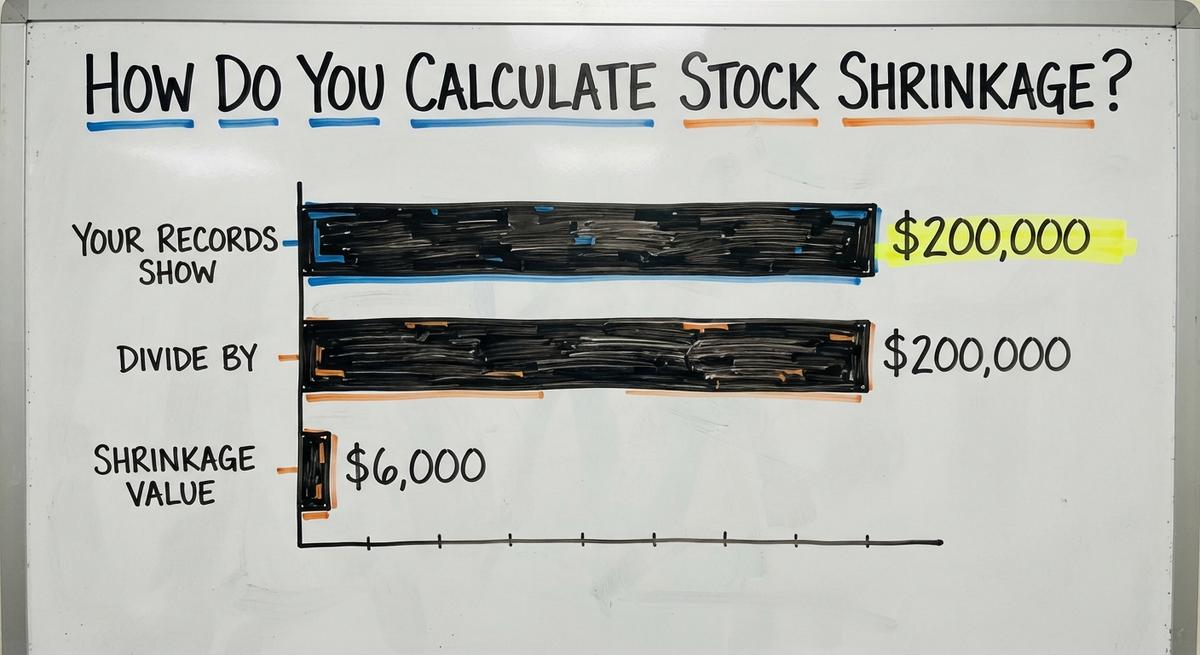
You calculate stock shrinkage by subtracting the counted value of your stock from the recorded value. Then divide that gap by the recorded value. The answer is your shrinkage as a percentage.
Two steps, in words:
- Take the value your records show and subtract the value you counted by hand.
- Divide the result by the recorded value and read it as a percent.
Here is a small example with round numbers. Your records show $200,000 of stock. A physical inventory count (a full hand count of every item) finds $194,000. The dollar loss is $6,000. Divide $6,000 by $200,000 and you get 3%.
The same math works by item, by bin or by supplier. Run it on each slice and the weak spots show.
The formula is simple, and the value comes from running it on small slices.
What Causes Stock Shrinkage in a Warehouse?
Stock shrinkage has 4 main causes: errors, damage, theft and supplier problems. In small and mid-size operations, errors cause more loss than theft. A wrong number costs you as much as a stolen box.
Causes also mix. A short delivery gets keyed in wrong, then picked twice. By the time you count, nobody can tell which step failed. Each cause below has its own fix.
Treat theft as the last suspect, not the first.
Receiving and Counting Errors
Receiving errors are mistakes made when stock first comes through the door. They start the loss before the goods reach a shelf. Three habits cause most of them:
- Staff sign for a short shipment without counting the boxes.
- Someone enters the wrong item code or unit of measure, such as cases for each.
- Paper packing slips get keyed in hours or days later.
A case of 12 entered as 12 cases is a big gap. The book count jumps while the shelf stays the same.
Every receiving error is a loss that was booked before it happened.
Picking, Packing and Shipping Mistakes
Picking mistakes are errors made when staff pull stock for an order. They hide well, because the product did ship. The record just does not match. Watch for these:
- A picker grabs the wrong item or the wrong quantity.
- A customer changes an order by phone or email, and nobody updates the record.
- Staff move stock between bins and write nothing down.
Each one leaves one location too high and another too low. The total may look fine until a count reveals it.
Unlogged moves turn good stock into missing stock on paper.
Damage, Spoilage and Expiry
Damage is stock you still own that no one can sell. Forklift hits, crushed boxes and wet pallets all count. Dated goods such as food, chemicals and adhesives expire on a set day.
The real loss comes when staff toss the item and never write it off. The record still shows it on the shelf. Inventory accuracy (how closely the record matches the shelf) drops with each unlogged toss.
A written-off item is a known cost. An unlogged one is a mystery.
Is Stock Shrinkage the Same as Theft?
No. Stock shrinkage is the total gap, and theft is only one possible cause. Counting errors, damage and supplier short shipments often outweigh it.
Theft still happens. Staff or outsiders can take stock. A vendor can ship 90 units and bill for 100. Open access to stock areas makes any of this harder to trace.
Assume no one is at fault until the records say otherwise. Good records protect honest staff and show a real problem fast.
Call it shrinkage first and a cause only after the trail proves it.
Not sure this is the right shape for your operation
Describe how the work runs today. We map it on a call and show you what it would look like built around that, before you spend anything.
Book a call
How Spreadsheets and Paper Records Hide Shrinkage
Nobody can tell who changed a count or when. A cell gets overtyped and the old value is gone. You find the gap at count time, with no trail to follow.
Spreadsheets and paper records hide shrinkage by keeping several copies of the truth. One number sits in an accounting package. Another sits in a spreadsheet. A third lives in a desktop database, and a fourth on a printed sheet.
These copies drift apart. Someone re-keys a count and drops a digit. Someone updates one file and skips the others. Each hand-off adds a gap.
When 4 files hold 4 answers, nobody can say which one is wrong.
How to Find Where Your Shrinkage Is Happening
Finding shrinkage means comparing counts across areas, products and shifts until a pattern shows. A gap that clusters in one aisle or one shift points to a process, not bad luck.
Use this order:
- Start with the highest-value items and the fastest movers.
- Compare variances by area, product and shift.
- Trace each variance back to a receipt, a pick or an adjustment.
Inventory adjustments are changes to a count made outside a normal receipt or sale. Review each one. A few big adjustments often explain most of the loss.
The NIST Manufacturing Extension Partnership offers neutral guidance on supply chain and inventory process.
Every variance has a paper trail, and your job is to follow it.
How Cycle Counting Reduces Stock Shrinkage
Cycle counting is a method of counting a small slice of stock every day or week instead of everything once a year. It cuts stock shrinkage because errors surface while the trail is still fresh.
A yearly count finds a gap that is 11 months old. A weekly slice finds one that is 3 days old. Staff can still recall the receipt or the pick.
Count high-value items more often. Count slow, cheap items less. A common rhythm is weekly for top items and monthly or quarterly for the rest.
Two staff spending 8 hours at $22 an hour spend $352 on one full count. Small daily counts spread that cost and catch more.
Frequent small counts beat one big count every time.
Tighten Receiving to Stop Losses at the Door
Tight receiving stops loss at the door, where it is cheapest to fix. Stock that enters the record wrong stays wrong until the next count.
Use these habits:
- Count every delivery and check it against the buy order.
- Note damage on the spot and take a photo before the driver leaves.
- Enter received stock the same day, not later in the week.
- Report short shipments to the supplier at once, with the count in hand.
Same-day entry matters most. Stock that sits on the dock but not in the system cannot be sold. It also cannot be found when someone goes looking.
Receiving errors cost the least to fix at the dock and the most once stock is on the shelf.

Control Who Can Move and Adjust Stock
Control over stock moves means every change has a name and a reason attached. Without that, a gap has no owner and no story.
Set these rules:
- Limit access to storage areas where practical.
- Need a reason code for every adjustment, such as damage, count fix or return.
- Split duties so the person who counts is not the person who adjusts records.
Reason codes also tell the books what happened. Write-offs for damage and expiry belong in the accounting records as a cost. Ask your accountant how to book them.
When two people touch every adjustment, errors and fraud both get harder to hide.
The comparison is easier when one option is built for you
Off-the-shelf means fitting your process to the software. We do it the other way round, and the first look costs nothing.
Book a callWhy Do Bin Locations Cut Stock Shrinkage?
Bin locations cut stock shrinkage because each item has one named home, so nothing gets lost in plain sight. Misplaced stock looks like missing stock on a count sheet. A labeled bin removes that false loss.
This works at small scale. Shelf labels and a simple code, such as aisle, rack and shelf, are enough. Assign each item one primary spot. Post the code where staff can see it.
Then a picker knows where to go and a counter knows where to look.
A labeled shelf turns a lost item into a found one.
What Is a Normal Stock Shrinkage Rate?
Be careful with numbers you find online. Many have no named source. Your own history is a better guide.
A normal shrinkage rate depends on the industry and the product. Fragile, perishable and small high-value goods lose more than bulk steel or paper. No single figure fits every warehouse.
Track your shrinkage rate (the loss as a percent of recorded value) after every count. For context on the size of the stock involved, the Census Bureau's wholesale trade data tracks wholesale inventories and sales.
A falling trend matters more than any single figure.
When Software Helps Control Stock Shrinkage
Software helps when manual tracking has run out of road. Three signs show it:
- The same errors repeat after you fix them.
- A physical inventory count takes days and shuts down shipping.
- Staff argue over which number is right.
The pay for stock clerks and order fillers is public at the Bureau of Labor Statistics. At an assumed $22 an hour, 3 people spending 6 hours a week on re-keying and fixing counts cost $20,592 a year.
Look for these features:
- One shared record of stock for the whole team.
- An audit trail that shows who changed what and when.
- Scan-based entry that replaces typing.
Some tools connect to your accounting software instead of replacing it. A full ERP (a large system that runs the whole company) is not the only path.
Ask any provider:
- How does your tool fit the way we already work?
- Can we start with receiving and counts only?
- What happens to our current data?
Pick the lightest tool that gives you one record and a trail.
A Simple Plan to Start Reducing Stock Shrinkage
A four-step plan is enough to start cutting stock shrinkage this quarter. Follow the order.
- Measure the gap. Run one physical inventory count and work out the percent.
- Find the top 3 causes. Trace the biggest variances to a receipt, pick or adjustment.
- Fix receiving and adjustments first. Count at the dock and add reason codes.
- Review the trend monthly. Compare each count with the last one.
Most small teams can finish step 1 in a week. The rest builds from there.
Start with step 1 this week, and let the numbers pick your next move.

Frequently asked questions
What is the difference between shrink and inventory shrinkage?
Nothing. Shrink is slang for inventory shrinkage. Both mean the value of stock your records list but you cannot find, sell or prove you still own.
Can stock shrinkage be a positive number?
Yes, in a way. A count can come in above the record, which shows an entry error or unlogged receipt. Treat that gap like any other and trace it.
How often should you count inventory to catch shrinkage?
Count top-value and fast items weekly. Count slower items monthly or quarterly. Small, steady counts find errors sooner than one count a year.
How should shrinkage be recorded in the books?
Record it as an inventory adjustment with a reason code. Your accountant picks the expense account. Keep the count sheet as proof for each entry.
How can a small distributor reduce stock shrinkage?
Fix receiving first, then label bins and need reason codes. Add weekly counts of top items. These steps cost little and remove the most loss.
Is stock shrinkage the same as theft?
No. Theft is one cause among several. Counting mistakes, damage, expiry and supplier short shipments often cause more of the gap in small warehouses.
When is it time to move off spreadsheets and paper?
Move when the same errors repeat, counts take days, or staff dispute the numbers. Those signs show that files and sheets no longer match each other.
Start with a free first look
A 30 minute call, your operation mapped, and a clear picture of what we would build. No obligation and nothing to install.
Book a callRelated guides
More on the same work.
Guides
- Inventory Shrinkage is Recorded When
- Shrinkage in Inventory
- Shrinkage Formula in Retail
- Inventory Shrinkage Accounting Entry
- Calculate Inventory Shrinkage
- Apics Safety Stock Formula
- Dead Stock
- Stock Turnover Ratio Formula
- Replenish Stock
- Retail Stock Management Software
- Medical Stock Management System
- Stock and Inventory Simple
- Stock Software
Common questions
- How to Record Inventory Shrinkage
- What Common Events Could Result in Inventory Shrinkage
- How is Shrinkage Calculated
- How to Calculate Safety Stock in Excel
- Reorder Point vs Safety Stock
- What is Free Stock in Inventory Management
- What is Stock Out Cost in Inventory Management
- How to Manage Stock Effectively
- Stock Inventory Definition
- How to Resolve Stock Discrepancy?
- What is Fluctuation Stock in Inventory Management