


What is Free Stock in Inventory Management
Free stock is inventory you own that no order has claimed. Learn the free stock formula, why it drifts, and how to keep the number right.
Book a callWhat Is Free Stock in Inventory Management?
Free stock is inventory you own that no order has claimed. You can still sell it or use it. Teams also call it available stock or available-to-promise stock. Here is a plain example. You have 500 units on the shelf. Customers have been promised 200 of them. Your free stock is 300. That 300 is the number a sales rep can safely offer to the next buyer. Free stock in inventory management is the number that answers one question: what can I still promise today?
We build it for your operation, and the first look is free
If you would rather not compare products, describe how your operation already works and we build the system around it.
Reviewed November 2026.
No build cost. You see it running on your own process first, and the monthly subscription starts only once it is live.
Book a callShould Free Stock Include Incoming Stock or Safety Stock?
Some teams leave out incoming stock and count only the shelf. Both rules work. Pick one and write it down.
You can also subtract safety stock. Safety stock is a buffer you keep back for surprises. If you hold 50 cases as a buffer, free stock drops to 200.
Scan-based counts depend on shared labels. GS1 describes its work as the GS1 barcode standards, which give every product an identity that scanners read the same way everywhere.
One written formula gives every person the same answer.

Free Stock vs. On-Hand Stock: What Is the Difference?
Free stock is what is left after promises are subtracted, while stock on hand is everything physically in the building. The two numbers match only when no order is waiting.
They drift apart when orders are picked but not yet shipped. The boxes still sit on the dock. On-hand stock counts them. Free stock does not, because a customer already owns that claim.
| Measure | What it counts |
|---|---|
| Stock on hand | Every unit in the building |
| Allocated stock | Units tied to a customer order |
| Free stock | On hand, minus allocated units |
You will hear related words. Allocated, committed and reserved stock all mean units that are spoken for. Some teams use them in slightly different ways. Choose one word for each state and use it everywhere.
The gap between the two numbers is exactly the amount you have already promised.
Not sure this is the right shape for your operation
Describe how the work runs today. We map it on a call and show you what it would look like built around that, before you spend anything.
Book a call
How Does Free Stock Help Ship Dates and Small Operations?
Ship dates get firmer too. You can tell a buyer a date with more confidence when you know what is truly free.
Small operations feel this most. One person often just knows the numbers. That works until they take a day off.
A shared free stock number turns one person's memory into something the whole team can use.

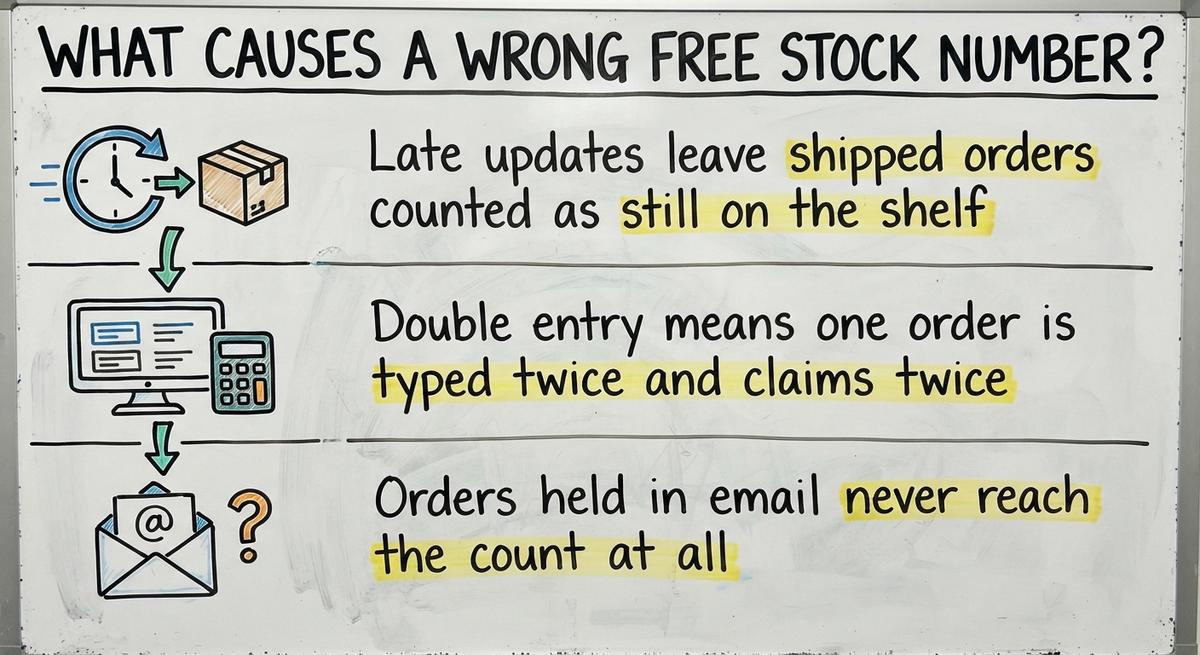
What Causes a Wrong Free Stock Number?
Three causes show up again and again:
- Late updates leave shipped orders counted as still on the shelf.
- Double entry means one order is typed twice and claims twice the units.
- Orders held in email never reach the count at all.
Most bad counts start with a delay in one small step.
Does the IRS Expect You to Track Inventory?
The IRS also expects you to count stock. IRS Publication 538 says: "To figure taxable income, you must value your inventory at the beginning and end of each tax year." Good inventory tracking serves your tax duty and your sales floor.
Pieces kept in five places will never add up to one number.
The comparison is easier when one option is built for you
Off-the-shelf means fitting your process to the software. We do it the other way round, and the first look costs nothing.
Book a call
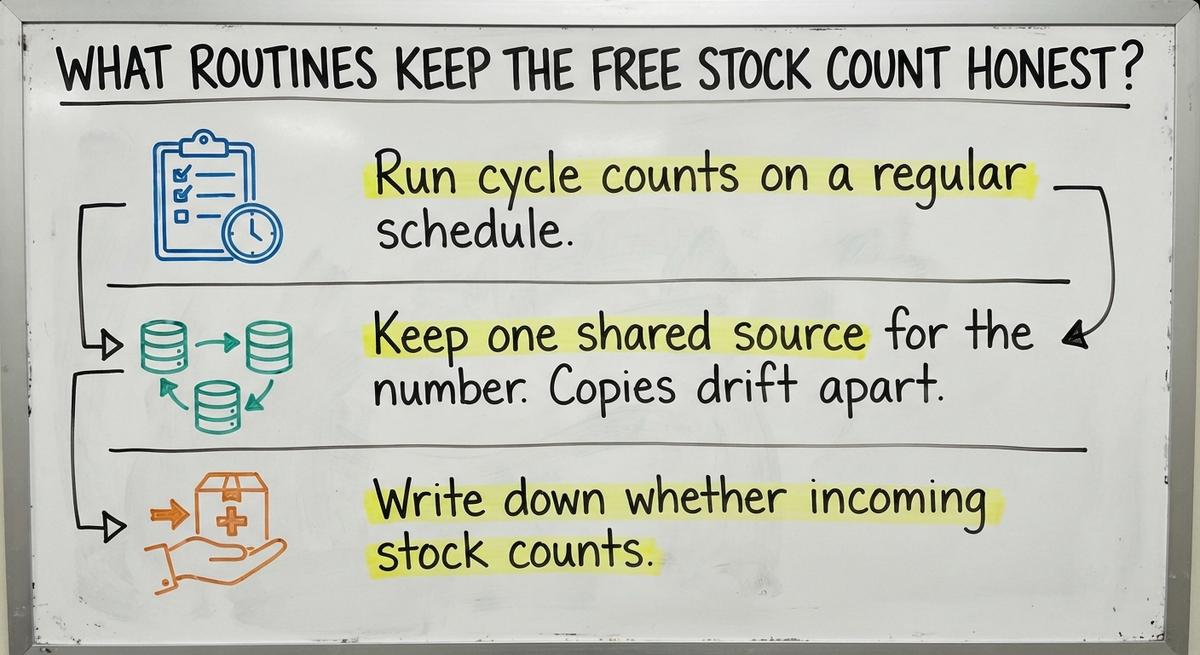
What Routines Keep the Free Stock Count Honest?
- Run cycle counts on a regular schedule. A cycle count checks a small part of the shelves each day instead of the whole building at once.
- Keep one shared source for the number. Copies drift apart.
- Write down whether incoming stock counts, and make everyone follow that rule.
Some teams call a full count stock taking. The habits above make that count a check rather than a rescue.
A number that has one owner, one rule and one place to live stays right.
Who Can Build a Free Stock Tool Around Your Operation?
That is the work The Software Society does. Our Custom Workflow Rollout replaces fragmented manual work with a system that matches real operations. If your team is outgrowing its sheets, book a review of your current process and we will map where your free stock number goes stale.
Software earns its place when it removes the handoffs that break your count.
What Do You Mean by Stock Inventory?
Stock inventory means the goods a business holds to sell or use. It covers raw parts, work in progress and finished products. Raw parts are the pieces a business holds before they are used. Work in progress is made up of goods that are not yet finished. Finished products are the goods that are ready to sell. Free stock is the slice of that total that no order has claimed.
Frequently asked questions
What do you mean by stock inventory?
Stock inventory means the goods a business holds to sell or use. It covers raw parts, work in progress and finished products. Free stock is the part of that total that no order has claimed.
Is free stock the same as available stock?
Yes, free stock is the same as available stock. Many teams also say available-to-promise. All three terms mean units you own that no order has claimed.
Can free stock be negative?
Yes, free stock can go negative. It happens when promised units exceed what you hold and have on order. A negative number is a warning that you oversold.
Does free stock include incoming buy orders?
It depends on your written rule. The full formula adds stock on order from suppliers. Some teams count only the shelf. Pick one rule and apply it everywhere.
Does free stock include safety stock?
Only if you choose to leave it in. Many businesses subtract safety stock so the buffer stays protected. Write down which way you count it.
How often should free stock update?
Free stock should update each time an order is entered, shipped or received. Daily updates are the minimum for a busy wholesale shop. Live updates are better.
Start with a free first look
A 30 minute call, your operation mapped, and a clear picture of what we would build. No obligation and nothing to install.
Book a callRelated guides
More on the same work.
Guides
- Free Inventory Management Software for Small Business
- Simple Inventory Management Software Free
- Warehouse Stock Management Software
- Cloud Stock Management Software
- Warehouse Stock Management System
- Small Business Stock Management Software
- Hospital Stock Management System
- Retail Stock Management Software
- Medical Stock Management System
- Cost of Inventory Management Software
- Inventory Management Software Freeware
- Price of Inventory Management Software
- Inventory Stock Software
- Stock and Inventory Simple
Common questions
- What is the Best Free Inventory Management Software to Download?
- What is Stock Out Cost in Inventory Management
- What is the Best Free Software for Warehouse Inventory Management?
- What is Holding Cost in Inventory Management
- What is Ordering Cost in Inventory Management
- What is Stock Taking in Inventory Management
- What is Fluctuation Stock in Inventory Management
- How to Manage Stock Effectively
- How Much Does Inventory Management Software Cost
- Stock Inventory Definition