

Replenish Stock
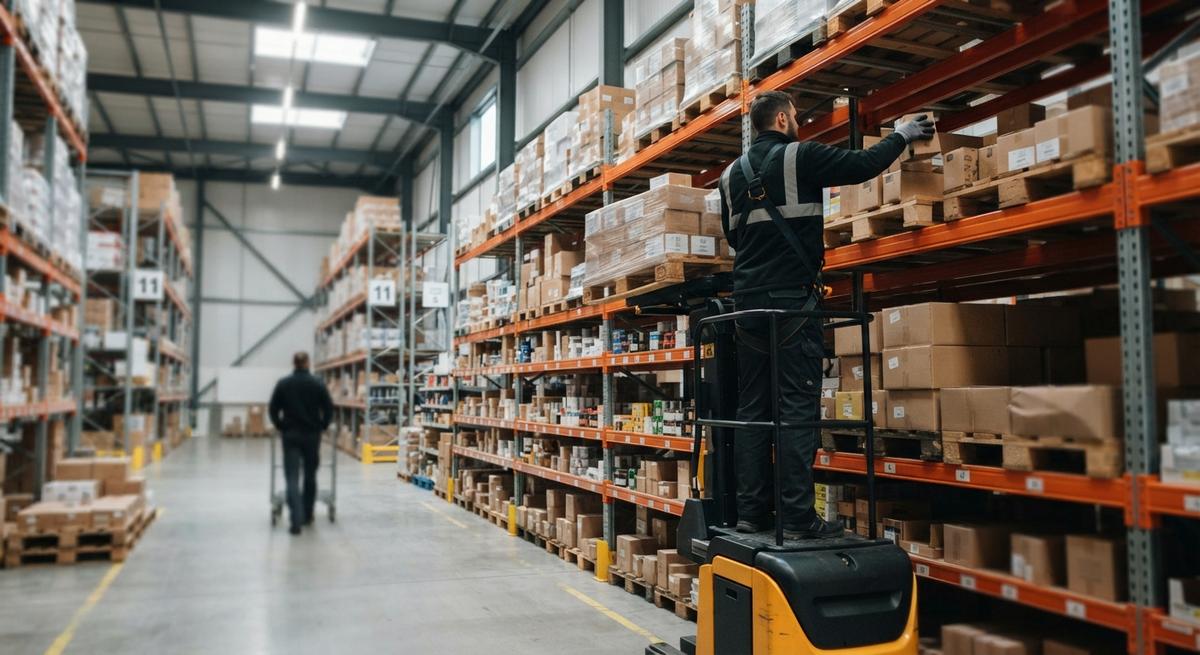
To replenish stock is to order or move goods so shelves and bins never run empty. Owners do it by buying from suppliers or by refilling pick bins from bulk storage. The goal is the right item, in the right amount, at the right time.
Book a callWhat Does It Mean to Replenish Stock?
To replenish stock means to refill what you sold before the shelf is empty. Stock replenishment is a loop. You sell, you count, you refill.
Reviewed November 2026.
Two Kinds of Stock Replenishment
There are 2 kinds of stock replenishment. Each one has its own trigger and its own owner.
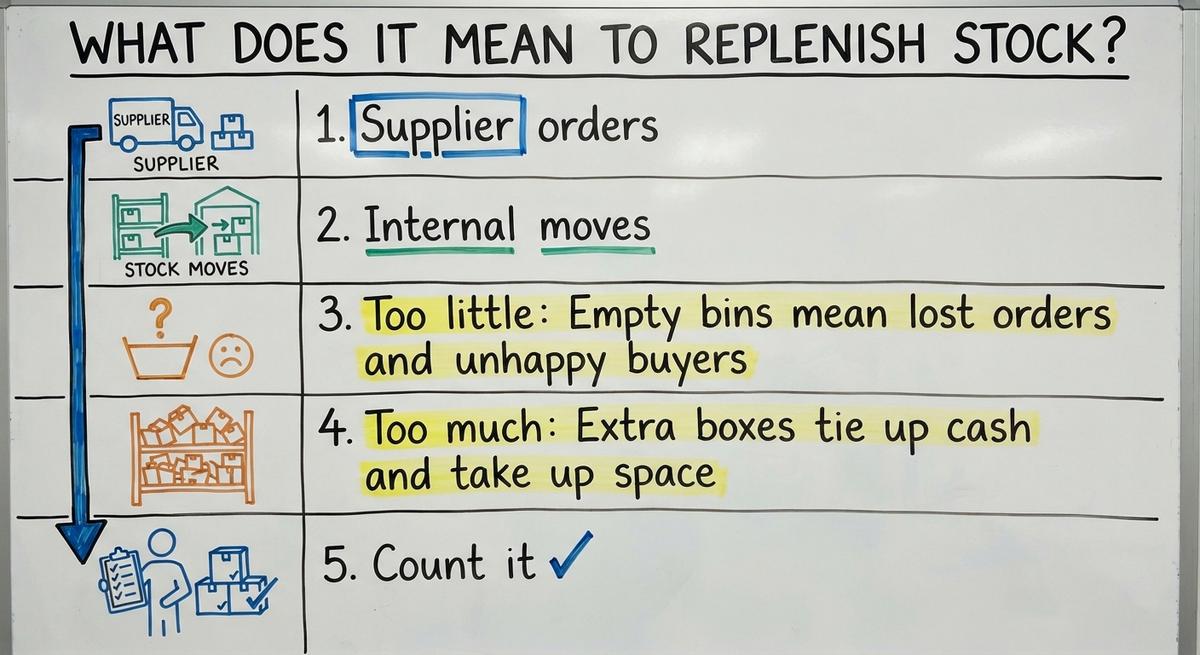
- Supplier orders: You buy more goods from a vendor with a buy order, which is a written request to buy.
- Internal moves: You carry goods from bulk storage to a pick location, which is the bin where staff grab items for orders.
Both kinds keep inventory levels steady, so plan each one on its own.
Why Replenishing Stock on Time Matters
A stockout is a day when you have none of an item to sell. Each one costs a sale and may cost a customer.
- Too little: Empty bins mean lost orders and unhappy buyers.
- Too much: Extra boxes tie up cash and take up space.
- Count it: IRS Publication 538 says "you must value your inventory at the beginning and end of each tax year."
Good replenishment keeps both problems small, and it keeps your books clean.
We build it for your operation, and the first look is free
If you would rather not compare products, describe how your operation already works and we build the system around it.
No build cost. You see it running on your own process first, and the monthly subscription starts only once it is live.
Book a callAre You Failing to Replenish Stock Well?
Yes, you are failing if 2 or more of these signs sound familiar. Check each one against last month.
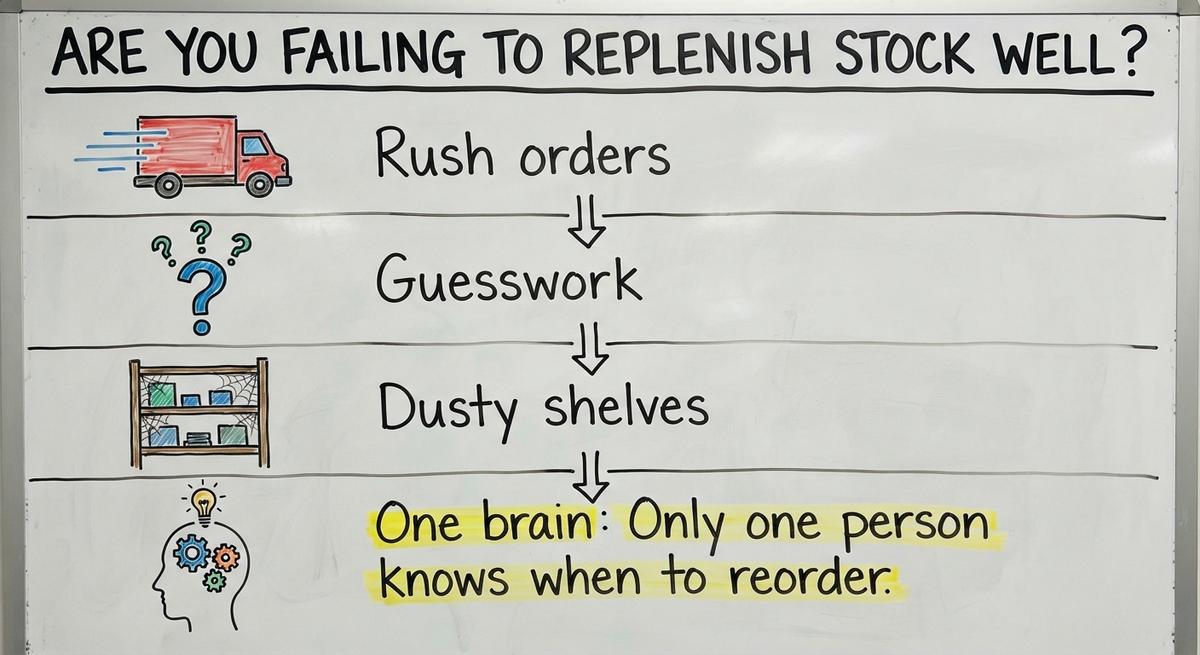
- Rush orders: You pay for fast shipping again and again to fix gaps.
- Guesswork: Staff say "I thought we had that" when a customer asks.
- Dusty shelves: Slow items sit for months while fast sellers run out.
- One brain: Only one person knows when to reorder.
One sign is a warning, and 2 signs mean your process needs rules.
How Do You Know When to Replenish Stock?
There are 3 ways to time a refill: a fixed schedule, a reorder point, or demand-based ordering. A fixed schedule means you order every Monday. Demand-based means you order from forecast sales. Pick the method for each item. One rule for all items fails.
Set a Reorder Point for Each Item
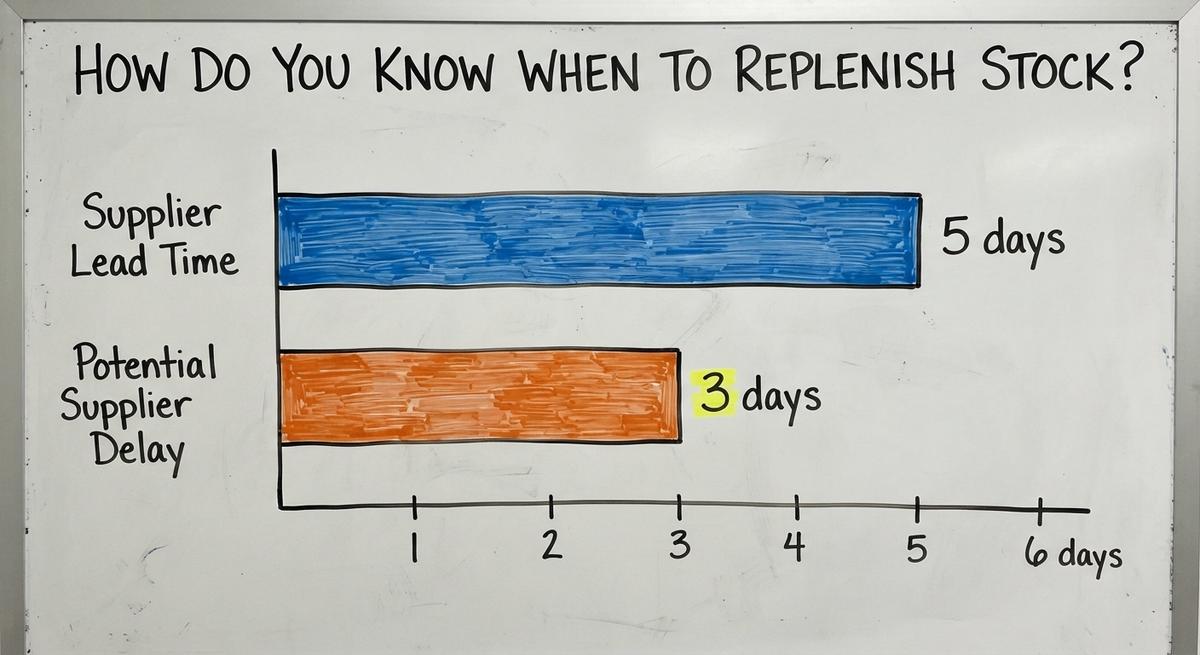
A reorder point is the on-hand count that tells you to order. The formula is daily sales times supplier lead time, plus safety stock. Lead time is the days from order to delivery.
Here is a small example:
- You sell 10 units a day.
- The supplier takes 5 days.
- Safety stock is 20 units.
- Reorder point: 10 x 5 + 20 = 70 units.
When on-hand stock drops to 70, you order.
Work Out How Much Safety Stock to Keep
Safety stock is extra inventory you hold for late trucks and sales spikes. Look at your worst recent delay and your busiest week. If a supplier once ran 3 days late and you sell 10 a day, you need 30 units of buffer.
- Key items: Hold more, since a stockout hurts most.
- Slow items: Hold little, as cash sits idle.
Set the buffer from your own worst case, not from a guess.
Decide How Much to Order Each Time
Order size is a balance of 3 costs: the cost to place an order, the cost to store goods, and the supplier minimum. Economic order quantity is the order size where those first 2 costs meet. Small, frequent orders cut storage cost. Big orders cut order cost.
Watch for price breaks and for case or pallet sizes. A 5% discount means little if the extra boxes sit for a year.
Sort Items With ABC Analysis and Real Sales Data
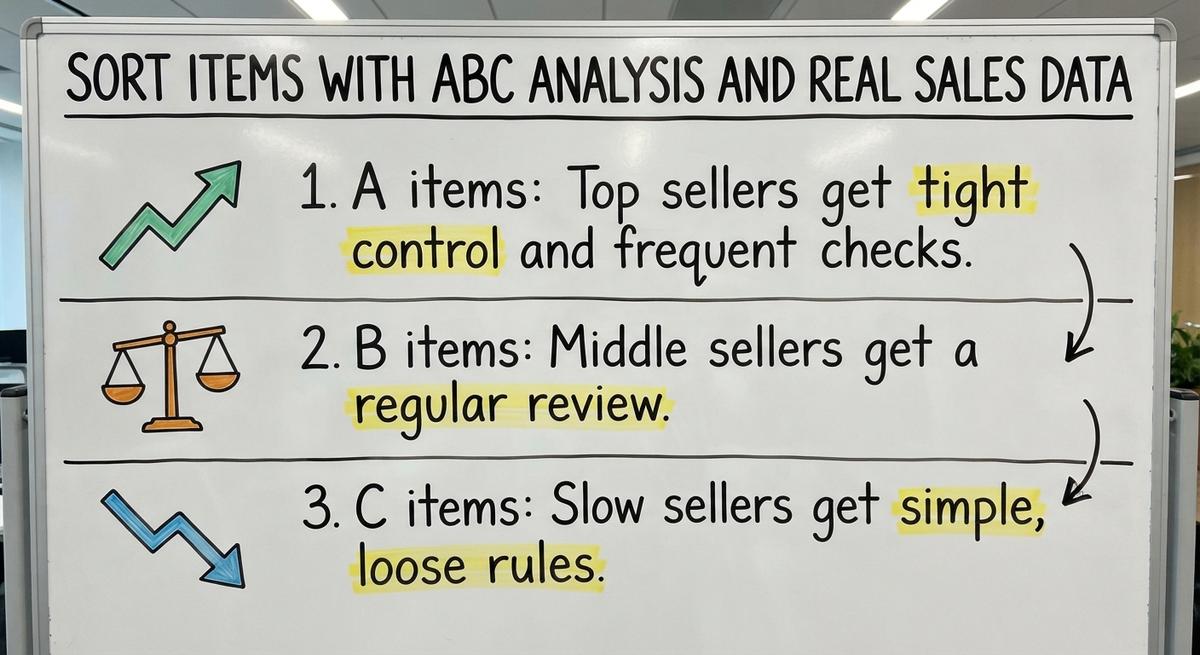
ABC analysis is a way to rank items by how much money they bring in. It saves time for small teams. Spend your effort where it pays.
- A items: Top sellers get tight control and frequent checks.
- B items: Middle sellers get a regular review.
- C items: Slow sellers get simple, loose rules.
Sort once a quarter, and your best hours go to your best items.
What Sales Data Should You Use to Replenish Stock?
Use sales history by item, pulled from your accounting system or sheets. Aim for 12 months if you have them. Look for seasonal swings and for one-time big orders.
Clean out odd spikes before you trust an average. One 500-unit order in a month of 50-unit sales will fool any formula.
Real data beats memory, so pull the numbers first.
Not sure this is the right shape for your operation
Describe how the work runs today. We map it on a call and show you what it would look like built around that, before you spend anything.
Book a call
Replenish Stock From Suppliers and Bulk Storage
Supplier orders and bin refills use the same logic with different steps. Learn both. Each one has its own checklist.
Supplier Orders Step by Step
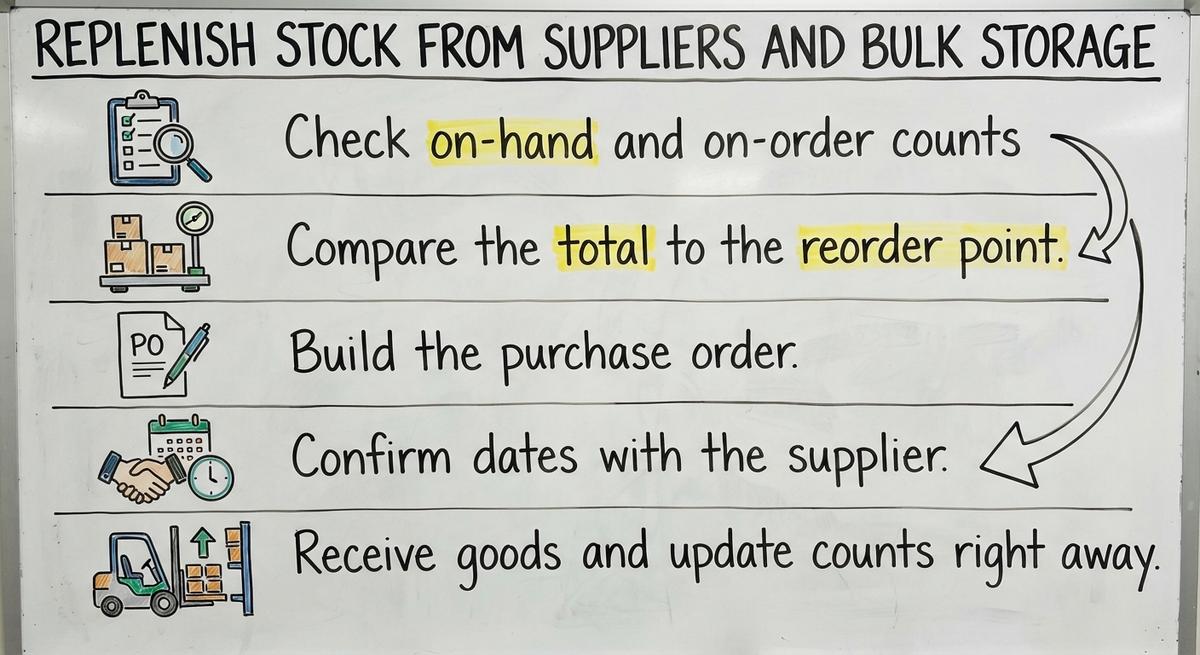
A supplier order is a 5-step loop. Run it for each item that hits its reorder point.
- Check on-hand and on-order counts.
- Compare the total to the reorder point.
- Build the buy order.
- Confirm dates with the supplier.
- Receive goods and update counts right away.
Skip step 1 and you will double-order, so count open orders every time.
Refilling Pick Locations From Bulk Storage
A pick location is a bin that is cheap to reach. Refill it before it hits zero. Set a min and a max for each bin. If a bin holds 48 units and sells 12 a day, refill at 12.
Move goods in slow hours, such as early morning. Pickers then never wait on a refill.
A bin that never empties is a bin that never slows an order.
The comparison is easier when one option is built for you
Off-the-shelf means fitting your process to the software. We do it the other way round, and the first look costs nothing.
Book a callPlan for Late Shipments, Peak Seasons and Accurate Counts
Lead time, demand and counts all shift over the year. Each shift breaks a fixed rule. Review all 3 on a set date.
Handle Lead Time Changes
Track actual versus promised delivery dates for each supplier. If a supplier slips from 5 days to 8, raise the reorder point. Redo the math with 8.
Keep a backup supplier for key items. A second source costs little to set up.
A late supplier needs a new reorder point the same week.
Plan for Seasonal and Promotional Demand
Seasonal demand is a sales rise that repeats each year. Look at last year's peaks by item. Order earlier from slow suppliers. Ask customers about big orders coming up.
If an item doubled in November last year, plan for double again. Place that order in September.
Last year's sales are your best guide to next year's peak.
Keep Your Counts Accurate
A cycle count is a small count of a few items each day instead of one big yearly count. Replenishment is only as good as the numbers behind it. Count A items often.
- Receipts: Log them the day they arrive.
- Returns: Log them the same day.
- Damage: Write it off at once.
A wrong count leads to a wrong order, so fix counts first.



What Are the Common Mistakes When You Replenish Stock?
The 4 most common mistakes are rules that never change. Each is easy to fix.
- One rule for all: A fast seller and a dusty item need different rules.
- Open orders ignored: You order again for goods already on the way.
- Stale reorder points: Nobody updates them after sales change.
- Scattered notes: Memory and loose sheets hide the real count.
Fix the one that hurts most this week.

See it running on your own process first
No build cost. The subscription starts once it is live and doing the job, not before.
Book a call
Tools and Numbers That Keep Replenishment on Track
Tools matter less than rules. Add a tool only when a manual step keeps failing. The NIST Manufacturing Extension Partnership offers vendor-neutral guidance on supply chain and inventory process.
When Spreadsheets and Paper Stop Working
Sheets fail in 3 ways: version conflicts, copy-paste errors, and one person who knows the file. A clerk who spends 3 hours a week fixing a sheet at $20 an hour costs $3,120 a year. The US Bureau of Labor Statistics lists pay for inventory clerks if you want your own local figure.
Keep your accounting software where it works. Automate only the repeat manual steps. Pick tools that fit your process, not a big switch.
Which Numbers to Track for Replenishment
Track 4 numbers each month. The US Census Bureau publishes wholesale inventories and sales, so you can compare your own ratio.
- Stockout rate: The share of orders you could not fill from stock.
- Inventory turnover: How many times a year you sell through your stock.
- Days of stock on hand: How long current stock lasts at today's sales.
- Fill rate: The share of ordered units you ship on time.
Review them monthly and act on any big change.

A Simple Weekly Replenishment Routine
A weekly routine is a 3-step checklist that anyone on your team can follow. Keep it short. Print it.
- Monday: Review the low-stock list and flag items near their reorder point.
- Wednesday: Place orders and confirm dates with each supplier.
- Friday: Check receipts, update counts and log any damage.
Start this week. Pick your 10 fastest sellers, set a reorder point for each, and run the routine for 4 weeks.

Frequently asked questions
Is stock replenishment a skill?
Yes, it is a learnable skill. It takes basic math, clean counts and steady habits. A new hire can learn the reorder point formula and a weekly routine in a few days.
How often should you replenish stock?
Fast sellers need a check every day or week. Slow items need one every month. Let the reorder point decide, not the calendar, when sales swing from week to week.
What is the difference between replenishing from suppliers and replenishing pick bins?
Supplier orders bring new goods into the building and take days. Bin refills move goods you already own from bulk racks to the pick area and take minutes.
How do you avoid running out of fast-selling items?
Give fast sellers the highest safety stock and the tightest checks. Count them often. Raise the reorder point as soon as sales climb or a supplier slows down.
How do you avoid overstocking slow items?
Set a low max level and order small batches. Review slow items each quarter. Stop buying any item that has not sold in 6 months until the shelf clears.
Can a small warehouse replenish stock without a big ERP system?
Yes. A sheet, accounting software and a printed weekly checklist are enough for many small teams. Add a tool later only if a manual step keeps failing.
How much safety stock do you need?
Enough to cover your worst recent delay and your busiest week. If a supplier ran 3 days late and you sell 10 a day, hold about 30 units.
Start with a free first look
A 30 minute call, your operation mapped, and a clear picture of what we would build. No obligation and nothing to install.
Book a callRelated guides
More on the same work.
Guides
- Warehouse Stock Management Software
- Warehouse Stock Software
- Cloud Stock Management Software
- Warehouse Stock Management System
- Small Business Stock Management Software
- Hospital Stock Management System
- Make to Stock Examples
- Types of Stock Control Systems
- Stock Software
- Low Stock Alert
- Procedure for Stock Control
Common questions
- How to Calculate Safety Stock in Excel
- Reorder Point vs Safety Stock
- How to Stock Control
- How to Calculate Cycle Stock
- What is Stock Taking in Inventory Management
- How to Maintain Stock Levels
- What is Fluctuation Stock in Inventory Management
- How to Prevent Stock Discrepancies
- Why is Stock Rotation Important in Relation to Food Safety
- Stock Inventory Definition
- What is Free Stock in Inventory Management
- Why is Safety Shot Stock Dropping
- How to Resolve Stock Discrepancy?