


Shrinkage Formula in Retail
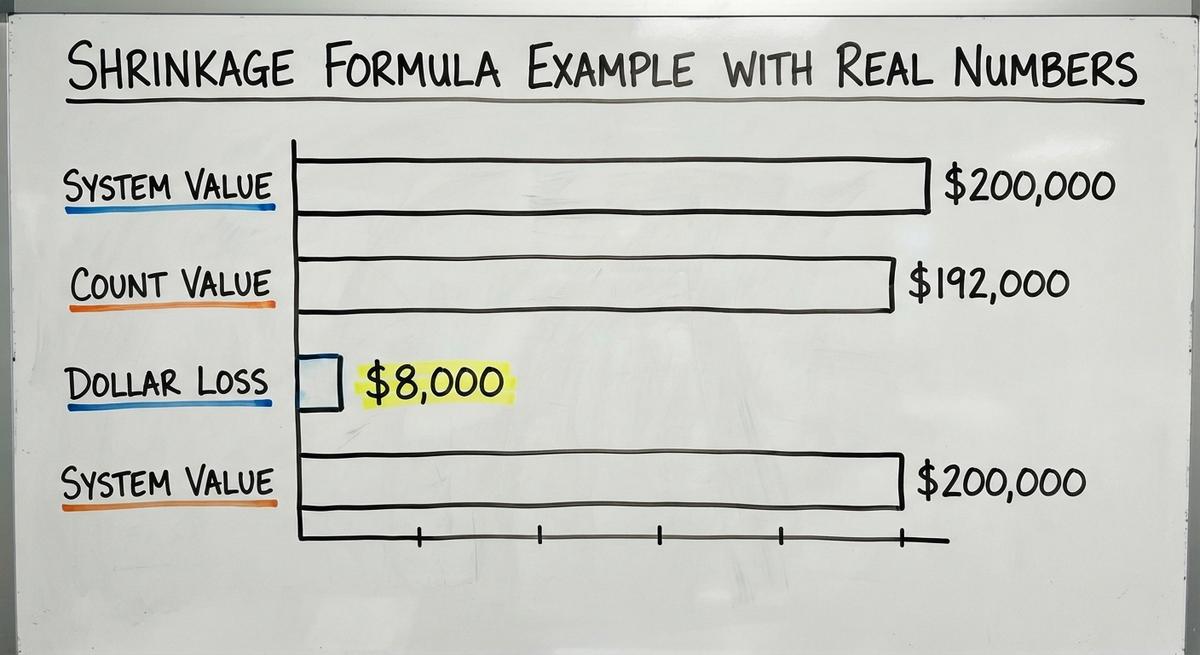
The shrinkage formula in retail is book inventory minus actual inventory. The result is the value of stock you lost. Divide that loss by book inventory to get a shrink rate. A store with $200,000 in its system and $192,000 on its shelves has lost $8,000, or 4%.
Reviewed November 2026.
Every step uses plain math you can check with a calculator.
Book a call
What Is the Shrinkage Formula and What Does Shrinkage Mean?
Inventory shrinkage is stock you paid for but can no longer sell or find. It is the gap between your records and the real count. Stores, wholesale distributors, and warehouses all face it.
The US Census Bureau tracks national stock levels in its Monthly Retail Trade report. The report describes retail inventories and sales. Your own gap is smaller, but the same math applies.
The formula has two parts, a dollar loss and a percent. The next sections show both.
Shrinkage is the gap between recorded stock and counted stock, shown in dollars and as a percent.
How Does the Basic Shrinkage Formula Work?
The basic shrinkage formula is shrinkage ($) = book inventory value minus actual inventory value. Each term has one job.
- Book inventory: the dollar value your system says you should hold right now, based on buys, sales, and returns.
- Actual inventory: the dollar value of goods your team counted by hand during a physical inventory count at one set time.
The formula needs a real count and a clean record to compare it with. A bad count or a messy record gives a wrong answer.
A negative result means you hold more stock than the records show. That points to a missed receipt or a counting slip.
Two trustworthy inputs matter more than the subtraction itself.
We build it for your operation, and the first look is free
If you would rather not compare products, describe how your operation already works and we build the system around it.
No build cost. You see it running on your own process first, and the monthly subscription starts only once it is live.
Book a callHow to Calculate Shrinkage Rate as a Percent
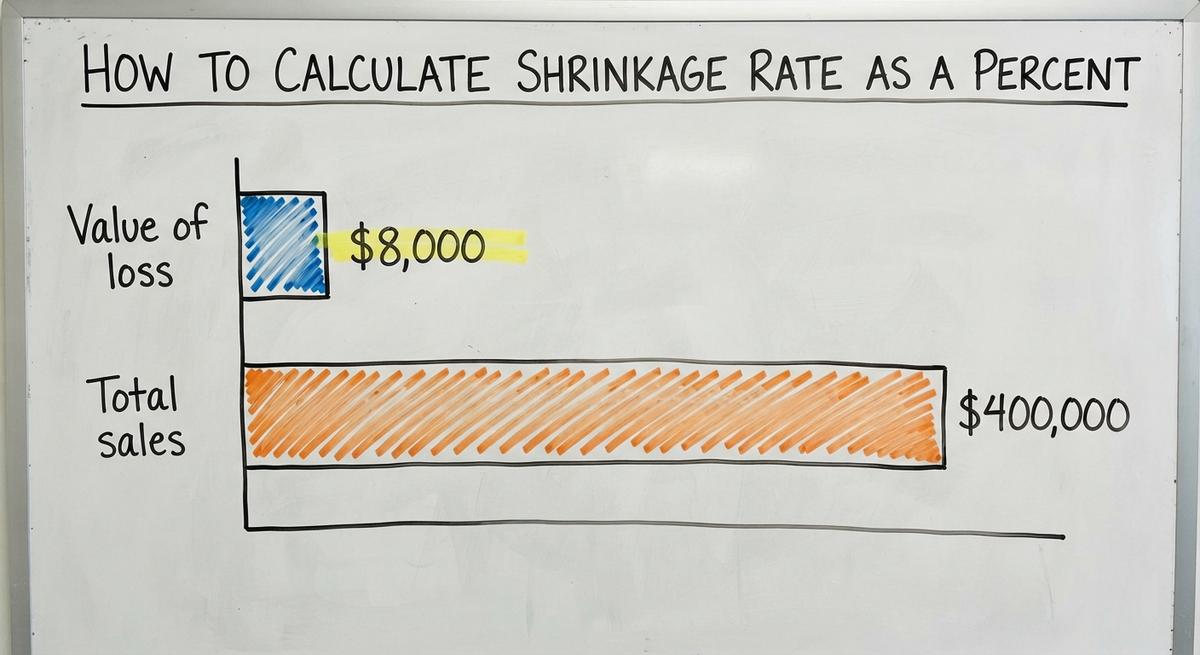
The shrink rate is the loss shown as a share of stock. Use this: shrink rate % = (recorded value minus counted value) divided by recorded value, times 100.
Some firms divide by sales instead. That version shows loss as a share of sales. Both are valid.
Say the same $8,000 loss came on $400,000 in sales. The rate on sales is 2%. The rate on stock is 4%. Same loss, two views.
Pick one method and keep it. Month-to-month comparison then holds up. Switching methods makes the trend meaningless.
A shrink percentage only helps when the method stays fixed.
Shrinkage Formula Example With Real Numbers
The worked example below ends in a 4% shrink rate. Say your system value is $200,000. Your count comes to $192,000.
- Subtract the count from the system value: $200,000 minus $192,000 is $8,000, and that is your dollar loss for the period.
- Divide the loss by the system value: $8,000 divided by $200,000 equals 0.04 as a decimal.
- Multiply that decimal by 100 to turn it into a percent, so the shrink rate is 4%.
So you lost $8,000, or 4% of your stock. If you turn that stock once a year, that is $8,000 of cash gone.
The math is easy. The hard part is trusting the two inputs, covered next.
The subtraction takes seconds, but trust in the inputs takes work.
How to Find Your Book Inventory
Book inventory is the count your system says you should have. Build it in four steps:
- Start with the dollar value of inventory at the beginning of the period, taken from last period's closing count.
- Add the cost of every buy received during the period, matched to the buy orders and vendor invoices on file.
- Subtract the cost of everything you sold during the period, using the same cost basis as your buys.
- Subtract returns sent to vendors, and add customer returns that you put back into sellable stock.
Data kept in accounting software, spreadsheets, and paper sheets can disagree. Each can hold a different number for the same item. Pick one record as the source of truth before you start.
A book number is only as good as its entries.
How to Find Your Actual Inventory
Actual inventory comes from a full count or a cycle count. Cycle counting is a count of a small slice of stock on a set schedule, so you never count everything at once.
- Count at a set time, such as close of business on the last day of the month, so everyone uses the same cutoff.
- Freeze all stock moves during the count, with no picks and no receipts, so the numbers do not shift mid-count.
- Value the count at cost, and value the system number at cost too, so both sides use the same basis.
The IRS says in Publication 538: "you must value your inventory at the beginning and end of each tax year." A count is not just good practice. It is a tax duty.
A frozen, cost-based count gives you a number you can defend.
Not sure this is the right shape for your operation
Describe how the work runs today. We map it on a call and show you what it would look like built around that, before you spend anything.
Book a callWhat Is a Good Shrinkage Rate?
A good shrinkage rate is a low one, and zero is rare. Retail shrink is often reported near 1% to 2% of sales. Check a current industry source, such as the National Retail Federation, before you rely on that range.

The right target depends on three things:
- Product type: loose small parts vanish faster than pallets of boxed goods, so they need tighter counts and tighter storage.
- Value: high-priced items draw more theft, so they need locked storage and more frequent counts than cheap items.
- Shelf life: food and dated goods expire, so they need regular write-offs and a clear first-in, first-out rule.
Say last year's rate was 4%. A goal of 3% this year means $6,000 lost on $200,000 of stock. That is $2,000 saved.
Set your own target from your own past rates, then try to beat it each quarter.
What Causes Inventory Shrinkage?
Four big causes drive inventory shrinkage: theft, handling errors, paperwork errors, and vendor or damage issues. In a warehouse, most shrink is error, not theft. Each cause gets its own part below.
Knowing the cause tells you where to act first.
Employee and Customer Theft
Theft is stock taken by staff or by outsiders. Both count as shrink. Open access, weak sign-outs, and unlocked areas make it easy.
A locked cage and a sign-out sheet cut the chance. A receipt check at the exit and a two-person close add more layers.
Theft is real, but it is rarely the biggest cause in a distribution center.
Receiving, Picking, and Paperwork Errors
Handling errors are wrong counts at the dock, mis-picks, and missed entries. They are the top cause in most warehouses.
Handwritten sheets and retyped numbers cause drift. One small error repeats. Say a dock clerk logs 48 units when 50 came in. Each later order draws from a book number that is 2 units too low.
After 100 such slips, the gap is 200 units. At $10 a unit, that is $2,000.
Small errors, repeated daily, add up to large losses.
Vendor Errors and Damaged or Expired Goods
Vendor errors are short shipments, wrong items, and damage nobody logged. Spoiled or out-of-date stock adds to the gap when no one writes it off. The records still show it as sellable.
Check each delivery against the buy order. Log damage the day you find it.
Unrecorded loss stays in the records until a count exposes it.
How to Read Your Shrinkage Results
A shrink number is a starting point, so split it into parts. Break it down by:

- Product: shows which items lose the most dollars, so you can count those items more often than the rest.
- Location: shows which bin, aisle, or building has the biggest gap, so you can send a checker there first.
- Shift: shows if losses cluster under one crew, and that points to a training need or a access problem.
- Vendor: shows which supplier ships short most often, so you can raise the issue with a record in hand.
Look for patterns, not one-time spikes. A single bad month can be a counting slip. Three bad months in one aisle is a signal.
Say one aisle holds $3,000 of your $8,000 loss. That aisle is 37.5% of the problem. Start your fixes there.
Splitting a rate by cause turns a number into an action.
The comparison is easier when one option is built for you
Off-the-shelf means fitting your process to the software. We do it the other way round, and the first look costs nothing.
Book a callHow Often Should You Calculate Shrinkage?
Calculate shrinkage at least every quarter. Many businesses do it once a year. That hides problems for 12 months.
A 4% loss can build all year before a year-end count shows it. A quarterly check shows it in 3 months.
Monthly or quarterly checks with cycle counts catch issues sooner. Count fast movers and high-value items more often than slow, cheap ones. A weekly count of your top 20 items takes far less time than a full shutdown count.
Short, frequent counts find small gaps before they grow large.
How Can a Warehouse Reduce Shrinkage?
A warehouse reduces shrinkage by tightening every step where stock changes hands. Start with these:
- Count goods at the dock and check each delivery against the buy order before anyone signs for the shipment.
- Assign a bin location to every item, and scan or log each move from receipt to shipment.
- Limit who can adjust stock levels, and need a written reason for each change in the system.
- Run regular cycle counts on a fixed calendar so that no area goes unchecked for long.
- Write off damaged and expired goods on the day you find them so the book number stays honest.
The NIST Manufacturing Extension Partnership offers vendor-neutral guidance on supply chain and inventory process.
Control at each handoff stops small errors from growing.

Why Spreadsheets and Paper Make Shrinkage Harder to Track
Retyping between them adds errors. Say 3 people retype 40 lines a day, and 1 line in 50 is wrong. That is about 2 bad lines a day, or over 500 a year.
Several sources of truth make the book number shaky. Stock can live in an accounting package, a spreadsheet, and printed pick sheets. Each then holds a slightly different count.
This advice holds for any tool. Fewer places to enter data means fewer places to be wrong. Make one record the master and treat all others as copies.
One trusted record is worth more than three that nearly match.
Shrinkage Formula Mistakes to Avoid
Four mistakes ruin an otherwise sound shrinkage formula:
- Mixed values: comparing a cost-based book number with a retail-priced count gives a false gap that hides the real loss.
- Moving stock: counting as picks and receipts continue means the count is stale at once and cannot be trusted.
- Skipped write-offs: damaged goods left in the records look like missing stock and inflate the loss for the period.
- Changing formulas: a new method each period makes trends impossible to read and hides whether fixes work.
Here is how mixed values bite. Say stock that cost $192,000 sells for $240,000 at retail. Compare that count to a $200,000 cost-based book number and you see a false gain of $40,000.
Avoid all four and the number becomes useful.
Next Step
The next step is one clean run of the formula this month. Follow these steps:
- Freeze stock moves and take a full count at cost, using one cutoff time for every area.
- Write down the dollar loss and the shrink rate, using the same method you plan to keep.
- Split the loss by product and location to find the aisle or item that drives it.
Repeat in 3 months with the same method, and you will see if your fixes work.
One clean, repeatable run beats any guess about where stock goes.
Frequently asked questions
What does shrinkage mean in retail?
Shrinkage in retail is the loss of stock between the time you buy it and the time you sell it. Theft, error, damage, and spoilage all cause it.
Is shrinkage the same as theft?
No. Theft is one cause of shrinkage. Counting mistakes, vendor short shipments, damage, and expired goods also create the gap, and in many warehouses they cause more of it.
What is the difference between book inventory and actual inventory?
Book inventory is the amount your records say you hold. Actual inventory is the amount you find by counting. The difference between the two is your shrinkage.
Should shrinkage be measured in units or dollars?
Track both. Dollars show the cost and let you compare across products. Units show where handling goes wrong, since one cheap part can vanish in large numbers.
Is shrink a cost of goods sold item?
Yes, in most cases. Lost stock is usually folded into cost of goods sold when you adjust the books to match the count. Ask your accountant how to record it.
What is the difference between shrink and loss?
Shrink is the net gap found when you compare records with a count. Loss is a broader word for any cause of missing value, such as a known theft or a spill.
What is the shrinkage formula in retail?
The formula is book inventory minus actual inventory. Divide that result by book inventory and multiply by 100 to get a shrink rate as a percent.
Start with a free first look
A 30 minute call, your operation mapped, and a clear picture of what we would build. No obligation and nothing to install.
Book a callRelated guides
More on the same work.
Guides
- Inventory Accuracy Formula
- Stock Turnover Ratio Formula
- Inventory Shrinkage Accounting Entry
- Inventory Shrinkage is Recorded When
- Calculate Inventory Shrinkage
- Average Days to Sell Inventory Formula
- Total Cost of Inventory Formula
- Retail Inventory Management
- Retail Inventory Management Systems
- Retail Inventory System
- Inventory Management Software Retail
- Inventory Software for Retail Shop
- Retail Stock Management Software
- Retail Inventory Tracking Software
- Cycle Count Software
- Warehouse Audit Checklist
- Weighted Average Inventory Valuation Method