


Warehouse Audit Checklist
A warehouse audit checklist is a set of planned checks for your warehouse. It compares how the site runs with how it should run.
Reviewed November 2026.
The list covers stock, process, safety and records. Use one list each time so every audit tests the same things.
It suits teams that run on an accounting package, spreadsheets and paper.
Each section shows what to check and where your records disagree. Those gaps point to the manual steps that cause repeat errors. The last sections turn your findings into a plan that fixes root causes.
Book a call
What Is a Warehouse Audit, and How Is It Different From a Stock Count?
A warehouse audit is a planned check of how the warehouse really runs. It tests the whole operation, from the dock to the paperwork.
A stock count only checks quantities. A cycle count is a small, repeated count of a few items on a set schedule.
An audit uses counts as one tool among many. It also asks if staff follow the steps and if the papers match the bins. The count is just one entry on the audit sheet.
Why a Warehouse Audit Checklist Matters
A warehouse audit checklist is a fast way to find lost stock, mis-picks and paper gaps before customers do. It also keeps each check the same every time. Small teams with no auditor gain the most.
The Occupational Safety and Health Administration says the industry includes "establishments operating facilities for general merchandise, refrigerated goods, and other products". Sites differ, so your list must fit your own floor.
Counts also have a legal side. IRS Publication 538 says you "must value your inventory at the beginning and end of each tax year."
Skipping checks gets expensive. Say 3 people spend 6 hours a week fixing count errors at $22 an hour. That is $20,592 a year.
A short, steady audit costs far less than chasing errors.
We build it for your operation, and the first look is free
If you would rather not compare products, describe how your operation already works and we build the system around it.
No build cost. You see it running on your own process first, and the monthly subscription starts only once it is live.
Book a callHow Often Should You Audit Your Warehouse?
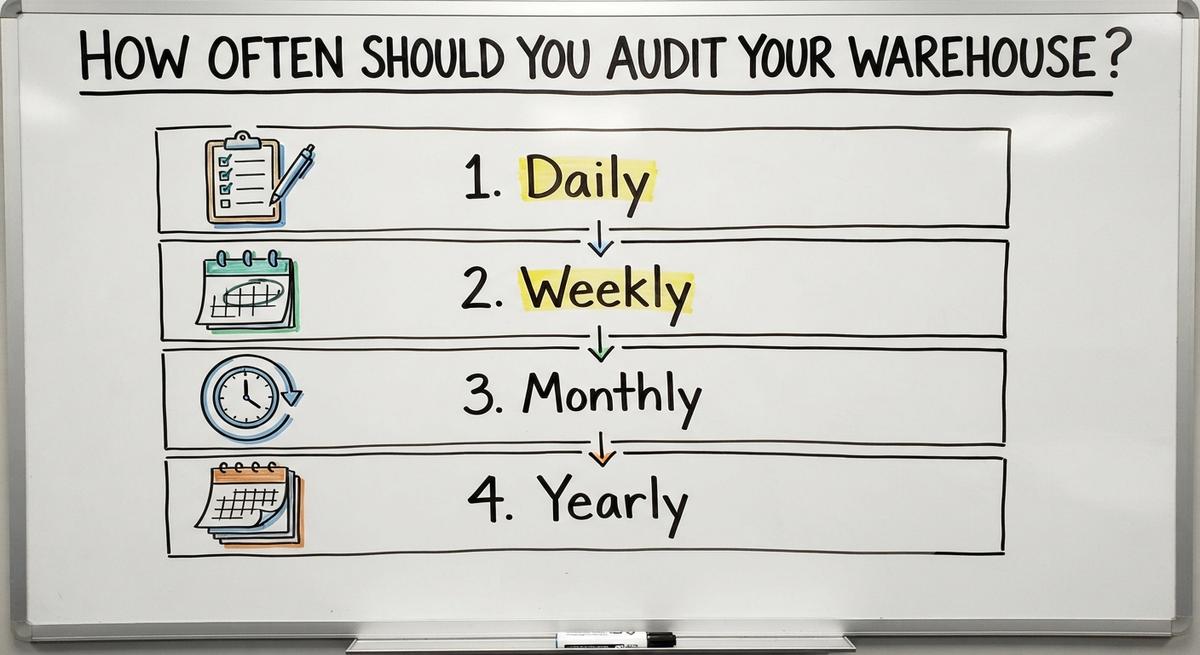
Audit timing is a rhythm of daily, weekly, monthly and yearly checks. Treat it as a guide, not a rule.
- Daily: Spot check 5 to 10 bins when each shift ends and note any miss.
- Weekly: Run a cycle count on your fastest-moving items and match results against the system.
- Monthly: Review one process, such as receiving, from the loading bay to the bin.
- Yearly: Run a full inventory audit across all four areas of the warehouse.
Audit sooner after a big change. A new layout, new staff or a busy season can break habits fast. Shorten the gap until the numbers settle.
Before You Start: Prepare for the Audit
Preparation is a one-day job that sets the audit up to work. Pick a goal, a date and an owner. A goal can be as plain as "find why mis-picks rose in May." Choose a quiet time, not a shipping peak.
Gather the records you will test:
- Pick tickets: Pull the last 2 weeks of tickets to trace orders back to the bin.
- Receiving records: Collect signed delivery papers and buy orders for the same period.
- System lists: Export item lists from your accounting package and any spreadsheets.
Tell staff what is happening and why. Say plainly that the review targets the process, not the people.
Who Should Perform a Warehouse Audit?
The best auditor is someone from outside the area being checked. A fresh pair of eyes spots what daily habit hides. Workers who know an area well stop noticing its problems.
In a small team, swap leads: the shipping lead audits receiving. Add the owner for the yearly warehouse audit.
How Can Small Warehouses Audit Without Special Software?
The kit for a small warehouse audit is simple: a printed checklist, a clipboard, a phone camera and one shared spreadsheet. Print the list below. Mark each item as you walk the floor.
Type results into the sheet that evening. Paper and a spreadsheet work well when you use them the same way every time.
Not sure this is the right shape for your operation
Describe how the work runs today. We map it on a call and show you what it would look like built around that, before you spend anything.
Book a call
Receiving and Storage Checklist
Receiving is the first step, and storage is where goods then sit. In any warehouse audit, errors that start at the loading bay follow stock to its bin.
Receiving Checklist
The receiving checklist is a short list of three checks at the loading bay.
- Match to the order: Check each delivery against the buy order before you sign for it.
- Note problems early: Write down damage and shortages on the driver's paper before the truck leaves.
- Log it that day: Enter every item with the right count and bin location before you close up.
If the order form, the receipt and the system disagree, mark that line as a miss.
Storage and Layout Checklist
A storage and layout checklist is a check of how goods sit and move.
- Clear labels: Bins and shelves carry large, readable labels that match the item names in your system.
- Smart slots: Fast-moving items sit close to the pick path so pickers walk less.
- Open aisles: Aisles stay clear and no overflow stock sits unmarked on the floor.
- Separate holds: Damaged or returned goods sit in a marked area away from sellable stock.
A tidy layout makes every later count faster and more accurate.
Inventory Accuracy Checklist
Inventory accuracy is the share of items where the shelf count matches the system count. In a warehouse audit, check it with a sample, not a full count.
- Pick 50 to 200 items. Include fast movers, slow movers and high-value goods.
- Count each item on the shelf. Count blind if you can, without looking at the system first.
- Set your tally beside the system figure and mark each match or miss.
- Look for items in the wrong bin and for negative or stale quantities.
- Divide matches by items checked. If 188 of 200 match, accuracy is 94%.
The Warehousing Education and Research Council shares a standard set of distribution center measures. Use it to see how your rate stacks up.
Write the rate down each time. A trend tells you more than one number.
Picking, Shipping and Returns Checklist
The outbound side is the part of a warehouse audit that follows an order from pick sheet to truck, and back again if it returns. Each step can break the link between stock and records.
Picking and Packing Checklist
Picking and packing are the steps between a pick sheet and a sealed box. Errors here reach the customer, so each line of the checklist is worth checking.
- Clear sheets: Pick sheets are current and easy to read, with bin locations that fit the racks.
- Final check: A second look happens before packing, even if it takes only 10 seconds per order.
- Mis-pick log: Staff record each mis-pick and its cause, such as a similar item name or a wrong label.
- Ready supplies: Boxes, tape and labels are stocked and every label prints correctly.
What Should You Check Before an Order Ships?
The first check is that the order matches the packing slip and the carrier label before it leaves. Then add three more items to your warehouse audit checklist:
- Saved records: Shipping papers are saved where anyone can find them in under a minute.
- Late orders: Late or partial shipments are logged with a reason.
- Prompt deduction: Stock leaves the system on the day the box leaves the dock.
Returns and Damaged Goods
Returns are goods that come back, and they split stock records fast. Log each return the day it arrives. Give staff a clear path: restock, repair or discard.
Then check that the credit you gave matches the stock change. A credit with no stock entry means your books and shelves now disagree. That gap belongs on every warehouse audit.
The comparison is easier when one option is built for you
Off-the-shelf means fitting your process to the software. We do it the other way round, and the first look costs nothing.
Book a callSafety, Security and Equipment Checklist
A warehouse safety checklist is a guard for people first, then stock and tools. It does not replace the rules. Read the official requirements at OSHA's warehousing page. Nothing here is legal advice.
Warehouse Safety Checklist
The warehouse safety checklist is a set of three checks for hazards that hurt people or stop work. Walk the floor and check each line by eye rather than from memory.
- Clear exits: Exits, fire extinguishers and walkways stay free of boxes and pallets.
- Equipment logs: Forklift and equipment checks are written down and signed each shift.
- Sound racking: Racking shows no bent beams, leaning frames or missing pins.
Security and Access Checklist
The security checklist is a test of who can reach the building, its systems and its top stock. Answer each line with a name or a visible lock, not a guess.
- Key list: You can name who holds each key, door code and system login.
- Locked value: High-value items sit in a cage or locked room.
- Sign-in: Visitors and drivers sign in and out at the door.
Equipment and Supplies Checklist
The equipment checklist is a test that tools and supplies are ready to use. Test each item today rather than assuming it works.
- Working tools: Scanners, printers, scales and pallet jacks all work today.
- Spare stock: Spare labels, tape and boxes are on hand for the week.
- Service dates: Each machine has a maintenance date on file.
Each warehouse audit sheet needs a line for people, locks and tools.

Paperwork and Data Checklist
The paperwork check is a test of whether your records tell one story. Manual steps show up most here. Walk one item from the PO to the receipt, to the invoice, to the bin.
- Match the chain: Buy orders, receipts and invoices should agree with the stock records on count and cost.
- Compare systems: Spot differences between your accounting software, your spreadsheets and the printed sheets.
One clean paper trail is the goal of this part of the audit checklist.
Item Data and Double Entry Checks
Item data is the name, unit and cost that each record carries. Once the document chain matches, look at how that data is written and entered.
Double entry is data typed in twice. Each retype is a chance for error.
- Check the basics: Item names, units and costs should read the same everywhere, such as "case of 12" versus "each."
- Find double entry: Note any data typed in twice during the warehouse audit.
The GS1 barcode standards explain why one shared code scans the same at every site. NIST offers neutral guidance on supply chain and inventory process.
Every spot where staff retype data is a manual step to fix later.
See it running on your own process first
No build cost. The subscription starts once it is live and doing the job, not before.
Book a callHow Do You Score and Record Audit Results?
Scoring is a three-point scale: pass, needs work or fail. Keep the scale to those 3 so any team member scores an audit checklist the same way.
- Add proof: Take a photo and write one line of notes for every fail.
- Use one file: Keep all results in one spreadsheet or folder.
- Date each audit: Store each run in its own tab to see change over time.
A fail on safety or on a high-value item goes to the top of the list that day. Records kept in one place show whether problems shrink or repeat.
Turn Audit Findings Into an Action Plan
An action plan is a list that turns each fail into a named fix with an owner and a deadline. Without a plan, the findings become a report that no one reads.
- Sort the fixes: Rank each by what the problem costs and the effort to fix it. Do cheap fixes for costly problems first.
- Assign owners: Give each fix one owner and one due date.
- Fix the root: Ask why the error happened. A mis-pick from a similar label needs a new label, not a warning.
- Re-check: Test the same items again in 30 days.
Common Warehouse Audit Mistakes
- No follow-up: Auditing once and never checking the fixes wastes the effort.
- Blame: Blaming people hides the process fault that made the error likely.
- Bad timing: Counting during busy shipping hours adds errors to the count.
- Stale lists: A checklist that never changes stops matching your warehouse.
The plan works when each fix has a name, a deadline and a re-check.

When Manual Audits Stop Working
Manual audits are failing when the same errors repeat after you fix them. Other signs are counts that take days and records spread over many places.
Your warehouse audit findings often point to steps a person does by hand every day. Retyping, re-counting and copying between sheets are common ones.
Staff time has a price. The Bureau of Labor Statistics tracks pay for stockers and order fillers, which lets you price those hours. The Auburn University RFID Lab publishes independent research on tagging for tracking stock.
Before you talk to any software provider, list the problems that repeat. Bring your audit scores and ask how each one gets fixed. Run your first audit this month and keep the list.
Frequently asked questions
How often should a warehouse be audited?
Match the rhythm to your volume. Most small teams do quick daily spot checks, weekly counts of fast items, a monthly process review and one full audit a year. Add an extra audit after any big change.
What is the difference between a warehouse audit and a cycle count?
A cycle count tests quantities on a rolling schedule. An audit is wider. It also tests how staff work, how safe the floor is and whether paper and system records agree.
How do you check inventory accuracy?
Count a sample of items on the shelf and compare each to the system. Divide matching items by items checked. A result of 188 matches from 200 items gives 94%.
Who should perform a warehouse audit?
Pick someone who does not run the area being checked. In a small team, leads can swap areas. The owner should join the yearly audit and sign off on the action plan.
Is 14489 a safety audit checklist?
We cannot confirm that it is. A number alone does not prove what a document covers. Check who issued it and what it says. For warehouse safety, start with the official OSHA warehousing guidance.
How can small warehouses audit without special software?
Use a printed list, a clipboard, a phone camera and one shared spreadsheet. Mark each line on the floor, then type scores in the same day. Consistent use matters more than tools.
What do you do with the audit results?
Turn each fail into a fix with one owner and one due date. Rank fixes by the cost of the problem and the effort needed. Test the same items again after 30 days.
What should a warehouse audit checklist include?
Cover receiving, storage, stock accuracy, picking, shipping, returns, safety, security, equipment and records. Add a pass, needs work or fail score for each line, plus space for photos and notes.
Start with a free first look
A 30 minute call, your operation mapped, and a clear picture of what we would build. No obligation and nothing to install.
Book a callRelated guides
More on the same work.
Guides
- Inventory Audit Checklist
- Inventory Audit
- Warehousing Processes
- Cycle Count in Warehouse
- Receiving Process Warehouse
- Warehouse Inventory Management Software
- Warehouse Inventory Tracking Software
- Warehouse Inventory Management Systems
- Pick and Pack in Warehouse
- Warehouse Receiving Software
- Warehouse Inventory Systems
- Warehouse Stock Management Software
- Warehouse Management System Top 10
- Software for Warehouse Management System
- Warehouse Shipment
- Warehouse Tracking System
- Warehousing Operations
- Inventory and Warehouse Management Software
- Small Business Warehouse Management System
- Cloud Based Warehouse Management