


Inventory Shrinkage Accounting Entry
The inventory shrinkage accounting entry is a journal entry that debits an expense and credits Inventory for the value of missing stock. Reviewed November 2026 against IRS Publication 538. The entry makes the books match the shelf. Debit inventory shrinkage expense (or cost of goods sold). Credit Inventory. The amount is the book count minus the counted stock, times unit cost.
Book a callWhat Is Inventory Shrinkage and What Causes It?
Inventory shrinkage is the gap between the stock your books show and the stock you count. Say the books show 500 boxes. A physical inventory count (a full count of every item on hand) finds 485. The 15 missing boxes are shrinkage. Shrinkage is lost value, so it cuts profit.
What causes inventory shrinkage in a warehouse?
The five main causes are theft, damage, spoilage, miscounts, and receiving errors. A wrong item picked or shipped with no record of the swap adds to the list. Paper sheets and spreadsheet updates that skip a step finish the job. Most shrinkage is a record problem, not a theft problem. GS1 sets the barcode standards that scan-based counts rely on.
We build it for your operation, and the first look is free
If you would rather not compare products, describe how your operation already works and we build the system around it.
No build cost. You see it running on your own process first, and the monthly subscription starts only once it is live.
Book a callThe Inventory Shrinkage Journal Entry
The inventory shrinkage journal entry has two lines. One debit and one credit, for the same amount.
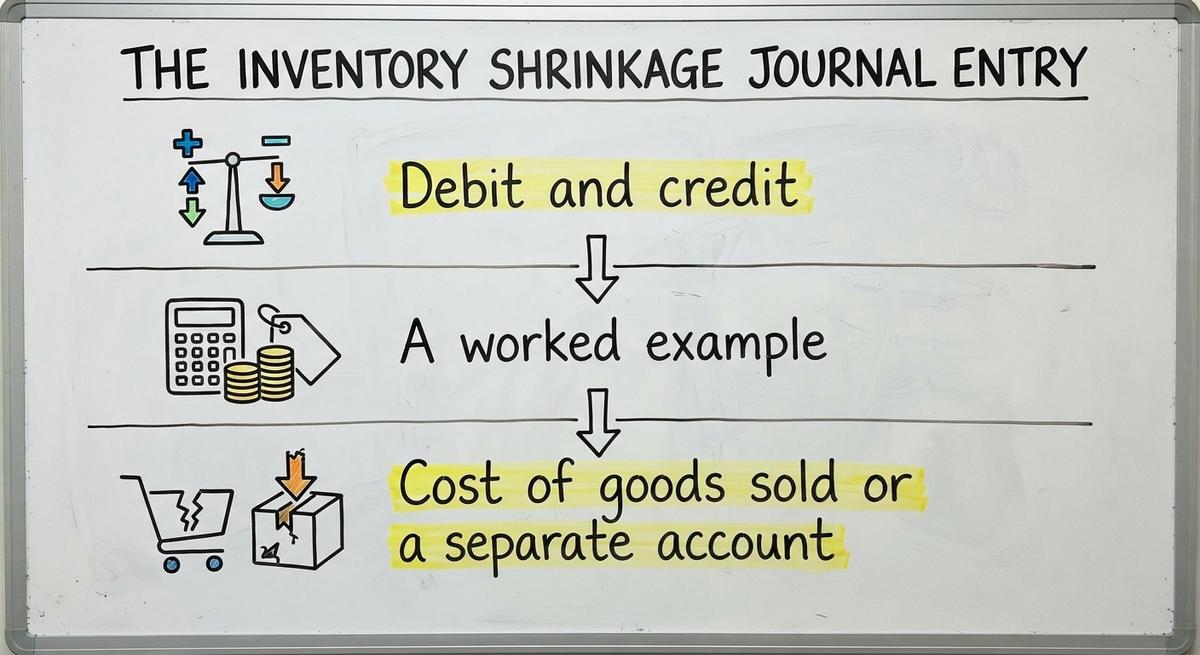
Debit and credit
Here is the entry in plain text:
`` Debit Inventory Shrinkage Expense $150 Credit Inventory (asset) $150 ``
The asset goes down because the stock is gone. The expense goes up because the loss is a cost. This is the shrinkage debit and credit pair. It is also an inventory write-off (removing the value of lost goods from the books).
A worked example
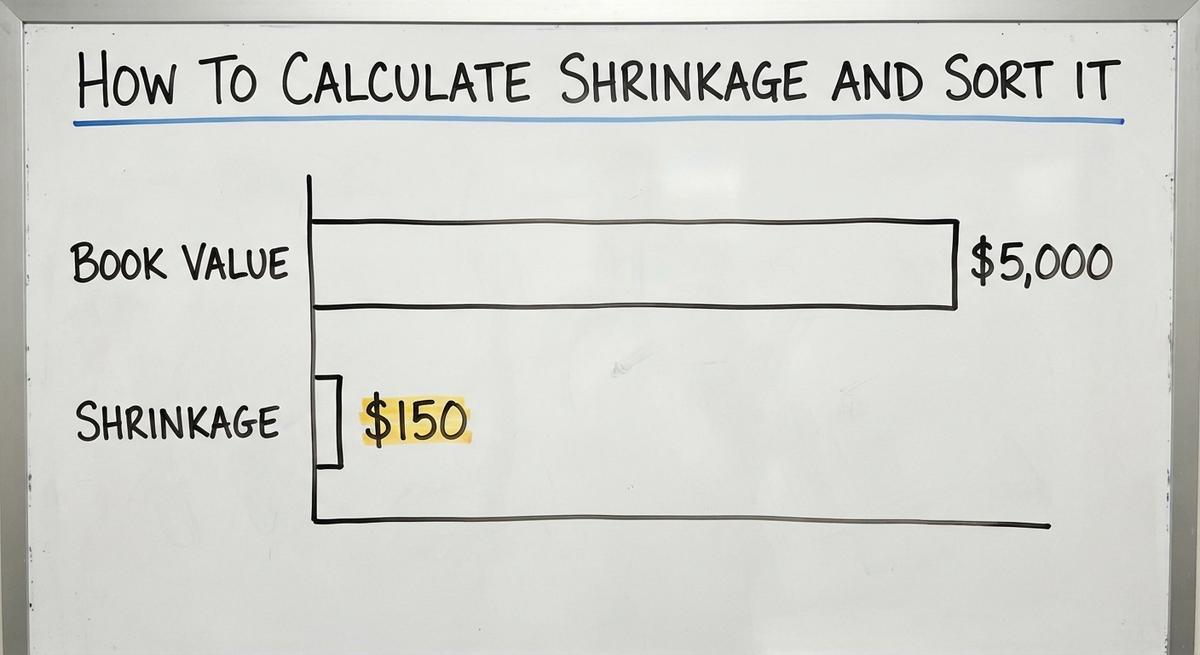
The books show 500 units at $10 each. That is $5,000. The count finds 485 units, worth $4,850. Shrinkage is 15 units, or $150.
- Before: Inventory is $5,000 and shrinkage expense is $0.
- Entry: Debit shrinkage expense $150. Credit Inventory $150.
- After: Inventory is $4,850 and shrinkage expense is $150.
The new inventory balance now equals the count.
Cost of goods sold or a separate account
Cost of goods sold (COGS) is the cost of the items you sold. Small, normal shrinkage often goes there, because a little loss is a regular cost of selling goods and it keeps your books simple. A separate shrinkage account is better for trends. You see the loss on its own line each month, so a rise stands out instead of blending into COGS. Ask your CPA which treatment fits your business, since the right choice can depend on your size, your reporting needs, and how you file taxes.
How to Calculate Shrinkage and Sort It
The math has one formula and one test. The formula gives the dollars. The test tells you where to book them.
The calculation
Shrinkage is book value minus counted value. Book value is what your records say you should have, and counted value is what you actually found on the shelves. Use the unit cost method you already use, so the numbers match the rest of your books. Then find the rate:
`` Shrinkage rate = shrinkage / book value $150 / $5,000 = 3% ``
Track the rate each month. A rate that climbs points to a problem.
Normal and abnormal shrinkage
Normal shrinkage is small and expected, like breakage. Abnormal shrinkage is large or sudden, like theft or a flood. Abnormal losses can go to a separate loss account. Confirm the split with your accountant. An inventory reserve account (a set-aside balance for expected losses) can also cover the normal part.
Not sure this is the right shape for your operation
Describe how the work runs today. We map it on a call and show you what it would look like built around that, before you spend anything.
Book a callHow Do You Record Inventory Shrinkage in an Accounting Package?
You record shrinkage with an inventory adjustment. The steps work in your accounting software and other packages that sync with it. Menu names vary by version, so check your own screen. This is the inventory adjustment that accounting software users look for.
- Open the inventory quantity adjustment screen.
- Set the adjustment date to the count date.
- Adjust by quantity on hand.
- Pick the shrinkage expense account.
- Save and review the new balance.
When to book the entry
Book the entry after each physical count or cycle count (a count of a small slice of stock on a rotating schedule). Book it at month end and year end so reports are right, and so your inventory balance and expenses reflect what you actually have on hand. Old errors are harder to trace, because receipts, shipments, and staff memory fade, so do not wait. Booking promptly also keeps each month's numbers comparable.
Check the count first
Run four checks before you book, because a miscount can look like real shrinkage and you would be booking a loss that never happened. Recount the item. Check recent receipts and shipments. Look for unposted transactions. Look for stock in the wrong bin or the wrong unit of measure. Book only after these checks pass, so the entry reflects true loss and not a simple record error.

Does Shrinkage Affect Taxes and Financial Statements?
Shrinkage lowers inventory on the balance sheet. It also lowers profit on the income statement. The IRS says, "To figure taxable income, you must value your inventory at the beginning and end of each tax year." See IRS Publication 538. Tax effects depend on your facts, so ask a CPA.
The comparison is easier when one option is built for you
Off-the-shelf means fitting your process to the software. We do it the other way round, and the first look costs nothing.
Book a callWhy Manual Steps Make Shrinkage Worse
Most bad counts start with retyping. Count sheets get retyped, and each retype is a chance for error. Spreadsheets, databases, and email threads then disagree with each other. An accounting package is only as accurate as what you enter.
These mistakes make it worse:
- Using the wrong cost per unit skews the dollar amount.
- Writing off losses without a count hides the real cause.
- Burying shrinkage in a general expense account hides the trend.
- Fixing the books but not the cause lets the loss repeat.
Two people spending 3 hours a week at $22 an hour on retyping cost $6,864 a year. The loss is not only in the shrinkage.

How Can a Small Warehouse Reduce Shrinkage?
A small warehouse cuts shrinkage with 4 habits. Run cycle counts on fast-moving items. Set clear receiving and picking steps with a record of each. Limit who can adjust stock. Review shrinkage by item, bin, and month. NIST offers vendor-neutral supply chain guidance on process.
Keep your books and fix the manual steps
Custom software can replace the manual count, receiving, and adjustment steps. You keep the accounting package for the books. We build around how your team already works, with no forced move. It fits teams of 5 to 100. Adjustments can flow to your accounting software with a reason code and no retyping. Good warehouse inventory tracking software does this job.
A routine to start this month
This is a short routine you can begin this month to catch shrinkage early and keep your records accurate. Small, steady steps make differences easier to explain and trends easier to see.
- Count a small set of top items each week.
- Record the reason for each difference.
- Book one entry at month end.
- Review the trend with the owner or manager.

Next Steps for Cleaner Inventory Records
The entry is simple: debit shrinkage expense, credit Inventory. Clean records make it small, because fewer errors mean fewer surprises at each count. Start with the checks and the weekly routine above, and watch your shrinkage rate over time. If manual count steps slow your team, talk with our Columbus, Ohio team about them.
Frequently asked questions
What are the typical journal entries used for inventory in accounting?
Buying stock debits Inventory and credits Cash or Accounts Payable. Selling stock debits Cost of Goods Sold and credits Inventory. A shrinkage write-off debits a shrinkage expense and credits Inventory.
What is inventory shrinkage in accounting?
Inventory shrinkage is the loss of stock between what the books show and what a count finds. Theft, damage, and entry errors all cause it. The business books the loss as an expense.
What is closing inventory in accounting?
Closing inventory is the value of stock on hand at the end of a period. A physical count sets it. It becomes the opening balance for the next period.
Is inventory shrinkage a debit or a credit?
Both. The shrinkage expense is a debit. The Inventory asset is a credit. The two amounts match.
Is shrinkage an expense or an asset loss?
Shrinkage is an asset loss that you record as an expense. Inventory is the asset and it goes down. The expense goes up by the same amount.
How much shrinkage is normal?
The right level depends on your goods and your handling. Track your own rate each month and watch for jumps. Ask your CPA how to treat the normal part.
Can I book shrinkage in my accounting software without a count?
You can enter the adjustment, but you should not. A count proves the loss is real. Without one, you may write off a record error and miss the cause.
Start with a free first look
A 30 minute call, your operation mapped, and a clear picture of what we would build. No obligation and nothing to install.
Book a callRelated guides
More on the same work.
Guides
- Accounting and Inventory Software for Small Business
- Inventory Reserve Account
- Inventory Audit Checklist
- Inventory Management Best Practices
- Moving Average Method Inventory
- Warehouse Inventory Management Software
- Warehouse Inventory Tracking Software
- Warehouse Inventory Management Systems
- Best Inventory Software
- Quickbooks Inventory Management Software
- Warehouse Inventory Systems
- Classification of Inventory
- Inventory and Warehouse Management Software
- Custom Inventory Management Software
- Excess Inventory
- Closed for Inventory
- Warehouse Inventory Management System
- Retail Inventory Management
- Multi Location Inventory Management Software
- Ms Excel Inventory Template
- Warehouse Inventory Software Programs