


What is a Good Inventory Accuracy Percentage
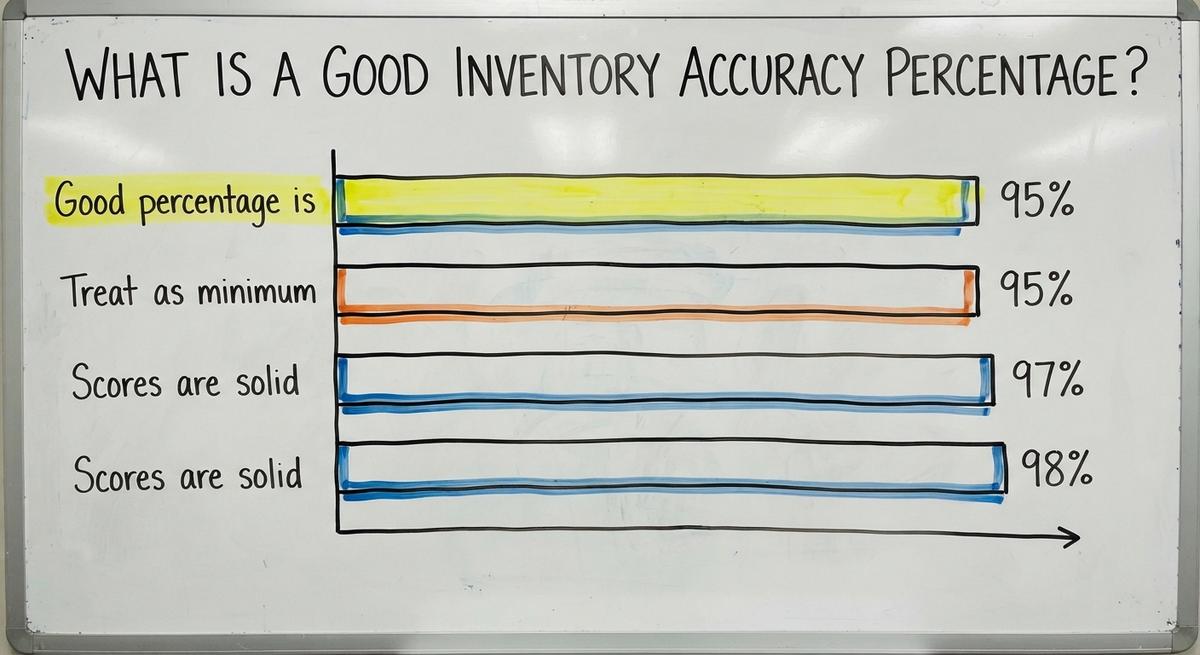
Inventory accuracy is the share of items where your system count matches the count on the shelf. A good rate is 95% or higher.
The best warehouses reach 99%.
Book a callWhat Is a Good Inventory Accuracy Percentage?
A good inventory accuracy percentage is 95% or higher. Most teams treat 95% as the minimum.
Scores of 97% to 98% are solid. Anything at 99% or above is best in class.
Accuracy means the shelf and the record agree. Your ideal target depends on 3 things:
- Your products: Cheap bulk parts need less care than costly items with a high unit price.
- Your order volume: Busy days turn small count errors into missed orders fast.
- The cost of a miss: A $5 bolt is a minor loss. A $900 pump that is not there loses a sale.
Set your 2025 target by what one miss costs you.
We build it for your operation, and the first look is free
If you would rather not compare products, describe how your operation already works and we build the system around it.
No build cost. You see it running on your own process first, and the monthly subscription starts only once it is live.
Book a callWhat Inventory Accuracy Actually Measures
A stock count is the act of counting items by hand or by scan.
Inventory accuracy measures how often the software figure equals the physical tally.
Barcode standards from GS1 set the common language that scan-based counts rely on.
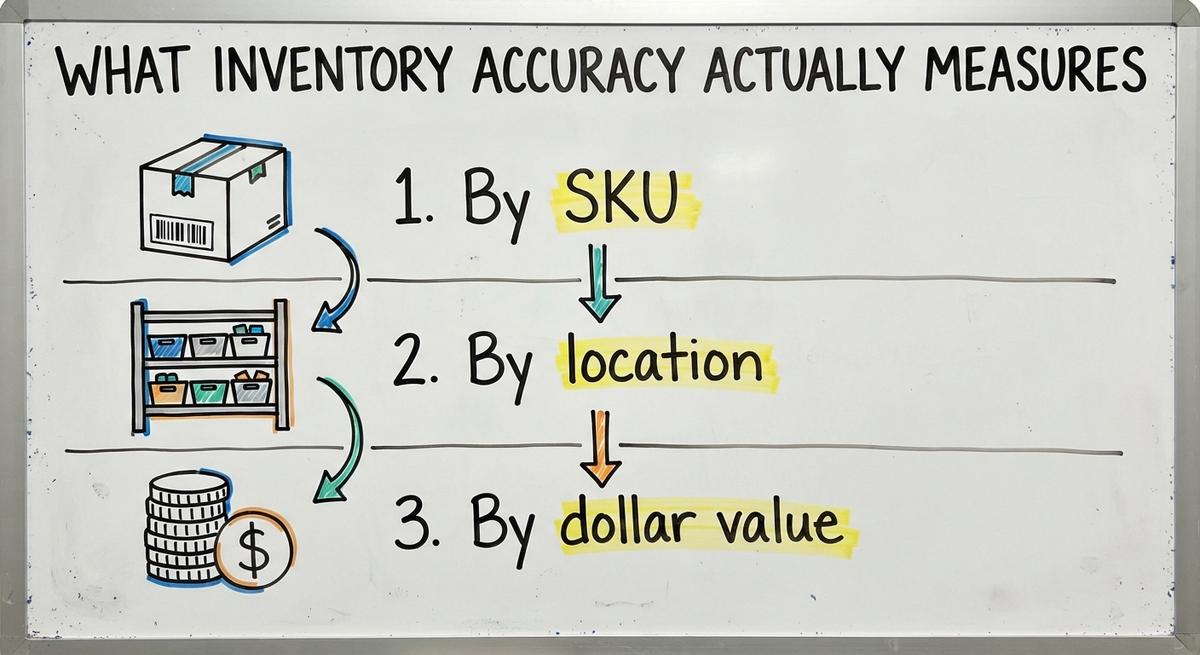
You can score the match in 3 ways:
- By SKU: Count how many product codes match.
- By location: Count how many bins or shelves hold the right stock.
- By dollar value: Weigh each miss by what it costs.
Each method gives a different rate, so pick one and keep it.
By SKU
A SKU is one product type with its own code. SKU accuracy asks how many codes match.
Follow these steps:
- Compare the recorded quantity with the shelf quantity for each code.
- Mark each code as a match or a miss.
- Divide the matches by the codes you checked.
SKU scoring shows how many product types are right. It hides how large each miss was.
Use SKU scoring for a fast health check.
By location
Location accuracy checks each bin or shelf. A SKU can match in total and still sit in the wrong bin.
Follow these steps:
- Compare where the record places an item with where it truly sits.
- Score each bin as right or wrong.
- Divide the right bins by all bins checked.
Pickers lose time when stock is not where the record says.
Location scoring protects pick speed.
By dollar value
Dollar accuracy weighs each miss by its cost. One big miss moves the score more than 10 small ones.
Follow these steps:
- Add up the dollar value of every gap between record and shelf.
- Compare that sum with the full value of the stock you checked.
Dollar scoring shows where money is at risk. It can hide many small misses.
Use dollar scoring when a few costly items drive your profit.
How Do You Calculate Inventory Accuracy?
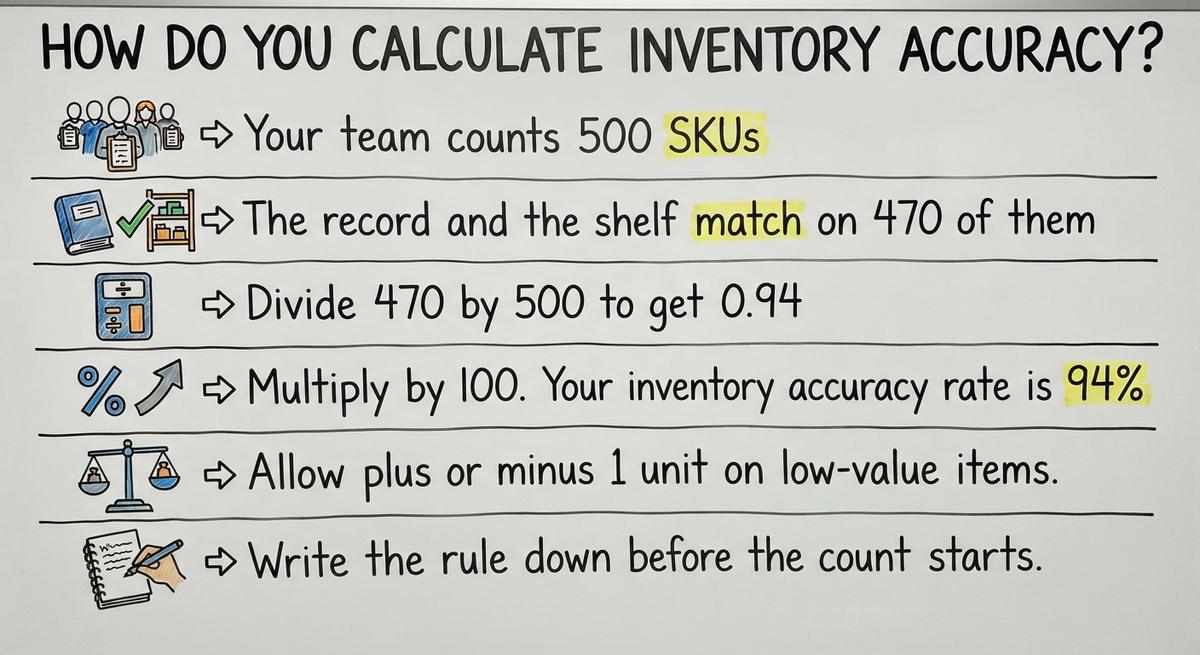
To calculate inventory accuracy, divide the items with matching counts by the items counted, then multiply by 100.
The formula is: matching counts ÷ total counted × 100.
Here is a worked example:
- Your team counts 500 SKUs.
- The record and the shelf match on 470 of them.
- Divide 470 by 500 to get 0.94.
- Multiply by 100. Your inventory accuracy rate is 94%.
Set clear rules before you count:
- Allow plus or minus 1 unit on low-value items.
- Write the rule down before the count starts.
- Never change the rule after the count, as that hides real problems.
The same formula works for SKU, location or dollar value counts. Only the thing you count changes.
Fix the rule first, then count.
Not sure this is the right shape for your operation
Describe how the work runs today. We map it on a call and show you what it would look like built around that, before you spend anything.
Book a call
Inventory Accuracy Benchmarks by Rate
An inventory accuracy benchmark is a rough target to compare your rate against.
Sources differ, so treat these bands as guides. Each band shows up on the floor in a way an owner notices.
| Rate | What it means |
|---|---|
| Below 90% | Urgent: stockouts and backorders every week |
| 90% to 95% | Average: rush shipping and some oversells |
| 95% to 98% | Good: few surprises |
| 99% or higher | Excellent: orders ship as promised |
A low rate hurts in 3 places:
- Customers wait on backorders.
- Staff pay for rush freight to cover a gap.
- Buyers reorder stock you already own.
Move up one band and the daily firefighting drops.
Why a Few Percentage Points Matter
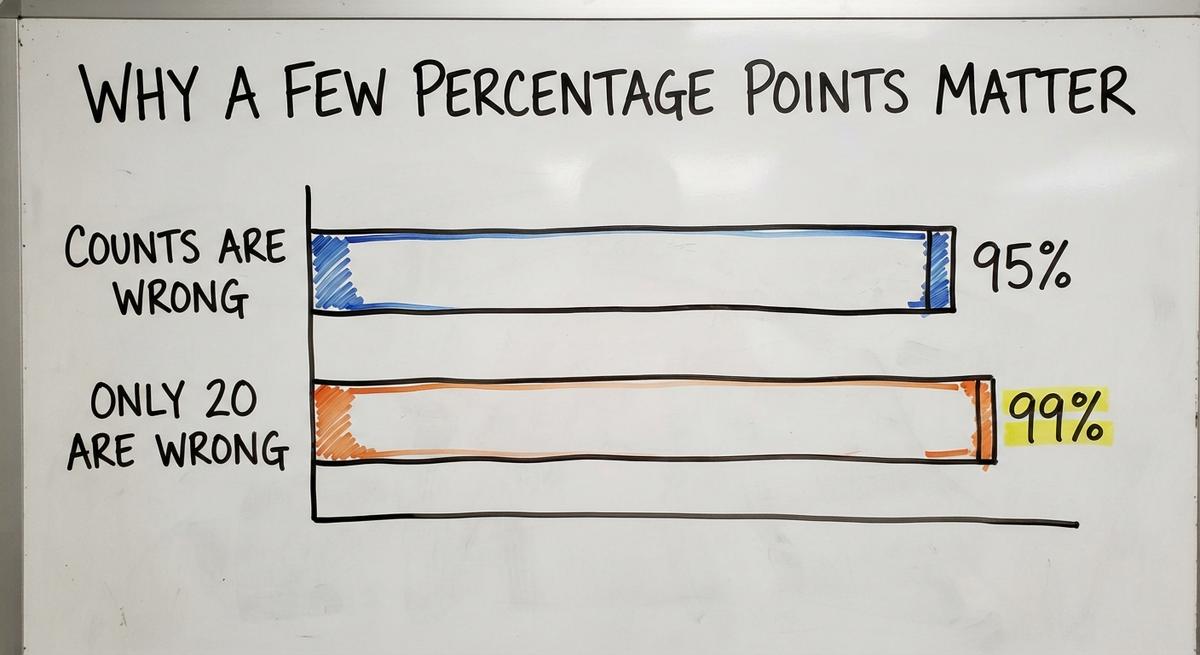
A few points matter, as small gaps become many bad entries. At 95% accuracy on 2,000 SKUs, about 100 counts are wrong.
At 99%, only 20 are wrong.
Each miss costs money:
- Lost sales: Software shows stock on hand, the shelf is empty, and the order slips.
- Overstock: Software shows zero, so you buy more and tie up cash.
- Wasted labor: Say 100 misses take 15 minutes each to chase. That is 25 hours, or $500 at $20 an hour.
- Unhappy customers: Late orders break trust. The US Federal Trade Commission holds sellers to the ship date they gave.
Bad counts also skew buy plans and financial reports. Every wrong number feeds the next decision.
A 4-point gap costs you sales, cash and time.
The comparison is easier when one option is built for you
Off-the-shelf means fitting your process to the software. We do it the other way round, and the first look costs nothing.
Book a call
Common Reasons Accuracy Falls Short
Poor inventory accuracy has a few repeat causes. Most are habits, not bad staff.
Look for these first:
- Typing errors: Quality Magazine says the average error rate in manual data entry is "about 1%." On 10,000 entries, that is 100 errors.
- Split records: Stock data lives in an accounting package, a spreadsheet, printed sheets and email.
- Unlogged events: Returns, damages, transfers and shrinkage (stock lost to theft or loss) never reach the record.
- Floor mistakes: Staff pick the wrong item or receive the wrong amount. Unlabeled bins make it worse.
- Lag: Someone moves a box at 9 and updates the record at 4.
Find the cause that hits you most and fix that one first.
How to Raise Your Inventory Accuracy
To improve inventory accuracy, fix the counting habit first and the record habit second.

A small distributor can do both without a big system change.
Fix the counting
Three steps improve count accuracy by catching errors early. Follow them in order, as each makes the next easier.
- Start cycle counting. A cycle count is a small count of a few items on a set schedule. Begin with fast movers and high-value items.
- Label every bin and shelf with a clear location code.
- Log the cause of each miss, not just the new count.
Early catches make every later step easier.
Fix the records
Clean records rest on 3 habits:
- Record each receipt, pick and move at the moment it happens.
- Keep one source of stock truth. Fewer re-typed numbers means fewer typos.
- Pick the one place where counts win a tie, and tell everyone.
Root causes beat recounts. A recount fixes today and a cause fix fixes next month.

How Often Should You Count Inventory?
A warehouse should count some stock every week and all stock at least once a year.

The IRS says "you must value your inventory at the beginning and end of each tax year."
Annual full counts
The cost is lost work time during the closure. Errors found on the day can have built up for months.
A full count checks everything at once. The floor closes for a day or more.
One push gives a single snapshot of all inventory at a point in time.
Use the full count as a yearly check, not a daily tool.
Ongoing cycle counts
Cycle counting spreads the work out. A small team can count 5 to 10 bins a day with no shutdown.
Use an ABC split:
- A items are top-value stock, so count them most often.
- C items are low-value stock, so count them least.
Track your rate each month, and build a 2025 count calendar. A falling line shows a problem early.
Small daily counts catch drift before it grows.
See it running on your own process first
No build cost. The subscription starts once it is live and doing the job, not before.
Book a call
When Do Spreadsheets and Accounting Software Stop Being Enough?
Spreadsheets and accounting software stop being enough when your accuracy stays below 95% after you fix the basics.
Accounting tools track money well. Bin-level stock is a gap when manual sheets sit beside them.
Watch for these signs:
- Your rate has sat under 95% for 3 months.
- You oversell items that show as in stock.
- Staff type the same numbers into 2 places.
Ask first if a smaller fix can fit your current workflow. A full replacement is not always needed.
Many owners search what is the best inventory management software for small business. The better question is which gap costs you most.
Name the gap first, then pick the smallest fix.


Your Next Step
A first count of 50 SKUs is enough to set a baseline. Take these steps:
- Pick one accuracy method from the list above.
- Count 50 SKUs this week.
- Work out your rate with the formula above.
- Write the number down as your starting point for 2025.
- Count again in 30 days and compare the two results.
The change between the two results shows if your fixes work.
Frequently asked questions
What's a good inventory ratio?
No single ratio fits every firm. Inventory-to-sales ratios vary by industry, and the US Census Bureau publishes wholesale figures at census.gov/wholesale/index.html. Compare yourself to peers selling similar goods, not to a national average.
Is 95% inventory accuracy good?
Yes, 95% is a fair minimum for most distributors. It leaves about 5 wrong counts per 100 items. Aim for 97% or more if your items are costly or orders move fast.
Does inventory accuracy differ by SKU, location or dollar value?
Yes. Each method scores a different thing, so the same stock room can show 96% by SKU and 91% by dollar value. Choose one method and track it every month.
What causes poor inventory accuracy?
Typing errors, split records and missed returns or damages drive most gaps. Picking mistakes, unlabeled bins and slow updates add more. Track the cause behind each miss to see which one hits you hardest.
How often should a warehouse count inventory?
Count high-value and fast-moving items weekly or monthly, and the rest less often. Every item needs at least one full count a year. Small teams can count a few bins each day.
How can a small distributor improve inventory accuracy without a big system change?
Start with daily cycle counts, clear bin labels and same-moment updates for each pick and receipt. Cut the number of places where stock is typed. These steps cost little and work inside your current tools.
Is 99% inventory accuracy realistic for a small warehouse?
Yes, with steady habits. Small teams with fewer SKUs and tidy bins reach 99%. Daily counts, one source of stock data and fast fixes for each miss get you there.
Start with a free first look
A 30 minute call, your operation mapped, and a clear picture of what we would build. No obligation and nothing to install.
Book a callRelated guides
More on the same work.
Guides
- Good Inventory Apps
- Cycle Counting Inventory
- Inventory Audit Checklist
- Inventory Audit
- Inventory Management Best Practices
- Moving Average Method Inventory
- Inventory Shrinkage Accounting Entry
- Inventory Shrinkage is Recorded When
- Calculate Inventory Shrinkage
- Inventory Process Flow
- Warehouse Inventory Management Software
- Warehouse Inventory Tracking Software
- Warehouse Inventory Management Systems
- Best Inventory Software
- Quickbooks Inventory Management Software
- Warehouse Inventory Systems
- Classification of Inventory
- Inventory and Warehouse Management Software