


Inventory Shrinkage is Recorded When
Inventory shrinkage is recorded when a physical count, cycle count, or found loss shows less stock than the books say. Post the loss once you confirm it, not when you only suspect it. A 120-case book count against 114 on the shelf is 6 cases of shrinkage.
Three signs point to a loss:
Book a callInventory Shrinkage Is Recorded When Book Stock Exceeds Actual Stock
Inventory shrinkage is the gap between book stock and actual stock. A count or a found loss shows that gap. You post it once the loss is confirmed.
- Book stock is the unit count held in your system.
- Actual stock is the number of units sitting on your shelves.
- A variance is the gap between those two counts.
A hunch is weak proof. A missing pallet is not shrinkage until you search and come up empty. The rule stays simple: if the bin holds fewer units than the ledger shows, and you checked, you post it.
Check first, then post the loss.
We build it for your operation, and the first look is free
If you would rather not compare products, describe how your operation already works and we build the system around it.
No build cost. You see it running on your own process first, and the monthly subscription starts only once it is live.
Book a callWhat Inventory Shrinkage Means
Inventory shrinkage is stock you paid for that you can no longer sell. The loss shows in units or in dollars. Sales have nothing to do with it.
Picture a system that shows 120 cases with 114 on hand. You lost 6 cases. Cost of goods sold (COGS) is different. COGS holds the price of items sold to customers. Shrinkage holds the price of items you lost.
Keep two lines apart:
- COGS tracks goods that left through a sale.
- Shrinkage tracks goods that left with no sale.
GS1 sets the barcode standards that scan-based counts rely on. A scan ties each unit to one record. That link exposes a gap fast.
Shrinkage is a loss with no sale behind it.
When Is Inventory Shrinkage Recorded?
Inventory shrinkage is recorded on the day a loss is known and measured. Five events trigger it:
- A full physical count shows fewer units than the system.
- A cycle count of a few bins shows a shortfall.
- Damaged or expired goods turn up and cannot be sold.
- A theft or a lost shipment is confirmed.
- A manager signs a write-off after a review.
Each event ends the same way. You post an adjustment that matches the books to the shelf. Capture three facts at that moment:
- The date you confirmed the loss.
- The item number and the units missing.
- The name of the person who confirmed it.
The day of discovery is the day of the entry.
After a Physical Inventory Count
A physical inventory count is a full count of every item in the building. Many firms run one at year end, on December 31. Staff count each unit. Compare counted units to system units. Then post the difference.
Review each variance before you post. A miscounted bin is not a loss. Prepare before the count:
- Freeze receipts and picks during the count.
- Assign each aisle to a two-person team.
- Print count sheets with the system quantities hidden.
Then follow up after the count:
- Count each bin twice if the gap is large.
- Have a second person sign off on big gaps.
A full count gives you one clean date on which books and shelves agree.
After a Cycle Count
A cycle count is a small, regular count of a few items or bins. A team might count 20 bins each day. Losses show up within days. They do not wait for a year-end surprise.
The same rule applies to each count. Compare the shelf to the books. Review the gap. Post only the gap you cannot explain.
- Count fast-moving items more than slow ones.
- Pick the bins on a set schedule.
- Log each count with a date and a name.
Regular counts also pay off in other ways:
- You find a repeat error within days, not months.
- You spot a weak process in one aisle.
- You train staff on the exact bins that fail.
Small, steady counts beat one large yearly shock.
When Damaged or Expired Goods Are Found
You record damaged goods the day someone finds them and sees they cannot be sold. A crushed case or an expired lot is a loss on that day. Do not park it in the aisle until the next count.
Tag each loss with a cause code, so damage stays apart from theft. Add a photo or a short note. Auditors and carriers ask for proof.
- Note the date, the item, and the units.
- Take a photo of the damage.
- Keep the carrier paperwork for a claim.
Damage tends to come from a few sources:
- Forklift hits crush cases at the dock.
- Leaks spoil goods on lower racks.
- Expired lots reach their date before they sell.
A cause code today saves an argument at audit time.
Not sure this is the right shape for your operation
Describe how the work runs today. We map it on a call and show you what it would look like built around that, before you spend anything.
Book a callWhen Theft or Loss Is Confirmed
Theft gets posted once the shortage is confirmed. Say a pallet goes missing. You search the building. You check the receiving log and the carrier. It is still gone. Now you post the loss.
Do not wait for a year-end count if the amount is large. The Loss Prevention Research Council reports in its 2023 retail security survey that "88% of retailers reported shoplifters are more aggressive and violent" than a year earlier. The NRF notes that its 2022 Retail Security Survey was conducted with the Loss Prevention Research Council and sponsored by Appriss Retail.
Search in this order before you confirm theft:
- Check the receiving log for the shipment.
- Ask the carrier to confirm the delivery.
- Search nearby bins and staging areas.
- Review transfer and return records.
Keep a written trail:
- Write down each place you searched.
- Note the time and the person who searched.
- Attach any camera or gate log entries.
A written trail proves the loss was real.
What the Inventory Shrinkage Journal Entry Looks Like
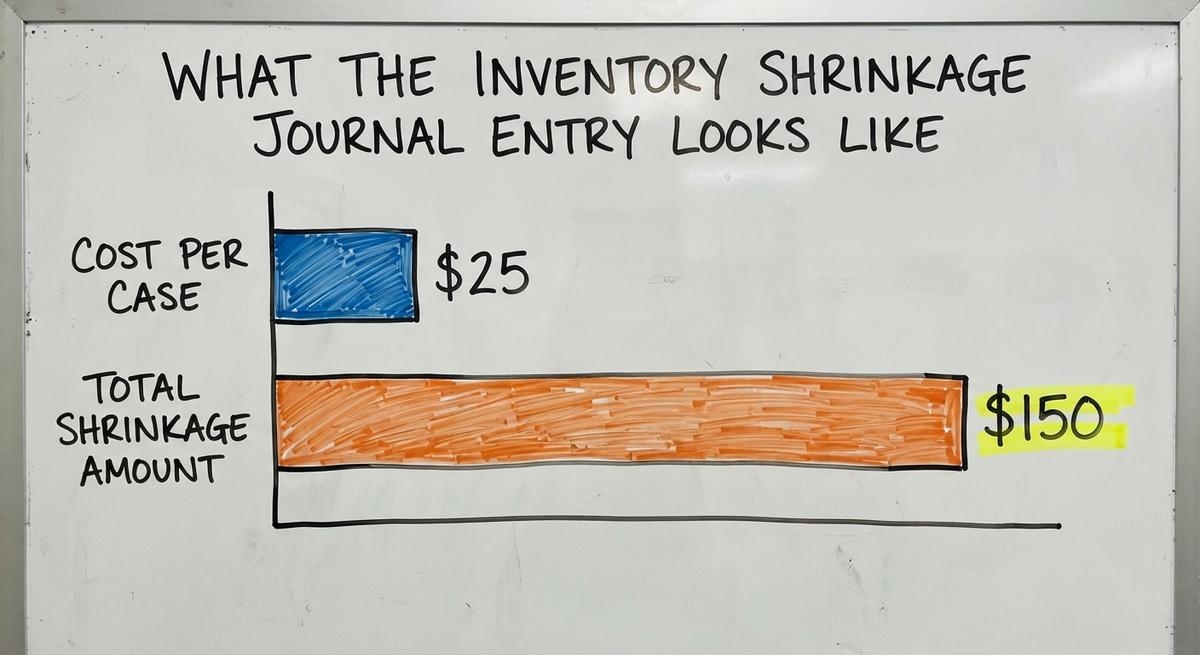
The inventory shrinkage journal entry is a debit to an expense account and a credit to the inventory account. Take 6 cases that cost $25 each. The loss is $150.
- Debit: Inventory shrinkage expense (or COGS), $150.
- Credit: Inventory asset, $150.
The debit adds an expense. The credit cuts the asset. Books now match the shelf. This is the core of any inventory shrinkage accounting entry.
An accounting package may call the step an inventory adjustment. An accounting software inventory adjustment records the same loss. Ask your accountant to confirm the account setup. In most packages the steps run like this:
- Open the item record.
- Enter the counted quantity.
- Pick the shrinkage account.
- Add a reason note and save.
One entry moves $150 off the asset line and onto the expense line.

Why the Law and Your Customers Care About Counts
A count is a duty, not only a habit. The IRS says in Publication 538: "To figure taxable income, you must value your inventory at the beginning and end of each tax year."
In plain terms:
- Value your stock on the first day of the tax year.
- Value it again on the last day.
- Keep count sheets with your tax records.
Customers care too. The FTC mail order rule says you must ship when you said you would. A false count makes you promise stock you do not hold.
Two checks protect you:
- Count at the start and end of each tax year.
- Match counts to what you promise on orders.
An honest count protects both your tax return and your delivery dates.
The comparison is easier when one option is built for you
Off-the-shelf means fitting your process to the software. We do it the other way round, and the first look costs nothing.
Book a callWhere Does Shrinkage Show Up on the Books?
Shrinkage shows up in two places:
- The balance sheet shows a lower inventory asset.
- The income statement shows a higher expense.
So yes, inventory shrinkage is an expense. Many firms post the expense to COGS. Others open a separate shrinkage account. A separate account makes trends clear. You can compare month to month and spot a rise at once.
A separate account helps in three ways:
- You see shrinkage apart from normal sales costs.
- You can set a monthly target.
- You can show owners a clean trend.
Tax treatment is a question for a CPA. Do not guess.
A split account turns a hidden loss into a number you can watch.

Normal vs. Abnormal Shrinkage
Normal shrinkage is a small, expected loss such as breakage or spoilage. Many firms fold it into COGS. Abnormal shrinkage is an unusual or large loss, like a flood or a stolen pallet.
- Normal: a few damaged units in a busy month.
- Abnormal: a $4,000 loss from one event.
- Normal: spoilage that fits the shelf life of the item.
- Abnormal: a sudden jump in missing units with no cause.
Track abnormal loss on its own line. Then you can see what went wrong. Have your CPA review how each type is treated. Handle an abnormal event in three steps:
- Open a separate line for the event.
- Write a short report on the cause.
- Review the fix with your team.
Normal loss is a cost of doing business, and abnormal loss is a signal to investigate.
Common Causes of Inventory Shrinkage in a Warehouse
Warehouse inventory control fails in six main places. Each one leaves book inventory vs. actual inventory out of line.
- Receiving errors: a driver drops 50 units and a clerk logs 55.
- Picking errors: a picker grabs the wrong item and the bin count drifts.
- Mislabeled bins: stock sits in a spot the system does not list.
- Damage: forklifts, stacking, and wet floors ruin goods.
- Theft: staff, vendors, or outsiders take stock.
- Paperwork gaps: transfers and returns never reach the system.
Quick checks catch each cause:
- Compare the packing slip to the dock count.
- Audit pick accuracy on a sample of orders.
- Walk the aisles and match bin labels.
Most of these start as small habits. A missed scan today is a missing case next quarter.
Fix the habit and the loss stops at the source.
Why Paper and Spreadsheet Tracking Hides Shrinkage
Paper and spreadsheets hide shrinkage by leaving gaps:

- A printed pick sheet shows a plan, not what happened.
- An Excel count has no log of who edited a cell.
- An email approval is hard to find later.
Delays make it worse. A clerk moves 10 cases at noon and types it in at 5 p.m. For 5 hours the system is wrong. That creates a false variance.
A supply planning guide puts the risk well: "If your system says you hold 100 units when you actually hold 400, you will keep buying stock you do not need." The guide on obsolete stock covers the price of wrong records.
Late records leave signs:
- Counts differ at the start of every shift.
- Staff say "the system is wrong" each week.
- Adjustments pile up on the last day of the month.
A record made late is a record that lies for a while.
How to Calculate Your Shrinkage Rate
The shrinkage rate is the share of book value you lost. The formula has three steps:
- Subtract actual value from book value.
- Divide that gap by book value.
- Multiply the result by 100.
Here is a worked case:
- Book value of stock: $50,000.
- Actual value counted: $48,500.
- Loss: $50,000 minus $48,500, or $1,500.
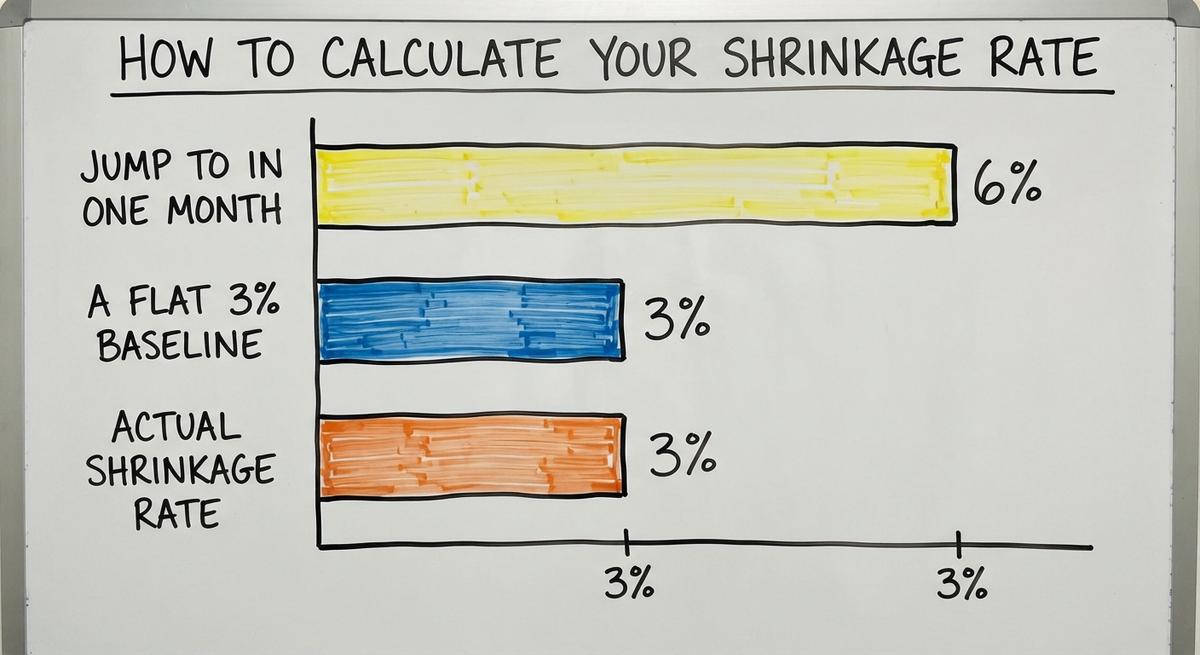
- Rate: $1,500 divided by $50,000, times 100, is 3%.
Track the rate each month. A flat 3% is a baseline. A jump to 6% in one month tells you to look closer. Use the rate to:
- Compare one month with the next.
- Compare one site with another.
- Judge if a fix worked.
The rate turns a loss into a trend you can watch.
See it running on your own process first
No build cost. The subscription starts once it is live and doing the job, not before.
Book a call
How Often Should You Count Inventory?
Count fast-moving and high-value items more often than slow, cheap ones. A good plan mixes cycle counts with one full count each year. A weekly count of your top 20 items beats a yearly count of everything.
- Count top sellers weekly.
- Count high-value goods every 2 weeks.
- Count slow items each quarter.
- Run one full count at year end.
Rank your items to set the pace:
- Rank items by unit cost, from high to low.
- Rank items by how often they sell.
- Rank items by how often they go missing.
More counts mean smaller gaps. A gap of 3 units is easy to explain. A gap of 300 units is not.
Frequent counts keep each surprise small enough to trace.
Can You Trace a Variance Before You Write It Off?
Yes, and you should. A variance is a gap between counted and book units. Most gaps have a plain cause. Work through these steps:
- Recount the item.
- Check the bins next to it.
- Review recent receipts, picks, transfers, and returns.
- Check unit-of-measure mistakes, such as each vs. case.
- Write off only the gap you cannot explain.
The unit mistake is common. A case of 12 logged as 12 cases creates a false gap of 132 units. Other false gaps look like this:
- A return sits on the dock, not yet scanned to a bin.
- A transfer posts at the source site but not the target.
- A pick is logged twice by two staff.
A write-off is the last step, not the first.
Ways to Reduce Shrinkage Over Time
A small warehouse can cut shrinkage with four habits. Each one closes a gap that paper leaves open.

- Scan or log every move: record each receipt, pick, and transfer the moment it happens.
- Limit adjustments: let only 2 or 3 people change stock, and need a reason code.
- Control high-value goods: keep them in a locked or caged area.
- Review monthly: read the shrinkage report with your team.
Slow habits add up. Two people who spend 4 hours a week fixing records at $22 an hour cost $9,152 a year. The Bureau of Labor Statistics publishes pay data for stock clerks if you want to check your own rate.
Try these quick wins in the first 30 days:
- Label every bin with a scannable tag.
- Move the priciest goods to a locked area.
- Hold a 15-minute review each Friday.
Fewer errors made today mean less time spent fixing them later.
Keeping
Frequently asked questions
How to journalize inventory shrinkage?
Debit an inventory shrinkage expense or cost of goods sold, and credit the inventory asset. For 6 cases at $25, debit $150 and credit $150. Confirm the accounts with your accountant.
Is inventory shrinkage an expense?
Yes. Shrinkage raises an expense and lowers the inventory asset. Many firms post it to cost of goods sold, and others use a separate shrinkage account to watch the trend.
When is inventory shrinkage recorded for a missing pallet?
Record the loss once you have searched and confirmed the pallet is gone. A suspicion alone is not enough. Large losses should not wait for the next year-end count.
How can a small warehouse reduce shrinkage?
Log every receipt, pick, and move as it happens. Limit who can adjust stock, lock up high-value goods, and review the shrinkage report each month with your team.
Is inventory shrinkage tax deductible?
Shrinkage lowers the value of your stock, and that can cut taxable income. Rules vary by case. Ask your accountant how to treat it on your return.
Is shrinkage the same as an inventory write-down?
No. Shrinkage is a loss of units you can no longer find. A write-down cuts the value of units you still hold, such as stock that sells for less than cost.
How do you record shrinkage in an accounting package?
You post an inventory adjustment. Enter the new counted quantity, pick the expense account, and add a reason. The package debits the expense and credits the asset for you.
Start with a free first look
A 30 minute call, your operation mapped, and a clear picture of what we would build. No obligation and nothing to install.
Book a callRelated guides
More on the same work.
Guides
- Inventory Shrinkage Accounting Entry
- Calculate Inventory Shrinkage
- Inventory Audit Checklist
- Inventory Management Best Practices
- Moving Average Method Inventory
- Inventory Process Flow
- Warehouse Inventory Management Software
- Warehouse Inventory Tracking Software
- Warehouse Inventory Management Systems
- Best Inventory Software
- Quickbooks Inventory Management Software
- Warehouse Inventory Systems
- Classification of Inventory
- Inventory and Warehouse Management Software
- Custom Inventory Management Software
- Excess Inventory
- Closed for Inventory
- Warehouse Inventory Management System