


Weighted Average Inventory Valuation Method
Weighted average inventory valuation is a way to cost stock. Every unit on hand gets the same blended cost. Divide total cost by total units to find it. Redo the math when new stock arrives.
Book a call
What Is the Weighted Average Inventory Valuation Method?
Weighted average is a rule that gives every unit in stock one shared cost. Some call it the average cost method, or WAC. A new buy changes the average.
Reviewed November 2026.
The weighted average inventory valuation method sets two numbers. Cost of goods sold (COGS) is what you paid for items you sold. Ending inventory is the value of what is left.
The method is one of several inventory valuation methods. Others are FIFO, LIFO, and the specific spotting inventory method. Weighted average is the one that blends costs together.
Why Valuation Matters for Wholesalers
Valuation is the rule that decides how much profit you report. Prices change between buys, so you need a rule to assign cost to each sale. The rule moves gross profit, the balance sheet, and your tax bill.
The IRS says in Publication 538: "To figure taxable income, you must value your inventory at the beginning and end of each tax year." Scan-based counts rely on GS1 barcode standards for clean item IDs. A clear rule keeps your books steady.
We build it for your operation, and the first look is free
If you would rather not compare products, describe how your operation already works and we build the system around it.
No build cost. You see it running on your own process first, and the monthly subscription starts only once it is live.
Book a callHow Do You Calculate Weighted Average Cost?
Weighted average cost is total cost divided by all the units you could sell. Total cost is the value of opening stock plus all buys. Total units is the count of opening stock plus all units bought.
Weighted average cost = total cost available ÷ total units available
The answer is a cost per unit. Multiply it by units sold to get COGS. Apply the same figure to units left to value ending inventory. One blended figure prices every sale.
A Simple Worked Example
300 units are in this example. A small warehouse buys 100 units at $10 on January 5 and 200 units at $13 on January 20.
- The first buy costs 100 × $10, or $1,000, based on the January 5 invoice.
- The second buy costs 200 × $13, or $2,600, based on the January 20 invoice.
- Total spend is $3,600 for 300 units, so all stock sits in one pooled layer.
- Average cost is $3,600 ÷ 300, or $12 per unit, applied to every unit in stock.
Now the shop sells 150 units. COGS is 150 × $12, or $1,800. Ending inventory is 150 × $12, or $1,800. A calculator check is easy: $1,800 + $1,800 = $3,600. The two parts always add back to total cost.
Periodic vs. Perpetual Weighted Average Inventory Valuation
The two versions are periodic and perpetual. A periodic inventory system finds one average at the end of the month or year. A perpetual inventory system finds a new average after every buy.
The perpetual version is also called moving average cost. The choice changes your numbers.
Periodic uses every buy in the period, even ones made after a sale. In the example above, one $12 average covers every sale that month. Perpetual uses only the stock on hand at sale time. Perpetual takes more effort but gives a live cost on every order. Pick the timing that matches how fast you need cost data.
How a Moving Average Updates After Each Purchase
The moving average is a cost that resets each time stock arrives. Say you hold 150 units at $12, worth $1,800. On February 3, you receive 50 units at $15, worth $750.
- New total is $2,550 for 200 units, so the new average is $12.75 per unit.
- A sale of 40 units before that receipt uses $12, and a sale after it uses $12.75.
- Late receiving entries break the chain, so staff must log each receipt the day it lands.
Records decide how fresh the average stays.
Benefits and Limits of the Average Cost Method
Weighted average costing is a compromise between exact and rough. Weigh both sides before you pick it.

Benefits of Weighted Average
Weighted average is simple to teach and simple to run. Four gains stand out.
- Staff can follow the math with just one formula and one basic calculator each day.
- Price swings get smoothed, so profit does not jump from one buy to the next.
- Mixed bins of look-alike items need no lot tracking, so receiving stays fast.
- Nobody can pick a cheap or costly lot to shape the profit you report.
The method trades detail for steady, fair numbers.
Drawbacks of Weighted Average
4 limits matter, and all of them come from blending.
- The method does not track the exact cost of one lot or one single unit.
- Sharp price moves show up slowly in the average, so reports lag the market.
- Serialized or high-value items need exact cost, so they fit this method poorly.
- A bad receiving entry flows into every average that follows it in the system.
If you need exact unit cost, pick a different method.
Weighted Average vs. FIFO and LIFO
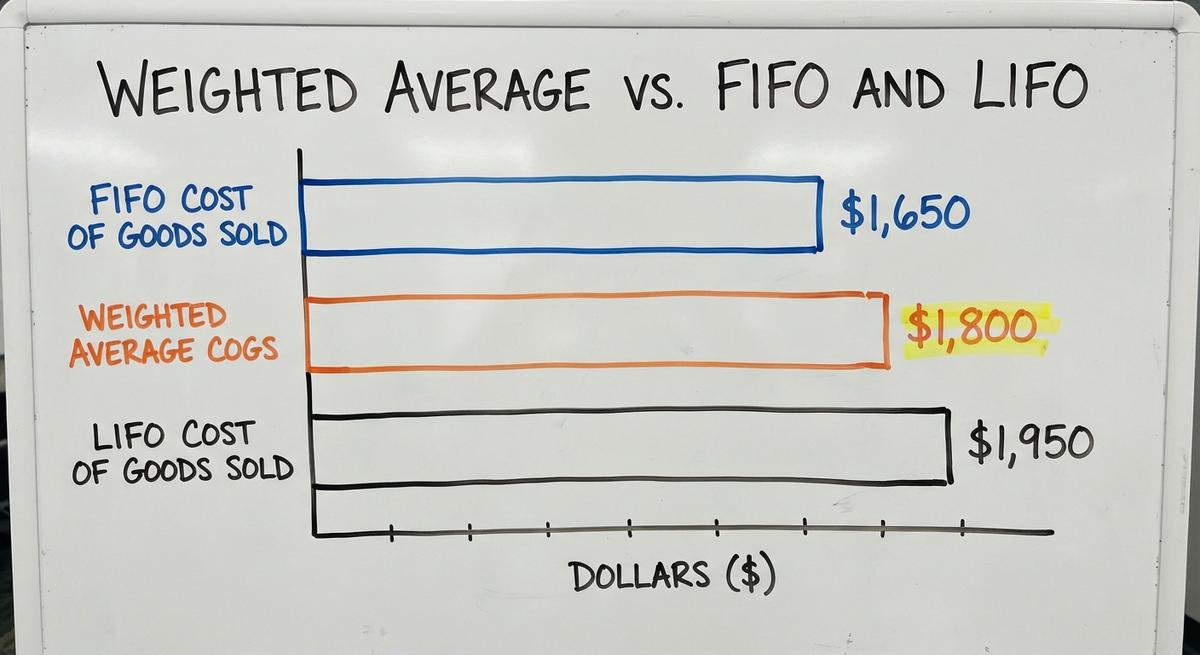
FIFO and LIFO are the two main rivals. FIFO is first in, first out, so the oldest units leave first. LIFO is last in, first out, so the newest units leave first. Weighted average lands between them.
Weighted Average vs. FIFO: Which Shows More Profit?
FIFO is the method that shows more profit when prices rise. FIFO sells your cheap, old stock first, so COGS drops. Inventory valuation FIFO also leaves the newest, pricier cost in the warehouse.
Using the same 150-unit sale from the example above:
| Method | COGS |
|---|---|
| FIFO | $1,650 |
| Weighted average | $1,800 |
| LIFO | $1,950 |
Pick the method that matches how stock really moves.
Not sure this is the right shape for your operation
Describe how the work runs today. We map it on a call and show you what it would look like built around that, before you spend anything.
Book a callWeighted Average vs. LIFO
LIFO is allowed under US GAAP but not under IFRS. The table shows LIFO at $1,950, the highest cost when prices rise. Higher cost means lower profit and lower tax.
Tax rules apply. The IRS has a conformity rule that links the books to the tax return for LIFO. Ask an accountant before you choose it. Weighted average inventory valuation sits between the two results and rarely draws that kind of review.
Which Businesses Fit Weighted Average Best?
Bulk goods are the best fit for weighted average. Four groups gain the most.
- Sellers of fasteners, packaged goods, and liquids can blend costs across many receipts with little effort.
- High-volume, low-cost items are not worth the work of lot tracking at all.
- Distributors who place small, frequent orders see unit costs change often, so averaging helps.
- Sellers of unique or serialized goods should look elsewhere for a better fit.
The more alike your units are, the better the average works.

What Data Do You Need for Weighted Average Costing?
Records are the base of every average. Four inputs matter most.
- Buy cost per receipt must match the vendor bill, not the original buy order.
- Landed cost is the full cost to get goods in the door, including freight and duties.
- Counts on hand must be reliable, so run cycle counts on a set schedule.
- Units of measure must convert cleanly, such as cases to each, in every record.
The Census Bureau tracks wholesale inventories and sales each month. Your own data matters more than any national figure.
The NIST Manufacturing Extension Partnership offers vendor-neutral guidance on inventory process. Accurate counts also protect your promise to ship on time, a duty set out in the FTC mail order rule.
Clean data makes the average worth trusting.
The comparison is easier when one option is built for you
Off-the-shelf means fitting your process to the software. We do it the other way round, and the first look costs nothing.
Book a callHow Freight, Discounts, and Returns Change the Average
Freight-in is part of landed cost, so add it to inventory cost. Say 200 units cost $2,600 and freight is $200. Your cost becomes $2,800, or $14 a unit.
- Vendor discounts lower the cost of that receipt and so lower the average.
- A return to a vendor removes units and their cost, so the average resets.
- Freight on goods you ship out is a selling cost, not an inventory cost.
Write down each rule and apply it the same way every time.
Common Mistakes to Avoid
4 mistakes cause most bad averages in weighted average costing.
- Mixing methods across items with no clear reason makes reports hard to compare later.
- Receiving stock late means the system sells goods at an old, outdated cost.
- Negative inventory, where you sell what the system thinks you lack, throws off every average.
- Unit of measure mismatches can turn a $12 case into a $12 each in the books.
Fix the data at the dock and the math takes care of itself.
Can an Accounting Package Handle Average Costing?
Many accounting packages are able to use average cost for inventory, so check the details for your version. Many small shops connect accounting software inventory to a count tool or a sheet.
The average depends on how receipts are entered. Enter a bill before the goods arrive and the cost lands early. Skip freight and the cost runs low. Side spreadsheets break the link, because the sheet and the books drift apart.
One entry path makes the average match your books.
When Spreadsheets Stop Working for Average Costing
Spreadsheets are fragile once volume grows. Watch for these signs.
- You track many SKUs and many receipts each week across several vendors.
- Staff update costs by hand instead of pulling them from the receiving record.
- Counts and costs live in separate files that nobody reconciles each month.
Copy and paste errors compound. One wrong cell feeds the next average. A clerk paid the BLS median wage for stock clerks still loses hours to fixing files.
You can automate only the manual steps and keep your accounting tools as they are.

How to Check Your Inventory Value Is Right
4 checks keep inventory value honest. Run them on a set schedule.
- Reconcile the inventory report to the general ledger at the end of each month.
- Spot-check 5 SKUs by hand with the weighted average formula shown above, and log results.
- Compare cycle counts to system counts, then log every gap for the team to review.
- Investigate any large swing in unit cost before you close the books.
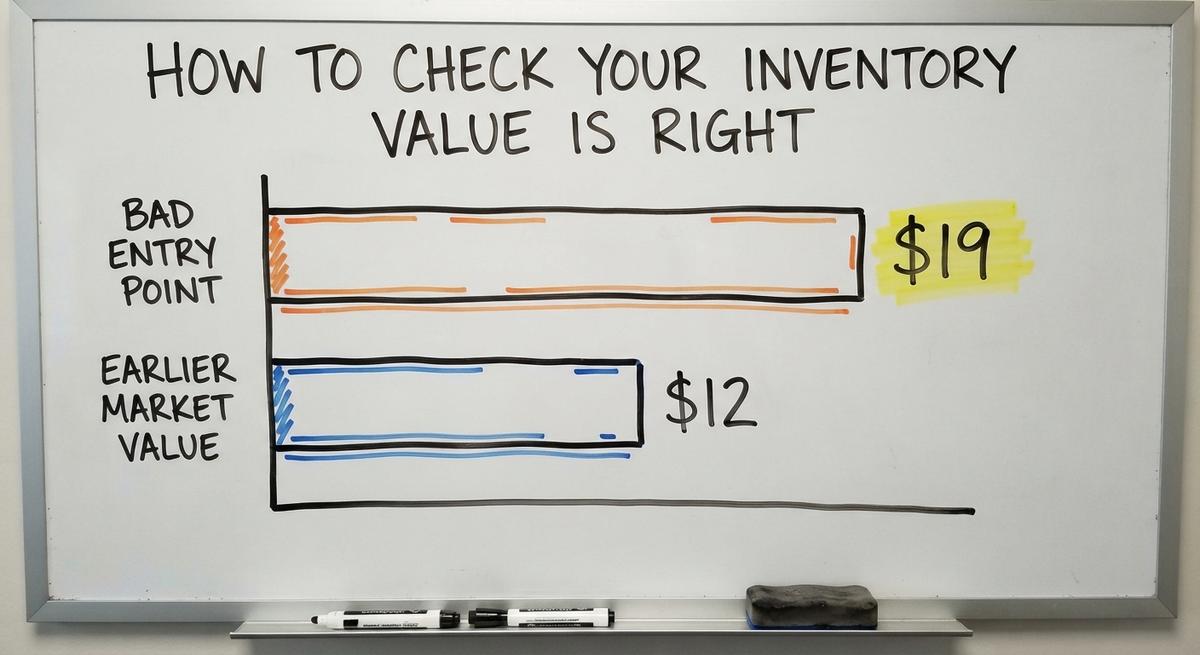
A swing from $12 to $19 in one month signals a bad entry, not a market move. Look there first.
See it running on your own process first
No build cost. The subscription starts once it is live and doing the job, not before.
Book a callCan You Switch From Weighted Average Inventory Valuation to Another Method?
A method change is allowed with a sound reason and steady use afterward. You cannot flip methods to chase a better profit number.
A tax change can need an IRS filing, often Form 3115. Talk to your accountant before you act. Document the date of the change. Record the effect on opening balances.
A written note today saves an audit headache later.

Next Steps
One SKU is your starting point. Work its weighted average by hand this week. Compare the result to your system. If the two differ, trace the receipts, freight, and counts. Bring the findings to your CPA before you change any method.
Frequently asked questions
How to calculate weighted average?
Add the cost of all stock available, then divide by all units available. For 300 units costing $3,600, the answer is $12 a unit. Multiply that number by units sold or units left.
How to do FIFO, LIFO, and weighted average?
Pick which cost sells first. FIFO sells the oldest layer first, LIFO sells the newest layer first, and weighted average blends all layers into one price. Then multiply that cost by units sold.
What is meant by the weighted average profit method?
People use the phrase for weighted average costing. Profit is sales minus cost of goods sold, and cost comes from the blended average. The method does not set profit by itself.
Is weighted average allowed under GAAP?
Yes. US GAAP accepts weighted average, FIFO, and LIFO. IFRS accepts weighted average and FIFO but bars LIFO. Pick one and apply it the same way each year.
How often should the average be recalculated?
Recalculate after each receipt if you run a perpetual system. A periodic system recalculates once at the close of the month or year. Daily receivers gain the most from the perpetual route.
Can I use it for some products and not others?
Yes, if you have a sound reason, such as serialized items needing exact cost. Apply the same method to similar goods, and record why each group differs. Ask your CPA about tax effects.
Start with a free first look
A 30 minute call, your operation mapped, and a clear picture of what we would build. No obligation and nothing to install.
Book a callRelated guides
More on the same work.
Guides
- Moving Average Method Inventory
- Specific Identification Inventory Method
- Inventory Pricing Methods
- Inventory Valuation Fifo
- Average Days to Sell Inventory Formula
- Cogs Average Inventory
- Inventory Accuracy Formula
- Cycle Counting Inventory
- Inventory Audit Checklist
- Inventory Audit
- Inventory Management Best Practices
- Inventory Shrinkage Accounting Entry
- Inventory Shrinkage is Recorded When
- Calculate Inventory Shrinkage
- Inventory Accuracy
- Inventory Process Flow
- Warehouse Inventory Management Software
- Warehouse Inventory Tracking Software
- Warehouse Inventory Management Systems