


Cycle Count in Warehouse
A cycle count in warehouse work is a small count of 20 to 30 items, done on a set schedule. Staff count a few items each day. Over a year, every item gets checked, and no one shuts the floor. Reviewed November 2026.
Book a call
What Is a Cycle Count in a Warehouse?
A cycle count is a count of a small part of your stock on a regular schedule. Staff count a few bins or items each day. Normal work keeps running while they count.
The goal is plain. The system record must match what sits on the shelf. That match is called inventory accuracy.
Over a year, the team counts every item. Fast movers get counted many times. Slow movers get counted once or twice.
Some readers want a wider primer on what is cycle counting in inventory management. The core idea fits in one line: count a little, every day, and fix what you find.
Cycle Count vs. Full Physical Inventory
A full physical inventory count checks every item on one day. Most firms do it once a year. Many close the doors for a day or a weekend to finish it.
A cycle count works in small pieces all year. Nobody shuts down.
OSHA says the industry includes "establishments operating facilities for general merchandise, refrigerated goods, and other products." Those floors have trucks and people moving all day. A rushed shutdown count adds stress to that mix.
Here is how the two compare:
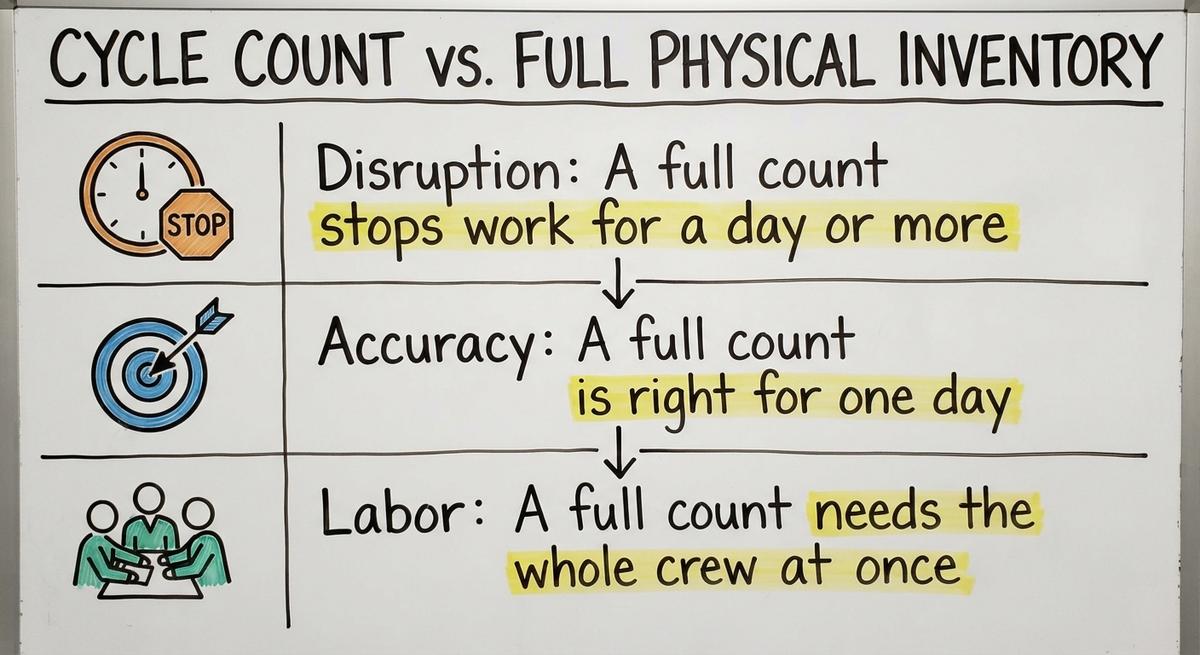
- Disruption: A full count stops work for a day or more. A cycle count pauses only the bins in hand.
- Accuracy: A full count is right for one day. Cycle counts keep records close to right all year.
- Labor: A full count needs the whole crew at once. A cycle count needs 1 person for an hour or two.
Some firms still run one yearly count for the books. Cycle counts make that count a quick check.
We build it for your operation, and the first look is free
If you would rather not compare products, describe how your operation already works and we build the system around it.
No build cost. You see it running on your own process first, and the monthly subscription starts only once it is live.
Book a callWhy Does Cycle Counting Matter for Small and Mid-Size Warehouses?
Cycle counting matters because a small team cannot stop work for a weekend. A daily count of 25 items takes about 1 hour and keeps orders moving.
Errors show up while the cause is still fresh. A wrong pick on Tuesday is easy to trace on Wednesday. It is hard to trace in December.
Clean counts bring real gains:
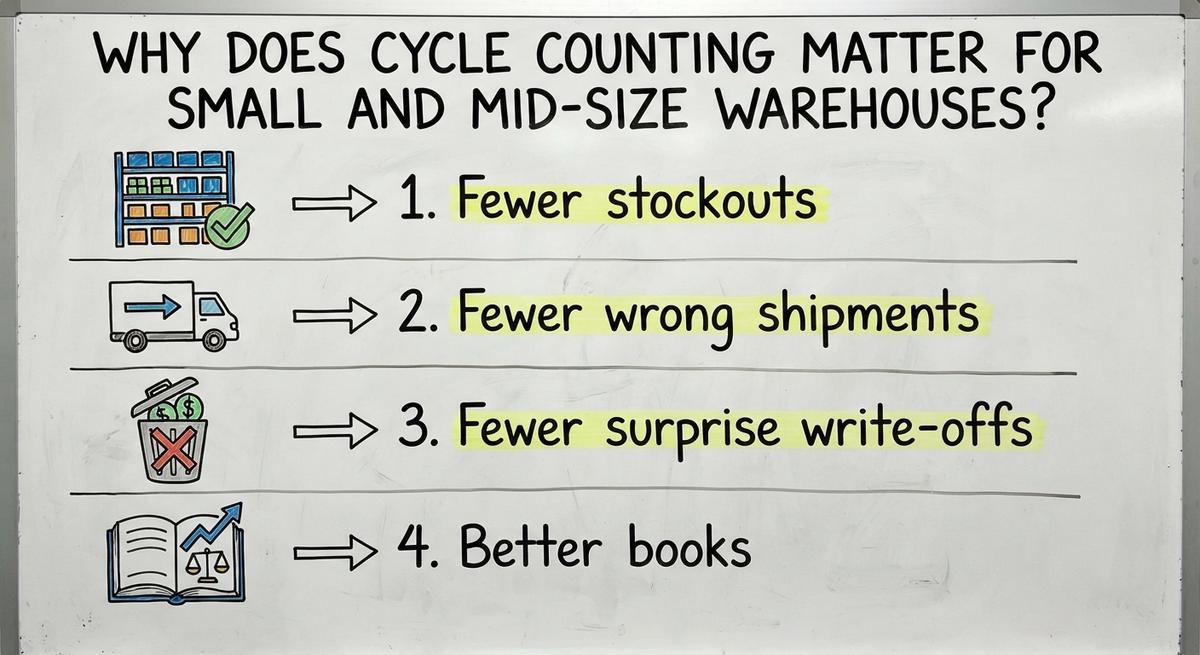
- Fewer stockouts: Buyers see true stock, so they reorder on time and not after a customer calls.
- Fewer wrong shipments: Pickers find the item where the record says it sits, so orders go out right.
- Fewer surprise write-offs: Small gaps get fixed each week, so no large loss waits for the year-end count.
- Better books: The IRS is plain on the duty: "you must value your inventory at the beginning and end of each tax year."
True numbers help both the books and the buyer.
Signs Your Warehouse Needs Cycle Counting
Four signs show that a warehouse needs cycle counting now. One sign is a nuisance. Two or more mean the records are not safe to trust.
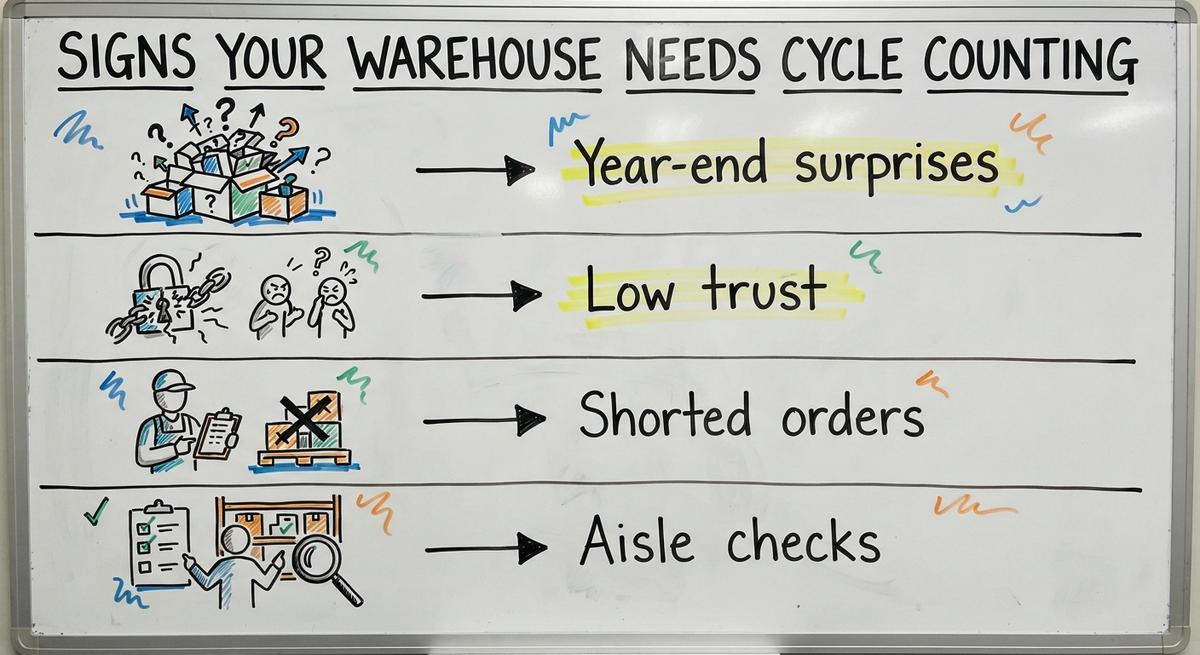
- Year-end surprises: The yearly count finds big gaps, and no one can say when or how they began.
- Low trust: Staff do not believe the on-hand numbers, so they keep their own notes and tallies.
- Shorted orders: Orders ship short or go on backorder when the system shows stock as available.
- Aisle checks: Employees walk the aisles to look before they promise a customer anything.
Picture a 20-person distributor. A sales rep calls the floor before every big quote. That call costs a few minutes each time. Across a year, those minutes add up to days.
When staff stop trusting the screen, the records have already failed.
Not sure this is the right shape for your operation
Describe how the work runs today. We map it on a call and show you what it would look like built around that, before you spend anything.
Book a callMain Types of Cycle Count Methods
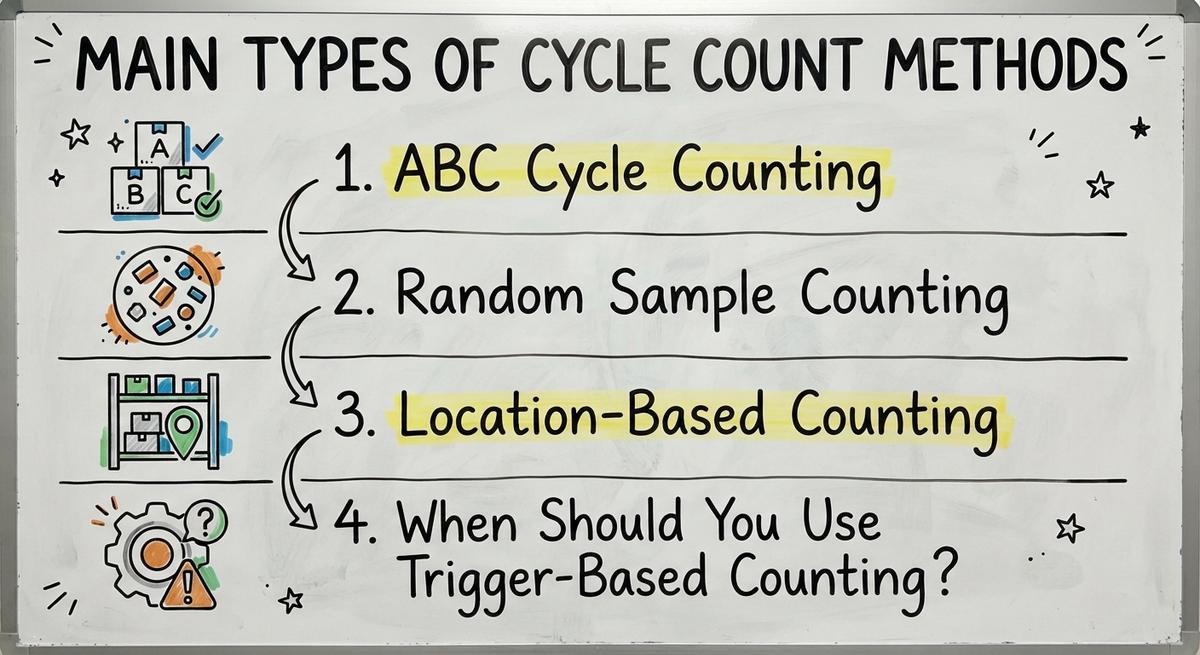
There are 4 main methods for cycle counting inventory. Each one picks the daily list in a different way. The right pick depends on your products and your team size.
You do not need to choose just one. Many small teams run abc cycle counting as the base plan. They add trigger counts on top for problems that pop up.
The next four sections cover each method in turn. Read them with your own item list in mind.
The best method is the one your crew will still follow in 6 months.
ABC Cycle Counting
ABC cycle counting sorts items by value or speed and counts the top group most. It is the most common method for distributors.
- A items: These are high in value or move fast. Count them most often.
- B items: This middle group gets counted less often.
- C items: These are low in value or slow. Count them least.
Take a 20-person distributor with 1,000 items. Say 100 are A, 300 are B, and 600 are C. Count A monthly, B quarterly, and C twice a year.
That is 1,200 counts for A, 1,200 for B, and 1,200 for C. The total is 3,600 counts a year. Over 250 workdays, that is about 14 counts a day.
The ABC plan puts your effort where a mistake costs the most.
Random Sample Counting
Random sample counting means you pick items or bins by chance each day. A spreadsheet can draw 20 random rows in seconds. The crew then counts those 20.
This method is easy to start. It needs little setup and no item grades.
It works well for spotting broad problems. If 6 of 20 bins are wrong, the whole floor has a habit that needs a fix.
The weakness is plain. Chance may skip a key item for months. A top seller might not come up for a long stretch.
Random counts suit a first month, and ABC grades can follow once the habit sticks.
Location-Based Counting
Location-based counting means you count one aisle, rack, or zone each day. The list follows the layout of the building, not the item grade.
This method works best when bins carry clear labels. The counter walks one path and checks every bin on it.
It also cuts walking. The counter does not zigzag across the floor. Fewer trips also mean less double handling of stock.
A 10-aisle warehouse can count 1 aisle a day and cover the floor in 2 weeks. Busy aisles can repeat sooner.
Location counts save steps, but only if every bin has a label that a stranger can read.
When Should You Use Trigger-Based Counting?
Use trigger-based counting when a signal says a record is wrong. The count happens at once, not on a calendar date.
Common triggers include:
- Zero or negative stock: A record that drops below zero cannot be right, so count that bin today.
- A short pick: The picker cannot find the item, so someone should count the bin and its neighbors.
- A big receipt: A large delivery is easy to enter wrong, so count it before the stock is put away.
- A returned item: Returns often go to the wrong bin, so check the home bin after each one.
Trigger counts catch errors at the moment they appear.
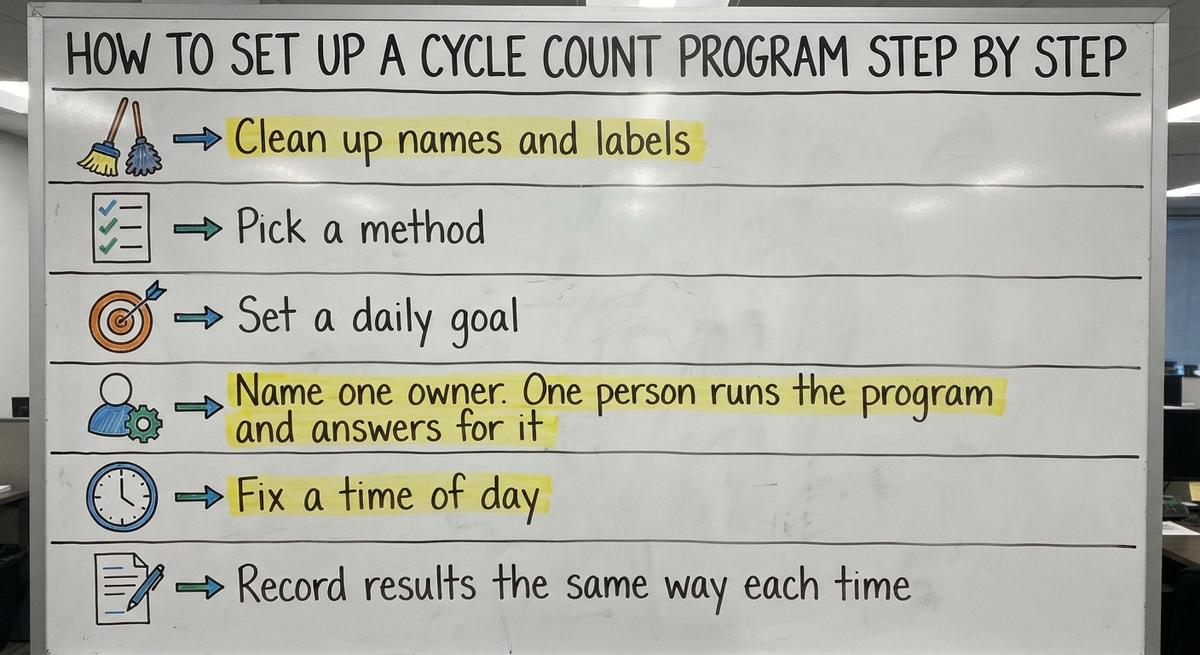
How to Set Up a Cycle Count Program Step by Step
A cycle count program takes 6 steps to set up. Most small teams finish them in one to two weeks. Do them in order.
- Clean up names and labels. Give each item one name and one code. Label every bin in plain, large print.
- Pick a method. Start with random or ABC counts. Add triggers later.
- Set a daily goal. Begin with 20 to 30 items. Adjust after 2 weeks.
- Name one owner. One person runs the program and answers for it.
- Fix a time of day. Count early, before the rush, when bins are quiet.
- Record results the same way each time. Use one sheet layout and one log.
Step 1 matters most. Two names for one item will make every count look wrong.
A program with a clear owner and a fixed hour survives a busy season.
The comparison is easier when one option is built for you
Off-the-shelf means fitting your process to the software. We do it the other way round, and the first look costs nothing.
Book a call
How Often Should You Count Each Item?
Count frequency depends on 3 things: value, speed, and error history. A fast, costly item with past errors needs the most counts. A slow, cheap item needs the fewest.
Start small. A cycle count schedule of 20 to 30 items a day is enough for a first month. Then adjust.
Here is a sample plan by team size:
| Team size | Daily count goal |
|---|---|
| 5 to 15 staff | 10 to 20 items |
| 16 to 50 staff | 20 to 40 items |
| 51 to 100 staff | 40 to 100 items, split across 2 counters |
Count more often where errors keep showing up. A bin that is wrong twice in a row should be counted weekly until it stays right.
Let the error history, not the calendar, set the pace.
How to Run a Single Count Day
A count day is a short routine of about 1 to 2 hours. The steps are the same each day. A fixed routine cuts mistakes and speeds the work.

Set up the list
Print the count list or load it on a phone. Pause movement for the bins on the list. Tell the pickers which bins are closed that morning.
A short pause keeps the count clean. Stock that moves mid-count gives a false gap.
Count blind
The counter does not look at the system number first. Seeing it can sway the count. A blind count is more honest.
The counter writes the number found on the sheet. Count full cartons and loose units, and write the unit type.
Recount and record
When the count and the record differ, count again. A second look often finds a simple slip. Ask a second person if the gap stays.
Log the result before you leave the bin.
A blind count with a recount gives you a number you can trust.

What to Do When the Count Does Not Match
When the count does not match, set a tolerance first. A tolerance is the size of gap you accept without a deep look. For example, 2 units or $25 on a low-cost item.
Check the records first
Look at recent receipts, picks, returns, and transfers for that item. A pick entered twice or a late receipt is a common reason.
If the records explain the gap, fix the entry and move on.
Find the root cause
Ask why the gap happened, not just how to fix it. Was the unit of measure wrong? Was the item in a nearby bin?
Then adjust the record. Write a note and sign it with a name. Inventory adjustments with no note are hard to trust later.
A fix with no cause found will come back next month.

Common Causes of Inventory Errors
Five causes explain most inventory discrepancies in small warehouses. Knowing them helps you read a count gap like a clue.
- Mis-picks and unit errors: A picker grabs a case instead of an each, or picks a similar item by mistake.
- Receiving errors: Counts on the dock are wrong, and returns sit in a corner and never get logged.
- Wrong bin: Staff put stock in any open space, so the record shows one place and the item sits in another.
- Manual entry: Numbers copied from paper sheets or spreadsheets pick up typos along the way.
- Damage and theft: Broken or missing goods are not always written off when they happen.
Most errors start at the dock or the pick face, so count there first.
See it running on your own process first
No build cost. The subscription starts once it is live and doing the job, not before.
Book a call
What Cycle Count Mistakes Should You Avoid?
Avoid 4 cycle count mistakes: no follow-up, a single counter, skipped weeks, and silent edits. Each one weakens trust in the numbers.
- No follow-up on causes: Counting without a fix just records the same gap again and again.
- Mover as only counter: The person who moves stock should not be the only one who checks it.
- Skipping busy weeks: Busy weeks are when errors grow, so keep even a small count going.
- Changing numbers with no notes: Every edit needs a reason and a name, or the log is useless.
A program that skips the hard weeks fails when it is needed most.

Metrics That Show the Program Is Working
Four numbers show whether your program works. Track them each month, and plot them on one sheet. The Warehousing Education and Research Council publishes a standard set of distribution center measures if you want to compare.
- Inventory record accuracy: Divide the bins that match by the bins counted, then show it as a percent.
- Adjustments: Track how many you make and how large each one is in units and dollars.
- Repeat error spots: List bins and aisles that miss twice or more in a quarter.
- Stockouts and shorted orders: Count them each month and watch the trend line fall.
If accuracy rises and shorted orders fall, the program pays for itself.
Tracking Counts When You Run on Accounting Software and Spreadsheets
Many small distributors keep the books in an accounting package. They count stock on paper and in spreadsheets. That setup works if you keep it tidy.

Risks of copied data
Every copy of a number is a chance for error. Three risks stand out:
- Copied data: Typing a paper count into a sheet, then into the books, adds two spots for typos.
- Version confusion: Two staff edit two copies of one file, and no one knows which is right.
- Lost sheets: A clipboard left in a truck cab takes a day of counts with it.
Keep a clear count log
A count log is one sheet that holds every count. Give each row these fields: date, counter, bin, expected, counted, and reason.
Manual work has a price. Take 3 people who spend 6 hours a week on count sheets at $22 an hour. That is $20,592 a year. The US Bureau of Labor Statistics lists pay for shipping, receiving, and inventory clerks. Use your own pay rates.
When manual tracking costs more than it saves, it is time to change it.
When Manual Counting Tools Stop Being Enough
Manual tools stop being enough when the paper costs more than the errors. Three signs tell you:

- Piled sheets: Count sheets stack up faster than anyone can enter them.
- Slow adjustments: Inventory adjustments take hours to post to the books.
- Repeat errors: The same bins miss month after month.
Fix the manual steps first. Clean labels, one log, and a fixed routine help a great deal. You need no giant system change to get there. The NIST Manufacturing Extension Partnership offers vendor-neutral guidance on supply chain and inventory process.
If you do look at cycle count software, check for 3 things:
- Handheld or phone counts: Staff count at the bin and skip the paper step.
- Adjustment history: Every change shows who made it, when, and why.
- Ties to accounting: Counts flow to the books without retyping.
Barcodes help too. GS1 sets the standards that let a code printed by one firm scan at another. The Auburn University RFID Lab publishes independent research on tags for supply chains.
Fix the habits first, then pick tools that fit the habits you have.

Start Your First Count This Week
Pick 20 items today. Print a list. Count them blind, log the gaps, and ask why each one happened. Repeat tomorrow.
If paper and copied numbers slow you down, talk with a software partner about fixing your workflow. Bring your count log, and ask for steps that fit the way your team works.
Small counts, done daily, build records you can trust.
Frequently asked questions
Is a cycle count the same as a physical inventory count?
No. A physical inventory counts every item on one day and often stops work. A cycle count checks a small set each day, so the whole stock gets covered over the year.
How many items should be counted each day?
Start with 20 to 30 items for a team of 5 to 100. Watch how long it takes, then adjust. Raise the number once the crew finishes without delaying orders.
What is ABC cycle counting?
ABC cycle counting ranks items by value or speed. Top items get counted most, middle items less, and low items least. A common plan is monthly, quarterly, and twice a year.
Who should do the counting?
Use someone who does not move that stock. A second set of eyes catches more. In a small team, swap roles weekly so no one counts their own picks.
What is a good inventory accuracy rate?
Most teams aim for 95% or higher on item counts. Set your own goal from your starting point. Raise it as errors fall and habits settle.
Can a small warehouse run cycle counts without special software?
Yes. Printed sheets, a spreadsheet, and a clear log are enough to start. Add tools later if sheets pile up or adjustments take hours.
Which items should be counted first?
Count fast movers and high-cost items first. Add items with past errors next. Slow, cheap items can wait for later cycles.
Start with a free first look
A 30 minute call, your operation mapped, and a clear picture of what we would build. No obligation and nothing to install.
Book a callRelated guides
More on the same work.
Guides
- Cycle Count Software
- Cycle Counting Inventory
- Abc Cycle Counting
- Cycle Counting
- Inventory Counting Software
- Warehousing Processes
- Receiving Process Warehouse
- Warehouse Inventory Management Software
- Warehouse Inventory Tracking Software
- Warehouse Inventory Management Systems
- Pick and Pack in Warehouse
- Warehouse Receiving Software
- Warehouse Inventory Systems
- Warehouse Stock Management Software
- Warehouse Management System Top 10
- Software for Warehouse Management System
- Warehouse Shipment
- Warehouse Tracking System
- Warehousing Operations
- Inventory and Warehouse Management Software