

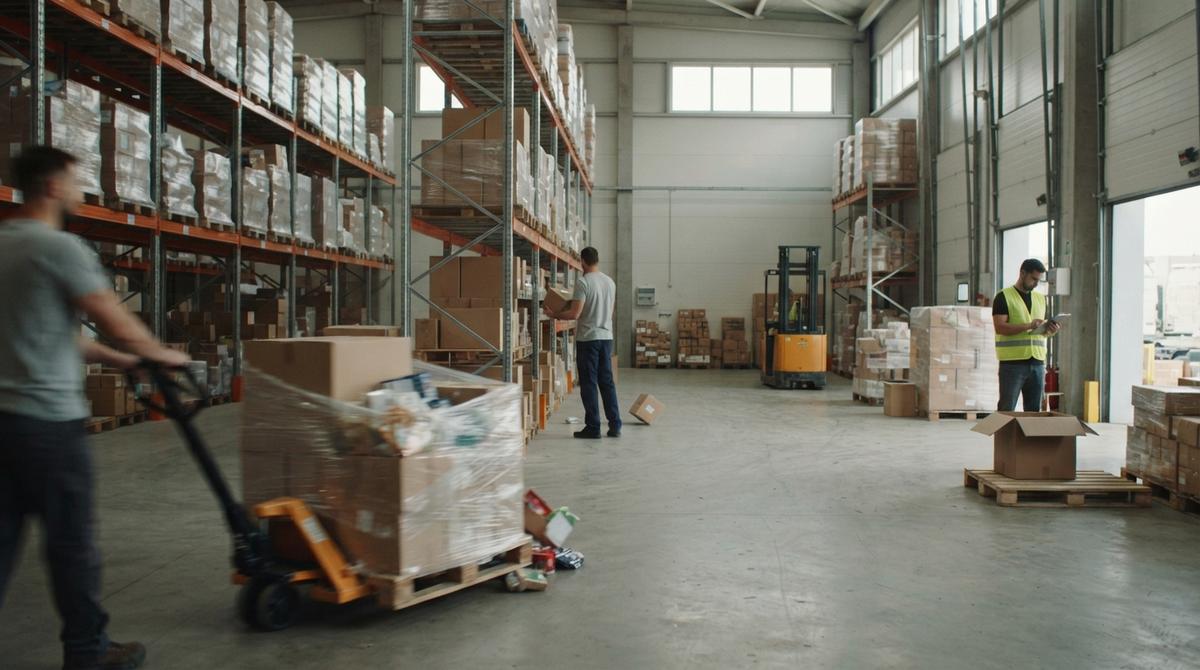
What Common Events Could Result in Inventory Shrinkage
Inventory shrinkage is the gap between the stock your records show and the stock on your shelves. Theft causes some of it. Damage, receiving errors, picking mistakes, bad counts and spoilage cause most of it. Most causes are process gaps, not crime. Small and mid-size warehouses can fix most of them with simple habits. Reviewed November 2026.
Book a call
What Is Inventory Shrinkage?
Inventory shrinkage is the loss of stock on paper or on the shelf. The system says 100 units. The shelf holds 94. The 6 missing units are shrinkage.
Shrinkage is the result. The events below are the causes. Price the gap to see the stakes. At $12 a unit, 6 missing units cost $72. Repeat that across 200 items and the loss is real money.
A small gap in a small warehouse still hurts. You sell stock you do not have, or you buy stock you already own.
What Common Events Could Result in Inventory Shrinkage?
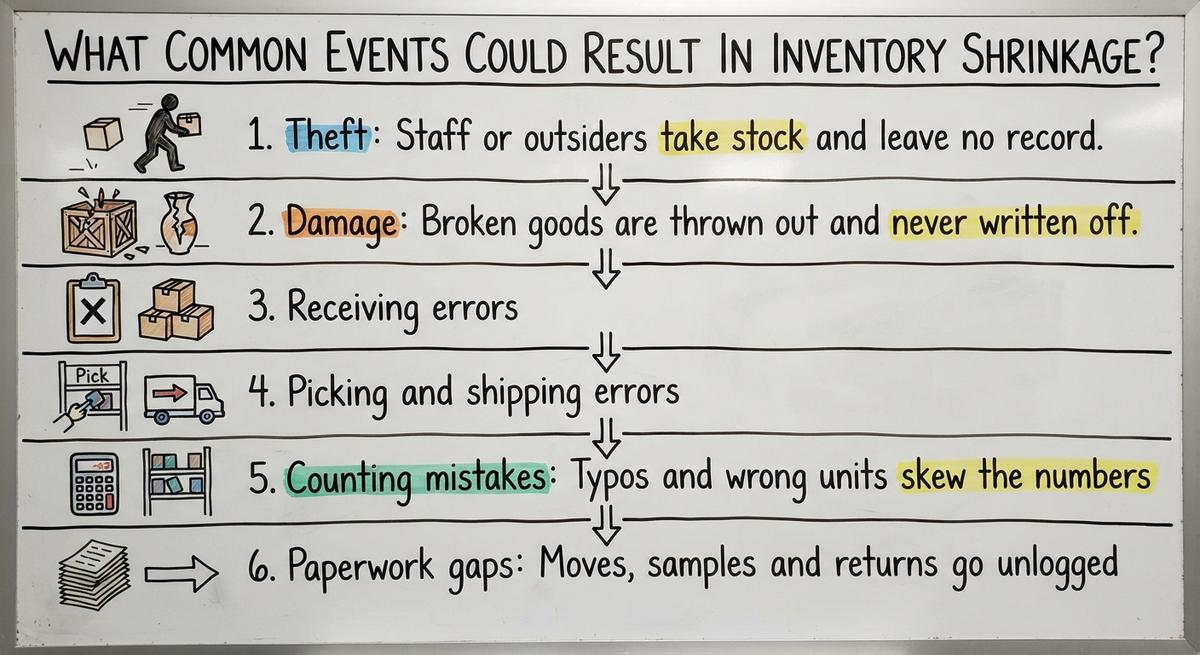
Eight common events cause inventory shrinkage. Most are accidents, not crime.
- Theft: Staff or outsiders take stock and leave no record.
- Damage: Broken goods are thrown out and never written off.
- Receiving errors: The dock accepts a short or wrong delivery as complete.
- Picking and shipping errors: Wrong items or extra units go out the door.
- Counting mistakes: Typos and wrong units skew the numbers.
- Paperwork gaps: Moves, samples and returns go unlogged.
- Spoilage or expiry: Dated goods pass their window.
- Vendor shortages: Suppliers ship less than they bill.
Scan-based counts rely on the barcode standards from GS1, the group that sets them. A clean scan at each step keeps the record honest.
The National Retail Federation runs a yearly security survey on retail loss. Its 2022 edition "was conducted in partnership with the Loss Prevention Research Council." Theft is only one line in that picture.
We build it for your operation, and the first look is free
If you would rather not compare products, describe how your operation already works and we build the system around it.
No build cost. You see it running on your own process first, and the monthly subscription starts only once it is live.
Book a callDoes Theft Cause Inventory Shrinkage?
Yes, theft causes inventory shrinkage, but it is one cause of many. Theft comes from two places: inside your team and outside it.
Does Employee Theft Cause Shrinkage?
Yes, internal theft is a real cause. It is rarely the biggest one.
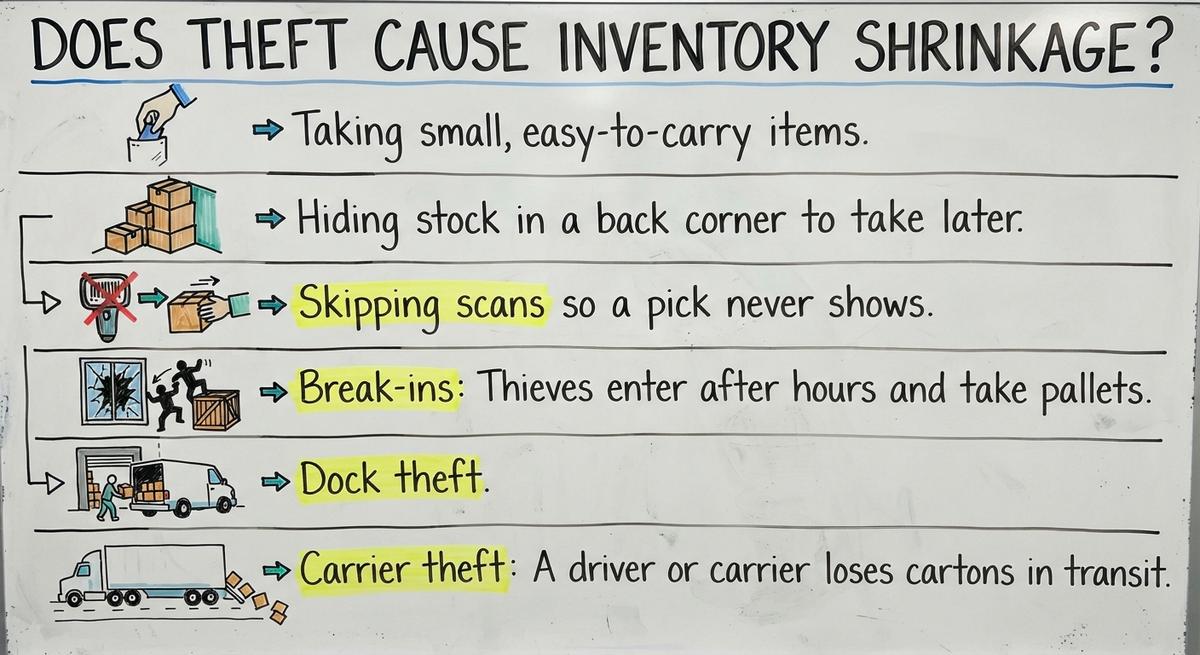
Common forms are small and quiet:
- Taking small, easy-to-carry items.
- Hiding stock in a back corner to take later.
- Skipping scans so a pick never shows.
Open stockroom access and no sign-out record make this easy. Weak controls invite problems. Good people can still slip when no one checks. A sign-out sheet fixes much of it.
How Does Outside Theft Lead to Shrinkage?
Outside theft is stock taken by people who do not work for you. Four paths are common:
- Break-ins: Thieves enter after hours and take pallets.
- Dock theft: Goods walk off an unattended loading dock or an unlocked bay.
- Carrier theft: A driver or carrier loses cartons in transit.
- Fake paperwork: Someone shows altered pickup papers and leaves with an order.
A locked bay and a check of every pickup slip close most of these doors.
Not sure this is the right shape for your operation
Describe how the work runs today. We map it on a call and show you what it would look like built around that, before you spend anything.
Book a callHow Do Damage and Receiving Errors Cause Warehouse Shrinkage?
Damage and receiving errors are two of the most common causes of warehouse shrinkage. One removes stock. The other starts the record wrong.

Damage in the Warehouse
Damage is any harm to stock that makes it unsellable. Forklift hits, dropped boxes, crushed pallets and water leaks all count.
A worker tosses a crushed carton and moves on. The stock leaves the shelf. It stays in the count. That is a gap with no cause on file.
The fix is a written damage log. Every tossed item needs a line. Proper inventory write-offs, the entries that remove lost stock from your books, keep the count true.
Can Receiving Errors Cause Shrinkage?
Yes, receiving errors cause shrinkage from day one. A receiving error is a wrong entry made when goods arrive.
Watch for these:
- A short shipment is accepted as complete.
- The wrong item or quantity is typed in at the dock.
- Staff skip the check against the buy order.
A truck brings 48 cartons. The slip says 50. If the dock logs 50, the system is 2 cartons high before anyone sells a unit. Count at the dock, every time.

How Do Picking, Shipping and Counting Errors Cause Inventory Discrepancies?
Picking, shipping and counting errors create inventory discrepancies, which are mismatches between your records and your stock. Some are real losses. Some exist only on paper.
Picking and Shipping Mistakes
A picking mistake is the wrong item or count leaving the building. Four things drive it:
- A picker sends the wrong item or one extra unit.
- An order ships and no one records it.
- Bin locations get mixed up, or two products look alike.
- A return comes back and never gets matched to stock.
The US Federal Trade Commission expects you to ship when you said you would. An accurate count helps you keep that promise.
Counting and Data Entry Errors
Counting and data entry errors do count as shrinkage in your numbers. They are paper losses, not physical ones. They still distort what you think you own.
Three slips repeat:
- Typos and double entries.
- The wrong unit, such as each versus case. A case of 12 typed as 12 cases is 132 extra units.
- Re-keying from paper sheets to spreadsheets to an accounting package, where each hand-off adds new mistakes.
Fewer hand-offs mean fewer errors. IRS Publication 538 is plain: "you must value your inventory at the beginning and end of each tax year." Bad counts feed bad tax numbers.
How Do Spoilage, Expiry and Vendor Errors Cause Shrinkage?
Spoilage, expiry and vendor errors cause shrinkage when stock loses value or never arrives. Each leaves a gap no one logged.
How Do Spoilage and Expiry Cause Shrinkage?
Spoilage and expiry cause shrinkage when dated goods pass their window and get thrown away. Old stock that sits until it is unsellable does the same.
The trap is the disposal. A manager bins 40 expired units and logs nothing. The system still shows 40 on the shelf. Log each disposal as a write-off the day it happens.
Can Vendor Errors and Unrecorded Transfers Cause Shrinkage?
Yes, vendor errors and unrecorded transfers both cause shrinkage. A vendor error is a supplier shipping less or labeling cartons wrong.
Watch for three more:
- A supplier short-ships and the dock does not notice.
- Stock moves between locations or sites with no record.
- Samples, giveaways and internal use never get logged.
Every move needs a record, even a free one. The NIST Manufacturing Extension Partnership offers vendor-neutral guidance on supply chain process.
The comparison is easier when one option is built for you
Off-the-shelf means fitting your process to the software. We do it the other way round, and the first look costs nothing.
Book a call
What Are the Warning Signs of Shrinkage?
Four warning signs show inventory shrinkage is already at work. Spot them early and the fix costs less.
- Missed counts: Your count results keep missing the system total.
- Phantom stock: You hit stockouts on items the system says you have.
- Repeat shorts: The same items come up short again and again.
- Growing gaps: The gap widens between full counts.
One miss is noise. A pattern is a signal. Act on the pattern.
How Can You Find Which Event Is Causing Your Shrinkage?
You find the cause of shrinkage by testing small and sorting what you learn. Cycle counting is a method of counting a few items each day instead of the whole warehouse at once. 20 items a day for 5 days is 100 items a week, with no shutdown.
Try these steps:
- Run cycle counting on a few items at a time, starting with fast movers.
- Sort every gap by cause: receiving, picking, damage or unknown.
- Record who, when and where for each adjustment.
- Cut manual re-entry between sheets and your accounting package.
- Fix the biggest cause first, then repeat.
The cause with the most lines on your sheet gets fixed first. If the terms feel new, read what is warehousing and inventory management for the basics.
Next Steps for Your Warehouse
If manual re-entry drives your errors, look into what is the best inventory management software for small business. Choose a tool that scans at the dock and logs every move. Then book a short review of your counts and receiving steps with any provider you trust.
Start with one week of honest data. Log every gap by cause and look at the top one. Most small warehouses find a process gap, not a thief.
Frequently asked questions
What is the most common cause of inventory shrinkage?
Process errors are the most common cause. Receiving mistakes, wrong picks and bad data entry add up faster than theft in most small warehouses. Track gaps by cause to see your own top one.
Is shrinkage always caused by theft?
No. Theft is one cause among many. Damage, counting slips, spoilage and unlogged moves create gaps with no thief involved. Check your process before you blame people.
How do receiving and shipping errors cause shrinkage?
Receiving errors log the wrong amount when goods arrive. Shipping errors send out the wrong item or extra units, or skip the record. Both leave the system out of step with the shelf.
Can bad record keeping cause shrinkage?
Yes. Missing write-offs, unlogged transfers and re-keyed numbers all create paper gaps. The stock may be fine, but the numbers say otherwise. Cleaner records close these gaps fast.
How do you find the cause of shrinkage in a warehouse?
Count a few items each day and sort every gap by cause. Log who, when and where for each fix. The cause that appears most is the one to tackle first.
How often should a small warehouse count stock?
Count a small set of items every day or week, and do a full count once or twice a year. Frequent small counts catch errors before they grow.
Start with a free first look
A 30 minute call, your operation mapped, and a clear picture of what we would build. No obligation and nothing to install.
Book a callRelated guides
More on the same work.
Guides
- Inventory Shrinkage Accounting Entry
- Inventory Shrinkage is Recorded When
- Calculate Inventory Shrinkage
- Event Inventory Software
- Cycle Counting Inventory
- Inventory Audit Checklist
- Inventory Audit
- Inventory Management Best Practices
- Moving Average Method Inventory
- Inventory Process Flow
- Warehouse Inventory Management Software
- Warehouse Inventory Tracking Software
- Warehouse Inventory Management Systems
- Best Inventory Software
- Quickbooks Inventory Management Software
- Warehouse Inventory Systems
- Classification of Inventory
- Inventory and Warehouse Management Software