

What is Holding Cost in Inventory Management
Holding cost in inventory management is what it costs to keep unsold stock. Learn the four parts, the formula, a worked example, and ways to cut it.
Book a callWhat Is Holding Cost in Inventory Management?
Holding cost is what it costs to keep unsold stock on your shelves for a period of time. Many people call it carrying cost. Firms usually show it as a percent of inventory value per year. It is a real cost even when no invoice arrives. That is why owners miss it.
Reviewed November 2026.
The two names mean the same thing.
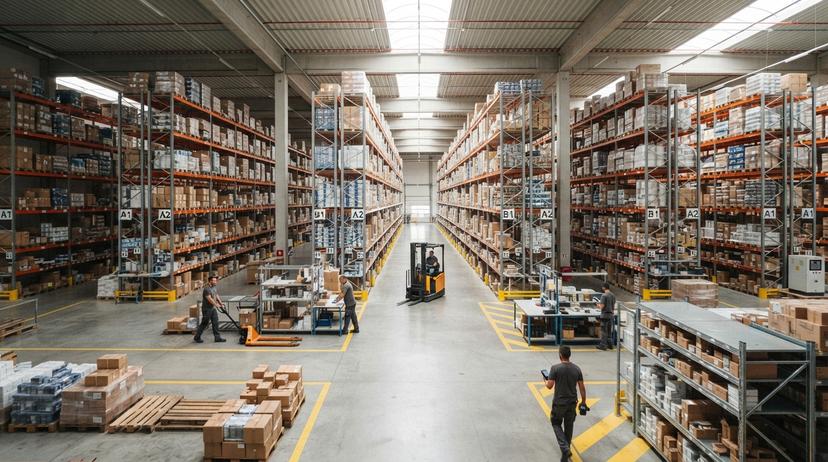
A simple picture helps. A pallet of goods bought for $10,000 does not cost $10,000 and stop there. Each month it sits, it also costs cash, space, insurance, and risk. The longer it waits, the more it costs.
We build it for your operation, and the first look is free
If you would rather not compare products, describe how your operation already works and we build the system around it.
No build cost. You see it running on your own process first, and the monthly subscription starts only once it is live.
Book a callWhat Costs Make Up Holding Cost?
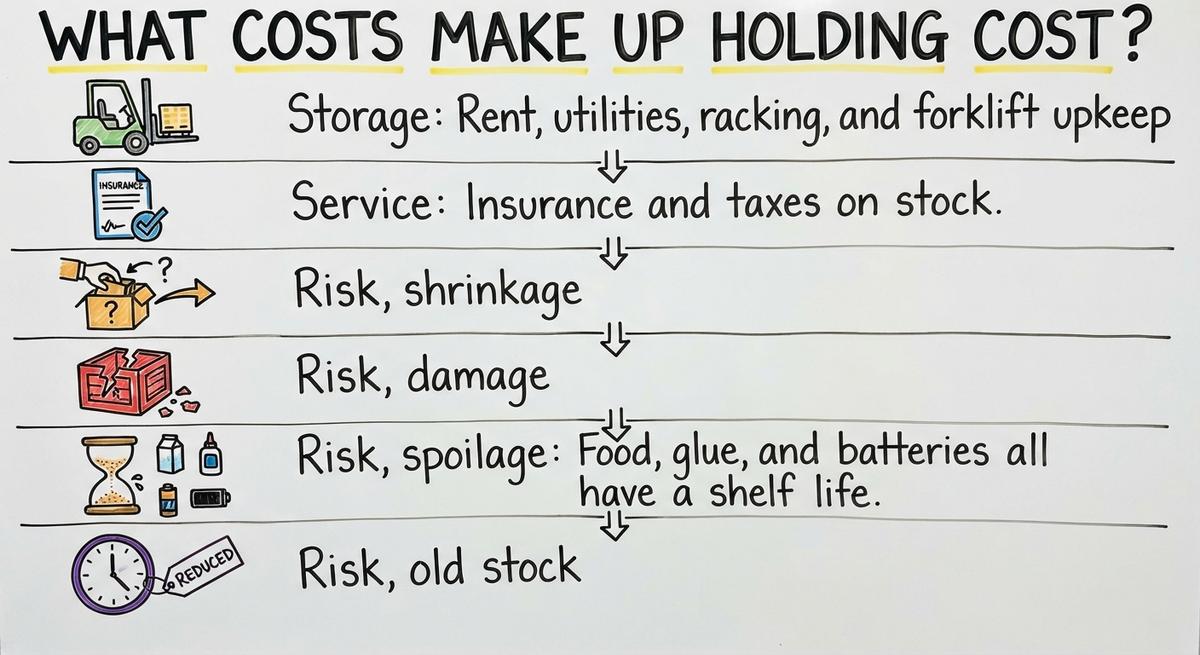
Holding cost has 4 groups of cost: capital, storage, service, and risk. The next sections cover each one. Most owners count only rent and forget the rest. That makes the true number look far smaller than it is.
Good records start with good labels. GS1 calls its barcode standards "the global language of business," and you can read about them on the GS1 barcode standards page. Scans that match your records make every cost below easier to track.
What Is Capital Cost in Holding Inventory?
Capital cost is the money tied up in stock, and it is often the biggest piece of holding cost. Cash on a shelf cannot pay bills or buy other goods. It also has a price. That price is the interest on a loan, or the return you could earn elsewhere.
Take a round example. A distributor holds $400,000 of stock. The owner pays 8% on a credit line. The yearly capital cost is $32,000. No invoice shows that number, but the cash is gone all the same.
Storage, Service, and Risk Costs
The other 3 groups add up fast in a warehouse. Each one has its own bills and its own blind spots. Here are examples from a wholesale setting:
- Storage: Rent, utilities, racking, and forklift upkeep. Labor to move and count goods belongs here too.
- Service: Insurance and taxes on stock. Software fees and handling costs also count.
- Risk, shrinkage: Stock that goes missing between receiving and shipping.
- Risk, damage: A forklift tip or a leaking roof ruins a full pallet.
- Risk, spoilage: Food, glue, and batteries all have a shelf life.
- Risk, old stock: A part for a model that no one makes anymore will not sell.
Each group is small by itself. Together they often rival the interest bill.
How Do You Calculate Holding Cost?
The inventory holding cost formula is simple: add your capital, storage, service, and risk costs for a year. Divide by total inventory value. Multiply by 100. The result is your holding cost rate.

Holding cost rate = (capital + storage + service + risk costs) ÷ total inventory value × 100
Here is a worked example. A distributor holds $500,000 of stock. Yearly costs are:
- Capital: $40,000
- Storage: $50,000
- Service: $15,000
- Risk: $20,000
The total is $125,000. Divide by $500,000 and you get 0.25. Multiply by 100 and the rate is 25%.
Holding Cost for One Item
To cost a single item, use this: item value × rate × time held. Take a $2,000 pallet held for 6 months at 25%. Multiply $2,000 by 0.25 and by 0.5 years. The pallet cost $250 to hold.
Many sources quote 20 to 30 percent as a rule of thumb. Your own rate depends on your loans, your space, and what you sell. Your own books give a better number than any average.
Not sure this is the right shape for your operation
Describe how the work runs today. We map it on a call and show you what it would look like built around that, before you spend anything.
Book a call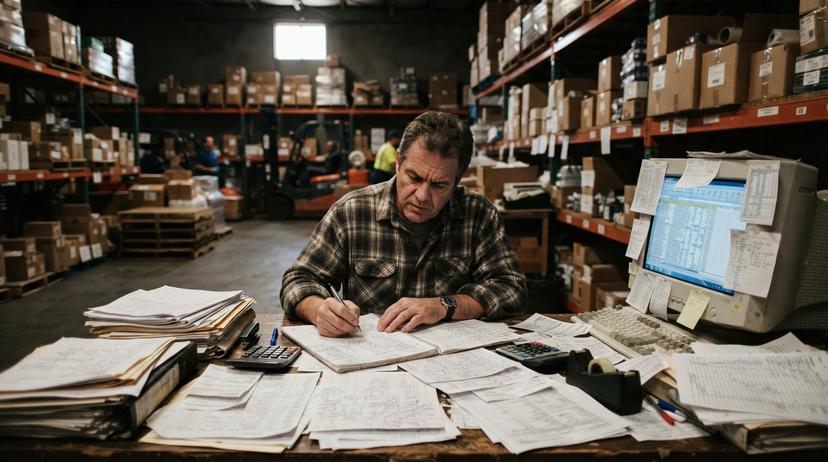
Why Does Holding Cost Matter for a Small Distributor?
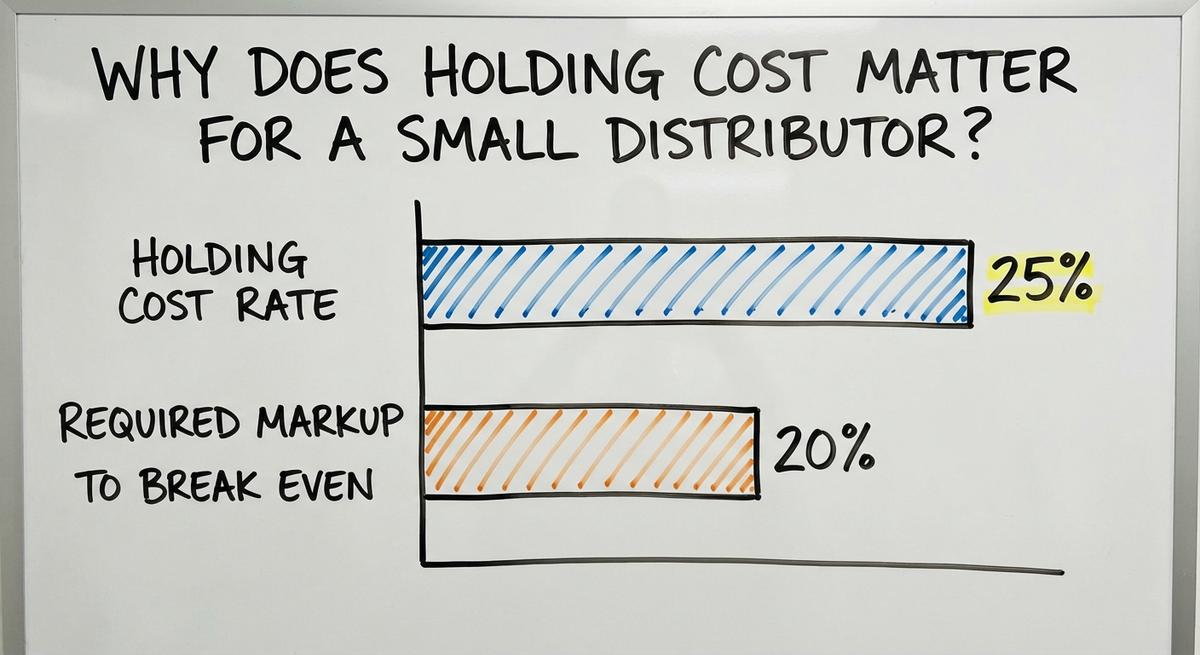
Holding cost matters because slow-moving inventory quietly eats margin. A 25% rate means a $1,000 item that sits for a year costs $250 to keep. Sell it at a 20% markup and the profit is gone.
Cash flow is tight at a firm with 5 to 100 staff. Cash in stock cannot cover payroll or a new truck. The US Census Bureau tracks wholesale inventories and sales each month, so you can see how large that pile of stock is across the trade.
Too little stock has a cost too. A missed order loses the sale and may lose the buyer. Read more on what is stock out cost in inventory management. Holding cost sets the other side of the scale. It helps you decide how much to order and when.
How Can You Lower Holding Cost?
You can reduce holding costs by moving less money into slow stock and by cutting handling work. Start with these steps:

- Find slow movers. List items with no sales in 6 months. Sell them at a discount, bundle them with fast sellers, or stop reordering them.
- Set each reorder point from real sales. A reorder point is the stock level that triggers a new order. Base it on past sales and supplier lead time, not a hunch.
- Order smaller amounts more often. Do this where suppliers allow. Less stock sits on the shelf at any one time. Some firms use jit inventory management for this, which means stock arrives just before you need it.
- Count stock on a schedule. Records that match the shelf stop double orders.
- Tidy the layout. Put fast sellers near the dock. Pickers walk less and each order costs less labor.
Small changes in order size and layout cut cost without new tools. The biggest saving comes from stopping buys of items that do not sell.

Why Spreadsheets Make Holding Cost Hard to See
Scattered data turns the real rate into a guess. Nobody can say which items are 9 months old without a long search. Outdated counts then lead to over-ordering and dead stock.
Manual tracking hides holding cost because the data lives in too many places. An accounting package such as a popular small-business bookkeeping program tracks inventory value well. Storage costs, aging, and reorder data sit in spreadsheets, desktop databases, printed sheets, and email.
Labor adds to the bill. Say 2 people spend 5 hours a week reconciling sheets at $22 an hour. That is $11,440 a year. The US Bureau of Labor Statistics lists pay for stock clerks, so you can check your own wage figure.
A custom tool can pull these pieces together. It keeps your accounting software where it already works. It replaces only the manual parts.
What Should You Do Next?
You should take 3 steps this week: list your yearly costs, find your holding cost rate, and check your oldest stock. Use the formula above. Sort your stock by the date of the last sale.
The IRS says in Publication 538 that "To figure taxable income, you must value your inventory at the beginning and end of each tax year." So the value figure you need already exists.
If manual tracking gets in the way, talk with a local Columbus, Ohio team. The Software Society builds software around how your operation already works. There is no big ERP move. Start with one question: which shelf holds your oldest stock?
Frequently asked questions
What are the costs associated with holding stock?
Holding stock costs money in 4 main ways. Capital cost is the cash tied up in goods. Storage cost covers rent, utilities, racking, and handling labor. Service cost covers insurance, taxes, and software. Risk cost covers theft, damage, spoilage, and stock that goes out of date. Many owners count only rent and miss the rest.
Is holding cost the same as carrying cost?
Yes. Holding cost and carrying cost are two names for the same thing. Both mean the cost of keeping unsold stock for a period of time. Firms show it as a percent of inventory value per year.
What is a typical holding cost percentage?
Many sources quote 20 to 30 percent of inventory value per year as a rule of thumb. Your own rate can be lower or higher. It depends on your loan rates, your space costs, and how fast your goods go out of date. Add up your own yearly costs to find your number.
How can you lower holding cost?
Sell or stop buying slow movers. Set each reorder point from real sales. Order smaller amounts more often where suppliers allow. Count stock on a schedule so records match the shelf. Tidy the layout so pickers walk less.
What are the four types of inventory costs?
There is no single list, and sources group costs in different ways. A common set is ordering cost, holding cost, shortage cost, and setup cost. Shortage cost is the loss from running out of stock.
What does "inventory carrying cost" mean?
Inventory carrying cost is the total cost of keeping unsold goods over a set time. It includes the cost of cash tied up in stock, storage, insurance and taxes, and losses from damage or old stock. Firms give it as a percent of stock value per year.
How does manual tracking hide holding cost?
Manual tracking spreads the facts across spreadsheets, printed sheets, and email. No one sees storage costs, stock age, and reorder data side by side. Counts fall out of date. Owners then over-order and end up with dead stock. The true holding cost becomes a guess.
Start with a free first look
A 30 minute call, your operation mapped, and a clear picture of what we would build. No obligation and nothing to install.
Book a callRelated guides
More on the same work.
Guides
- Cost of Inventory Management Software
- Warehouse Management Cost
- Total Cost of Inventory Formula
- Inventory Management Software Costs
- Warehouse Management Costs
- Costing Inventory
- Inventory Management Software Freeware
- Free Inventory Management Software for Small Business
- Price of Inventory Management Software
- Simple Inventory Management Software Free
- Warehouse Inventory Management Software
- Warehouse Inventory Management Systems
- Quickbooks Inventory Management Software
- Inventory and Warehouse Management Software
- Custom Inventory Management Software
- Warehouse Inventory Management System
- Retail Inventory Management
Common questions
- What is Stock Out Cost in Inventory Management
- What is Ordering Cost in Inventory Management
- How Much Does Inventory Management Software Cost
- How to Calculate Cost of Goods Sold Without Ending Inventory
- What is Free Stock in Inventory Management
- What is the Best Free Inventory Management Software to Download?
- What is the Best Free Software for Warehouse Inventory Management?