

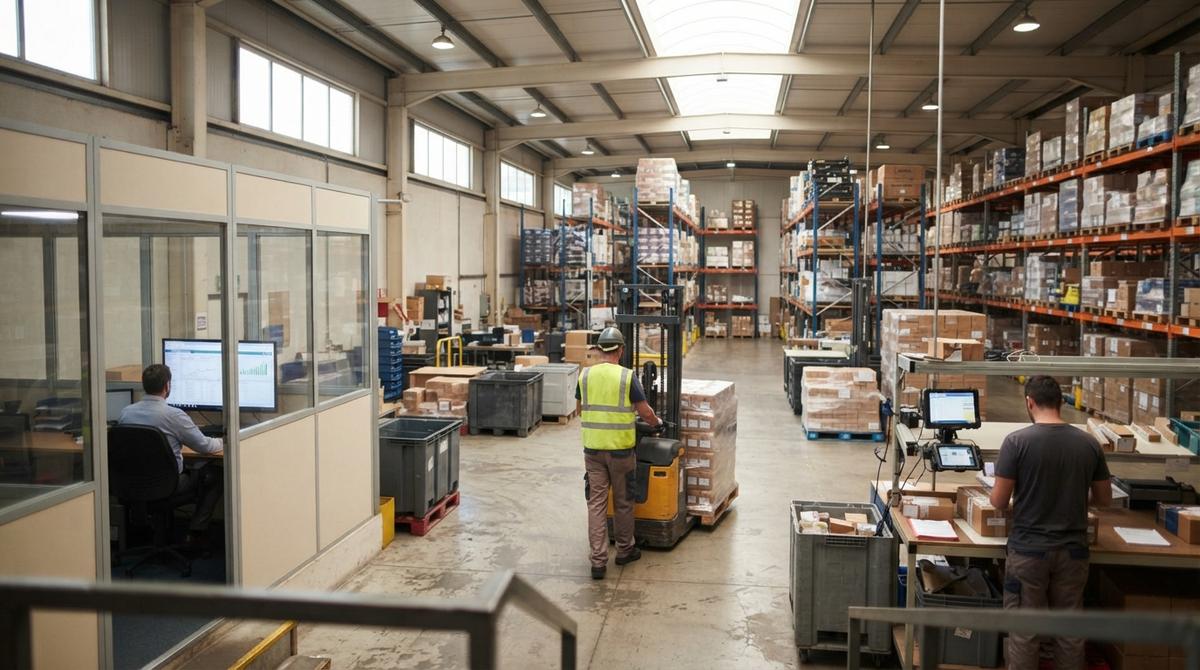
What is Ordering Cost in Inventory Management
Ordering cost is the cost to place and receive one buy order, no matter how many items are on it. It is a cost per order, not per item.
Book a callWhat Is Ordering Cost in Inventory Management?
Ordering cost is what it costs to place and receive one buy order (PO), whether the order holds 1 item or 500. People also call it procurement cost or setup cost.
Reviewed November 2026.
The key point is the unit. You count it per order. A $60 ordering cost means each PO costs $60 to create, send, receive and pay for. That holds if you buy 10 units or 10,000.
This is why the ordering cost sits at the heart of inventory management. Every order you place carries a fixed price tag. Place more orders, and the tag adds up fast.
We build it for your operation, and the first look is free
If you would rather not compare products, describe how your operation already works and we build the system around it.
No build cost. You see it running on your own process first, and the monthly subscription starts only once it is live.
Book a callWhat Costs Are Included in Ordering Cost?
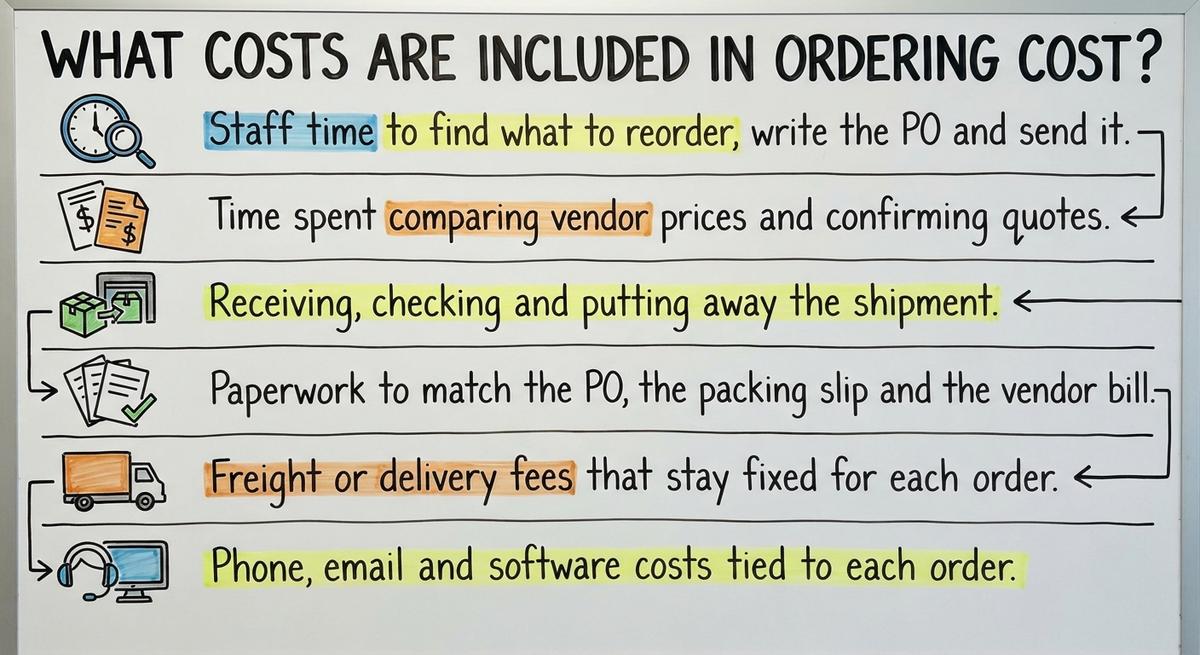
Ordering cost covers every step between "we need more" and "the bill is paid." Most of it is staff time. Add up each piece and the number is bigger than most owners guess.
- Staff time to find what to reorder, write the PO and send it.
- Time spent comparing vendor prices and confirming quotes.
- Receiving, checking and putting away the shipment.
- Paperwork to match the PO, the packing slip and the vendor bill.
- Freight or delivery fees that stay fixed for each order.
- Phone, email and software costs tied to each order.
Each item on this list is small. Together they make the price of one order.
How Do Clean Labels Help Receiving?
Good receiving also leans on clean labels. The standards body GS1 describes its work as setting the "barcodes" standards that let any partner scan the same item the same way. Scans cut the time spent at the dock.
Ordering Cost vs. Holding Cost
Ordering cost is the price of buying stock, and holding cost is the price of keeping it. Holding cost covers shelf space, handling, shrink (loss from theft, damage or waste) and cash tied up in goods.
The two pull against each other. Big orders mean fewer orders, so ordering cost falls. Big orders also mean more stock on the shelf, so holding cost rises. Small orders do the reverse.
A business with high ordering cost and low holding cost should buy in larger lots. The reverse case is rare. Few firms have cheap ordering and costly storage at the same time.
Add the two together and you get total inventory cost. Your goal is the order size where that sum is lowest.
The cost of running out is a third piece. Our guide on what is stock out cost in inventory management covers it.
Not sure this is the right shape for your operation
Describe how the work runs today. We map it on a call and show you what it would look like built around that, before you spend anything.
Book a call
How to Calculate Ordering Cost
The ordering cost formula is simple: total yearly cost of placing and receiving orders, divided by the number of orders placed. The result is your cost per buy order.
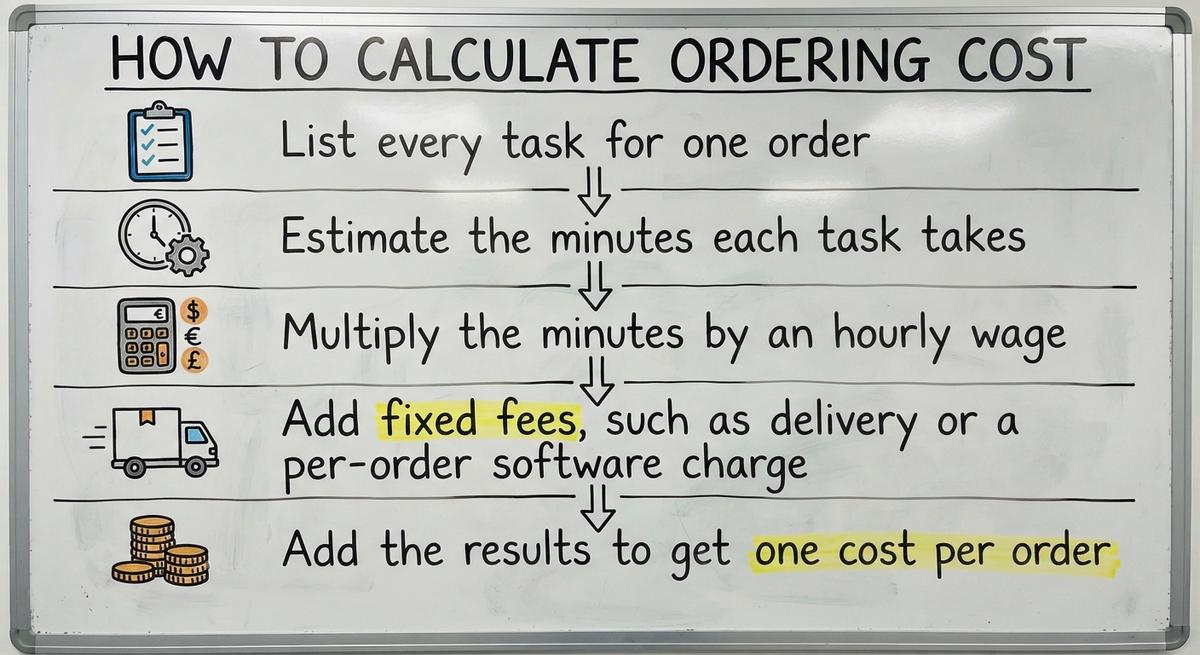
Follow these steps to get the total:
- List every task for one order, from spotting the need to paying the bill.
- Estimate the minutes each task takes.
- Multiply the minutes by an hourly wage. Include payroll taxes and benefits if you can.
- Add fixed fees, such as delivery or a per-order software charge.
- Add the results to get one cost per order.
Here is a plain case. Your yearly order costs total $36,000. You placed 600 orders. That is $36,000 divided by 600, or $60 per order.
Should You Start With an Estimate?
Start with an estimate. A rough number you trust beats a perfect one you never build. Refine it once you see where the time goes.
The US Bureau of Labor Statistics publishes wages for production, planning and expediting clerks. Use it to sanity check your hourly rate.

A Simple Example for a Small Distributor
A small distributor can see its ordering cost in one worked case. The numbers below are for illustration only. Use your own.
Picture a firm that tracks money in an accounting package and keeps reorder points on an Excel sheet. For each PO:
- The buyer spends 45 minutes. At $24 an hour, that is $18.
- The receiver spends 30 minutes. At $20 an hour, that is $10.
- The delivery fee is $25.
The total is $53 per order.
Now place 50 orders a month. That is 50 times $53, or $2,650 a month. Over 12 months, the firm spends $31,800 on ordering alone.
Cut 10 minutes of retyping from each order and the savings are real. Small steps repeated 600 times a year become big money.
Why Ordering Cost Matters for Your Bottom Line
Ordering cost matters because many small orders quietly drive up total cost. No single PO looks costly. The year-end sum does.
The number also sets how much you buy and how often. A high cost per order argues for fewer, larger buys. A low one lets you buy small and keep shelves lean.
That logic feeds the economic order quantity, or EOQ. EOQ is the order size that gives the lowest total of ordering cost and holding cost. It needs your cost per order as an input. A wrong input gives a wrong answer.
Hidden costs are common when staff work by hand across several files. Time spent hunting for a number never shows up on a bill. It still comes out of your margin.
The same logic ties to just-in-time buying. See what is jit inventory management for that side.

How Manual Processes Raise Ordering Cost
Manual work raises ordering cost by adding minutes to every order. Multiply those minutes by hundreds of orders and the loss is clear.
Here is where the time goes:
- Staff retype the same data from Excel, email and printed sheets into the accounting package.
- Typing errors lead to wrong quantities, duplicate orders and rush freight.
- Buyers chase stock counts before they can set a reorder point, which is the stock level that triggers a new order.
- Receivers match paper packing slips by hand against the PO.
A rush shipment can cost many times a normal one. One typo can trigger it.
The comparison is easier when one option is built for you
Off-the-shelf means fitting your process to the software. We do it the other way round, and the first look costs nothing.
Book a callWhy Do Accurate Counts Matter Beyond Cost?
Accurate counts matter beyond cost. The IRS says in Publication 538, "To figure taxable income, you must value your inventory at the beginning and end of each tax year." Messy counts hurt there too.
This is where working software helps. It removes the retyping, so each order costs less.
Ways to Lower Ordering Cost
You can lower ordering cost with a few steady habits. Each one removes minutes or fees from the order.
- Combine items from the same vendor into one order, so one fee covers more goods.
- Set clear reorder points so buying is not a guessing game.
- Standardize vendor terms and repeat orders, so you quote less often.
- Connect purchasing to the tools you already use, so no one retypes data.
- Keep your accounting software where it works and automate only the manual steps around it.
The best fix is the one that removes a step. A step that never happens costs nothing.
How Far Should You Push Ordering Cost Cuts?
Do not push too far. If you cut orders too hard, stock piles up and holding cost climbs. Watch total inventory cost, not just one half of it.
The NIST Manufacturing Extension Partnership offers vendor-neutral guidance on supply chain and inventory process. It is a good place to check your habits.
When Should You Look at Custom Software for Ordering?
Look at custom software when your reorders live in spreadsheets and your buyers rely on memory. Other signs are stockouts and overstock at the same time.
Custom software is built around how your team already works. There is no forced move to a new system and no big ERP (a large all-in-one business suite). You keep the tools that work.
The Software Society builds this kind of tool. A local team in Columbus, Ohio, works with small operations. The price of such a build is a fair question. Our page on cost of inventory management software gives a sense of the range.
If your orders cost more than they should, talk to us about your process.
Frequently asked questions
How is inventory cost calculated?
Inventory cost adds up what you pay to buy goods, ordering cost, and holding cost. Total inventory cost is the ordering cost plus the holding cost. Cost flow methods then decide which buy price you assign to each item sold.
What are ordering costs?
Ordering costs are the costs of placing and receiving one buy order. They include staff time, vendor quotes, receiving, paperwork, fixed freight fees and phone or software costs. They are counted per order, not per item.
What is an inventory cost flow method?
An inventory cost flow method is a rule for deciding which buy cost goes with each item you sell. Common rules are first in, first out, last in, first out, and average cost. Your accountant can tell you which one fits your tax and reporting needs.
How do you calculate ordering cost?
Divide the total yearly cost of placing and receiving orders by the number of orders. If you spend $36,000 on 600 orders, the cost is $60 per order.
What is the difference between ordering cost and holding cost?
Ordering cost is the price of buying stock. Holding cost is the price of keeping it, such as space, handling, shrink and tied-up cash. Big orders lower ordering cost and raise holding cost.
How can a small distributor lower ordering cost?
Combine items from the same vendor, set clear reorder points, and standardize vendor terms. Cut retyping by linking purchasing to the tools you already use. Do not cut orders so far that holding cost climbs.
How do manual spreadsheets and re-entry raise ordering cost?
Retyping data adds minutes to each order. Typing errors cause wrong quantities, duplicate orders and rush freight. Staff also lose time chasing stock counts before they can reorder.
Start with a free first look
A 30 minute call, your operation mapped, and a clear picture of what we would build. No obligation and nothing to install.
Book a callRelated guides
More on the same work.
Guides
- Cost of Inventory Management Software
- Warehouse Management Cost
- Total Cost of Inventory Formula
- Inventory Management Software Costs
- Order Management Software
- Ordering Management System
- Order Management System
- Order Management Program
- Warehouse Management Costs
- Costing Inventory
- Inventory Management Software Freeware
- Free Inventory Management Software for Small Business
- Price of Inventory Management Software
- Simple Inventory Management Software Free
- Cloud-based Purchase Order System
- Warehouse Inventory Management Software
- Warehouse Inventory Management Systems
Common questions
- What is Stock Out Cost in Inventory Management
- What is Holding Cost in Inventory Management
- How Much Does Inventory Management Software Cost
- How to Calculate Cost of Goods Sold Without Ending Inventory
- What is Free Stock in Inventory Management
- What is the Best Free Inventory Management Software to Download?
- What is the Best Free Software for Warehouse Inventory Management?