


Inventory Accuracy
Inventory accuracy is how well your records match your shelves. Measure it by dividing correct counts by total counts. Most teams aim for 95% or higher.
Book a call
What Is Inventory Accuracy?
Inventory accuracy is how closely the counts in your records match what sits on your shelves. It covers 3 facts: quantity, location and item identity. Quantity is how many. Location is which bin. Identity is the right SKU, the code that marks each product.
Reviewed November 2026.
Say the system shows 50 cases of one item. The shelf holds 46. Your count is off by 4 cases. A count is only true when all 3 facts match.

Why Inventory Accuracy Matters for Warehouse Inventory
Money is at stake too. Your books carry stock as an asset, so a wrong count means wrong asset values in your accounting package. The IRS states in Publication 538 that "you must value your inventory at the beginning and end of each tax year." Barcodes built on GS1 standards help each count start with a clean scan. Accurate counts protect both sales and taxes.
Inventory accuracy matters because orders depend on true counts. A wrong count sends a false promise to a buyer. Bad inventory records lead to stockouts, overselling, rush freight and unhappy customers. The FTC order merchandise rule expects sellers to ship when they said they would. An accurate count protects that promise.
We build it for your operation, and the first look is free
If you would rather not compare products, describe how your operation already works and we build the system around it.
No build cost. You see it running on your own process first, and the monthly subscription starts only once it is live.
Book a callHow Do You Calculate Inventory Accuracy?
You calculate inventory accuracy by dividing the items counted correctly by the items counted, then multiplying by 100. That is the inventory accuracy formula in plain words. Count by SKU and location, not just total units. Totals hide errors. A surplus in one bin can cancel a gap in another.
Keep a tally sheet with 3 columns:
- System count: the number your records show for one SKU in one bin.
- Physical count: the number a person finds by hand on the shelf.
- Match: a yes or no, with yes only when both numbers agree.
Count the yeses, divide by the rows, and you have your rate.
A Worked Example
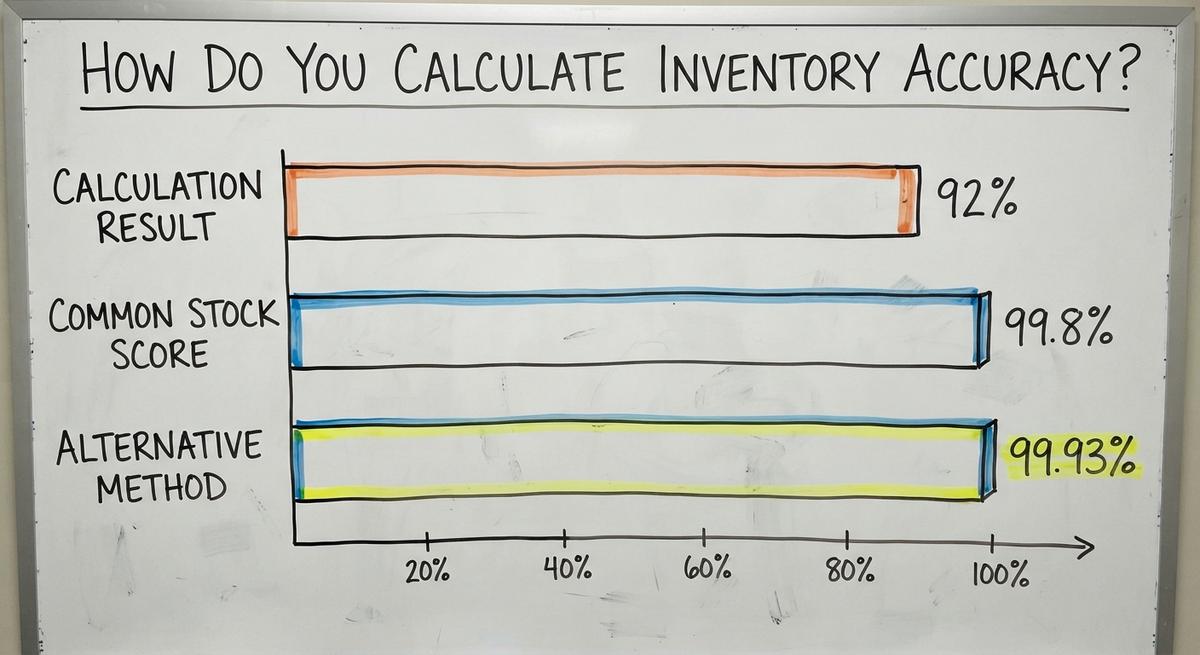
Learning how to calculate inventory accuracy takes one sheet of paper. Say you check 200 SKUs and 184 match. Divide 184 by 200 to get 0.92. Multiply by 100 and you get 92% accuracy.
Now study the 16 misses. Ten are off by 1 unit on cheap items. One is off by 40 units of a $90 part. That single miss is worth $3,600. A few big misses can matter more than many tiny ones.
Pick one way to measure. A count-based rate is simple. A dollar-based rate shows money at risk. One supply chain metrics article shows the same stock scoring 99.8% by one method and 99.93% by another. Choose a method and keep it.
What Is a Good Inventory Accuracy Rate?
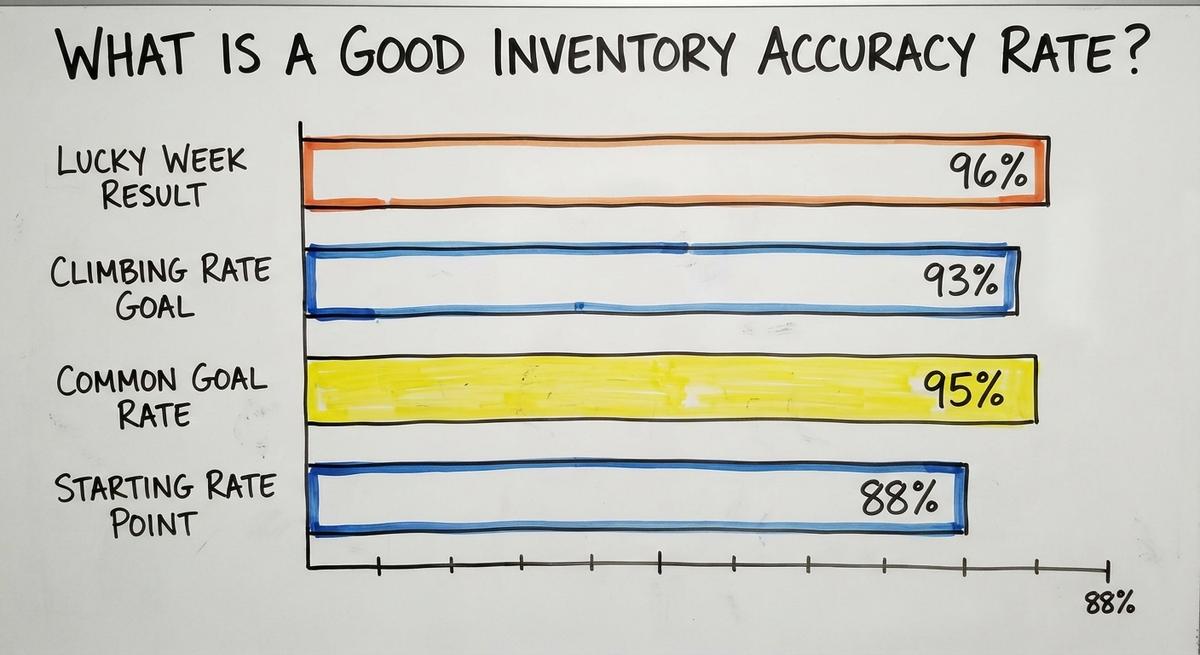
A common goal for the inventory accuracy rate is 95% or higher. The best operations aim above that. Many readers ask what is a good inventory accuracy percentage. The answer depends on your stock, so check any goal against your own needs.
Set tighter targets for 2 groups:
- Fast-moving items: one miss blocks orders within days, so these need the tightest target.
- High-value items: a small count gap here costs real dollars, so count them more often.
Trend matters more than one number. A rate that climbs from 88% to 93% over 6 months proves your habits work. One lucky 96% after a quiet week proves little.
Not sure this is the right shape for your operation
Describe how the work runs today. We map it on a call and show you what it would look like built around that, before you spend anything.
Book a callWhat Causes Inventory Errors?
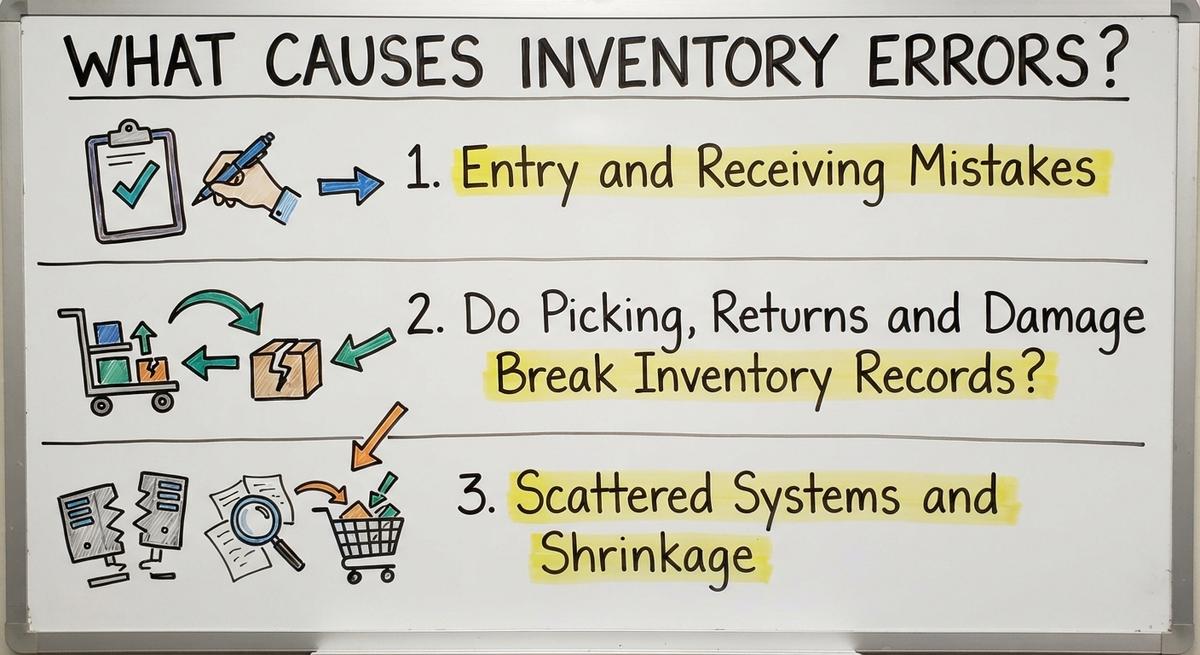
Inventory errors come from 4 places: typing, the dock, the pick line and scattered records. Each spot is a hand-off, where data moves from one person or file to another. Every hand-off adds risk. Fix the hand-offs and inventory accuracy rises. The next 3 parts cover each cause.
Entry and Receiving Mistakes
Manual data entry is typing counts by hand into a spreadsheet or accounting package. Typos and swapped digits slip in. Retyping from a printed sheet adds a second chance for a slip. Every re-entry is a chance for error.
The dock adds more. A worker counts 12 cases but logs 12 each. Unit-of-measure mix-ups, each versus case versus pallet, turn 1 pallet into hundreds of wrong units. Put-away is moving goods from the dock to a shelf. Goods placed in a bin nobody recorded are lost on paper. Log the bin at the moment you set the goods down.
Do Picking, Returns and Damage Break Inventory Records?
Yes, picking, returns and damage break inventory records when nobody logs them. A picker grabs a similar item and no one notes the swap. Two counts are now wrong.
A customer returns 5 units. They go back on a shelf but not into the system. Damaged cartons go in the trash with no adjustment. Each case leaves a gap between shelf and screen. Log swaps, returns and damage within the hour.
Scattered Systems and Shrinkage
Scattered systems are the largest cause for many small teams. One count lives in the accounting package. Another sits in a spreadsheet. A third is in a desktop database file. A fourth is in an email thread. The 4 disagree.
No single source of truth exists for on-hand quantity. A source of truth is the one record everyone trusts. Shrinkage is a smaller, separate cause. It means stock lost to theft, loss or spoilage. Fix the scatter before you chase shrinkage.
How to Improve Inventory Accuracy Step by Step
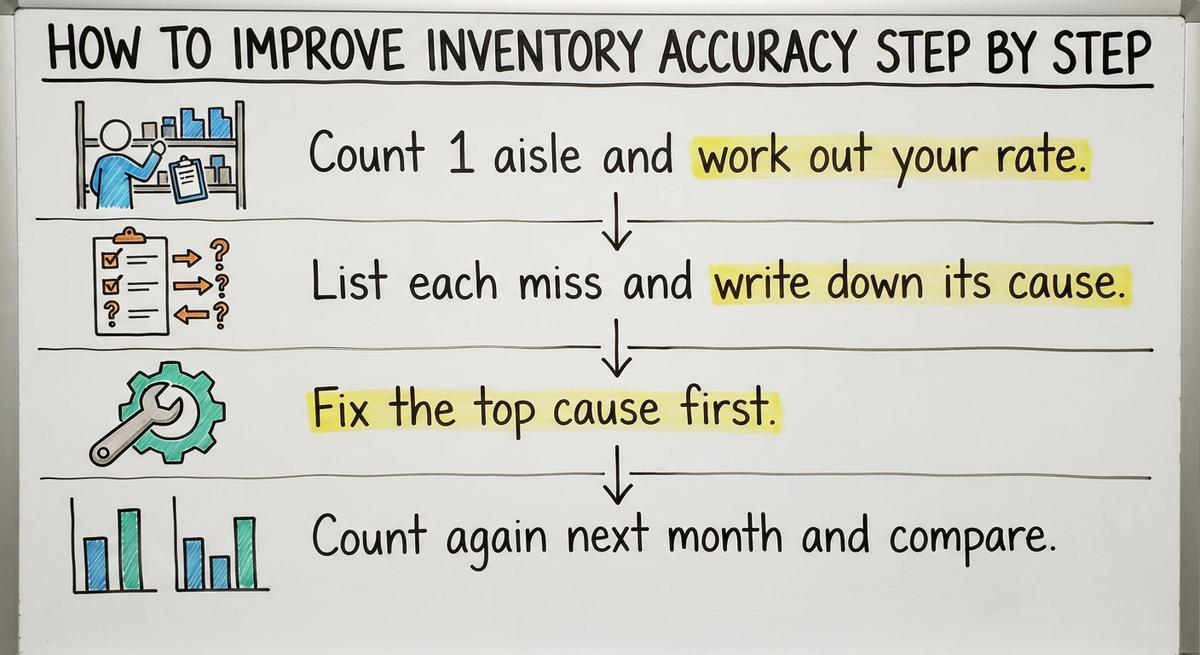
To improve inventory accuracy, measure your current rate first. Then fix the biggest cause. Do not fix everything at once. Small steps work for a team of 5 to 100 people. The NIST Manufacturing Extension Partnership offers vendor-neutral guidance on supply chain process.
- Count 1 aisle and work out your rate.
- List each miss and write down its cause.
- Fix the top cause first.
- Count again next month and compare.
Measure, fix one cause, and measure again.
The comparison is easier when one option is built for you
Off-the-shelf means fitting your process to the software. We do it the other way round, and the first look costs nothing.
Book a call
Use Cycle Counting Instead of Only Yearly Counts
Cycle counting is the habit of counting a small slice of stock each day or week. A yearly physical inventory count halts work and finds problems 12 months late. Cycle counting finds them in days. A crew that counts 20 bins a day covers 100 bins in a 5-day week.
Count high-value and fast-moving items more often. Count slow items less. Run stock counts on a fixed schedule so they become routine.
Find the cause of each miss, not just the fix. If a bin is short by 3 units, ask who touched it last and why. Each miss then teaches you where the process leaks.
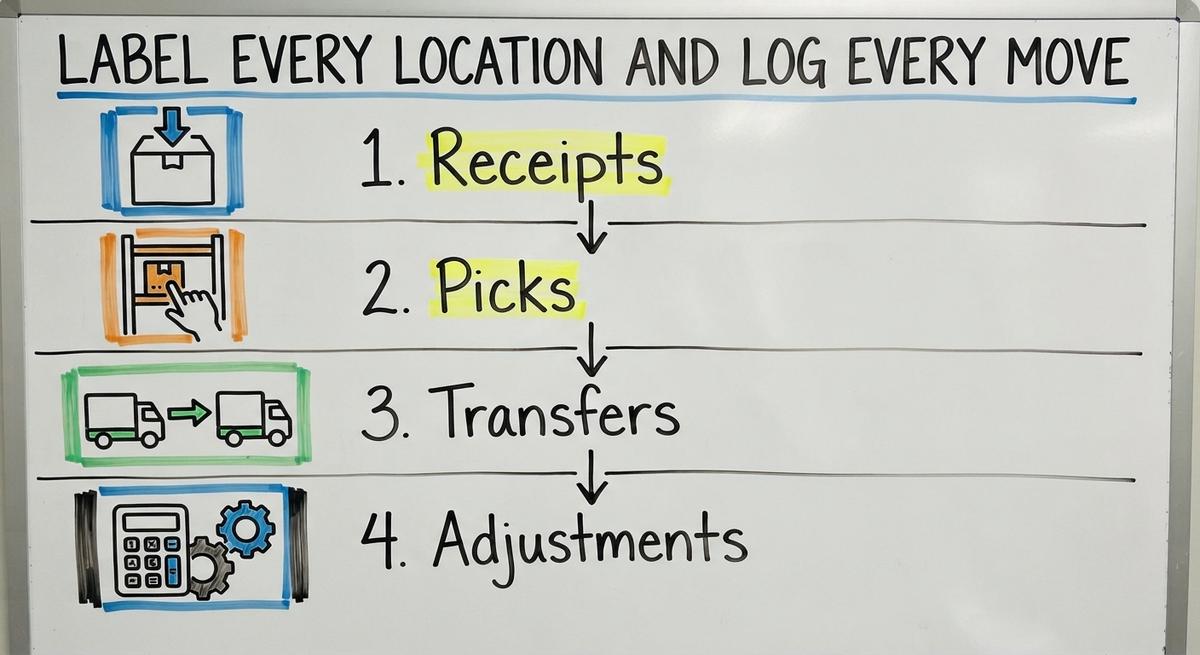
Label Every Location and Log Every Move
One home per SKU is the base rule of a tidy warehouse. Use consistent bin names, such as A-03-2 for aisle, rack and shelf. Put a clear label on each bin. Barcodes cut typing mistakes. GS1 publishes the common barcode standards.
Tags that read without a scan can help too. A University of Arkansas study found an RFID system "improved accuracy by about 13 percent in test stores compared to control stores." That test covered retail stores, so check the fit for your site.
Log every move when it happens, not at day's end:
- Receipts: record each delivery at the dock before the truck leaves.
- Picks: log each pick at the shelf, not from a sheet at the end of the shift.
- Transfers: note every move between bins so the location stays true.
- Adjustments: need a reason code such as damage, miscount or return.
Reason codes turn random misses into patterns you can fix.


Can You Cut Down on Re-Entering Data?
Where your accounting package works well, keep it. A scan tool can feed your accounting software, for example, so the books stay as they are. Replace only the manual hand-offs. Custom software can fit how you already work, so you skip a full system swap.
Yes, you can cut re-entry, and each cut lifts inventory accuracy. Capture data once and let it flow to other places. A scan at the dock should update the stock list and the books with no retyping.
Do the math on the cost. Take 2 clerks who spend 5 hours a week retyping at $20 an hour. That is $10,400 a year (2 x 5 x 20 x 52). Check local pay for these roles on the Bureau of Labor Statistics page, then use your own numbers.

See it running on your own process first
No build cost. The subscription starts once it is live and doing the job, not before.
Book a call
Train Staff and Assign Ownership
One named person should own inventory accuracy. Give that person the rate, the count schedule and the power to fix gaps. Shared ownership means no ownership.
Write short procedures of 1 page each. Explain why counts matter. A wrong count is a late order for a real customer.
Review misses without blame. Ask what went wrong in the process, not who slipped. Staff who fear blame hide errors. Staff who help find causes report them early. Owned, simple habits beat a thick manual.


Signs Your Process Is Holding You Back
Manual processes start hurting accuracy when volume outgrows memory and paper. Check your shop against this list:
- Floor walks: staff walk the floor to confirm stock before they promise an order to a customer.
- Year-end shocks: your yearly count turns up big surprises in units or in dollar value.
- Many spreadsheets: several files hold different numbers for the same SKU on the same day.
- Late logging: receipts and picks get logged at day's end, or the next morning.
- Weekly patching: someone spends hours each week reconciling counts by hand.
Three or more signs mean your process needs a fix.

How to Keep Inventory Accuracy High Over Time
Ask any software partner to map where your data gets retyped. Then pick 1 hand-off and fix it this month.
Tracking inventory accuracy every month keeps your gains in place. Review the trend, not one number. Keep counting, labeling and logging habits steady. Habits slip in busy seasons, so protect the schedule.
Revisit your tools when growth strains the process. The Census Bureau's wholesale trade data tracks monthly inventories and sales for wholesale firms. Use it to see how your own stock moves against the market.
Frequently asked questions
What is considered an acceptable inventory accuracy?
Most warehouses treat 95% as the floor. Aim higher for costly or fast-moving items. Set your goal by what one wrong count costs you, then watch the trend over several months.
What causes inventory inaccuracy?
Retyping, dock mistakes, unlogged picks and returns, and records split across files cause most misses. Theft and loss add a little. Each hand-off between people or files is a risk point.
How often should a warehouse count inventory?
Count a small slice every day or week. Check fast-moving and high-value items most often. Add a full physical count once a year if your tax or lender rules call for one.
What is cycle counting and how does it help?
Cycle counting means counting a few bins on a set schedule instead of everything once a year. Errors surface within days, and the team can trace each miss to its cause.
Can a small warehouse reach high inventory accuracy using an accounting package and spreadsheets?
Yes, if the team counts on a schedule, labels bins and logs moves at once. Tools matter less than habits. Retyping between files is the weak spot to fix first.
When do manual processes start hurting accuracy?
Manual work starts to hurt when order volume grows, staff multiply or files disagree. If people walk the floor before promising orders, the process has already slipped.
Start with a free first look
A 30 minute call, your operation mapped, and a clear picture of what we would build. No obligation and nothing to install.
Book a callRelated guides
More on the same work.
Guides
- Inventory Accuracy Formula
- Weighted Average Inventory Valuation Method
- Cycle Counting Inventory
- Inventory Audit Checklist
- Inventory Audit
- Inventory Management Best Practices
- Specific Identification Inventory Method
- Moving Average Method Inventory
- Inventory Shrinkage Accounting Entry
- Inventory Shrinkage is Recorded When
- Calculate Inventory Shrinkage
- Inventory Process Flow
- Inventory Pricing Methods
- Warehouse Inventory Management Software
- Warehouse Inventory Tracking Software
- Warehouse Inventory Management Systems
- Best Inventory Software
- Quickbooks Inventory Management Software
- Warehouse Inventory Systems