


Cycle Counting
Cycle counting is counting a small part of your stock on a set schedule. A pallet of bolts shows 40 on the screen and 34 on the rack. Nobody knows why.
Reviewed November 2026.
Cycle counting catches that gap early and cheaply. It also shows when they stop being enough.
Book a call
What Is Cycle Counting?
Cycle counting is counting a small slice of your stock on a regular schedule.
Ask what is cycle counting in inventory management, and this is the whole idea. Short counts, done all year.
The counts happen during normal work, so the warehouse keeps running. One day a worker counts a single aisle. The next day it is a different shelf.
Over a few weeks or months, every item gets counted at least once. Nobody locks the doors or holds orders.
Many small counts replace one giant count.
Cycle Counting vs. a Full Physical Inventory
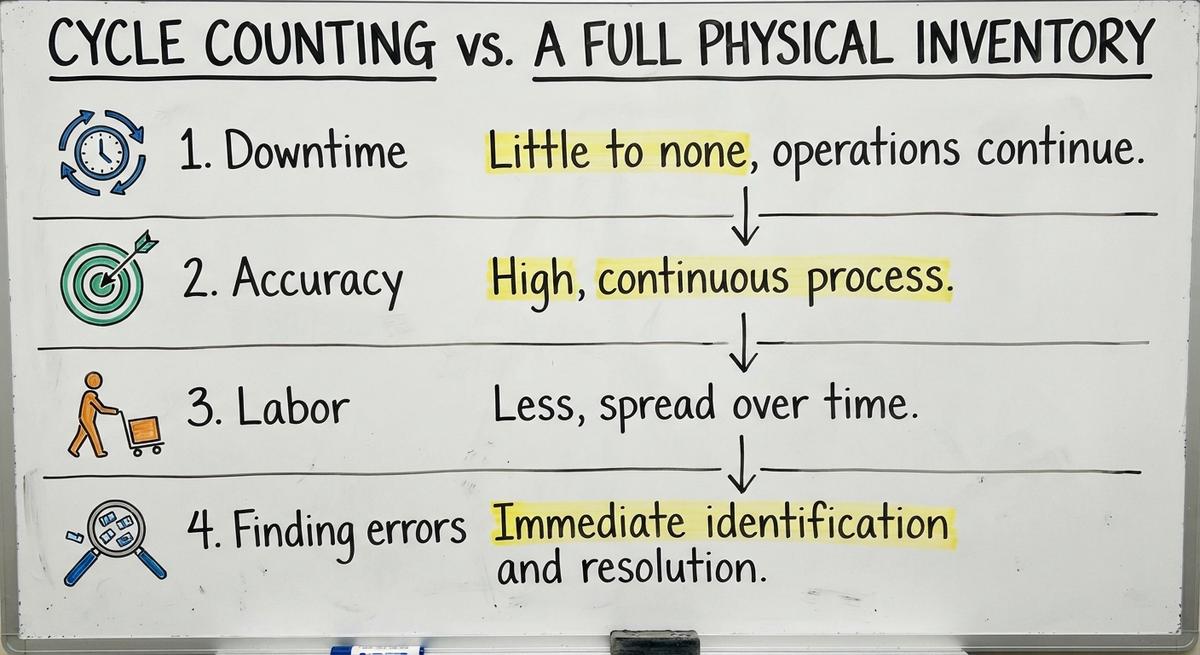
A full physical inventory is one big event, a shutdown once or twice a year. A cycle count is a set of small counts spread across the year.
The IRS says in Publication 538 that businesses selling merchandise generally must "keep an inventory." Either method can support that need. The two work very differently.
- Downtime: a full count means a full or partial shutdown, but a cycle count needs little or none.
- Accuracy: a full count is good on count day and then drifts, but a cycle count stays steady all year.
- Labor: a full count needs many people at once, but a cycle count needs one or two people in short bursts.
- Finding errors: a full count finds mistakes months later, but a cycle count finds them within days.
The real gap is speed: a cycle count finds a mistake when somebody still remembers what happened.
We build it for your operation, and the first look is free
If you would rather not compare products, describe how your operation already works and we build the system around it.
No build cost. You see it running on your own process first, and the monthly subscription starts only once it is live.
Book a callWhy Does Cycle Counting Matter for Small Warehouses?
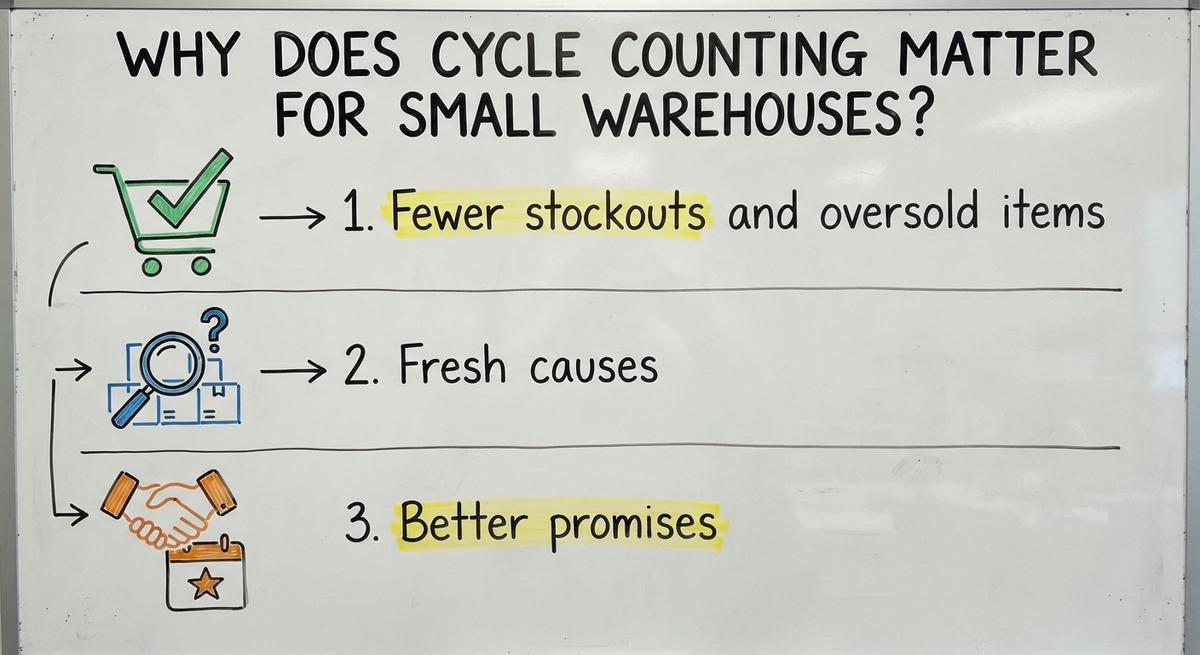
Cycle counting keeps the numbers close to the truth, so you sell what you actually have. The payoff shows up in three places:
- Fewer stockouts and oversold items: a shelf of cleaning supplies that really holds 12 cases stops showing 20 on the screen.
- Fresh causes: a miscount found this week can be traced to a receiving slip or a wrong pick.
- Better promises: buyers order from counts they trust, and customers get delivery dates that you can keep.
Counts you trust turn every purchasing and shipping decision into a safer one.
What You Need Before You Start
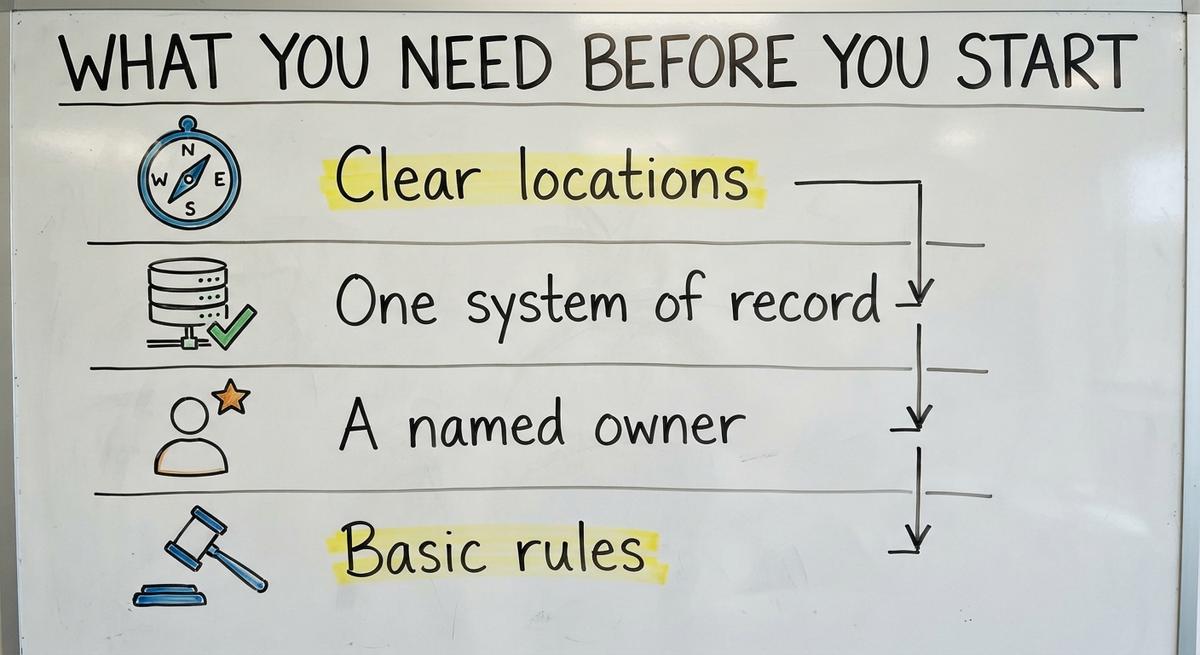
Four basics must be in place before the first cycle count. Without them, the results will not mean much. Each one removes a common source of confusion.
- Clear locations: every bin, shelf, and rack has a label, so a counter never wonders where an item lives.
- One system of record: a single place holds on-hand quantities, so there is only one number to check.
- A named owner: one person is responsible for the count schedule and for chasing down the results.
- Basic rules: write down who counts, when they count, and how they record what they find.
A count without an owner and a record is just a walk around the building.
Not sure this is the right shape for your operation
Describe how the work runs today. We map it on a call and show you what it would look like built around that, before you spend anything.
Book a callTypes of Cycle Counting Methods
A cycle counting method decides what gets counted on which day. Four common choices follow. Most small warehouses start with one and add a second later.

IRS Publication 538 puts it plainly: “To figure taxable income, you must value your inventory at the beginning and end of each tax year.”
The right pick depends on your layout, your product mix, and the time your team can spare.
ABC Cycle Counting
ABC cycle counting ranks items by value or speed, then counts the important ones more often. It puts effort where errors cost the most.
- A items: these are high value or fast moving items, and you count them about 12 times a year.
- B items: these are the middle group, and you count them about 4 times a year.
- C items: these are slow or low value items, and you count them about 2 times a year.
For example, pallets of your best selling fasteners are A items. A bin of old gaskets that sells twice a year is a C item.
These counts per year are a starting point, not a law. Your own error rates should move items up or down.
Location-Based Counting
Location-based counting means you count one aisle, rack, or zone each day. It suits operations with tidy layouts and clear labels.
A worker walks one zone, counts everything in it, and moves on tomorrow. The method is easy to explain to new staff. The rule is simply "today is aisle four."
The weakness is that fast and slow items get the same attention. Simple rules are what make this method stick.
Random Sample Counting
Random sample counting means picking items by chance each day, perhaps ten SKUs drawn from the full list.
It is useful for testing your overall accuracy. It gives an unbiased snapshot of how well the books match the shelves.
The weakness is coverage. Some items can go uncounted for a long time. Others come up twice. Use it as a spot check beside another method, not as your only plan.
When Should You Count Outside the Schedule?
Event-triggered counting is a count you run right away when something signals a problem. Do not wait for the calendar. Good triggers include:
- Stock hits zero or goes negative, so count that item the same day and find out why.
- A receiving error is found, so recount everything on that delivery before the stock moves on.
- A big return arrives, so count the returned items and the bin where they will sit.
- A customer complains about a wrong or missing item, so count that item and its neighbors.
These counts pair well with any schedule-based method. The trigger tells you where the trouble is, and the schedule covers the rest.
How to Set Up a Cycle Count Process and Schedule
A cycle count process needs five steps. You can start this week with a pen and a printout.

- Pick a method. ABC is a good default for mixed stock, as it puts your time where errors cost the most.
- Rank your items. Start with your top 50 fastest moving items, and do not try to rank everything on day one.
- Set a cycle count schedule. Decide which items come up on which days, and put the list on the calendar.
- Assign counters. Name a primary counter and a backup, so a sick day does not end the habit.
- Record results. Write the counted quantity, the system quantity, and the date on every line of the sheet.
Keep daily counts short, about 15 to 30 minutes. That is 20 to 40 line items for one person. Add more only when the habit holds.
A simple start for frequency is A items monthly, B items quarterly, and C items twice a year. Then adjust based on error rates.
Count more often where mistakes keep happening. Count less often where results stay clean for several rounds. Let your own error history, not a rule of thumb, set the final schedule.
How to Do a Cycle Count Day to Day, and What to Do When Counts Don't Match
Use blind counts: counters do not see the system quantity. That way they cannot be nudged toward it. If the gap is large, recount before touching any record.

A daily cycle count follows the same short routine each time. Print or load the count list in the morning.
Count before picking starts in that area when possible. Moving stock confuses totals.
When counts still do not match, treat the gap as a clue. Any inventory variance has a cause worth finding:
- Recount first, then check recent receipts, picks, and returns for anything that moved the stock.
- Look for unit of measure mix-ups, such as a case entered as single units, and for mislabeled bins.
- Set a dollar or percent limit above which a manager must approve the adjustment to the books.
- Write down the cause of each gap, not just the fix, so patterns show up later.
A log of causes shows which habits to change, and that is how errors stop repeating.
The comparison is easier when one option is built for you
Off-the-shelf means fitting your process to the software. We do it the other way round, and the first look costs nothing.
Book a callHow to Measure Inventory Accuracy
Inventory accuracy is the number of items that match divided by the number of items counted.
If your cycle count covers 50 items and 46 match, accuracy is 92 percent.
Track it by item group and by location. One messy aisle can hide behind a good overall number.
Set a target, then watch the trend by month. Do not judge any single day. There is no one correct target for every warehouse.
A fair first goal is whatever you hit now, plus a small rise each quarter. A rising line matters more than a perfect one.

What Mistakes Ruin a Cycle Counting Program?
Four mistakes do the most harm. Weak habits sink most programs, not weak math.
- Counting only when someone has time: the schedule slips, and soon the counts stop altogether.
- Skipping root-cause review: the same error returns next month with a new date on it.
- Letting adjustments pile up without approval: the books drift, and nobody can say who changed what.
- Counting items in transit or on open orders: stock that is moving is not on the shelf, so the count is wrong before it starts.
Protect the schedule first, and the rest gets easier.
Cycle Counting With Spreadsheets and Paper
Printed count sheets and a shared spreadsheet work well at small scale. They cost almost nothing, and everyone understands them.
A 5 person wholesaler can run cycle counting inventory this way for months. The cracks show up in a few places:
- Counts get retyped from paper into the file, and typos creep in along the way.
- Sheets get lost, left in a truck, or buried under other paperwork on a desk.
- Two people edit two versions of the same file, and nobody knows which is right.
Adjustments should flow back to the books without double entry. Suppose your accounting package, such as a popular small-business bookkeeping program, holds the official quantities. Keep using it for what it does well.
Fix only the manual gaps around it: building count lists, capturing results, and posting approved changes. You do not need to replace a tool that works to repair the steps that do not.
When Manual Counting Holds You Back, and What to Look for in Software
Four warning signs tell you it is time to move off paper count sheets. Move when they show up together.

- Time: counts take longer than the time they save, and the team starts to skip them.
- Trust: nobody believes the numbers on the sheet, so people recount on their own.
- Repeats: the same errors return month after month, and no one has time to dig in.
- No record: adjustments are made with no note of why, so causes are lost.
If you are there, compare cycle count software against what you actually need. Look for these features:
- Count lists created automatically from your own rules for items, zones, and frequency.
- Counting on phones or handheld scanners, so nothing is retyped from paper later.
- Variances, reasons, and approvals saved with each count in one clear record.
- A fit with your current workflow, so you are not forced into a full migration.
- A link to your accounting data, so approved changes post without double entry.
A full ERP is not the only answer. Sometimes a custom fix for just the manual parts costs less and disrupts less. Choose the smallest change that removes the retyping and the missing records.

Start Small This Week
Fifty items is enough to begin. Pick your top 50 items, set a 20 minute daily cycle count, and write down every cause you find.
After a month, you will know if paper still works. If retyping and lost sheets eat the gains, map those steps.
Then ask a software partner if a targeted fix for them beats a big system.
A small count done every day beats a big count done twice a year.
Frequently asked questions
What is the difference between cycle counting and inventory counting?
Inventory counting is the broad term for any stock count, including a yearly full count. Cycle counting is one kind: small, scheduled counts that run all year while normal work continues.
How to do a cycle count?
Choose a method, rank items, and list what to count today. Count blind, compare to the system, recount large gaps, then record the cause and get approval before adjusting any quantity.
How often should you cycle count?
Count daily in short sessions, and count each item by its rank. A common start is fast movers monthly, middle items quarterly, and slow items twice a year, then adjust by error rate.
How many items should you count per day?
Aim for what one person can finish in 15 to 30 minutes, often 20 to 40 line items. Raise the number only after counts are finished reliably for several weeks.
Which items should you count first?
Start with your top 50 fastest moving or highest value items. Mistakes there cost the most in lost sales and wrong promises, so early counts pay back quickest.
What is a good inventory accuracy rate?
There is no single standard, since it depends on product and process. Measure your current rate, set a target a little higher, and judge progress by the monthly trend.
Can you cycle count with accounting software and a spreadsheet program?
Yes. Print lists from a spreadsheet, count on paper, then enter approved changes in your accounting records. It works at small scale, though retyping raises the risk of errors.
When is it time to move off paper count sheets?
Move when counting takes longer than it saves, nobody trusts the sheets, or the same errors repeat. Lost pages and adjustments with no recorded reason are also clear signals.
Start with a free first look
A 30 minute call, your operation mapped, and a clear picture of what we would build. No obligation and nothing to install.
Book a callRelated guides
More on the same work.
Guides
- Cycle Count Software
- Cycle Counting Inventory
- Abc Cycle Counting
- Cycle Count in Warehouse
- Inventory Counting Software
- Inventory Accuracy Formula
- Replenish Stock
- Inventory Audit Checklist
- Inventory Audit
- Inventory Management Best Practices
- Moving Average Method Inventory
- Inventory Shrinkage Accounting Entry
- Inventory Shrinkage is Recorded When
- Calculate Inventory Shrinkage
- Inventory Process Flow
Common questions
- What is Cycle Counting in Inventory Management
- How to Calculate Cycle Stock
- What is a Good Inventory Accuracy Percentage
- How to Calculate Safety Stock in Excel
- Reorder Point vs Safety Stock
- What Common Events Could Result in Inventory Shrinkage
- How to Record Inventory Shrinkage
- What is the Cost Method to Value Inventory
- How is Shrinkage Calculated