

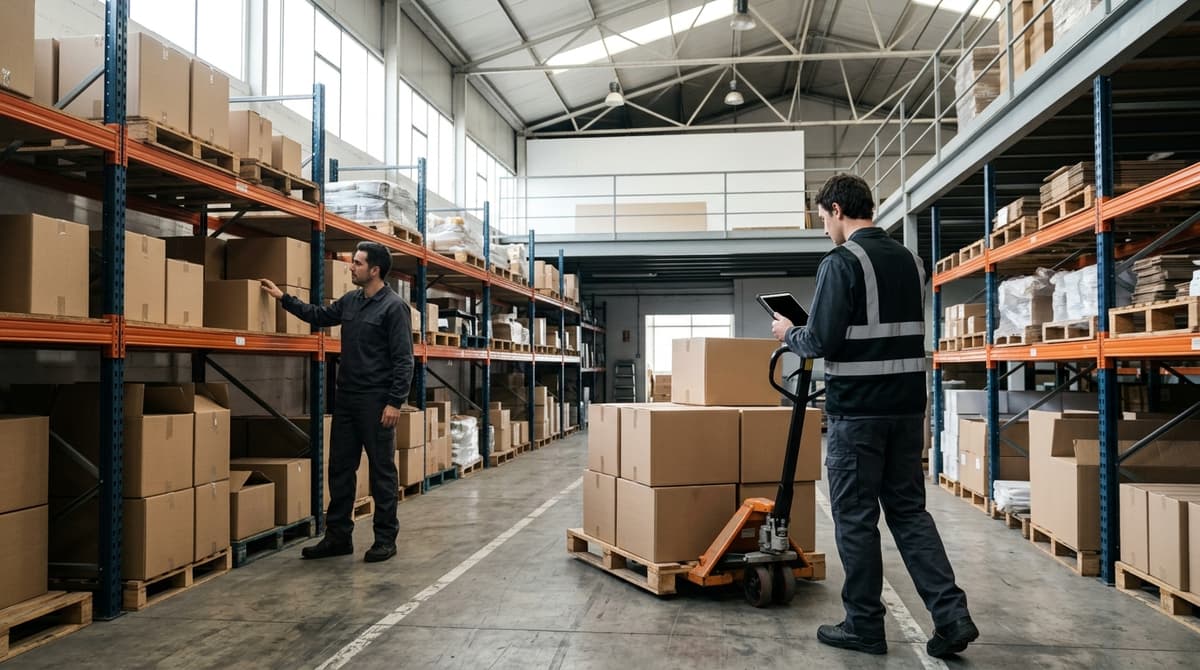
What Is The Most Important Part Of Warehouse Organization
The most important part of warehouse organization is location accuracy: knowing exactly where every item is, and trusting that record. It is not clean aisles or color-coded bins. That single factor controls whether orders go out right, whether counts hold up, and whether a new hire can work without a senior employee beside them. This guide, reviewed in September 2026, explains why and how to get it.
Published 5 August 2026. Reviewed and updated 15 September 2026.
Book a callWhat Is The Most Important Part Of Warehouse Organization?
Location accuracy means your records match reality. When a picker looks up item A, the system or sheet tells them bin C-04, and item A is actually in bin C-04. That match, every time, is what makes a warehouse function.
This is not the same as physical tidiness. A clean warehouse with items in the wrong recorded locations is still a broken warehouse. And a warehouse that looks rough but has perfect location data will outperform it on every metric that matters to customers.
Inventory visibility is the professional term for this. It means anyone on your team, not just the person who has worked there longest, can find any item without searching.
This applies at 500 SKUs and at 50,000. The scale changes the complexity, but the principle does not.
Why Is Physical Tidiness Not Enough?
A well-run warehouse requires more than physical tidiness. Labeled bins matter as the support for location accuracy. Staff training matters: people have to follow the system. A solid receiving process matters: that is where location data starts.
But here is the problem. Each of those things still fails if your location data is wrong.
A labeled bin means nothing if the item in it does not match the label. A trained picker cannot work fast if the pick list sends them to the wrong aisle.
A good receiving process only helps if someone records the location at the moment goods arrive.
OSHA states directly that "good housekeeping is one of the most important elements of accident prevention" at OSHA's warehousing safety page, and that is true.
But housekeeping and location accuracy are two separate disciplines. You need both, and location accuracy is the one that drives operational performance.
We build it for your operation, and the first look is free
If you would rather not compare products, describe how your operation already works and we build a warehouse location system around it.
No build cost. You see it running on your own process first, and the monthly subscription starts only once it is live.
Book a callThe Real Cost of a Slow Pick
Here is a plain example of what slow picks cost a warehouse. A picker should be able to pull a single item in 90 seconds. If the location data is wrong, they spend 8 minutes finding it instead.
The obligation behind all of this is not optional. IRS Publication 538 states: “To figure taxable income, you must value your inventory at the beginning and end of each tax year.” A stock figure nobody trusts makes that number a guess.
That is one pick. Multiply it across 200 picks in a day and you lose roughly 23 minutes of productive labor per pick on wasted search time. Across a week, that is nearly two full work days gone.
The cost is not just time. It is late orders, frustrated staff, and managers pulled into firefighting instead of planning. Location accuracy is not a housekeeping issue. It is a financial one.
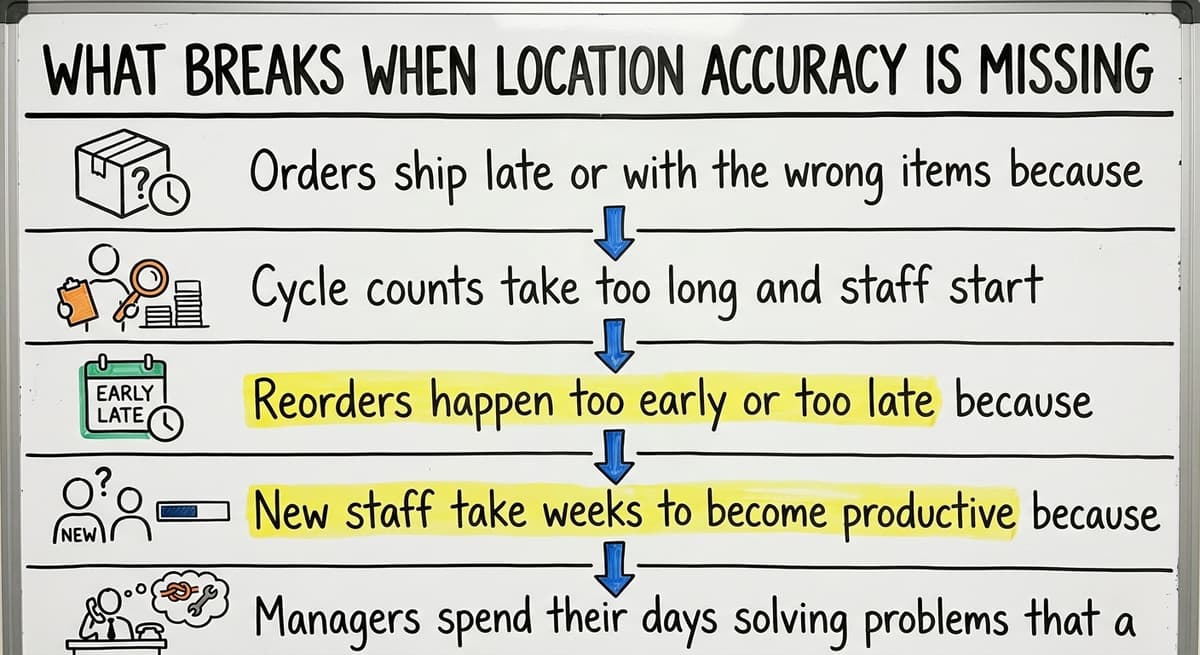
What Breaks When Location Accuracy Is Missing?
When your warehouse location records are unreliable, the problems stack up fast. They do not stay in the warehouse. They reach your customers.
Reviewed August 2026. Each figure comes from the assumptions stated beside it, so you can substitute your own and the arithmetic still holds.
- Orders ship late or with the wrong items when pickers grab whatever they find first
- Cycle counts take too long and staff start skipping them
- Reorders happen too early or too late because on-hand quantities are wrong
- New staff take weeks to become productive because they rely on one or two people who hold all the location knowledge in their heads
- Managers spend their days solving problems that a good system would prevent
None of these are people problems. They are system problems. And they get worse as volume grows.
The comparison is easier when one option is built for you
Choosing between off-the-shelf software and a custom-built system is easier when one option is shaped around your process. We do it the other way round, and the first look costs nothing.
Book a call
How Do Small Warehouses Currently Handle SKU Locations?
Most small warehouses solve SKU location tracking with tools that are available and free. That makes sense at a certain size. Here is what that looks like:
- Printed location maps taped to the wall or kept at the pick station
- Hand-written bin labels updated when someone remembers
- Spreadsheets updated manually after each pick or receiving run
- the accounting platform inventory used as a rough guide to what is on hand
- One or two experienced employees who carry the real location knowledge in their heads
These approaches work. At low volume, with a stable product mix and a small team, they hold together. The person who built the system knows it cold, and things move fast enough.
The break point comes with growth. More SKUs, more staff, more orders per day, and the manual system starts leaking. The spreadsheet gets out of sync.
The experienced employee calls in sick. A new hire spends half a shift searching for items that no one documented properly.
This is not a failure of effort. It is a natural growth problem. The system that worked at your previous scale is not designed for your current one.
Building a Warehouse Location System That Holds Up
Building a reliable warehouse location system does not require complex software. You need consistency. The same rules followed every time by every person.
Start With a Naming Convention and Assigned Homes
Before anything else, define how your warehouse is divided and how you name each section. A simple format like Zone-Aisle-Bin works for most operations.
Zone A, Aisle 3, Bin 2 becomes A-03-02. Every person on your team should be able to decode any location code without asking.
Then assign every item one home location. Not two. Not a primary and a secondary. One. When an item has multiple possible locations, pickers have to check both, and your count data splits across rows. One item, one home.
Receiving and Picking Must Close the Loop
A warehouse layout and naming convention are useless if location records do not get updated at the right moments.
Receiving must record the location when goods arrive, not at the end of the shift and not the next morning. The longer the gap, the more likely the record is wrong.
Picking must confirm or correct the location as part of the pick step. If a picker goes to C-04 and the item is not there, that correction needs to go back into the system immediately, not as a note on a clipboard.
This loop, receiving updates location in, picking confirms location out, is what keeps your data accurate over time. This does not require expensive tools. It requires a clear process and people who follow it.
What does it look like running on your own process?
The first thing you see is it running on your own process, at no build cost. The subscription starts once the system is live and doing the job, not before.
Book a call
Where Does Warehouse Inventory Management Software Fit In?
Manual location systems have a ceiling. When your order volume, SKU count, or team size grows past a certain point, the manual system cannot keep up no matter how disciplined your team is.
Warehouse inventory software closes that gap, so you do not have to replace everything you already use.
Keeping Your Accounting Software While Adding Real-Time Location Tracking
Many small distributors run their accounting in standard bookkeeping software. That works fine for accounting. What that software does not do well is real-time location tracking at the bin level.
Good warehouse inventory management software keeps your accounting software for what it does well and adds a layer on top that handles SKU locations, pick accuracy, and receiving process updates in real time.
Your books stay in that program. Your warehouse operations get a system built for warehouse operations.
For a deeper look at this, see accounting software and warehouse management: what to keep and what to replace.
What Does the Software Actually Change Day to Day?
The practical difference that warehouse inventory management software makes day to day is straightforward:
- Staff see where to go, not just what to pick
- Receiving clerks update stock locations without a separate data entry step
- Managers get accurate counts without stopping operations for a full physical count
- New hires become productive in days rather than weeks because the system guides them
Custom-built tools can match your existing warehouse layout and workflow rather than forcing you to reorganize around the software. That matters for operations that have evolved over years and have a layout that works.
See custom warehouse software for small distributors for more on that approach.
If you are not ready for a full warehouse management system, there are options between a spreadsheet and an enterprise platform. See how to track inventory without a full ERP for a practical breakdown.

Signs Your Warehouse Is Ready for a Better System
You do not need to wait for a crisis to know your warehouse is ready for a better system. These are the signals that show up before the crisis:
- You have had at least one costly mis-ship in the past 90 days
- A key employee is the only person who knows where certain items live
- Your team spends more than 10 percent of pick time searching rather than picking
- Cycle counts are being skipped because they take too long
- Your accounting software's inventory quantities no longer match what is actually on the shelf
If two or more of those are true right now, your current system has reached its limit. The good news is that you do not need to overhaul everything at once.
You need a location system that is consistent, and software that supports it without creating a new management burden.
For a full look at what that kind of connected system looks like in practice, see the overview of warehouse inventory software.
If you want to talk through what your warehouse actually needs, The Software Society builds custom workflow systems aligned to real operations.
No generic templates, no forced process changes. Reach out and describe what is breaking, and we will show you what a practical fix looks like.
Frequently asked questions
Frequently asked questions
What are the 5 main activities in a warehouse?
The five main activities are receiving, put-away, storage, picking, and shipping. Receiving is where goods arrive and get counted and recorded. Put-away moves them to their assigned storage location. Storage is the ongoing management of items in their locations.
Picking pulls items to fill orders. Shipping packages and dispatches those orders. Location accuracy connects all five. If the put-away step records the wrong bin, every step after it is working with bad information.
How to best organize a warehouse?
There is no single layout that works for every warehouse, but the organizing principle that matters most is location accuracy.
Start by defining a consistent bin or zone naming convention. Assign every item one home location. Make sure receiving updates location records the moment goods arrive.
Then choose a storage layout that matches your pick frequency: fast-moving items close to the shipping area, slow-moving items further back. The best organization is the one your team can follow consistently, not the one that looks best in a diagram.
What are the 5 KPIs for a warehouse?
The five most commonly tracked warehouse KPIs are order accuracy rate, on-time shipment rate, inventory accuracy, pick rate (units or orders per hour), and receiving cycle time. Of these, inventory accuracy is the foundation.
If your location records are wrong, your order accuracy and pick rate will suffer regardless of how hard your team works. Most operations that struggle with KPIs trace the root cause back to unreliable location data rather than a staffing or process problem.
What are the 5 key skills of a warehouse worker?
The five skills that matter most in practice are attention to detail, physical stamina, ability to follow a process consistently, basic numeracy for counts and quantities, and communication.
Attention to detail is the most critical: a small error in a bin label or a receiving record creates downstream problems for every person who touches that item afterward.
Good warehouse software reduces the burden on individual memory and attention by making the correct action the obvious one.
Why does location accuracy matter more than physical tidiness in warehouse organization?
Physical tidiness supports safety and makes location accuracy easier to maintain, but that alone will not guarantee it. A clean warehouse where items are recorded in the wrong bin locations will still produce mis-ships, slow picks, and unreliable counts.
Location accuracy means your records match reality. That match is what allows any team member, not just your most experienced one, to find and pick the right item every time.
Can a warehouse keep your accounting software and still add better inventory tracking?
Yes. Standard accounting software handles bookkeeping well and many small distributors have no reason to replace it. What that software does not do well is real-time bin-level location tracking.
A dedicated warehouse system can sit alongside it, handling SKU locations, pick accuracy, and receiving updates while the accounting program continues to manage the financial records. The two systems serve different purposes and work better together than either does alone.
What does a reliable warehouse location system look like in practice?
A reliable system has three parts. First, a consistent naming convention for every zone, aisle, and bin so any team member can decode a location without help. Second, one assigned home location per item with no exceptions.
Third, a process where receiving records the location as soon as goods arrive and picking confirms or corrects the location as part of the pick step. That loop keeps data accurate over time.
The system does not need to be complex. It needs to be followed consistently.
How do I know if my warehouse needs a software solution?
Look for these signals: a costly mis-ship in the past 90 days, one employee who is the only person who knows where certain items live, more than 10 percent of pick time spent searching, cycle counts being skipped because they take too long, or accounting software quantities that no longer match the shelf.
If two or more of these are true, your manual system has reached its limit and a software solution will pay for itself quickly in recovered labor and reduced errors.
How should a warehouse layout be designed?
A warehouse layout should be designed around a clear, consistent naming system that anyone can decode, such as dividing space into zones, aisles, and bins with a simple code like A-03-02.
Every item should be assigned exactly one home location, not multiple, so pickers always know where to look and counts stay accurate. The layout only works if everyone on the team follows the same rules every time.
What is warehouse slotting?
Warehouse slotting is the practice of assigning each item a specific, consistent storage location rather than letting it sit wherever there happens to be space.
Giving every item one clear home, instead of a primary and a backup spot, keeps location records reliable and prevents pickers from having to check multiple places for the same product.
Good slotting supports accurate inventory counts and faster, more predictable picking across the whole operation.
How can warehouse picking efficiency be improved?
Picking efficiency improves most when location records are trustworthy, so pickers go straight to the right spot instead of searching. This depends on receiving updating locations as soon as items arrive, and pickers confirming or correcting locations during the pick itself rather than noting problems for later.
Closing that loop keeps data accurate over time, cuts wasted search time, and lets any team member pick confidently without relying on one experienced person's memory.
Why are labeling and barcoding important in a warehouse?
Labeling and barcoding matter because they support location accuracy, giving every bin a clear, readable identity that staff can trust.
A label is only useful if the item actually stored there matches it, so labeling works best paired with a disciplined process for updating records at receiving and picking.
Together they let any employee, not just the most experienced one, find items quickly and confirm counts without guesswork.
Start with a free first look
A 30 minute call, your operation mapped, and a clear picture of what we would build. No obligation and nothing to install.
Book a callRelated guides
The rest of this guide, for the parts of the job this page does not cover.
Guides
Common questions
- What is the Most Popular Warehouse Management System?
- Which Warehouse Management System Would a Jeweler Most Likely Use
- Why is Warehousing and Inventory Management Important
- What Are the Benefits of Warehouse Management System
- What is the Point of Warehouse Management System
- What Are the Top 5 Warehouse Management Systems?
- What is Asn in Warehouse Management System
- What is a Warehouse Management System
- What is the Best Warehouse Inventory Management System?
- What is a Warehouse Management System Used For
- What is the Difference Between Warehousing and Inventory Management
- What is Warehousing Operations
- What is the Purpose of a Warehouse Management System
- What is a Warehouse Management System Pdf
- What is Warehouse Operation
- What is B Type of Inventory in Warehouse Management
- What Does Lpn Stand for in Warehousing
- What is a Simple Warehouse Management System?
- What is Warehousing and Inventory Management
- What is a Warehouse Management System Example
- What Warehouse Management System Does Amazon Use
- What is Inventory Management and Why is It Important