


Cycle Counting Inventory
Cycle counting inventory is counting a few items on a set schedule. Owners of small warehouses with 5 to 100 staff can run it with paper sheets and a spreadsheet.
Reviewed November 2026.
Work goes on as normal, with no shutdown. A cycle count checks a small slice of stock. A physical inventory count checks all of it at once.
You need no big ERP system to start. Start with 20 items a day and grow from there.
Book a callCycle Counting Inventory vs. a Physical Inventory Count
A physical inventory count is a full count of every item, done once or twice a year. Many sites close for a day or more to do it. The question of what is cycle counting in inventory management has a short answer: small, steady counts instead of one big one.
The IRS has a reason for the yearly count. IRS Publication 538 says you "must value your inventory at the beginning and end of each tax year."
The yearly count serves the tax books, and the cycle count serves daily accuracy.
How a Cycle Count Works
A cycle count spreads the same work across the whole year. Here is what changes.
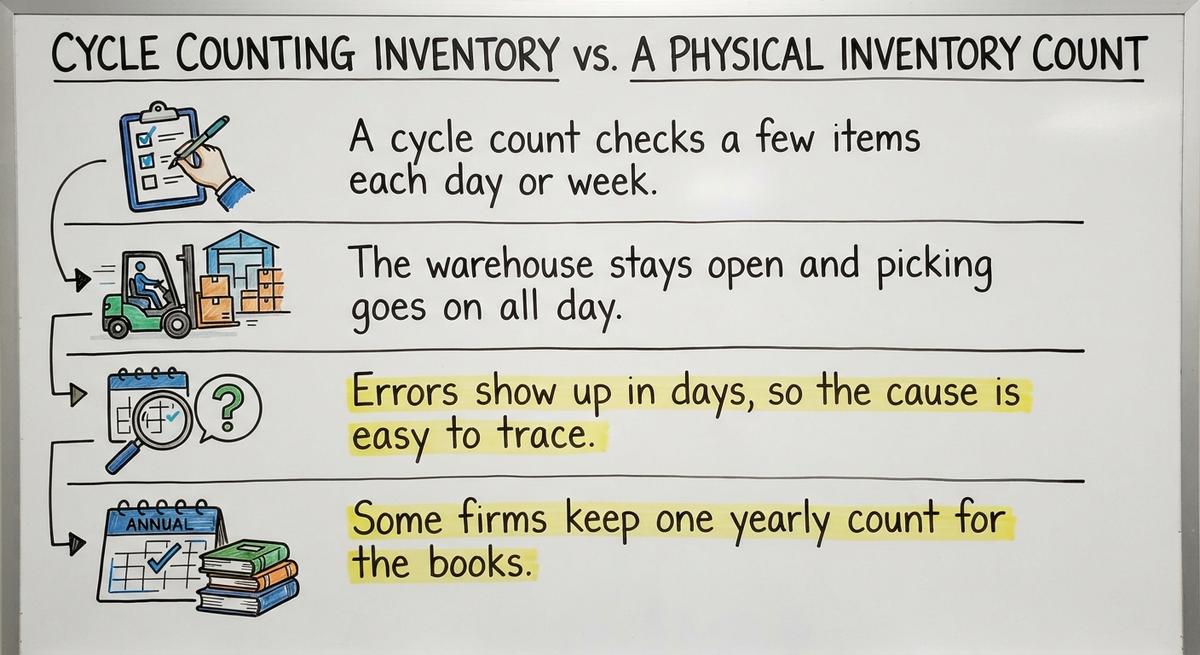
- A cycle count checks a few items each day or week.
- The warehouse stays open and picking goes on all day.
- Errors show up in days, so the cause is easy to trace.
- Some firms keep one yearly count for the books, and cycle counts make it faster.
Barcodes built on GS1 standards speed up scan-based counts. Small, frequent counts catch mistakes before they grow.
We build it for your operation, and the first look is free
If you would rather not compare products, describe how your operation already works and we build the system around it.
No build cost. You see it running on your own process first, and the monthly subscription starts only once it is live.
Book a callWhy Does Cycle Counting Inventory Matter for Small Warehouses?
Cycle counting inventory matters because wrong counts cause stockouts, late orders, and over-buying. A manager with 5 to 100 staff cannot stop shipping for a week. Orders must still leave on time. The FTC mail order rule says you must ship when you said you would.
Good counts also build trust in the numbers that drive buying and sales. The Census Bureau tracks wholesale inventories each month. Your own shelves deserve the same care.
Accurate counts keep orders on time and buying on target.
What Are the Benefits of Cycle Counting?
The gains are steady and easy to see.
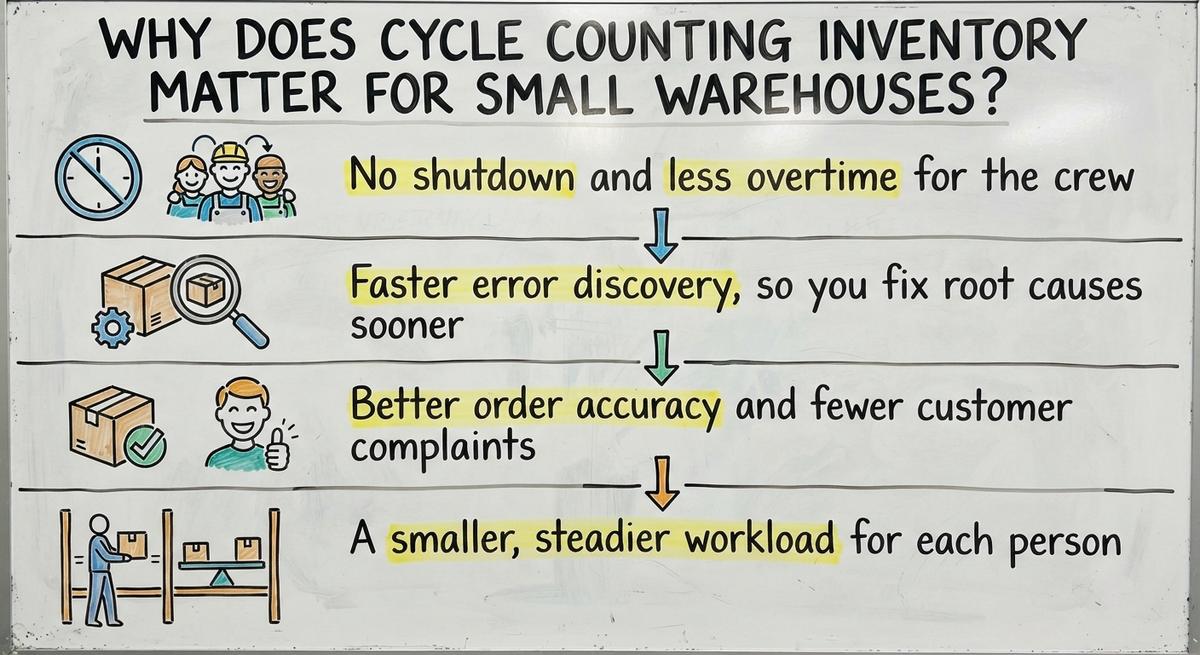
- No shutdown and less overtime for the crew.
- Faster error discovery, so you fix root causes sooner.
- Better order accuracy and fewer customer complaints.
- A smaller, steadier workload for each person.
Small counts spread the work thin and keep the numbers honest.
Cycle Counting Methods
Cycle counting methods are rules that pick which items to count and when. You can mix them. Pick the mix that fits how your stock moves. A shop with a few fast sellers needs a different plan than one with thousands of slow parts.

The right mix follows the way your stock moves.
ABC Cycle Counting
ABC cycle counting is a method that ranks items by value or speed and counts the top ones most. Learn more in our guide to abc cycle counting.
- A items are top value or fastest movers. Count them most.
- B items are the middle group. Count them less often.
- C items are slow or low value. Count them least.
A sample stock count schedule: A monthly, B quarterly, C twice a year. Count the items that cost you most, most often.
Location-Based and Random Sample Counting
Location-based counting means you count one aisle, zone, or bin group each day. Random sample counting means you pick items by chance to test overall accuracy. Both suit small teams that want a simple routine. Walk one aisle on Monday and the next on Tuesday. A plain route beats a clever plan nobody follows.
Not sure this is the right shape for your operation
Describe how the work runs today. We map it on a call and show you what it would look like built around that, before you spend anything.
Book a callEvent-Triggered Counts
An event-triggered count is a quick check set off by a warning sign. Count when one of these happens:
- A bin hits zero.
- A receiving error is found.
- A big return comes in.
- A negative on-hand number shows up.
These checks cost little and catch problems right away.
How Do You Start Cycle Counting Step by Step?
Start with one zone or your top 50 items, then follow 9 steps in plain order.

- Set a goal, such as 95% accuracy on A items.
- Clean up item names and bin labels.
- Group items into A, B, and C.
- Set a schedule.
- Assign counters.
- Count the items on the list.
- Compare the count to the book number.
- Fix the cause of each miss.
- Repeat tomorrow.
Small starts keep the habit alive.
How Many Items Should You Count Each Day?
The daily count is total items divided by the working days in the cycle. A made-up warehouse has 2,000 items and a 100-day cycle. That is 20 items a day. Add more on slow days. Cut back in busy seasons. Then catch up when the dock calms down.
Divide your items by your cycle days to set the pace.
Who Should Do the Counting?
The best counter is a careful person who did not receive or ship that stock. Rotate counters for fresh eyes. Keep the task short, so it never slows picking. A 20-minute count at the start of a shift works well.
A fresh, careful counter gives the most honest numbers.
What Should You Do When the Count Does Not Match?
When a count misses, recount first. Inventory variance is the gap between the book number and the shelf number. Say the book shows 40 units and the shelf holds 37. The variance is 3 units. At $12 each, that is $36.

Follow these steps in order:
- Recount the bin to rule out a miscount.
- Check recent receipts, picks, transfers, and returns.
- Find the cause, not just the number.
- Adjust the record only after review.
- Write down the reason for the change.
A fixed number with no known cause will come back.
Common Causes of Inventory Count Errors
Inventory count errors have a few usual sources. Each one has a direct fix.
- Mis-picks: Add a scan or a second look at the pick.
- Wrong unit of measure: Label each bin as each, case, or pallet.
- Wrong bin: Mark bins clearly and put items away at once.
- Receiving mistakes: Count the delivery before you sign.
- Unrecorded damage or returns: Log them the same day.
- Hand-keyed entries: Cut the number of times anyone retypes a figure.
Match each miss to its cause and the same error stops repeating.
The comparison is easier when one option is built for you
Off-the-shelf means fitting your process to the software. We do it the other way round, and the first look costs nothing.
Book a callCan You Cycle Count With a Spreadsheet and Paper Sheets?
Yes, you can cycle count with printed count sheets and a spreadsheet. Keep the accounting package, such as a small-business bookkeeping app, as the book of record where it fits. The sheets feed it. They do not replace it.
Manual work has limits. Staff retype numbers. Sheets get lost. Two versions of a file cause confusion. Adjustments run slow. Three habits help:
- Lock the count sheet format.
- Date every count.
- Keep one master list.
One clean file beats five copies.
When Manual Cycle Counting Starts to Break Down
Manual counting breaks down when the routine costs more than the errors it finds. Watch for these signs:
- Counts get skipped in busy weeks.
- No one knows the schedule.
- Adjustments pile up.
- The same errors repeat.
At that point, inventory counting software or an in-house build can set the schedule, make count lists, and review variance. Any provider or custom option can do this. For process guidance, see NIST supply chain resources.
Move to software when the routine costs more than it saves.

How Do You Measure Inventory Accuracy?
Inventory accuracy is the percent of counts that match the book. If 94 of 100 counts match, accuracy is 94%. Set higher targets for A items than for C items. Track the trend over time rather than chasing a perfect score.
Review results monthly with the team. Track these measures:
- Accuracy rate for each group.
- Variance in units and in dollars.
- Items that miss again and again.
Use each finding to fix a process.
Cycle Counting Mistakes to Avoid
Four mistakes end most cycle count programs. Each is easy to dodge.
- Counting too much at once: Big lists tire the crew and the habit dies.
- Skipping the root cause: A patched number leaves the problem in place.
- Showing expected quantities: Use blind counts, where the counter does not see the book number.
- Skipping busy seasons: Errors grow fastest when volume peaks.
Small, blind, steady counts with real fixes keep the program alive.
Your Next Step
Print one count sheet today. Pick 20 items from your top group. Count them tomorrow, compare them to the book, and write down why any miss happened.
One printed sheet and 20 items are enough to begin.
Frequently asked questions
Why are cycle counts important in Dollar Tree?
Cycle counts matter in any store because shelf numbers drift from system numbers. Frequent small counts keep shelves stocked, cut lost sales, and show theft or damage early. The reasoning holds for retail chains and small warehouses alike.
What's a good cycle count?
No single number is right for everyone. A good cycle count is a small list, finished on schedule, with every miss traced to a cause. Many sites aim for 95% or better on top items.
How often should you cycle count?
Count fast or costly items monthly and slow ones twice a year. Match the pace to how fast stock moves and how much a miss costs. Daily short counts keep the habit steady.
Is cycle counting required by law?
No law demands cycle counting. The IRS does need you to value inventory at the start and end of each tax year. Cycle counts are one way to make those numbers trustworthy.
Can I stop doing a yearly full count?
Some firms can stop. It depends on your accountant, your auditor, and how accurate your counts prove to be. Ask them first. Many keep one short yearly count as a check.
How long does it take to see results from cycle counting?
Most teams spot repeat errors within the first few weeks. Accuracy gains build over several months as you fix causes. Expect a steady climb in your monthly match rate, not an overnight jump.
What is the best way to count inventory for a small business?
There is no single best way. A spreadsheet suits low volume. Count software helps when sheets pile up. A custom build fits unusual needs. Choose by item count, staff time, and error rate.
Start with a free first look
A 30 minute call, your operation mapped, and a clear picture of what we would build. No obligation and nothing to install.
Book a callRelated guides
More on the same work.
Guides
- Cycle Count Software
- Abc Cycle Counting
- Inventory Counting Software
- Inventory Audit Checklist
- Inventory Audit
- Inventory Management Best Practices
- Moving Average Method Inventory
- Inventory Shrinkage Accounting Entry
- Inventory Shrinkage is Recorded When
- Calculate Inventory Shrinkage
- Inventory Process Flow
- Warehouse Inventory Management Software
- Warehouse Inventory Tracking Software
- Warehouse Inventory Management Systems
- Best Inventory Software
- Quickbooks Inventory Management Software
- Warehouse Inventory Systems
- Classification of Inventory